
Article
The Desk Lunch Report: How the Lunch Break Quietly Disappeared
Last Updated


By Ricardo Rodriguez and


Article
Last Updated
By Ricardo Rodriguez and
The traditional lunch break has become increasingly difficult to find in today's workplace. Packed schedules, constant notifications, and growing workloads have turned what was once a dedicated pause into another opportunity to answer emails, attend meetings, or keep projects moving.
To better understand how workers spend their midday break and what happens when they skip it, Software Finder surveyed 1,004 workers about their lunch habits, workplace expectations, and the impact missing lunch has on the rest of their day.

For many employees, lunch no longer provides a true break from work. Instead, it has become another multitasking window filled with screens, meetings, and unfinished tasks.
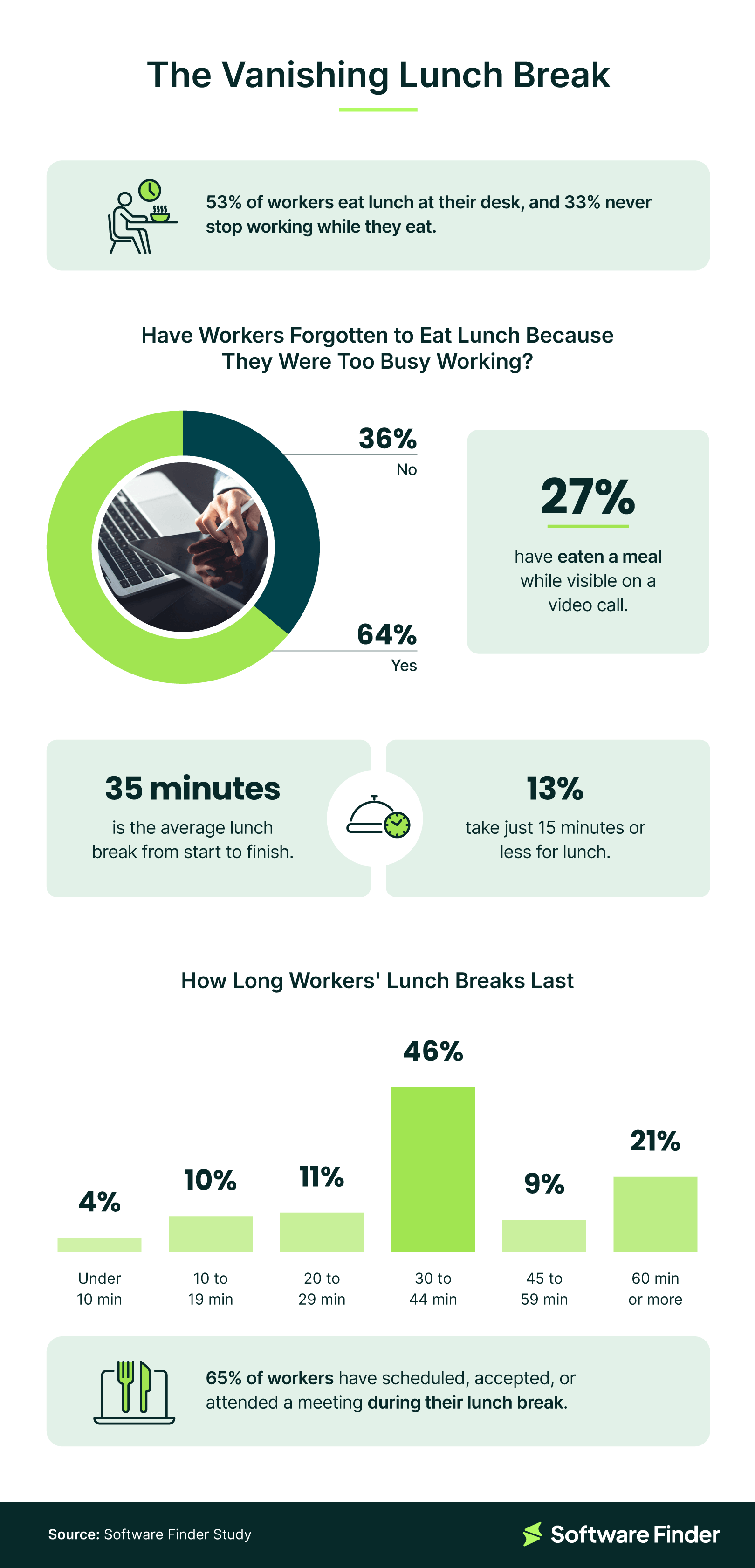
More than half of workers (53%) said they eat lunch at their desk, showing how common it has become to stay planted at the workstation throughout the day. Instead of stepping away, many continued working or remained surrounded by work-related distractions during what was once dedicated downtime.
One-third of workers (33%) said they keep working while they eat. Finance and insurance employees are the most likely to work through lunch (40%), followed by education (36%), healthcare, manufacturing, and government (32% each). Information technology workers are the least likely to do so (28%).
About 1 in 8 workers (13%) said they never take a genuine break away from work during a typical week. Fully in-office employees are the most likely to go an entire week without a real break (17%), compared to fully remote workers (14%) and hybrid workers (8%).
Scrolling also replaced stepping away for many workers. Overall, 59% said they browse social media while eating lunch. Gen Z led this behavior at 70%, followed by millennials (63%), Gen X (49%), and baby boomers (23%).
Busy schedules frequently eliminated lunch altogether. Overall, 65% said they have scheduled or joined meetings during their lunch window, while 64% have been so busy they simply forget to eat lunch. Even when workers could step away, 15% admitted they feel guilty taking the full lunch break they are entitled to, with Gen Z reporting the highest level of guilt (18%).
Skipping lunch has become routine for many employees, even in workplaces where breaks are technically available. Work demands often outweigh the opportunity to pause.
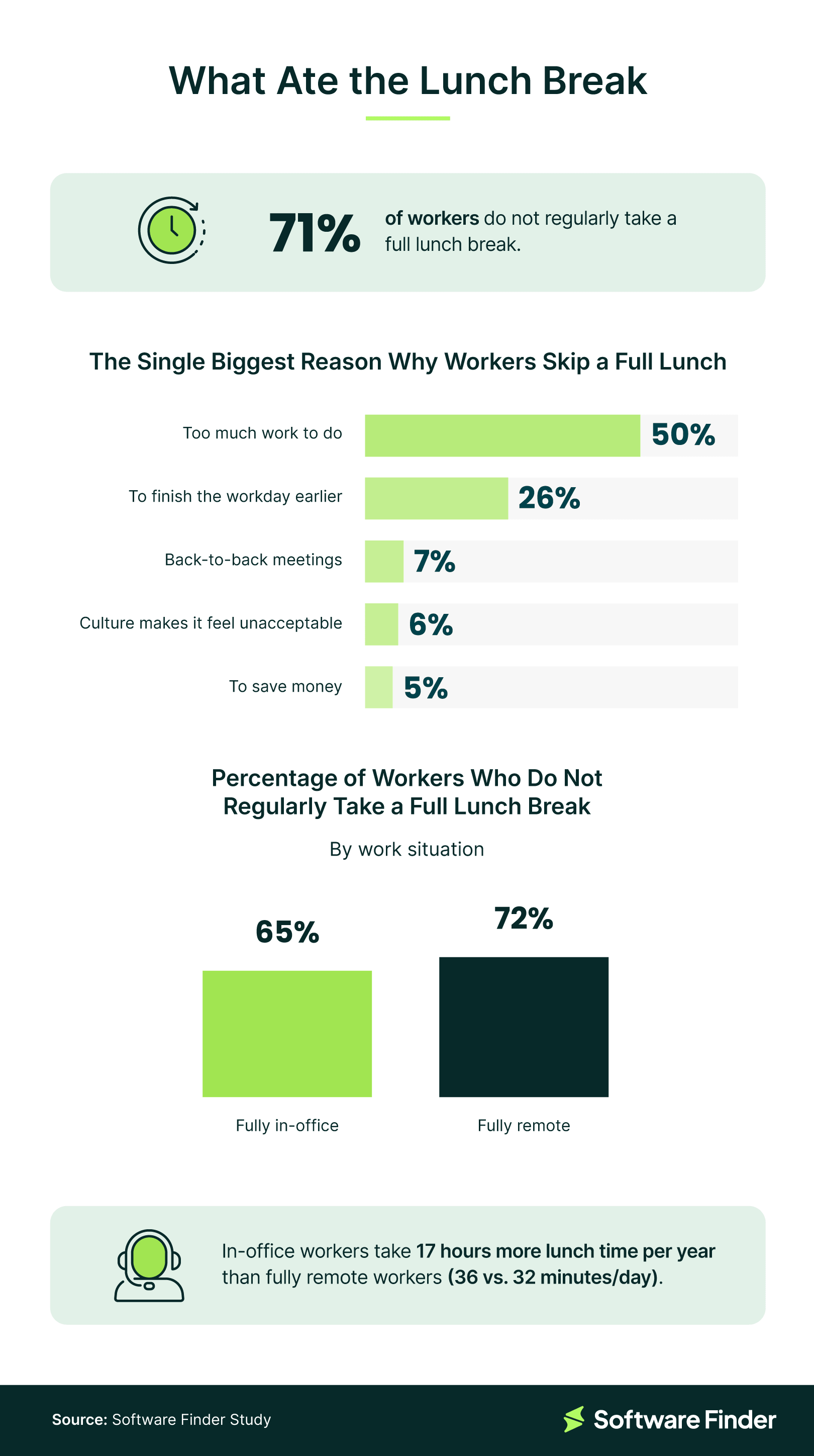
More than 7 in 10 workers (71%) said they don't regularly take a full lunch break. Millennials are the most likely generation to skip lunch at 74%, followed by Gen Z (68%) and Gen X (66%). Hybrid employees reported the highest rate of skipped lunches (77%), ahead of fully remote workers (72%). Fully in-office workers are the least likely to miss lunch, though 65% still said they don't regularly take a full break.
Workload is the leading reason employees skip lunch. Half of workers who missed lunch (50%) blamed having too much work to finish, suggesting that productivity expectations can take priority over personal time.
Many employees appear to have permission to take a break but struggle to use it. Nearly one-third (30%) said workers in their workplace could take a lunch break, yet many still ended up working through that time instead. The findings suggest that workplace culture and daily demands often matter more than formal policies.
The effects of skipping lunch don't end when the afternoon begins. Many workers reported feeling the consequences long after the lunch window had passed.
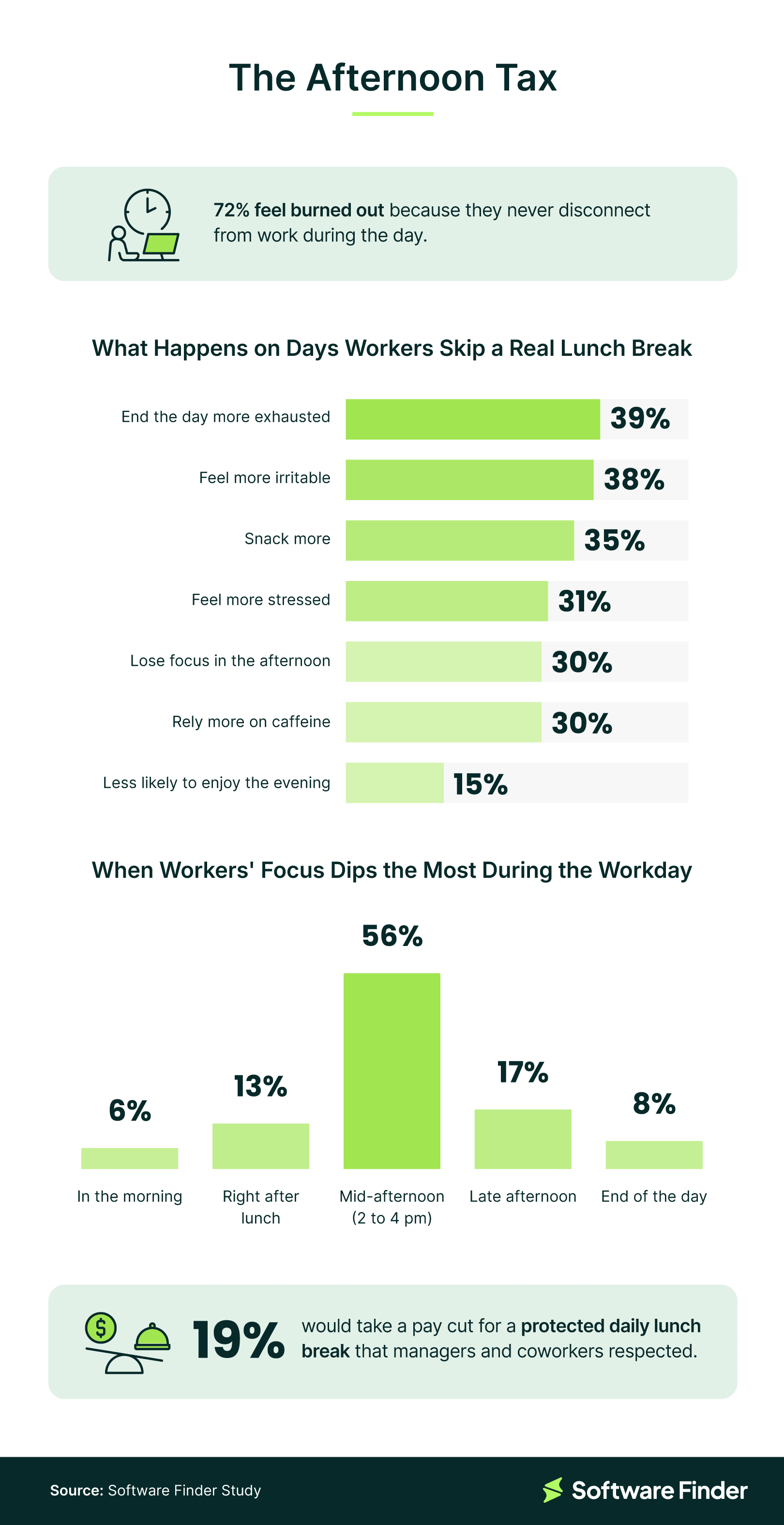
Nearly 2 in 5 workers (39%) said they end the workday more exhausted after skipping a real lunch break. The effect was especially pronounced among Gen Z, with 58% reporting greater end-of-day exhaustion, compared to 38% of millennials and 31% of Gen X workers.
Stress also increases when lunch disappears. Overall, Gen Z workers are the most likely to say they feel more stressed after skipping lunch (41%), followed by millennials (31%) and Gen X (23%).
Some workers value uninterrupted lunch breaks enough to attach a financial cost to it. Nearly 1 in 5 workers (19%) said they would give up part of their salary in exchange for a protected, respected lunch break. Among all workers, 12% said they would trade up to 5% of their salary. Gen Z again stood out, with 33% willing to trade pay for uninterrupted lunchtime, compared to 18% of millennials and 13% of Gen X workers.
The findings show that the lunch break has quietly shifted from a routine part of the workday to something many employees struggle to take. Meetings, workloads, and workplace expectations often replaced the opportunity to step away, leaving many workers feeling more stressed and exhausted by the end of the day.
As organizations continue to evaluate employee well-being and productivity, protecting uninterrupted lunch breaks may be a simple change with meaningful benefits. Sometimes, the most productive part of the day is the time spent stepping away from work.
Software Finder surveyed 1,004 workers about their lunch break habits, including where and how they eat, what interrupts their midday break, and how skipping one affects the rest of their workday. The sample included millennials (53%), Gen X (25%), Gen Z (18%), and baby boomers (4%).
Respondents skewed slightly female, with women representing 54% of participants and men representing 44%. Percentages may not total 100% due to rounding or because respondents could select more than one answer. Data was collected in July 2026.
Software Finder helps businesses evaluate and compare software solutions across HR, CRM, project management, accounting, ERP, healthcare, and more. Through expert resources, verified user reviews, and personalized software recommendations, Software Finder simplifies the software buying process so organizations can identify tools that support productivity, employee experience, and long-term business growth.
The information in this article may be shared for noncommercial purposes only. If you reference or republish these findings, please provide an attribution and link back to Software Finder.