Article
How B2B Buyers Are Finding Vendors Before You Ever Pitch Them
Last Updated

Writer


Article
Last Updated
Writer
The way B2B buyers discover software vendors is changing rapidly as artificial intelligence becomes embedded in everyday research workflows. Many decision-makers now rely on AI tools to summarize vendors, compare options, and narrow shortlists before speaking with sales teams.
To understand how this shift is affecting the software buying journey, a survey of 714 B2B software buyers examined how AI influences discovery, trust, and decision-making. The buying process is now increasingly being guided by AI long before a vendor ever enters the conversation.

AI tools have quickly become a central part of how buyers research and compare software vendors. Decision-makers are increasingly turning to AI to surface options, summarize information, and filter vendor lists before engaging directly with providers.
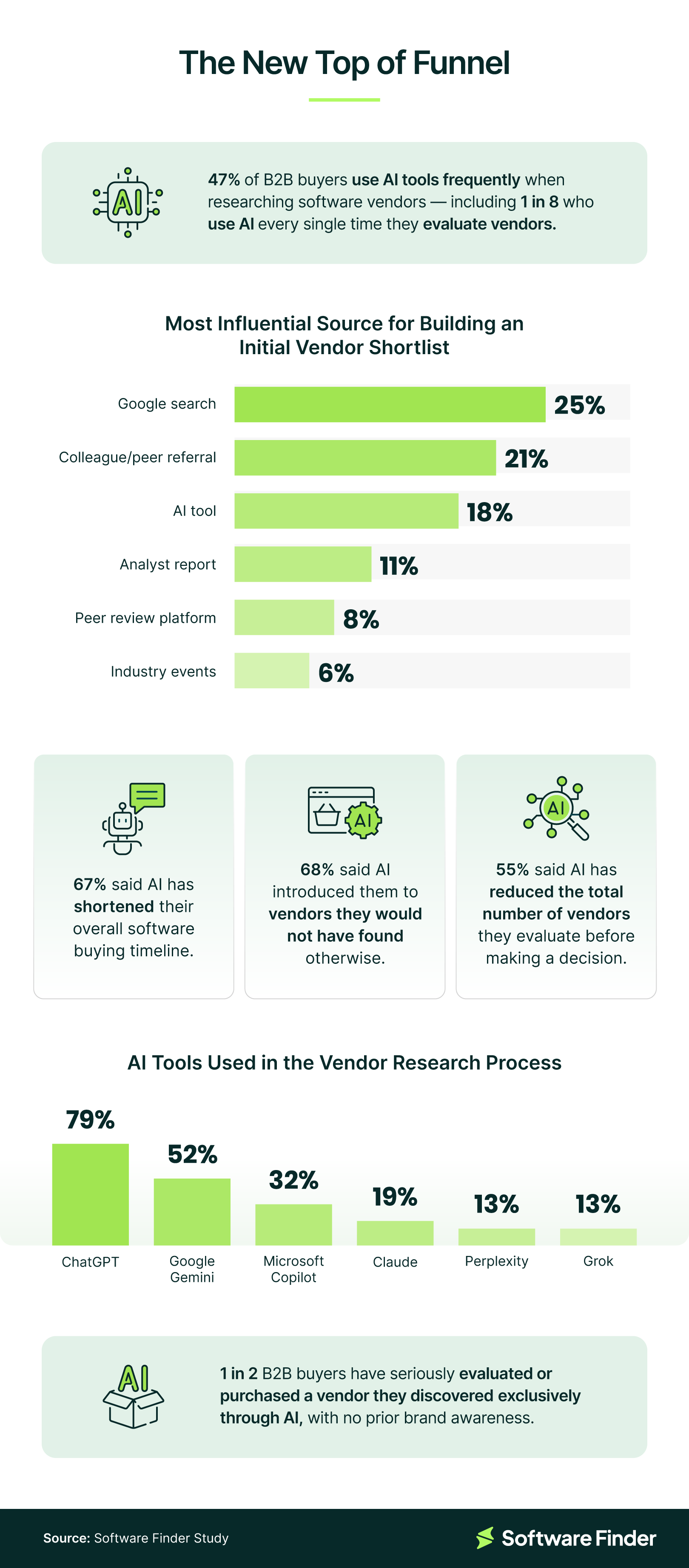
AI usage varies by industry, but adoption is widespread. Finance and marketing/advertising respondents reported the highest frequent use of AI when researching software vendors, at 60% and 59%, well above the 47% overall average. Another 40% of buyers said they now trust AI-generated summaries more than reading vendor websites themselves.
Nearly 1 in 5 B2B buyers (18%) named AI as their single most influential discovery source when researching vendors. For many organizations, AI is no longer just a research assistant. Instead, it's helping shape the initial shortlist of vendors under consideration.
When building a vendor shortlist, AI was the top discovery source in several industries, including:
These shifts are influencing which vendors get considered. Roughly 1 in 5 buyers (22%) said they have excluded a vendor from consideration because it did not appear in AI-generated recommendations, even if they were already aware of that vendor. Half of buyers reported seriously evaluating or purchasing a vendor they discovered exclusively through AI, with no prior brand awareness.
AI is no longer confined to the research stage. Buyers are increasingly bringing AI tools into live vendor evaluations and using them to guide decisions as conversations unfold.
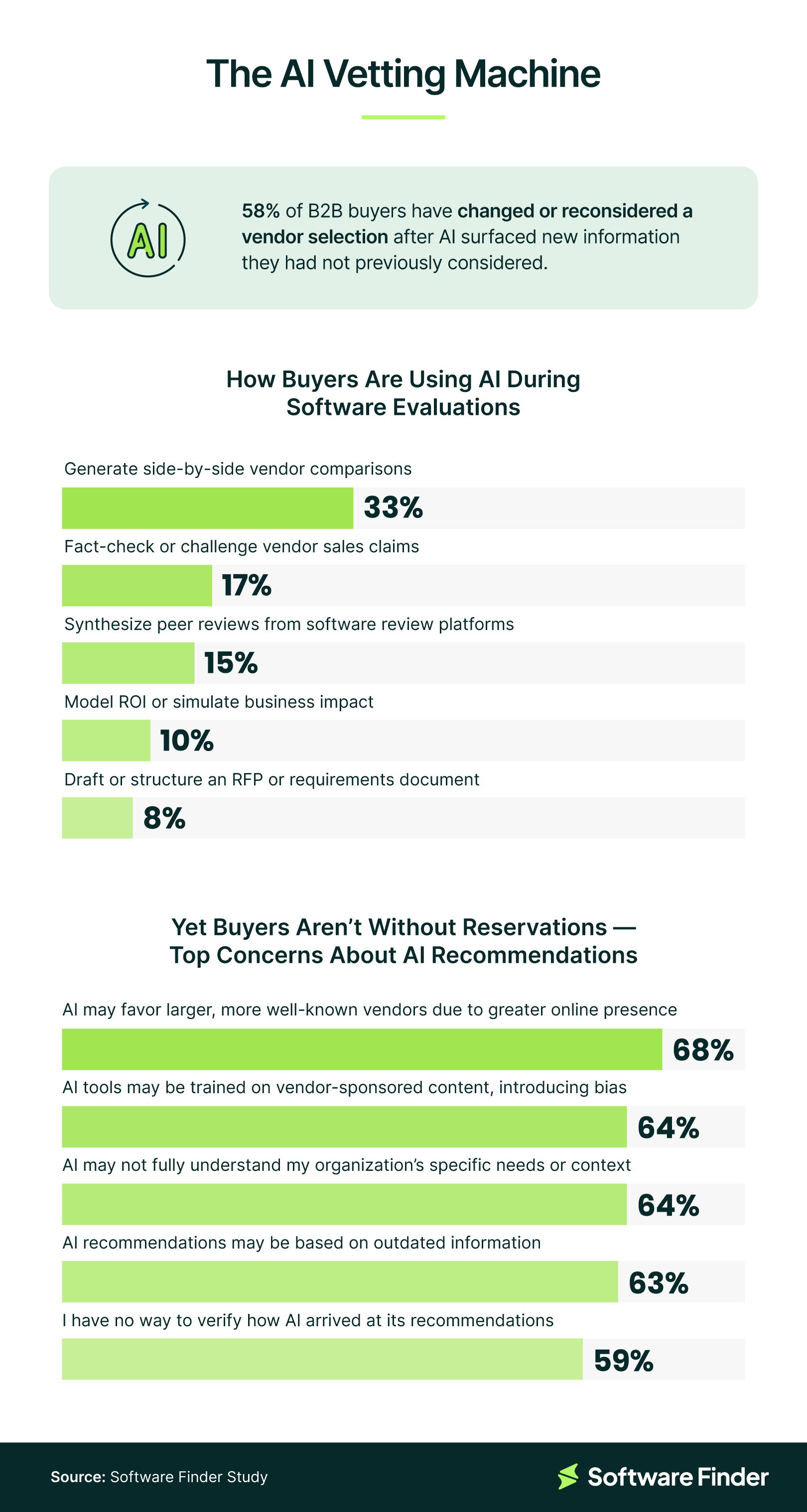
More than half of buyers (58%) said they changed or reconsidered a vendor after AI surfaced new information during the evaluation process. At the same time, 55% reported that AI helped them reduce the total number of vendors they ultimately evaluated.
AI is also becoming a tool for verification during sales conversations. A significant share of buyers (17%) have used AI to fact-check claims made by a vendor's sales team.
These behaviors indicate that AI is increasingly acting as a second opinion throughout the buying journey, providing additional context and influencing how buyers interpret vendor messaging.
While AI is gaining influence in vendor evaluation, attitudes toward transparency and disclosure remain complex. Buyers are increasingly relying on AI recommendations, yet organizational acceptance of AI-guided decisions is still evolving.
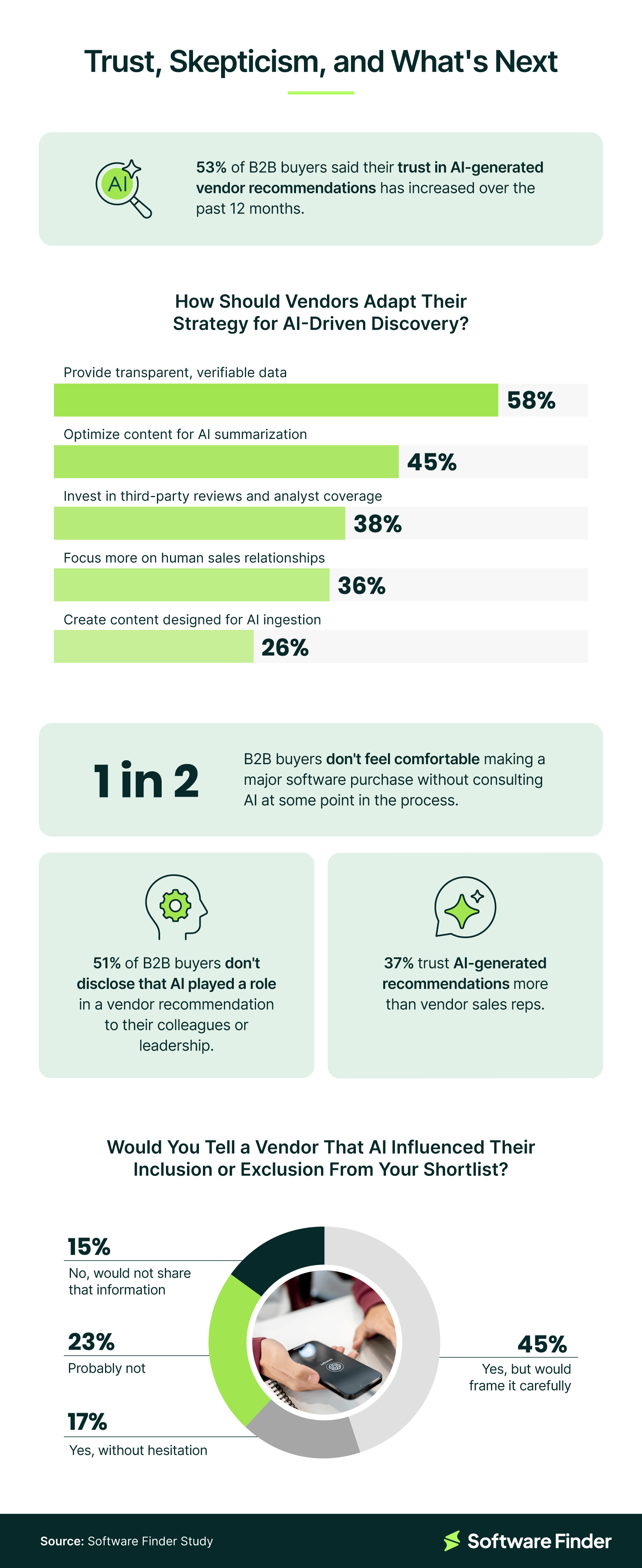
Half of B2B buyers said they would not feel comfortable making a major software purchase without consulting AI at some point in the process. Over the past year, 53% reported that their trust in AI-generated vendor recommendations increased.
In some cases, buyers trust AI recommendations even more than traditional information sources:
Despite growing trust, buyers are still navigating how openly AI should influence decisions. When asked how leadership might react to AI shaping a vendor recommendation, 39% believed stakeholders would respond positively, while 23% expected skepticism.
Respondents also identified several factors that would increase trust in AI recommendations:
AI is rapidly becoming a central force in how B2B software vendors are discovered, evaluated, and selected. Buyers are using AI to narrow vendor lists, validate claims, and uncover new options they might not have considered otherwise. In many cases, AI is shaping purchasing decisions before a vendor ever has the chance to make a sales pitch.
As AI continues to influence discovery and trust in the software buying process, vendors will need to think beyond traditional marketing channels. Visibility in AI-driven research environments may increasingly determine which vendors appear on a buyer's shortlist, and which never make it into the conversation.
This study is based on a survey of 714 B2B software buyers conducted in March 2026. Respondents were required to have been involved in evaluating or selecting software vendors for their organization within the past 12 months. The sample includes buyers across industries, including information technology, finance/banking/insurance, healthcare, manufacturing, marketing/advertising/pr, and retail/e-commerce. All percentages are rounded to the nearest whole number.
Software Finder helps businesses discover, compare, and select the right software solutions for their needs. We provide expert insights, product comparisons, and user-driven recommendations to help organizations evaluate vendors across categories such as CRM, ERP, HR, and project management software. By simplifying the research process, Software Finder empowers decision-makers to choose technology that supports growth and operational efficiency.
The information in this article may be shared or referenced for noncommercial purposes only. If used or cited, please provide proper attribution with a link back to Software Finder.