After-hours emails, late-night Slack messages, and vacation check-ins have become routine for many professionals, but is staying constantly available actually paying off? Software Finder surveyed 1,006 U.S. employees to find out how many workers feel pressure to stay reachable outside their normal hours, what that habit is costing them, and whether it delivers the career payoff many assume it does.
What we found is a gap between the pressure to stay connected and the reward for doing so. Being available around the clock takes a real toll on burnout, sleep, and work-life balance, but for most workers, it isn't translating into promotions, raises, or lasting career gains.
Key Takeaways

- The average worker spends 1.7 hours per week checking work communications after hours, the equivalent of more than 2 full workweeks a year spent on unpaid availability.
- 71% of workers feel pressure to be "always on," checking work communications after hours, with managers reporting the highest pressure at 81%.
- Always-on workers are 2.8 times more likely to report burnout from after-hours availability than workers who maintain firm boundaries (34% vs. 12%).
- Only 8% of workers say being highly responsive outside work hours directly contributed to a promotion, and just 12% credit it for a raise or bonus.
- 73% of workers check work communications during vacation, with 51% having responded to a work email and 18% having joined a work call or meeting on vacation in the past year.
- 49% of workers have worried that setting boundaries around after-hours communication would hurt their career, including 11% who worry frequently.
- Email (68%) and text messages (54%) drive after-hours work for more workers than Microsoft Teams (22%) or Slack (11%).
Who Stays Connected After Hours, And What Is It Costing Them?
Pressure to stay reachable outside of work hours is widespread, but it isn't distributed evenly across roles, industries, or generations.
Who Feels the Most Pressure To Stay Reachable
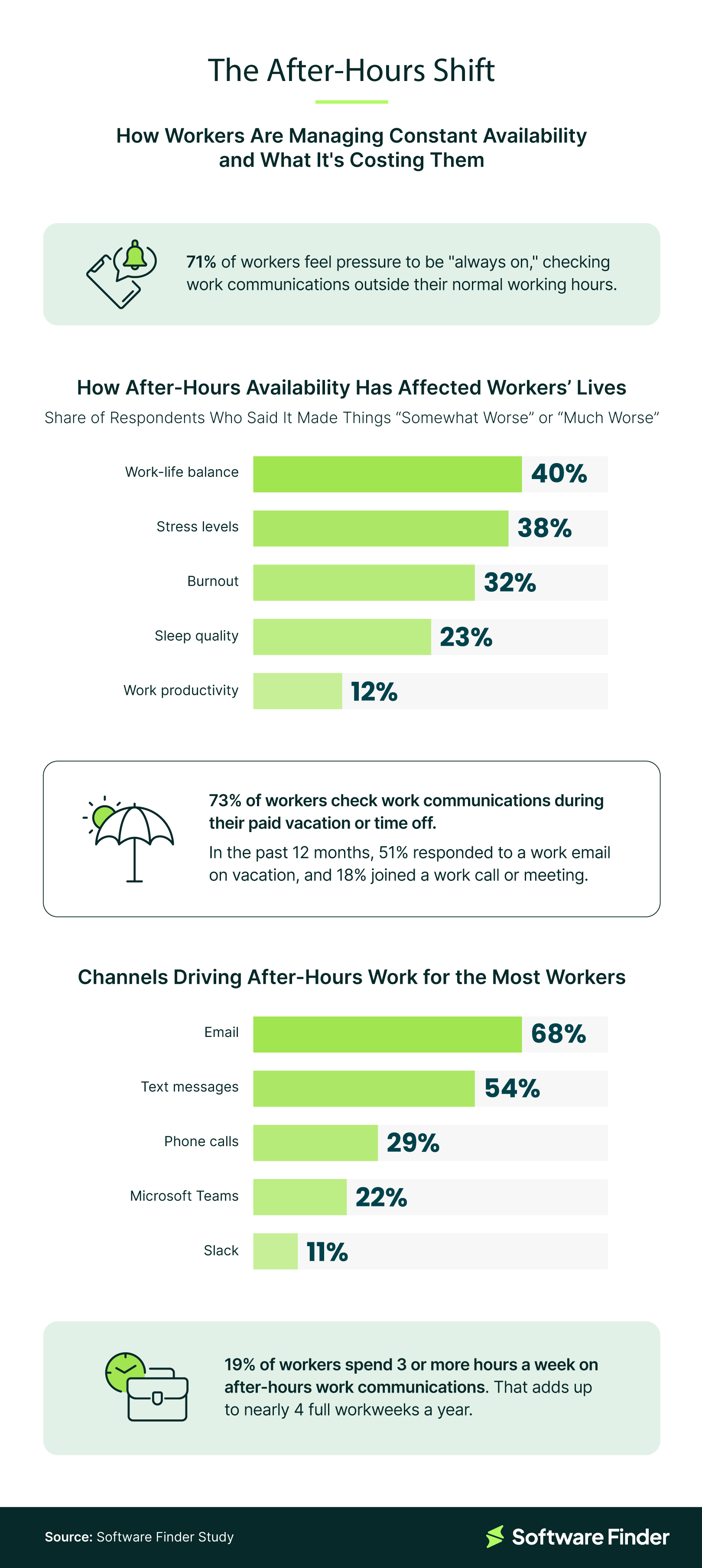
- 71% of workers feel at least some pressure to respond to work communications outside their normal working hours, including 81% of managers.
- 76% of hybrid workers feel pressure to respond after hours, the highest of any work arrangement, compared to 71% of fully in-person workers and 67% of fully remote workers.
- 87% of wholesale and retail workers feel pressure to respond after hours, the highest of any major industry.
- 65% of Gen Z workers feel pressure to respond after hours, the lowest of any working generation, compared to 72% of both millennials and Gen X workers.
- 80% of workers at mid-sized companies (50 to 249 employees) feel pressure to respond after hours, the highest of any company-size group.
- 29% of hospitality workers describe themselves as “always available, respond quickly,” more than double the 12% rate reported across all workers.
What After-Hours Availability Is Costing Workers
- 40% of workers say after-hours availability has worsened their work-life balance, 38% say it has worsened their stress levels, and 32% say it has worsened their burnout.
- 34% of millennials and 34% of Gen Z workers say their burnout has worsened, compared to 26% of Gen X workers.
- 44% of workers at mid-sized companies report worsened work-life balance, the highest of any company-size group.
- The average worker spends 1.7 hours per week checking work communications after hours, the equivalent of more than two full workweeks a year spent on unpaid availability.
- 19% of workers spend three or more hours a week on after-hours communications, the equivalent of nearly four full workweeks a year.
Vacation Doesn't Mean Fully Logging Off
- 73% of workers check work communications during their paid vacation or time off.
- 51% have responded to a work email on vacation in the past year, and 18% have joined a work call or meeting while off.
- Employees in the education sector are the most likely to stay connected on vacation: 85% check work communications, and 70% respond to work emails.
- Email (68%) and text messages (54%) drive after-hours work for more workers than Microsoft Teams (22%) or Slack (11%).
The Perceived Career Benefits Of Being Always Reachable
Many workers stay connected after hours because they believe it will pay off professionally, but the data suggests that payoff is far from guaranteed.
The Career Payoff Rarely Shows Up
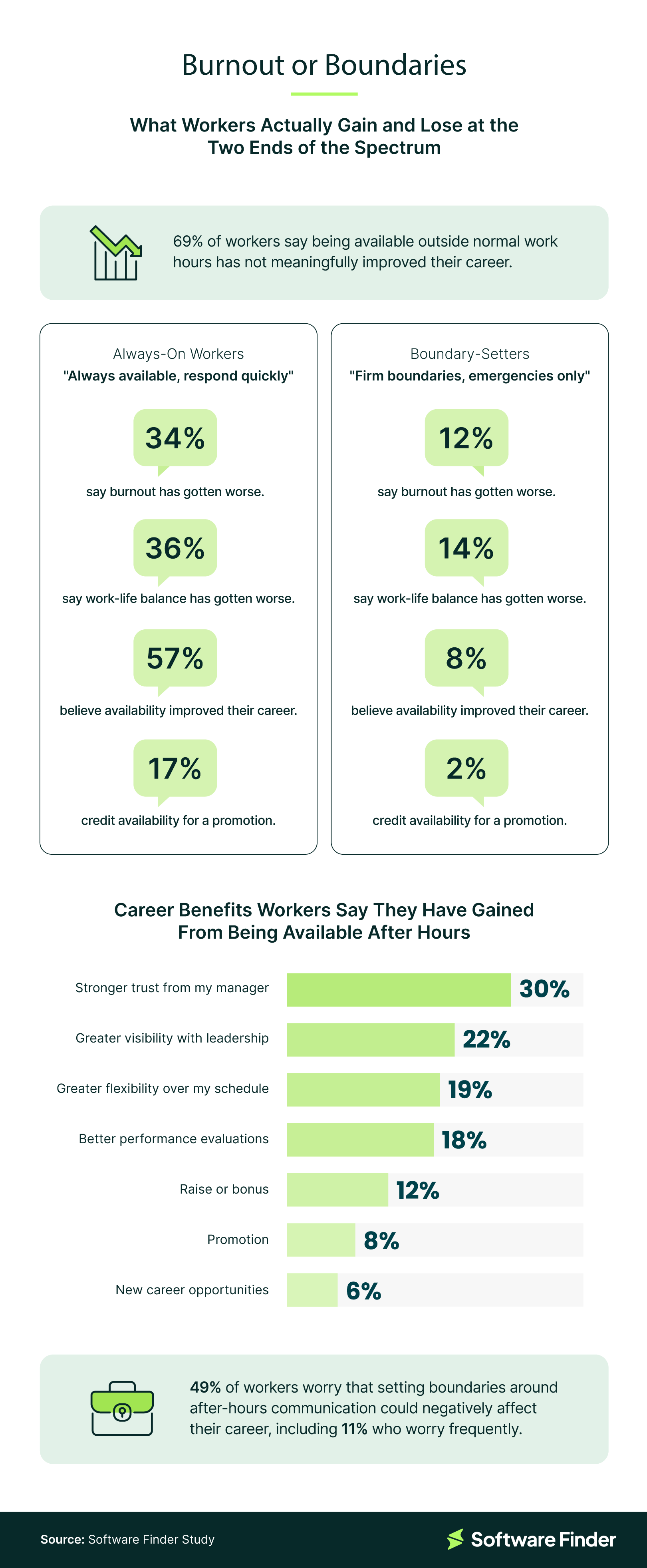
- 69% of workers say being available outside normal work hours has not meaningfully improved their career.
- Only 8% of workers credit after-hours availability for a promotion, and 12% credit it for a raise or bonus.
- Stronger manager trust (30%) is the most cited benefit, followed by greater visibility with leadership (22%) and greater schedule flexibility (19%).
Always-On Workers Pay a Steeper Price
- Always-on workers are 2.8 times more likely than boundary-setters to report worsened burnout (34% vs. 12%).
- They are 2.6 times more likely to report worsened work-life balance (36% vs. 14%) and 2.4 times more likely to report worsened sleep.
- 57% of always-on workers say availability has improved their career, compared to 8% of boundary-setters.
- 17% of always-on workers credit a promotion to after-hours availability, compared to 2% of boundary-setters.
- 24% of always-on workers credit a raise or bonus to their availability, compared to just 1% of boundary-setters.
Boundary-Setting Feels Riskier Than It Is
- 49% of workers worry that setting boundaries could hurt their career, including 11% who worry frequently.
- That worry climbs to 73% among information services workers, the highest of any major industry.
- 45% of managers believe after-hours availability has improved their career, compared to 24% of individual contributors.
- 17% of government workers believe after-hours availability has helped their career, the lowest of any major industry, compared to 40% of information services workers and 39% of technology workers.
Methodology
We surveyed 1,006 U.S. employees to understand how the always-on work culture is shaping burnout, stress, sleep, work-life balance, and the perceived career rewards of being constantly available. The survey examined how often respondents check or respond to work communications outside their normal working hours, the pressure they feel to remain reachable, how their availability has affected their well-being and personal life, and what career benefits, if any, they believe they gained from being available after hours.
The average age of respondents was 39. The gender breakdown was 52% women, 47% men, and 1% nonbinary or not listed. Millennials made up the largest share of respondents (57%), followed by Gen X (25%), Gen Z (15%), and baby boomers (3%).
Most respondents work fully in person (47%), while 29% work in a hybrid arrangement and 24% work fully remote. Individual contributors accounted for 65% of respondents and managers for 35%. Respondents worked across a range of industries, with the largest shares in medical and healthcare (14%), education (14%), technology (12%), and finance and insurance (11%).
The largest company-size group was large employers with 250 or more employees (56%), followed by medium-sized companies with 50 to 249 employees (22%), small companies with 10 to 49 employees (13%), and micro businesses with one to nine employees (9%).
Findings that translate weekly hours into workday or workweek equivalents assume a standard 40-hour workweek (eight hours per day, five days per week).
The survey was conducted online in June 2026.
About Software Finder
Software Finder helps businesses evaluate and compare software solutions across Business & Finance, Education & Research, and Design & Development, connecting decision-makers with expert reviews and side-by-side comparisons.
Fair Use Statement
The findings in this article are available for noncommercial reuse. If you reference this data, please link back to this page to credit Software Finder and the study respondents.