Article
The Economics of AI: A Complete Guide To The Cost Of AI In Healthcare
8 mins read
Last Updated

Writer


Article
8 mins read
Last Updated
Writer

Artificial Intelligence (AI) can be an expensive addition to any ecosystem; anyone with access to the internet knows that. However, when it comes to healthcare, AI systems have evolved much faster than in other sectors and thus can cost a lot more on average. Professionals in the medical field are no longer debating whether AI should be a part of their workflows; the conversation has now shifted to how much it exactly costs and where the optimal solutions lie.
For hospital administrators and health tech investors, AI has become more than a trendy term. It is now understood as a set of specialized tools that can include features like scribing systems and predictive diagnostic solutions, without which doctors might have to run diagnostics manually. This can take many hours, putting valuable lives at risk.
This guide lays out the basics of AI in healthcare software and explains the factors that have an impact on its price, with a detailed breakdown of what specific tools cost in 2026.
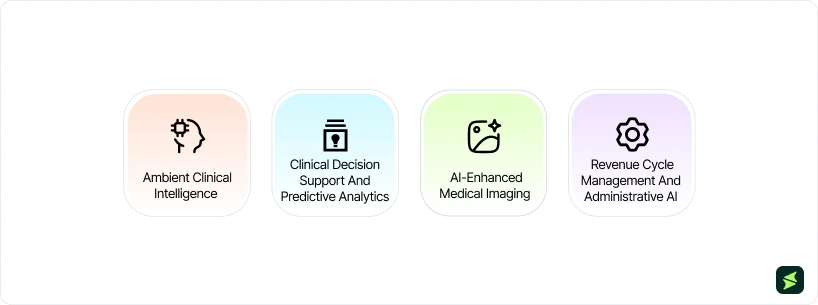
To put it in medical terms, AI-powered tools act like the connective tissue that holds modern healthcare software together. It stores patients’ data while also interpreting it in real-time to make the lives of healthcare workers much easier. To understand the cost of these tools, let us first categorize them by what they do:
The most visible applications of AI in healthcare are ambient clinical scribing systems. These tools use Natural Language Processing, known simply as NLP, and Generative AI to listen to patient-provider interactions and automatically generate structured clinical notes that are fed directly into the EMR. In other words, these are medical-specific AI-note takers, but they add details like dosage and timings as needed.
This works by taking real-time audio and tuning it for medical terminology. Which, in turn, reduces documentation time needed per patient.
Predictive AI models and CDS systems analyze historical patient data within the EHR to flag risks before they escalate. These include early-warning systems, readmission risk scoring, and medication reconciliation, basically acting as a predictive second opinion for practitioners. This works with machine learning algorithms that run continuously in the background of every patient's case, comparing their vitals against literally millions of historical data points to give real-time reports.
Radiology and pathology software now often include computer vision features that use AI tools to highlight anomalies in X-rays, MRIs, and CT scans, making diagnosis a lot faster and easier. This acts almost like a second pair of eyes, which significantly reduces the risk of diagnostic errors and triage time for critical cases such as intracranial hemorrhages.
AI-powered systems are transforming Revenue Cycle Management (RCM) by automating back-office details, focusing on prior authorizations, medical coding, and insurance denial management, among many other things. Similarly, Administrative AI agents are also used to simplify repetitive tasks with pre-programmed guidelines. These agents act as non-human supervisors managing the workflow and can be a huge factor in driving up the cost of medical AI.
The implementation of artificial intelligence features, like the systems mentioned above, in healthcare typically ranges from $20,000 to $200,000 for full-scale functioning. These costs depend on model complexity and data requirements, covering chatbot platforms and clinical protocols.
That being said, it has also been reported that in some cases, enterprise-wide AI implementation initiatives for healthcare corporations can reach as high as $1 million to $5 million. These kinds of huge costs come into play when multiple clinical systems and departments are involved.
At the most fundamental level, the largest cost components are data infrastructure, model development, and deployment systems. Setting up the underlying data architecture, pipelines, and governance frameworks can cost anywhere from $150,000 to $500,000, while developing and deploying custom AI models typically costs $200,000 to $800,000 for healthcare-grade systems.
AI implementation costs in healthcare vary significantly depending on what clinical or administrative problem the tool is solving. A chatbot handling appointment scheduling carries a fundamentally different price tag than a deep learning model trained on millions of radiology scans. What follows is a breakdown of these costs, at a case-by-case level:
Clinical Decision Support AI tools
Clinical Decision Support AI Tools help healthcare providers analyze patient records, lab results, and other clinical data to make accurate diagnostic or treatment decisions. These tools operate on predictive analysis and machine learning to identify potential risks, suggest treatment options, and flag inaccurate results. Market estimations place the cost of these tools around $50,000 to $1,000,000+, depending on the complexity of predictive models that might be needed.
AI Imaging Tools
These tools are used in departments like radiology, pathology, and oncology to analyze medical images and offer diagnostic support. AI imaging tools use advanced computer vision algorithms to detect anomalies in X-rays, MRIs, CT scans, and pathology slides. These tools are among the most advanced uses of AI applications in healthcare. Users have reported costs to be around $200,000 to $1,000,000, due to the need for deep learning models, large datasets, and specialized imaging support.
Healthcare Chatbots
These solutions are dedicated AI-assistants that help automate patient communication, appointment scheduling, symptom checking, and administrative workflows. Implementation costs typically range from $20,000 to $500,000, depending on the level of natural language processing capability and integration with patient systems.
AI-driven Remote Monitoring Platforms
These tools link hospital networks, assisting professionals in analyzing data from wearable devices and home medical equipment. This allows practitioners to track patient health from anywhere. Cost typically ranges from $50,000 to $1,000,000+, number of devices supported and integration with existing health systems.
Administrative AI Tools
Administrative AI tools are used to automate tasks like billing, claims processing, and scheduling. These tools rely on basic natural language functions; generally cheaper and deliver faster ROI, often reducing claim denials and speeding up administrative workflow. Users report the tentative price range to be around $5,000-$20,000/month, depending on the level of customization and integration with existing systems.
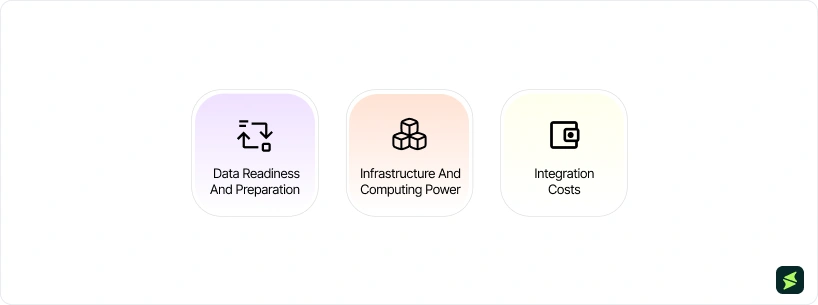
Implementing AI in a healthcare setting can prove to be significantly more expensive than in other sectors. This is primarily caused by three major hurdles, which are compliance, complexity, and clinical Risk. Let's break these factors down in a more understandable way.
Many medical professionals are still spending most of their time cleaning up and documenting patient data. Healthcare data is usually fragmented and inconsistent across multiple traditional systems.
This means that if your EHR data is unstructured, inconsistent, or scattered across different systems, you might have to pay an additional premium for data normalization. According to market estimations, preparing a dataset for a custom AI model can cost a medical practice anywhere from $5,000 to $150,000 before any AI development begins.
AI tools often require massive computing resources, specifically systems like Graphics Processing Units (GPUs) and Tensor Processing Units (TPUs). Then there is deployment, as Healthcare organizations can’t just use standard public clouds for storing sensitive patient data. They have to use HIPAA-compliant and high-security environments. These specialized environments often carry premium charges on top of standard cloud hosting.
Additionally, every time a doctor uses an ambient scribe, it costs tokens or compute seconds, just a bunch of names for ongoing costs. For a large healthcare system, these micro-costs can add up to $50,000+ in pure infrastructural costs.
Connecting an AI tool to the existing medical systems that your practice might be using is not a simple plug-and-play operation. EHR vendors often charge extra fees for access to their API and integration layouts, which must be handled carefully. Beyond that, customizing the AI’s interface so it fits smoothly, without any hiccups, into the doctor’s existing workflow, rather than acting like a separate tab. This integration typically adds another $40,000-$200,000 to the final cost of deploying the AI tool.
Although implementing AI in healthcare systems can require a substantial upfront investment, recent data from the industry suggests that the return on investment (ROI) can be significant. NVIDIA’s State of AI In Healthcare survey in 2025 indicated that approximately 85% of healthcare executives report an increase in annual revenue after implementing AI technologies, which is largely due to improved clinical documentation and more accurate capture of billable codes.
In addition, the same survey states that around 80% of organizations have reported measurable reductions in operational costs, which are driven by the automation of administrative workflows and improved efficiency in clinical decision-making. These findings align with the overall industry analysis, which shows that healthcare organizations are increasingly seeing stronger financial returns from AI adoption.
Financial modeling and estimations also suggest that the average return can justify the initial investment. Reports from AI Strategy Path estimate that for every $1 invested in a healthcare AI tool, organizations may realize approximately $3.20 in return within 14-16 months, largely through operational efficiency gains and improved clinical outcomes.
A clear example of this return on value can be seen with predictive analytics tools designed to prevent hospital readmissions. Avoiding a single readmission for conditions such as heart failure can save hospitals thousands of dollars per patient, particularly by reducing penalties. For mid-sized hospitals, preventing dozens of readmissions annually can translate into millions in potential savings, often covering the entire cost of AI software platforms.

Looking ahead, several technological and market trends are expected to change as AI tools continue to evolve. This shift will also change how healthcare organizations budget for artificial intelligence systems.
One major trend that has recently emerged is the commoditization of basic AI capabilities overall. This means that in healthcare, features such as clinical documentation assistance, automated patient messaging, AI-powered chatbots, and intelligent prescribing are all increasingly becoming standard components of EHR platforms rather than remaining as standalone tools. As adoption grows and competition increases, the cost of these baseline capabilities is expected to decline across the industry.
Another factor likely to reduce AI costs for healthcare is the evolution of more efficient and simpler AI models. Techniques such as model compression and quantization allow advanced algorithms to run on smaller computing environments, which reduces reliance on expensive cloud-based GPUs. This shift toward localized AI could help lower infrastructure costs for hospitals and clinics that currently rely heavily on cloud computing.
Data also indicates that the rising cost of RAM and storage devices, due to the increasing demand in AI data centers, is bound to increase the cost of healthcare AI tools as well. Advanced LLMs and more powerful processing systems for large amounts of medical data might also charge more, based on usage volume.
Another rising trend in healthcare technology is moving toward more advanced agentic AI systems, in which intelligent AI agents manage multi-step workflows on their own. Rather than assisting with one task at a time, these systems can generate clinical notes, schedule follow-up visits, submit prescriptions, and initiate insurance authorization requests within a single workflow.
Many of these solutions involve adopting performance-based pricing models, where providers will have to pay based on outcomes or completed tasks rather than simple software subscriptions.

As healthcare organizations expand their clinical operations, AI is quickly becoming a core part of their infrastructure. It has now turned into a mandatory investment instead of an optional innovation. While smaller clinics may initially have to spend tens of thousands of dollars to deploy AI-enabled tools, large health systems might be charged millions to build enterprise-level AI systems. Evaluating both the costs and the potential returns of AI will remain essential for healthcare leaders planning long-term digital growth for their healthcare team.