Article
EHR Integration Best Practices For Modern Healthcare Systems
7 mins read
Last Updated

Writer


Article
7 mins read
Last Updated
Writer

Electronic Health Records (EHR) integration plays a vital role in the modern healthcare environment, enabling the automated flow of data between clinical, administrative, and third-party systems such as practice management software, billing platforms, labs, imaging tools, and patient portals.
An effective integration harmonizes patient data, promotes coordinated care, and simplifies operations without compromising regulatory compliance.
We lay down the best practices of EHR integration, including strategy planning and interoperability standards, security, testing, deployment, and continuous optimization.

Strategic planning sets the framework for effective EHR integration by ensuring technical decisions align with clinical workflows, day-to-day operations, and long-term organizational objectives. The following steps translate this strategic foundation into practical actions that guide a smooth and effective integration process.
An effective EHR implementation begins with clear objectives that can match clinical, operational, and financial objectives. Major workflows, clinical situations, and data-sharing requirements, including the alignment of lab results, billing data, referrals, or patient engagement tools, should be identified by healthcare organizations. Making it clear what data should move, where to, keeps integrations consistent with practical requirements.
Current EHRs, practice management platforms, legacy systems, and third-party tools should be put into consideration to ascertain technical constraints. This evaluation ought to include interoperability criteria, API assistance, information quality, and vendor limitations. These factors should be considered at the beginning of the process in order to minimize complexity and unforeseen expenses in the future.
Involving clinicians, IT teams, administrators, compliance leaders, and executive sponsors from the beginning is critical. Early input helps ensure workflows match day-to-day clinical practice, improves user adoption, and keeps integration efforts consistent with business goals and regulatory obligations.

Technical standards and integration architecture shape how smoothly systems share data, how well integrations scale, and how efficiently they fit into everyday clinical and operational workflows.
When the right interoperability standards are selected and integrations are built with flexibility, organizations can progress beyond basic system connections. This approach enables reliable, real-time data exchange that helps with patient care, reporting needs, and future system growth.
The following sections outline key practices that help turn these standards and design choices into practical, high-impact integration decisions.
EHR integrations work best when designed around established interoperability standards, which reduce the need for custom implementation and make systems easier to expand or replace over time. HL7 v2 is still widely used for event-based messaging, such as admissions, orders, and results, across hospitals, labs, and ancillary systems.
Fast Healthcare Interoperability Resources (FHIR) facilitates an API-based data exchange over modern web technologies and is growing in popularity with real-time, application-driven use cases. C-CDA is common in most healthcare settings in document-based data sharing, including care summaries and transitions of care.
An API-first strategy helps avoid point-to-point connections by exposing reusable services for core capabilities such as patient data, scheduling, orders, and results. Designing integrations in modular components also enables simpler testing, maintenance, and scale as systems and requirements change over time.
Even when systems are technically connected, integrations can fail if data is handled differently across platforms. Proper data mapping and normalization align with identifiers, units, code sets, and standardized field definitions to support workflows, and reporting remains accurate, reliable, and clinically safe.

Regulatory compliance and data security are particularly critical in EHR integration since integrating multiple systems adds more points of contact where secure health information is exchanged. This commonly creates essential EHR security questions like who has access, how it is secured, and how risks are mitigated across combined settings. The following best practices show how organizations can translate these security and compliance requirements into concrete safeguards within their integration approach.
These measures together help minimize legal risk, safeguard patient trust, and facilitate consistent and long-term interoperability.
Effective change management relies on practical, step-by-step actions that assist teams in adjusting to integrated EHR workflows and using them in their daily work.
This emphasis on continuous improvement builds trust, increases adoption, and ensures integrations deliver lasting value rather than short-term technical wins.

Consistent EHR implementation requires a layered testing approach. Unit testing concentrates on the individual components, like FHIR resource processing, HL7 message construction, and data transformation guidelines. End-to-end data flow between interconnected systems is then verified through integration testing, i.e., ensuring that an HL7 ADT event correctly triggers the creation or updating of a patient record and the corresponding downstream workflows.
It is also important to perform performance testing to be sure that interfaces are able to push their peak volumes without delaying, especially during high-frequency events. Security testing ensures that authentication, authorization, encryption, and possible misuse conditions of the secured health information are taken care of. Testing must occur in the development and staging environments, as close as possible to production settings and vendor behavior.
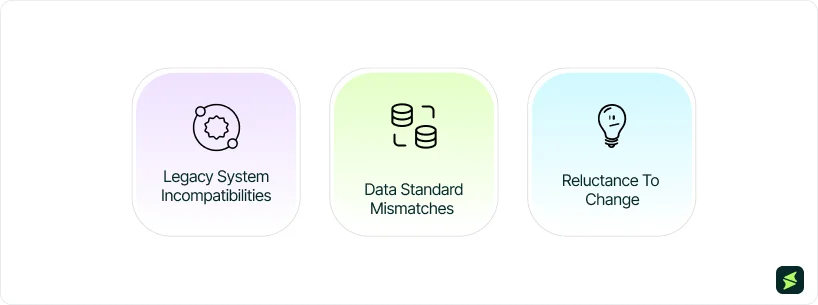
Many EHR integration issues arise from broader EHR implementation challenges, including legacy technology constraints, inconsistent data standards, and organizational pushback on change:

EHR integration is not only a matter of system connections. It determines the way care is provided, the way teams operate, and the way organizations comply with regulatory provisions. Through the best practices in planning, adoption of standards, security, testing, and change management, the organization can go beyond mere connectivity and go all the way to interoperability.
When done well, integration reduces risk, improves data flow, and lays out the framework for scalable, future-ready healthcare operations. Instead of seeing integration as a one-time task, leaders should treat it as a continuous capability. Starting from clearly defined goals, aligned stakeholders, and proven standards establish a solid foundation for successful EHR integration and lasting organizational value.