Article
After the Contract: How Enterprise Software Actually Performs
Last Updated

Writer


Article
Last Updated
Writer
Choosing enterprise software is a high-stakes decision for organizations looking to improve efficiency and streamline operations. Yet the real test begins after implementation, when employees start relying on these tools for their daily work.
To understand how software performs beyond the sales pitch, Software Finder surveyed 500 U.S. professionals who had been using their organization's primary software for at least 6 months. The findings reveal a clear gap between expectations and real-world outcomes, along with the factors that most influence long-term satisfaction and continued use.

Software implementation marks the transition from sales promises to daily use, where expectations meet operational reality.
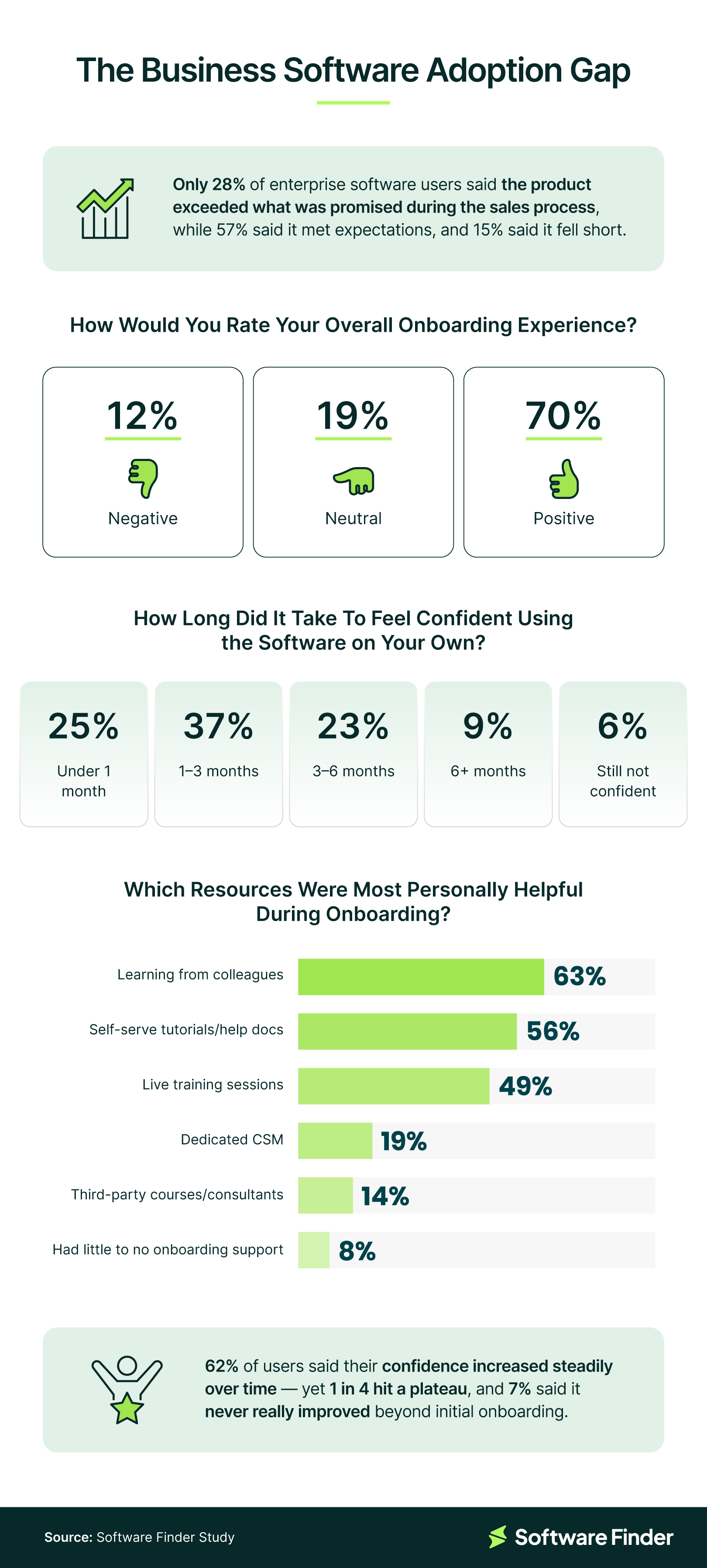
Just 28% of software users reported that the product they implemented exceeded what was promised during the sales process. That's the gap we found between pre-sale expectations and real-world performance once teams begin relying on the system.
Users who rated their software onboarding experience negatively were 25 times more likely to want to stop using the software entirely compared to those who had a positive onboarding experience (25% vs. 1%). These early interactions appeared to strongly influence whether employees felt confident adopting the system.
Sixty-three percent of users said learning from colleagues was the most helpful onboarding resource, surpassing tutorial documentation (56%) and live training sessions (49%). Informal, team-based knowledge sharing often filled the gaps left by formal onboarding programs.
Expectations also varied across software categories:
Once software is fully integrated into daily operations, the quality of vendor support becomes a defining factor in whether users remain satisfied. How responsive service and reliable technical assistance can directly influence long-term customer retention.
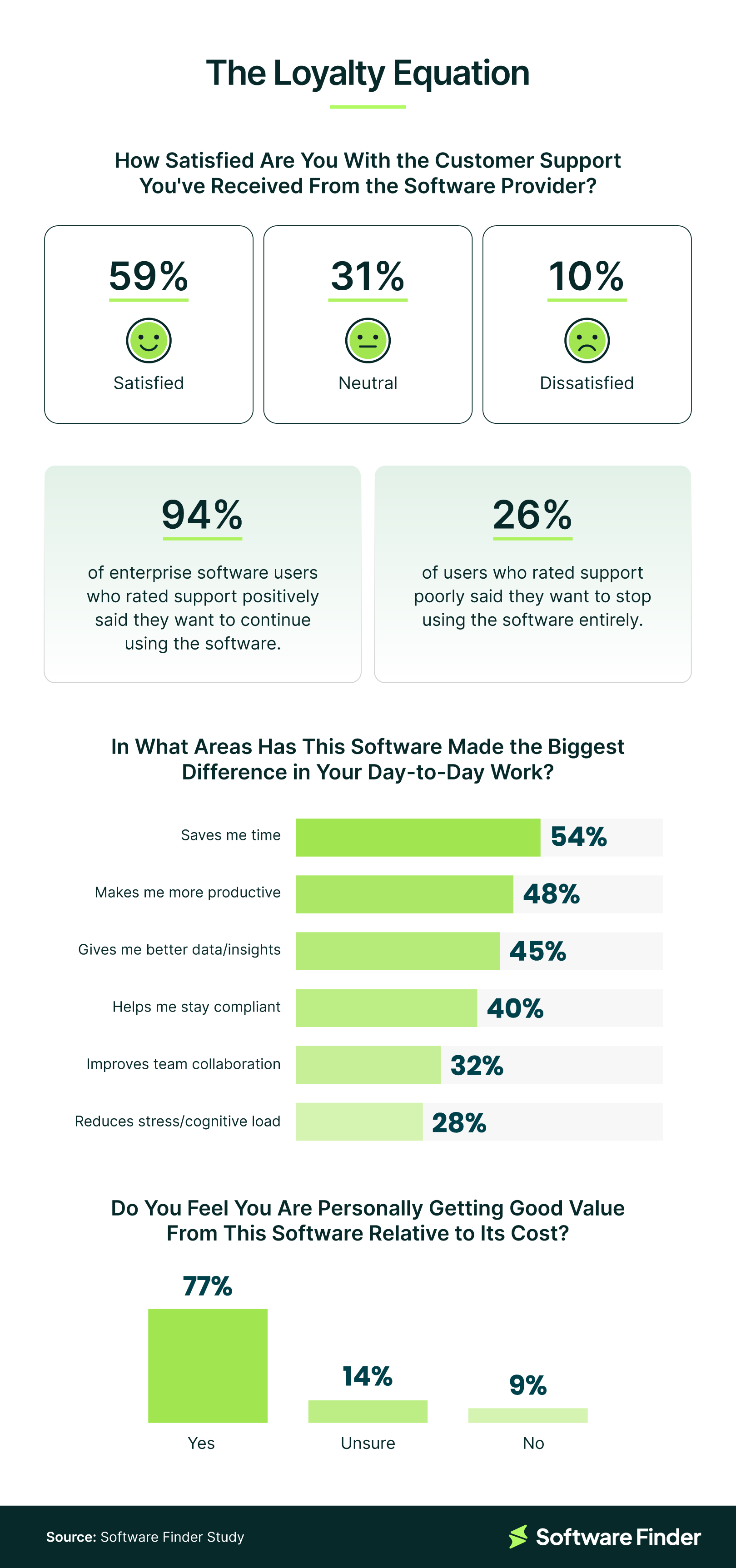
Among users who rated vendor support positively, 94% said they wanted to continue using the software. In contrast, only 26% of users who rated support poorly expressed the same intention. Even when software meets operational needs, poor support experiences can erode confidence and discourage continued adoption.
ERP software users were the most likely to rate support poorly, with 15% reporting dissatisfaction. Given the complexity and scale of ERP platforms, inconsistent support may create greater friction for teams that rely on these systems to manage core business processes.
While implementation challenges are common, many users discovered outcomes that weren't part of the original pitch.
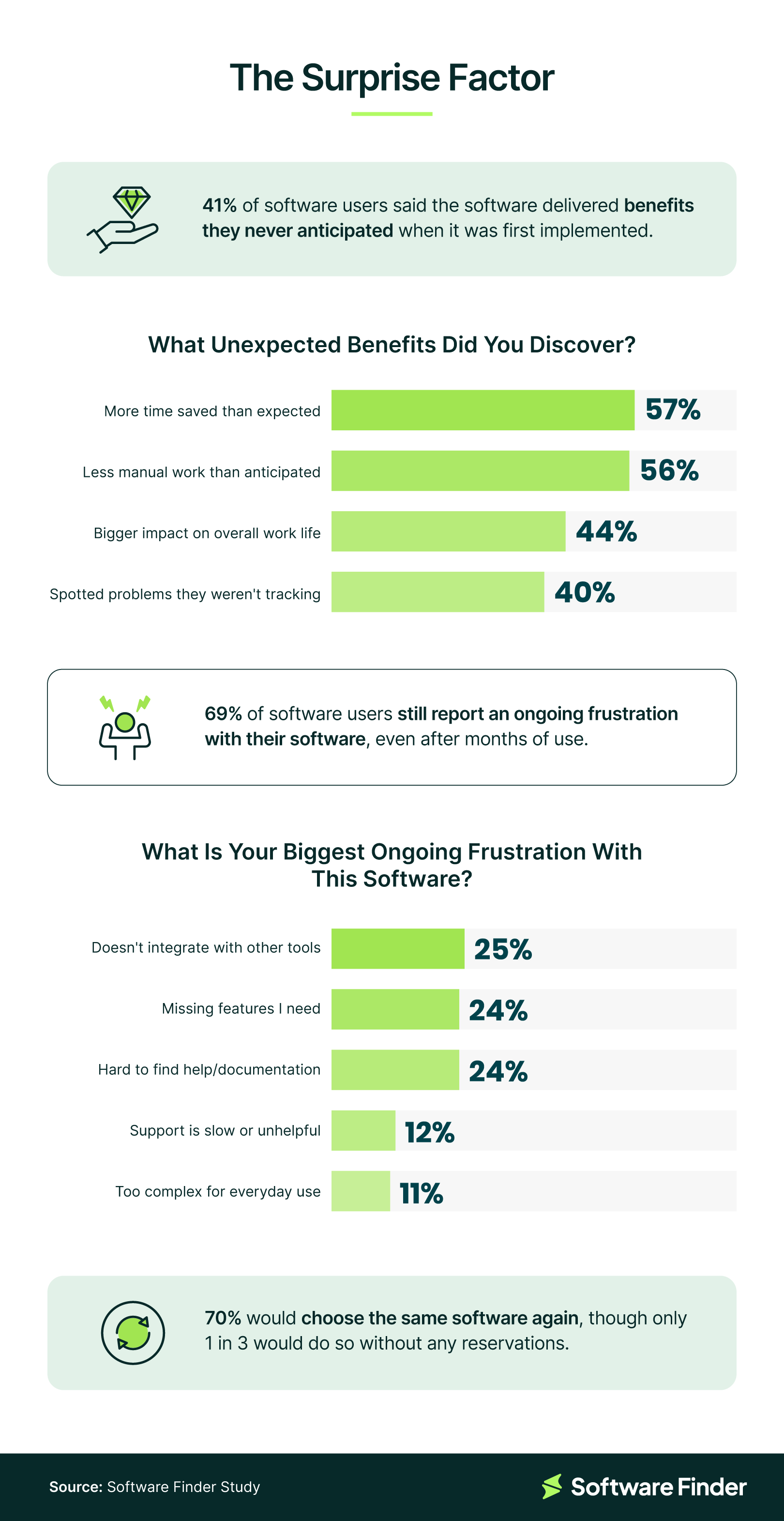
Unexpected benefits of enterprise software were surprisingly common. Overall, 41% of users reported discovering advantages after implementation that were not initially highlighted during the sales process.
These surprise benefits were particularly common among ERP users, with 48% reporting unexpected gains. HR software users followed closely behind at 45%, suggesting that once fully integrated, these systems often deliver operational value beyond their core functions.
Despite these positive surprises, hesitation still remained when it came to long-term commitment. Seven in 10 users said they would purchase the same software again, yet only 1 in 3 said they would do so without hesitation. This contrast suggests that while many tools ultimately deliver value, the journey from implementation to satisfaction can still be uneven.
Enterprise software decisions often focus on features, pricing, and sales demonstrations. However, the findings suggest that long-term satisfaction depends on what happens after implementation, especially onboarding quality, peer learning, and vendor support.
While many users ultimately find value in their software, early experiences and ongoing service play a decisive role in shaping confidence and continued use. Organizations that prioritize these factors may be better positioned to close the gap between promise and performance.
Software Finder surveyed 500 U.S.-based professionals who use enterprise software as part of their day-to-day work. Respondents were required to have been using their organization's primary business software for at least 6 months at the time of the survey.
The study covered four software categories: ERP (n=136), LMS (n=140), HR (n=86), and medical/clinical software (n=108). Respondents were distributed across generations, genders, and organization sizes. The survey was conducted online in March 2026. All percentages were rounded to the nearest whole number.
Software Finder helps businesses evaluate, compare, and choose the right software solutions for their needs. We provide expert insights, detailed comparisons, and personalized guidance across categories such as ERP, HR, LMS, and healthcare software. By simplifying the research process, Software Finder helps organizations make confident technology decisions that support long-term growth.
This content may be shared for noncommercial purposes only. If referenced or republished, please include proper attribution with a link back to Software Finder.