



The modern workday is no longer defined only by output. For many employees, it also includes maintaining the appearance of being busy long after their real work is finished. From strategic Slack messages to keeping inactive tabs open, workers across industries admitted to spending hours each week "performing" productivity rather than doing productive work.
To better understand how widespread this behavior has become, Software Finder surveyed 1,003 full-time U.S. professionals. Learn how workplace expectations, monitoring tools, and cultural pressure are impacting employee behavior across remote, hybrid, and in-office environments.

- 66% of employees and 73% of managers admit to faking productivity at work
- The average worker burns 5 hours a week maintaining the appearance of productivity. That's 32.5 days or nearly 7 workweeks a year
- At companies that monitor employees, 63% say surveillance makes them more likely to fake activity
- Nearly 1 in 2 workers who fake productivity (49%) say the pressure to appear busy has contributed to their burnout or exhaustion
Many professionals are not stretching out their workday because they have more to do. Instead, they are managing how their activity looks to others after their tasks are already complete.
Most Employees Admit To Faking Productivity
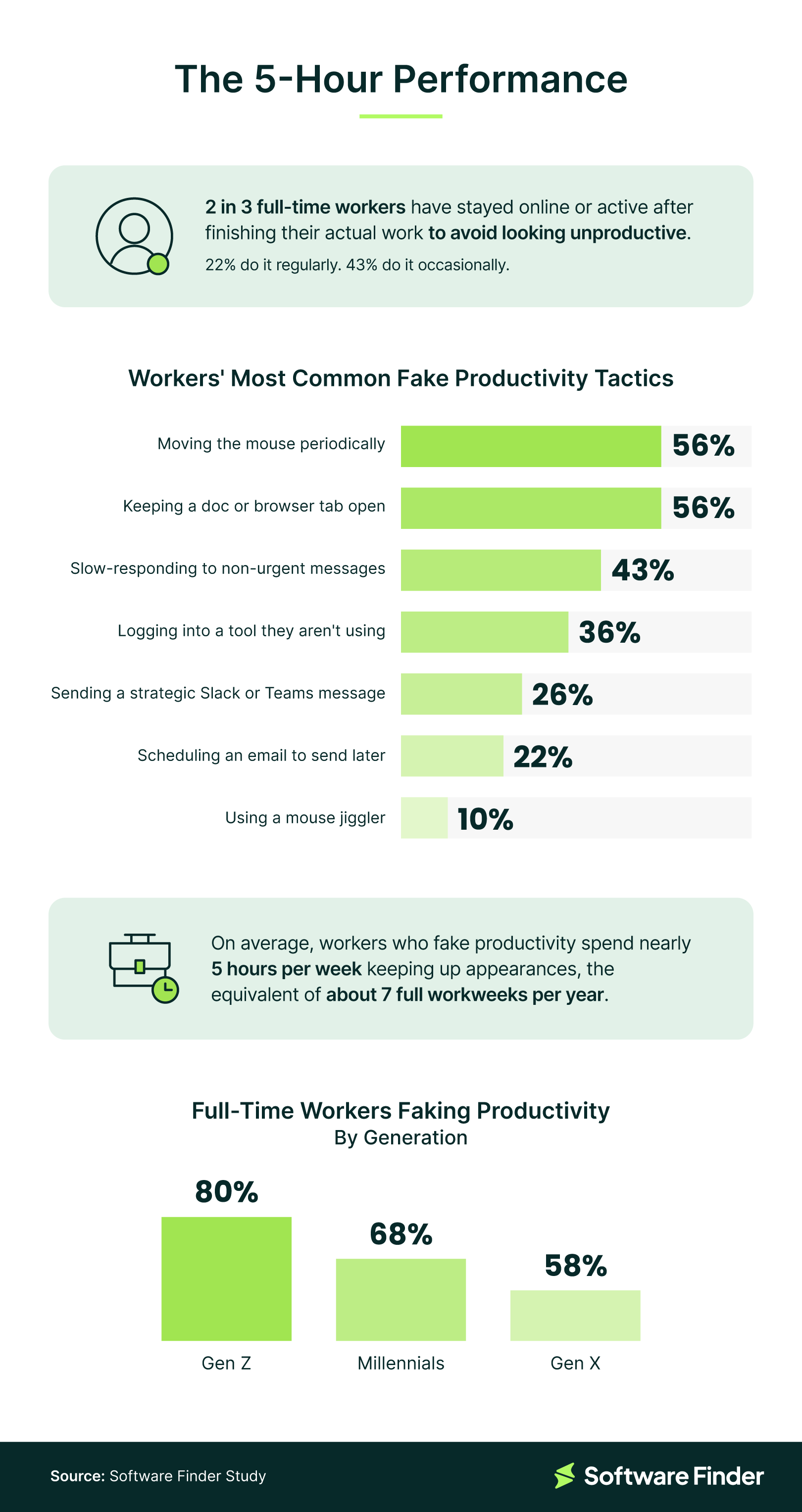
About 2 in 3 full-time workers (66%) admitted to staying online or remaining active after finishing their actual work. Among them:
- 22% said they do it regularly
- 43% said they do it occasionally
The average worker who fakes productivity spends nearly 5 hours each week maintaining the appearance of productivity, which is equivalent to almost 7 full workweeks/year. Workers who fake productivity reported doing so an average of 3 days/week, while 20% said they fake productivity every workday.
Why Employees Stay Online After Finishing Their Work
More than half of workers who fake productivity (51%) said they finish their actual work at least one hour before the workday officially ends. Another 22% said they finish two or more hours early.
Hybrid workers reported the highest levels of fake productivity:
- Hybrid workers: 76%
- Fully remote workers: 66%
- Fully in-office workers: 57%
Gen Z workers led every generation in performative work behavior:
- Gen Z: 80%
- Millennials: 68%
- Gen X: 58%
The Most Common Ways Employees Fake Productivity
Workers described a variety of methods used to maintain the appearance of activity after work was complete. They most often moved the mouse periodically (56%), kept a decoy document or browser tab open (56%), or slow-responded to non-urgent messages (43%) to simulate activity.
Use of mouse jiggers was significantly more common among hybrid and remote workers (14%) than among fully in-office employees (4%), and was nearly twice as common at monitored companies (13% vs. 7%).
Which Industries Have the Most Employees Faking Productivity?
Finance and banking emerged as the most performative industry overall, with 85% of workers admitting to faking productivity. That figure was 34 points higher than retail (51%) and 19 points above the overall average (66%).
Workers most commonly said they were faking productivity for:
- Their direct manager: 35%
- No one in particular, out of habit: 31%
- Senior leadership or executives: 14%
- HR or a monitoring system: 10%
- Their broader team or colleagues: 10%
Even when managers never directly confronted them, many workers still worried about appearing inactive. About 39% said they worried about it despite never being called out. Only 17% had actually been confronted by a manager for appearing idle.
The pressure to appear productive affected far more than schedules and screen time. Many workers linked the behavior directly to stress, burnout, and emotional exhaustion.
How Faking Productivity Is Driving Employee Burnout
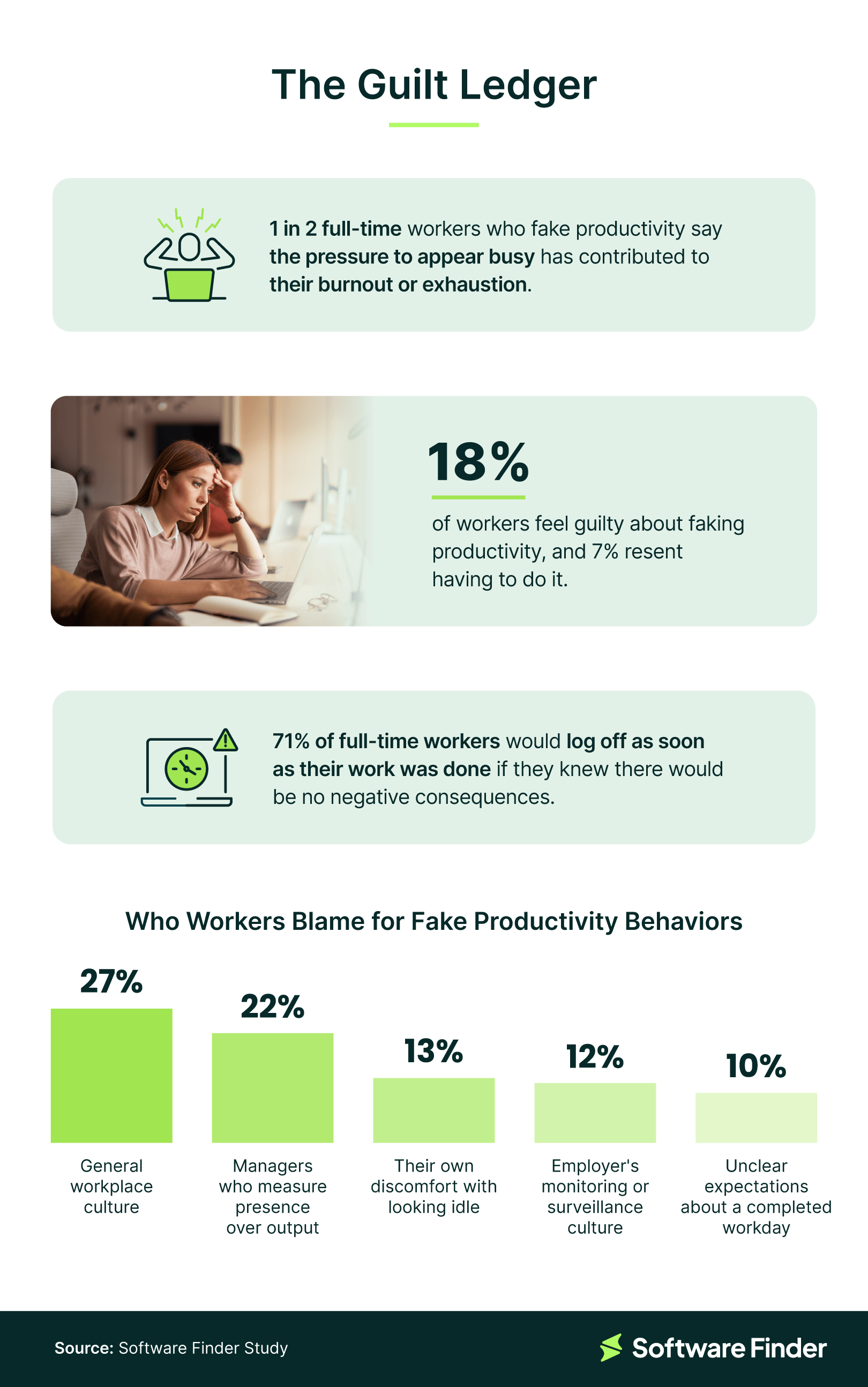
Nearly half (49%) of workers who fake productivity said the pressure to appear busy contributed to burnout or exhaustion.
Burnout rates varied by work arrangement:
- Fully in-office workers: 53%
- Hybrid workers: 49%
- Fully remote workers: 41%
The emotional toll also increased with company size. Among workers who fake productivity, burnout rates climbed to 56% at organizations with more than 1,000 employees.
Is Productivity Monitoring Software Making Things Worse?
Among employees at companies using productivity monitoring tools:
- 63% said monitoring made them more likely to fake activity
- Only 3% said it made them less likely
Overall, 75% of workers agreed that monitoring software makes employees more stressed rather than more productive. More than one-third (37%) strongly agreed.
Even at companies without monitoring software, fake productivity often continued out of habit. About 43% of workers at non-monitored companies said they still faked productivity despite knowing nobody was actively watching them.
Why Employees Intentionally Slow Down Their Work
More than half of workers (64%) said they have slowed down their work on purpose to avoid finishing too early because completing tasks quickly created more expectations. If there were no consequences, 71% said they would log off immediately after finishing their work, including 38% who strongly agreed.
Workers most often blamed fake productivity on the general workplace culture (27%) and on managers who measure presence over output (22%), rather than on their own discomfort with appearing idle (13%).
How Workers Feel About Faking Productivity and Why Women Feel It More
Workers were more likely to describe their feelings toward fake productivity as indifference (31%) or rational acceptance (28%) than guilt (18%).
Women consistently reported higher emotional strain than men:
- Feel guilty about it: 22% of women vs. 14% of men
- Worry about being called out: 44% vs. 32%
- Say it contributed to burnout: 53% vs. 44%
What Would Make Workers Feel Comfortable Logging Off?
Employees pointed to trust and flexibility as the biggest factors that would reduce performative work behavior. The top changes workers said would help included:
- Results-only evaluation systems: 26%
- Explicit permission or trust from managers: 25%
- Flexible or results-only scheduling policies: 15%
- Already feel comfortable logging off: 13%
- Nothing would change the culture: 11%
- Removing productivity monitoring software: 10%
This behavior is not limited to frontline employees. Many managers acknowledged that they have faked productivity themselves, even while struggling to identify it in their own teams.
Most Managers Also Fake Productivity for Their Own Boss
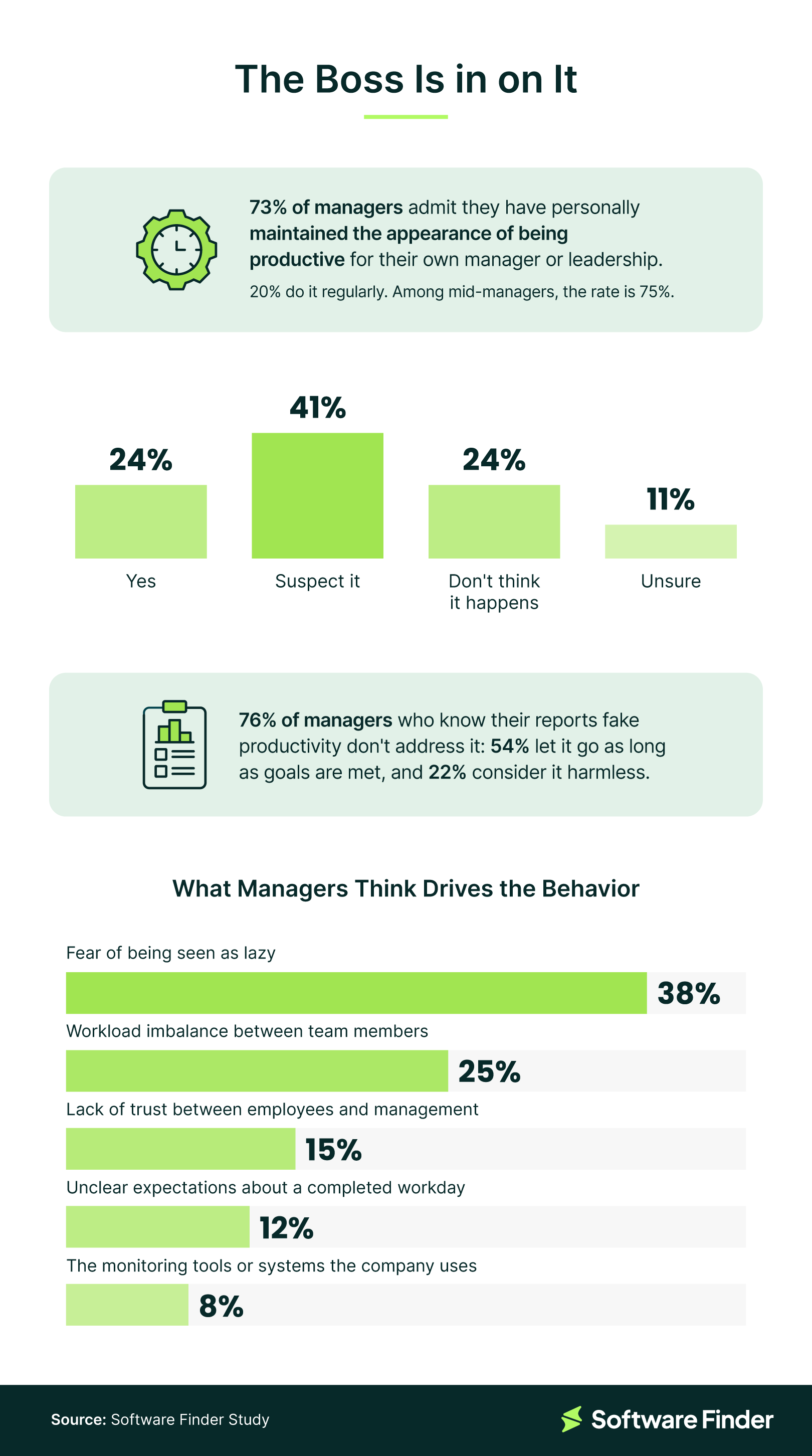
Nearly three-quarters of managers (73%) admitted they have personally maintained the appearance of productivity for their own managers or leadership teams.
Mid-level managers reported the highest rates:
- Mid-level managers: 75%
- Directors and above: 44%
Among managers who admitted doing it:
- 46% said they faked productivity for their direct manager
- 27% faked productivity for senior leadership
- 17% said it had become habitual
- 11% blamed HR or monitoring systems
Do Managers Know Employees Are Faking Productivity?
Managers are often aware that workers are faking productivity, but struggle to confirm it on their own teams. Only 24% of managers could confirm it was happening at work, while 41% suspected it but had not verified it. Another 24% believed it wasn't happening at all.
When managers did recognize the behavior, most chose not to intervene:
- 54% said they ignore it if goals are being met
- 22% considered it harmless and not worth addressing
Despite widespread performative work behavior, managers strongly supported changing traditional work structures. A large majority of managers (83%) said they supported adopting a 3-day or 4-day workweek, including 57% who strongly supported the idea.
Why Do Employees Fake Productivity? Managers Say Fear, Not Tools
Managers most often blamed fear of being seen as lazy (38%) and workload imbalance (25%), with monitoring tools ranking last at just 8%. Perceptions also shifted higher up the organizational ladder. Directors were far more likely to describe fake productivity as a rational response to workplace systems (43%) than individual contributors (27%).
The findings suggest many employees are not avoiding work. They are just responding to workplace cultures that still reward visibility as much as results. As companies continue rethinking productivity in hybrid and digital environments, there's an opportunity to reduce performative work by building healthier systems rooted in trust, flexibility, and output. Organizations that focus more on outcomes than appearances may be better positioned to improve both employee well-being and long-term productivity.
Methodology
Software Finder surveyed 1003 full-time U.S. professionals via CloudResearch Connect in May 2026 to understand how often, why, and how workers fake productivity after their actual work is done. The survey captured behaviors, time spent, emotional responses, blame attribution, and managers' and directors' perspectives on their own teams (n=375) and their behavior toward their superiors. The margin of error for the full sample at 95% confidence is approximately ±3.6%.
About Software Finder
Software Finder helps businesses evaluate and compare software solutions across HR, project management, CRM, ERP, cybersecurity, and more. Through expert resources, detailed reviews, and side-by-side comparisons, SoftwareFinder.com supports organizations looking to improve productivity, efficiency, and workplace performance with the right technology solutions.
Fair Use Statement
This content is available for noncommercial use only. If you share or reference these findings, please provide attribution and include a link back to SoftwareFinder.com.