Article
What Patients Want Most From Their Digital Healthcare Experience
Last Updated

Writer


Article
Last Updated
Writer
Modern patients want their healthcare tools to work as smoothly as the apps they use every day, and they quickly notice when something feels outdated. To gain a better understanding of what people actually need from their digital health experience, Software Finder surveyed 956 U.S. adults and asked about their use, trust, and navigation of electronic medical records (EMRs).
What people shared was honest and relatable. Many want quicker answers, clearer information, and tools that fit into their daily routines without extra effort. Their feedback offers practical direction for providers and health IT teams who want to create digital experiences that feel more helpful, more human, and easier for everyone to use.

Gen Z is setting new expectations for digital healthcare, and not all providers are keeping up.
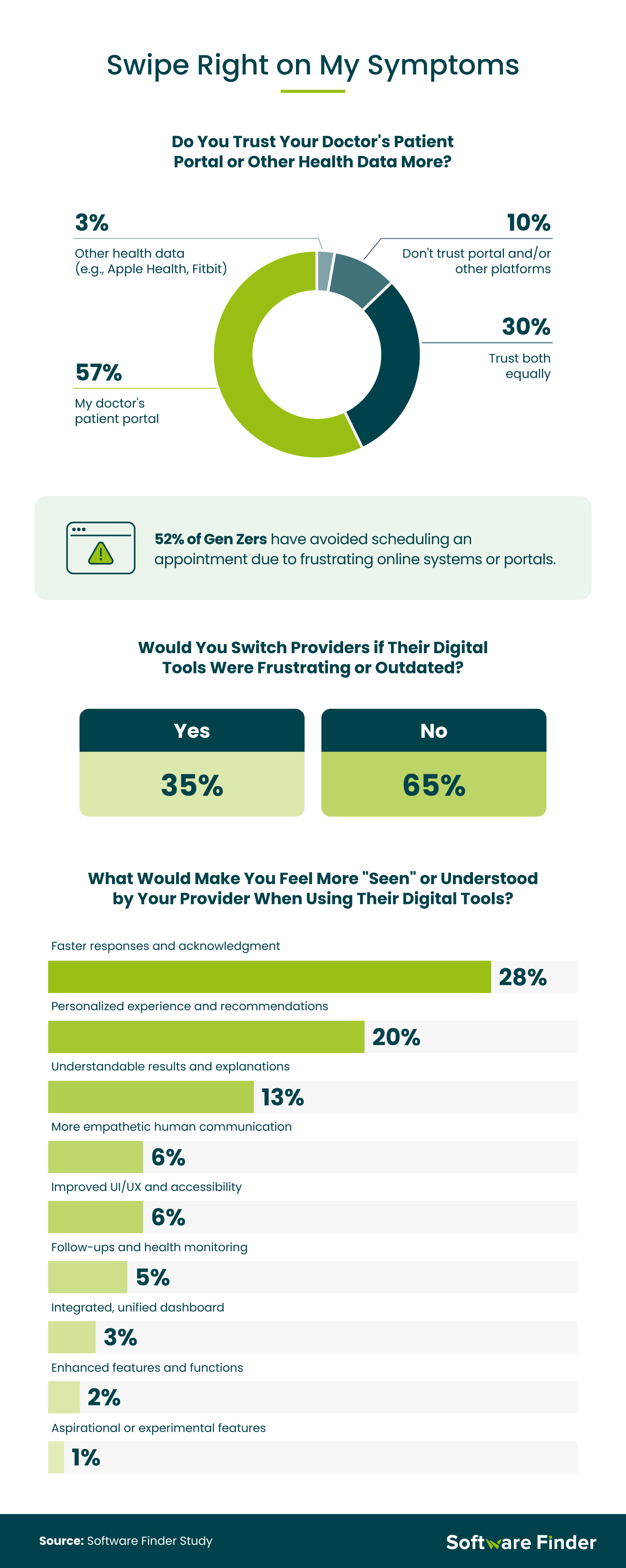
More than half of Americans (57%) still trust their patient portal through their doctor's office more than data from other health platforms or devices, like Fitbits or Apple Watches. Yet, 30% said they trust both equally, and 10% trusted neither. Only 3% of Americans said they trust their wearable device more than their patient portal, with Gen Z being the most likely to say so (6%).
More than a third of patients (35%) said they'd consider switching doctors if the practice's digital tools were frustrating or outdated. This sentiment was especially strong among Gen Z, 35% of whom said faster response times would help them feel more seen by healthcare providers, outpacing millennials (32%), Gen X (27%), and baby boomers (24%).
Personalization also plays a significant role in patient satisfaction. Millennials lead here, with 23% wanting more tailored digital healthcare experiences, compared to 18% of Gen Z and Gen X, and 15% of baby boomers. Integrated dashboards that sync wearable data with doctor records appealed most to Gen Z, with 11% wanting this feature, nearly 3 times the rate of baby boomers (3.7%).
"Patients increasingly judge digital healthcare tools by the same standards as the apps they use every day, and that shift directly impacts providers’ technology decisions," said Adnan Malik, CEO of Software Finder.
"When a portal feels slow or disconnected from other tools patients rely on, it introduces friction that can hurt satisfaction and retention. We're seeing practices prioritize platforms that integrate seamlessly and reduce administrative effort because those are the systems that ultimately build trust and long-term loyalty."
Even digital natives like Gen Z can struggle to make sense of their health data.
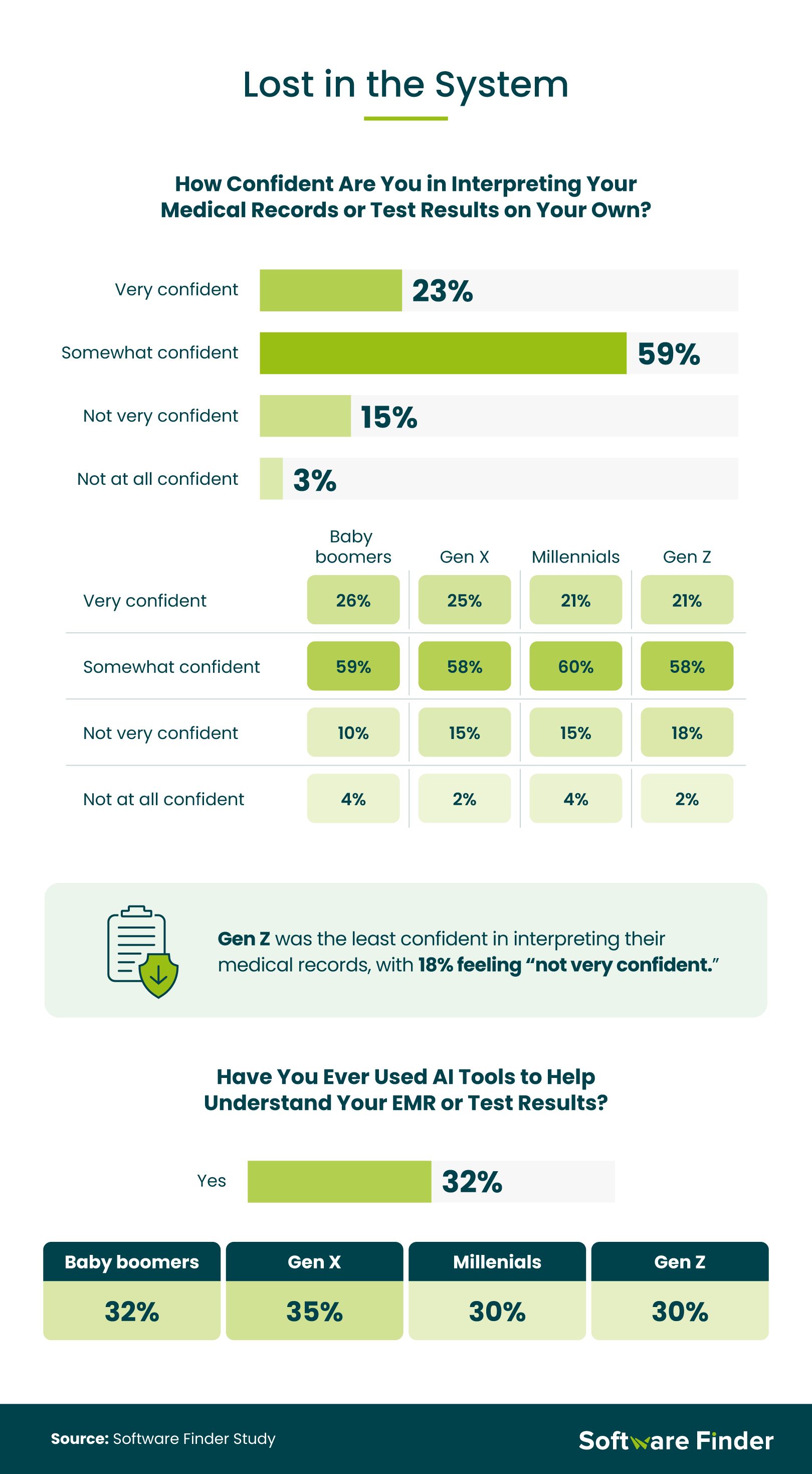
Despite growing up with digital records, Gen Z reported the lowest confidence in reading their own medical records. Only 21% felt "very confident" doing so. Another 20% admitted they were "not very confident" or "not at all confident," a higher rate than all other generations.
Overall, 59% of all patients said they were only "somewhat confident" in interpreting their EMR or test results. To bridge this gap, 32% of patients have turned to AI tools or digital assistants to help them understand their records. Gen X has done so the most often, at 35%.
"For many people, opening their medical record is a moment of hope mixed with hesitation," said Marium Lodhi, CMO at Software Finder. "When the language is unclear, or the details feel overwhelming, stress sets in fast. Patients want simpler guidance, even a high-level dashboard to show where to begin. When tools offer that clarity, people feel calmer and more in control of their care."
Patients of all ages are frustrated by clunky EMRs, and they're ready for change.
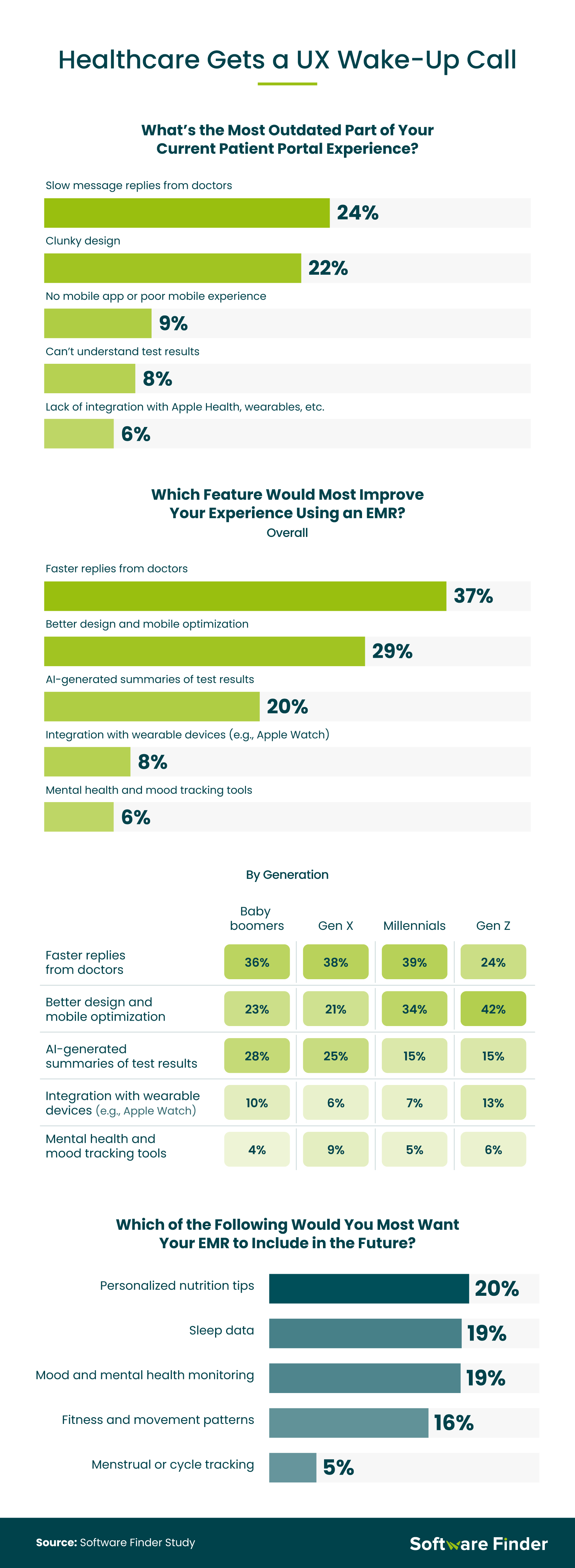
Patients said the most outdated parts of their digital healthcare experience are slow responses from doctors, clunky design, and the lack of a strong mobile app. These were the top issues people want fixed to improve their EMR experience, with AI features coming next.
One in five Americans said AI-generated summaries of their test results would make the biggest difference, a preference led by baby boomers at 28%. Gen Z leaned toward deeper tech integrations instead, with 13% saying wearable syncing would most improve their EMR experience. Mood and mental health monitoring was another commonly requested addition (19%), and Gen Z stood out here, with 25% hoping to see these metrics incorporated into their records.
Personalized guidance also resonated with many respondents. Twenty percent said they would like to see nutrition tips built into their EMR, while 16% wanted the software to track fitness or movement data. Baby boomers were again the most enthusiastic about both features, with 24% wanting nutrition insights and 22% wanting fitness tracking.
"Most patients aren't asking for something complicated," Shane Elahi, COO at Software Finder, pointed out. "They want faster communication, better design, and tools that fit into their daily routines. When EMRs fail at the basics, it shows up as real frustration, and providers feel the impact."
As digital healthcare becomes central to how people manage their well-being, expectations are rising fast. Patients want tools that are simple to use, easy to understand, and aligned with their daily habits. Younger generations look for speed and seamless integrations, while older adults appreciate features that bring clarity to their data.
For providers and health IT teams, choosing the right digital tools means focusing on what genuinely helps patients—not just what's new. When EMRs are clear, intuitive, and supportive, people feel more confident in their care and more connected to the providers they trust.
"The future of digital health comes down to simplicity," explained Malik. "If a tool helps people understand their data and get care without jumping through hoops, they'll use it. The providers who focus on ease of use will stay ahead of changing expectations."
Software Finder surveyed 956 U.S. adults to understand their experiences with electronic medical records (EMRs). Respondents were segmented by generation as follows: baby boomers (14%), Gen X (30%), millennials (42%), and Gen Z (13%). The survey measured attitudes toward EMR usability, trust in digital tools, and preferences for healthcare features.
Software Finder connects businesses and healthcare providers with the right software solutions to meet their needs. From electronic health records to telemedicine platforms, Software Finder simplifies the decision-making process with expert insights, detailed comparisons, and verified user reviews. Learn more about top-rated healthcare software on our EMR Software page.
If you'd like to share this data or report, feel free to do so for noncommercial purposes. Please include a link back to this page and proper attribution to Software Finder.