


The Grok vs ChatGPT debate misses the main point. The question isn’t ‘which is better?’, but ‘better for what?’. Both tools dominate the AI chatbot space but offer different approaches to how they handle tasks and user interactions.
To get a sense of which is the better option overall, we have compared Grok vs ChatGPT on key aspects such as core capabilities, pricing structures, and user feedback. This will help you choose an AI assistant that best fits your workflows, not just the marketing narrative.
Grok Starting Price: $10/month Best For: Healthcare, Marketing, Logistics Mobile App: Android, iOS Rating: N/A Get Demo Disclaimer: The pricing is subject to change. | ChatGPT Starting Price: $8/month Best For: Engineering, Finance, Marketing, Data Science Mobile App: Android, iOS Rating: 3.9 Get Demo Disclaimer: The pricing is subject to change. |
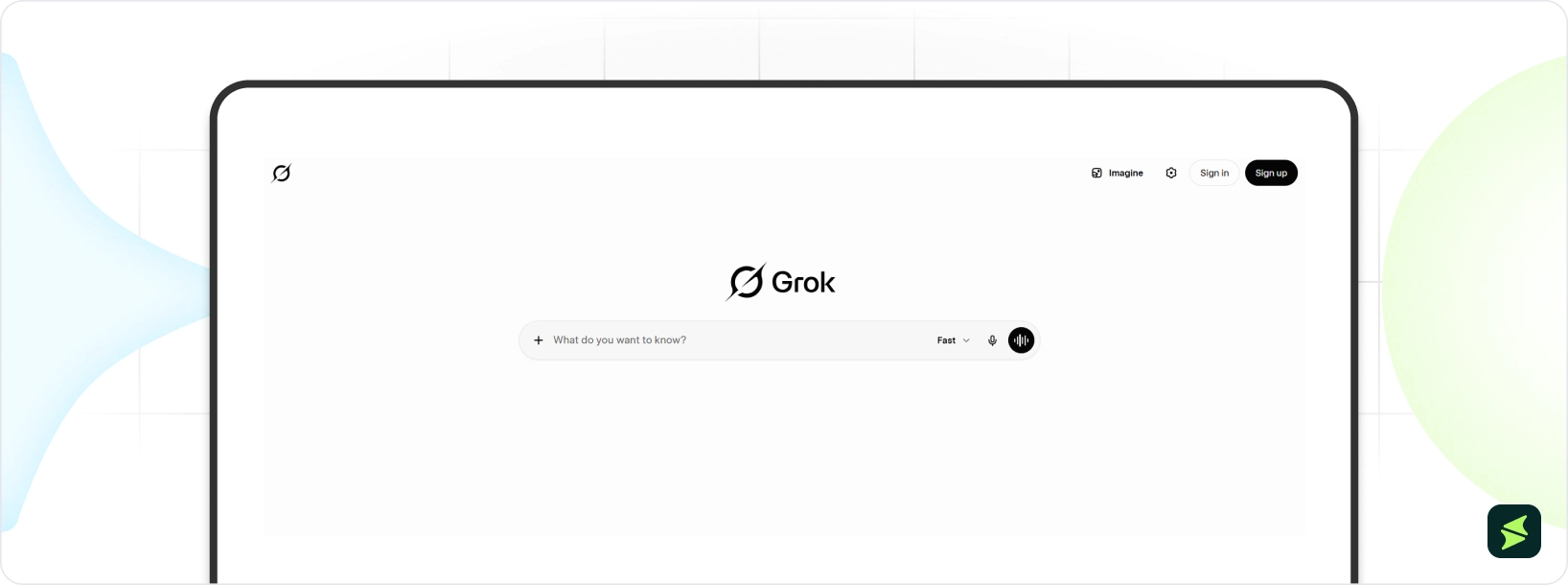
Grok, developed by xAI, was launched in 2023. Unlike most AI chatbots, it delivers direct responses with powerful capabilities in reasoning, coding, and visual interpretation. What sets Grok apart is its native real-time integration with X (formerly Twitter), which has evolved from a standalone feature to a core component of the platform. This integration enhances user experience by enabling real-time data access, content recommendations, and creative tools.
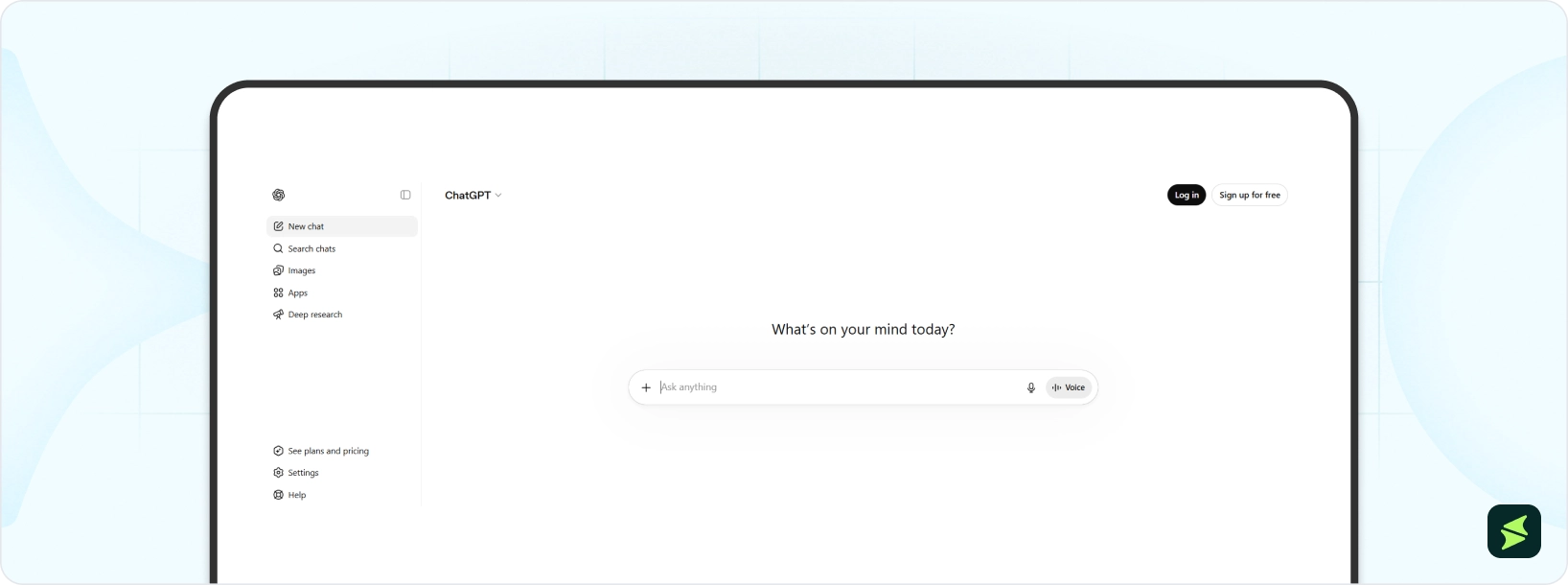
ChatGPT, developed by OpenAI, is a conversational AI assistant that generates speech, images, and text in response to user prompts. It supports multimodal interactions such as voice conversations, coding capabilities, image analysis, web search, and file uploads for data analysis and chart creation. The tool offers a dedicated research workspace known as Prism, which accelerates science writing and collaboration.
By The Numbers
Metric | Grok | ChatGPT |
Monthly Visits (Feb 2026) | 251.44M | 5.19B |
App Market Share | 3.4% | 45.3% |
Website Traffic | USA (19.8%) | USA (20.31%) |
Source: SEMrush, Demand Sage, February 2026
Features | Grok | ChatGPT |
Web Search | ✓ | ✓ |
Image Generation | ✓ | ✓ |
Document Analysis | ✓ | ✓ |
Custom GPTs | ✗ | ✓ |
Native Twitter Integration | ✓ | ✗ |
Video Generation | ✓ | ✗ |
Real-Time Data Awareness | ✓ | ✓ |
Group Chats | ✗ | ✓ |
Shopping Research | ✓ | ✓ |
Voice Mode | ✓ | ✓ |
Open Source | ✓ | ✗ |
Project Workspace | ✓ | ✓ |
Coding | ✓ | ✓ |
Grok is known for its simple, accessible interface on both the website and mobile. Users can start using it immediately without a complicated setup process. The platform handles follow-up questions smoothly and makes query refinement intuitive. For daily use, this simplicity proves genuinely valuable.
ChatGPT, in contrast, offers a more structured interface due to its feature panel on the right, like Apps, Codex, and Deep Research, providing an organized layout. The interface follows familiar patterns, though navigating the fuller feature catalog requires a bit more attention. When it comes to standard tasks, such as interpreting images, reasoning problems, and producing written content, performance is reliably competent.
There’s one significant key aspect that needs to be considered: the price.
Grok’s pricing starts at $10/month for the SuperGrok Lite plan and $30/seat for the SuperGrok plan. The platform also offers two pricing plans for businesses, which include:
- Grok Business - $30/seat
- Enterprise – Custom pricing
Moreover, it offers a 3-day free trial.
On the other hand, ChatGPT pricing starts at $8/month in its Go plan. The platform also offers further pricing plans for individuals, businesses, and enterprises, which include:
- Free - $0
- Plus - $20/month
- Pro - $200/month
- Business - $30/user/month
- Enterprise – Custom pricing
Disclaimer: The pricing is subject to change.
A key deciding factor is the usage limit. Grok’s limit depends on the subscription tier, and checking the limits through the xAI Console or the plans page. ChatGPT, on the other hand, uses structured message caps that vary by model and plan.

- Grok makes sense if real-time information and unfiltered responses are non-negotiable. The $10/month SuperGrok Lite plan is built for professionals who need to track live news, monitor market shifts, or pull insights from social media.
- ChatGPT, in contrast, offers better value for money with a free tier and a low-cost Go plan available at $8/month. It gives users access to powerful features without a high upfront cost.
Free Pricing Tier Comparison
Key Aspect | Grok (Free) | ChatGPT (Free) |
Model Access | Grok 4 and 4.1 | GPT 5.2 |
Usage Limits | 10 prompts every 2 hours, 3 image analyses, and 4 image generation | Send up to 10 messages with GPT-5.3 every 5 hours |
Capabilities | Basic chat, limited image generation, and analysis | Basic chat, image generation, and limited web search |
It’s important to focus on scalability, which helps determine how much the platform can handle growing workloads, integrate into systems, and support multiple users.
Primarily, Grok supports integration through its API. It connects with third-party tools through third-party frameworks, which include LiteLLM, Vercel AI SDK, and other frameworks. This enables Grok to handle larger workloads and adapt to evolving enterprise needs. While it’s a flexible choice for technical teams, it may still require additional setup. Grok’s 4.20 Beta version supports a context window of 2 million.
Grok truly diversifies itself with its access to information. Its integration with native X gives real-time access to social media conversations, breaking news, and trending topics, keeping users up to date.
Additionally, it scales across various organizational sizes, from small to mid-sized teams and large organizations. The tool supports large context windows, with models capable of handling up to 2 million tokens. This is particularly suitable for larger documents and longer conversations. Furthermore, Grok offers custom role-based user access and SSO, allowing organizations to manage user permissions and authentication.
Compared to Grok, ChatGPT’s 4.1 model supports a 1-million token context window. It helps in handling complex projects and large conversations without losing context. It connects easily to everyday tools, including Google Drive, Airtable, SharePoint, Slack, Asana, ClickUp, and many more. This helps teams to automate processes, expand workflows, and easily manage high volumes of interactions.
In contrast to Grok, ChatGPT relies only on web browsing capabilities to give current information, but doesn't offer the same social media immediacy.
The tool is well-suited for various business sizes, including growing teams, small and mid-sized businesses, and enterprises. This is due to its mature API infrastructure and collaborative workflows.
Moreover, ChatGPT has an admin console for enterprise controls. It is easy for the teams to manage users, enable secure authentication with SSO, and configure role-based access.
- Consider Grok if you need to process large volumes of data and rely solely on API-driven workflows
- For those who prefer built-in integrations and enterprise for a complete ecosystem to scale across teams, ChatGPT is a suitable choice
Grok maintains enterprise-grade security, including SOC 2 compliance, data encryption, and adheres to privacy laws, i.e., CCPA and GDPR. It protects user data and gives businesses full control over their sensitive information. Moreover, it provides 90-day audit logs that track administrative changes, API key usage, and team membership, adding another layer of transparency.
On the flip side, ChatGPT supports compliance with privacy laws, including the GDPR, CCPA, HIPAA, and FERPA. In simple terms, it follows standards for protecting and handling user data. It is ISO 42001, 27001, 27017, 27018, 27701, PCI-DSS, and CSA Star Level 1 certified. These certifications cover data privacy, payment security, and cloud operations.
- Grok works for enterprise use cases that focus on security compliance and data privacy
- ChatGPT is ideal for global enterprises needing broader privacy law coverage and payment security
Grok’s approach in terms of privacy is transparent. It offers the option to delete the chat history. Additionally, it allows users to select whether or not the data should be used for training.
- Mobile App Data Controls For Training Grok: On the mobile app, to select or deselect using your content for model training, go to Settings, Data Controls, and select or deselect ‘Improve the model’.
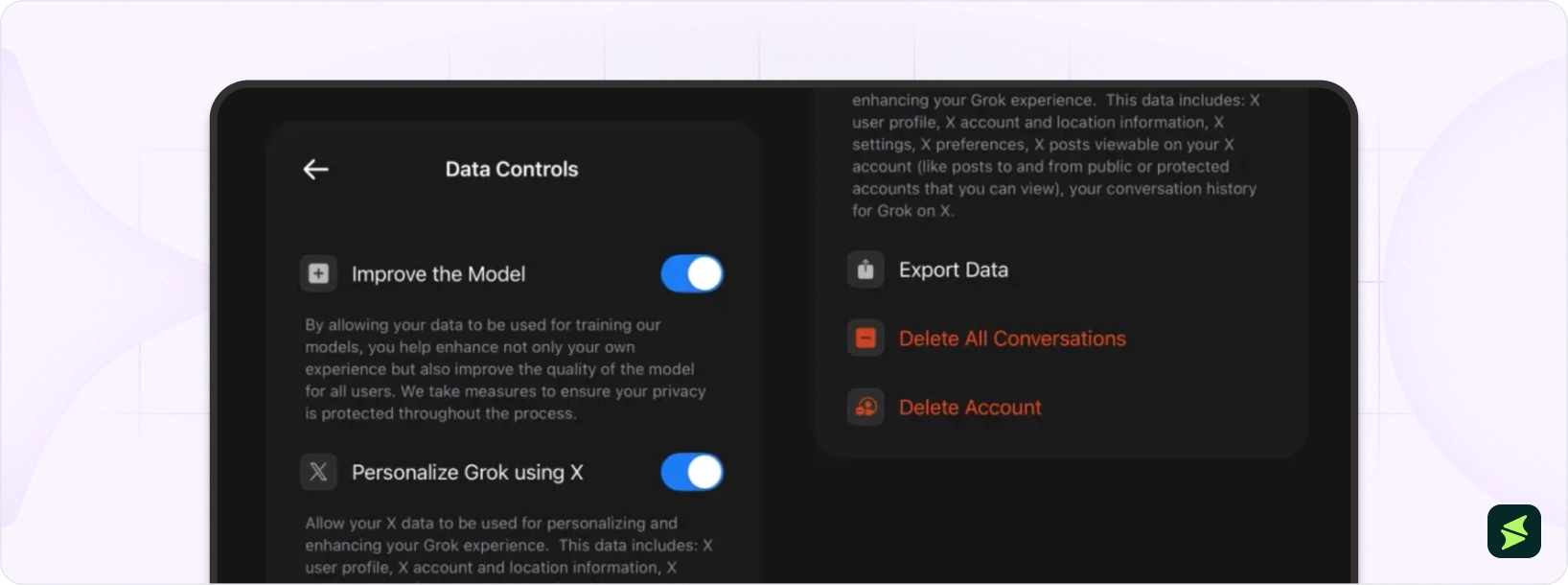
- Grok.com Data Controls For Training Grok: For the Grok.com website, you can go to Settings, Data, and then ‘Improve the Model’ to select whether your content is used for model training.
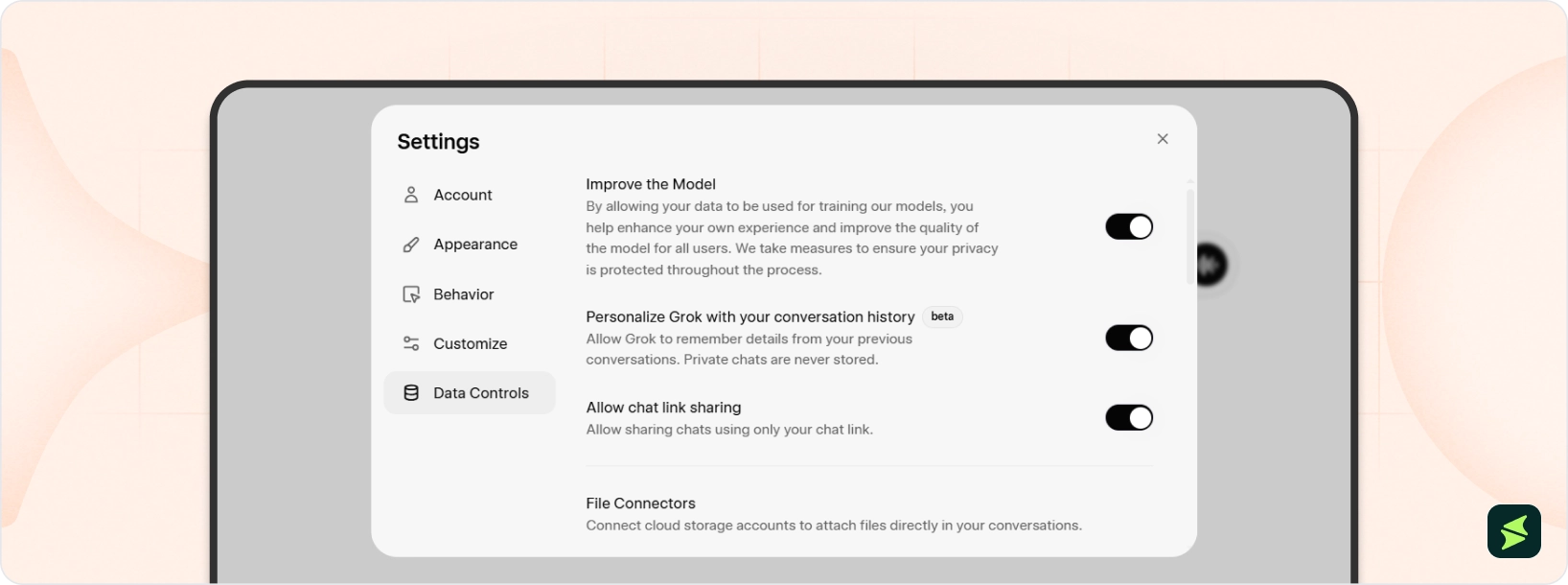
The tool offers the option of ‘Private Chat’. It ensures that the conversations are deleted from the system within 30 days, unless it is necessary that they be kept longer for legal, compliance, or safety purposes. Furthermore, it is recommended that users be cautious when sharing sensitive or personal information.
In contrast, ChatGPT uses the user’s conversations for training purposes unless the setting is changed, as mentioned in its Privacy Policy. Just like Grok, users can delete the chat history manually. Moreover, it has a temporary chat button that prevents conversations from being saved. However, users have to turn the temporary chat on every time they need it.
- For those looking for privacy controls that do not require repeated activation and auto-deletes chats within 30 days, Grok is the best choice
- ChatGPT works for users comfortable with active privacy management, with Temporary chat activation to prevent data usage
Grok does not offer a live chat option. Instead, the platform offers both email and phone support. It also has an active community forum on Discord, where users can ask questions to get prompt replies. Users can directly ask their queries through Grok. This built-in assistance reduces the need to rely heavily on traditional support channels, making problem-solving faster and more accessible.
Some Grok users mentioned that it is difficult to get timely responses, particularly for subscription or billing issues. A few also mentioned delayed email responses, which leads to slower query resolution.
ChatGPT, on the other hand, prioritizes community-driven support through an active user forum where members exchange solutions and troubleshoot issues for prompt responses without waiting for support staff. On both the desktop and mobile app, the chat support button is less intuitive to access, as it is hidden in the settings.
ChatGPT's customer support faces criticism from long-term paying users. It provides only form letter responses that fail to address specific issues, even when users report the same problems repeatedly.
- For those preferring support channels through email and phone, Grok is a suitable choice
- ChatGPT works if you're comfortable relying on community forums for peer-to-peer troubleshooting
While ChatGPT excels at conversational AI, generating text, answering questions, and assisting with creative or technical tasks, Grok extends beyond its capabilities through Grokipedia. It's an online encyclopedia where AI creates and fact-checks articles. The articles cannot be directly edited; however, it allows visitors to suggest corrections via a pop-up form, which are then reviewed by Grok.
Regarding ecosystem maturity, OpenAI is more advanced. Developers can build apps through the ChatGPT API or embed it into tools. This makes it ideal for SaaS companies and product teams. In contrast, Grok is developed and still in public beta. It allows developers to obtain an API from the xAI console to integrate with the workflows.
Grok is designed to be more casual and less restricted in tone, compared to ChatGPT. It delivers responses with an unfiltered and casual style. Whereas ChatGPT follows a polished and formal tone, making it better suited for professional, business, and compliance-sensitive use cases.
To make AI more accessible and useful worldwide, Grok supports over 145 languages. However, ChatGPT is available in 50+ languages across sign-up, login, and user settings.
Grok x Tesla Integration
As part of the real-world ecosystem, Grok is now integrated with some models of the Tesla vehicles, including Model S, Model 3, Model X, Model Y, and Cybertruck vehicles. It comes with:
- An AMD processor
- Vehicle software version 2025.26 or later
- Premium Connectivity or Wi-Fi connection
Drivers can talk to Grok, choose its personality and voice, and use it for answering questions and initiating commands. This integration highlights how Grok expands into physical products, something that ChatGPT lacks.
- Grok is ideal if you want innovation, casual responses, and real-world integrations like Tesla
- ChatGPT is better suited for software-based ecosystems and digital integrations, but it currently does not offer native integration with physical products
Reviewers praise Grok for its easy-to-use tool, which helps in creating images and videos. Many users appreciate the platform for its simple and intuitive interface. A user mentioned, ‘The interface feels straightforward, which makes it practical for daily use.’
Users are happy with the platform’s fast responses compared to other AI tools that slow down during deep research. Some marketing agencies mentioned that Grok works well for social media teams when it comes to rapid content ideation and trend spotting.
Users have mixed feelings about Grok's integration with Tesla, with some appreciating its utility and others finding it lacking. A user said, ‘Absolute game changer. I installed it this morning.’ Some users mentioned that the tool has limited documented APIs, making it difficult for developers to make custom workflows.
Most users like ChatGPT’s simple and clean interface for first-time users. A user highlighted, 'The interface is clean and easy to use, and updates like code interpreter and plugin access keep expanding its capabilities.' Reviewers also like how easily the tool conducts deep research on various topics for both work and personal purposes.
Regarding document analysis, users note that ChatGPT easily finds trends through sales data. A user said, ‘I can add a CSV file with my sales data, and it finds trends right away.’
Some users highlight that ChatGPT offers limited access to the image creation tool. It allows users to create only a few images in the free version. Furthermore, users say that it is less private compared to other tools. A user noted, ‘ChatGPT is not always secure when talking about privacy, it often knows something you didn't told it.’
Both xAI and OpenAI are actively expanding the capabilities of their platforms.
Grok’s development roadmap focuses on enhanced reasoning capabilities and expanded content handling. It may introduce Grok 5, aiming for deeper reasoning, faster processing, video understanding, and bridging Artificial General Intelligence (AGI).
OpenAI continues upgrading the core models with the newest GPT-5.4 generation that improves reasoning, long-document processing, and coding. Additionally, OpenAI is working to expand ChatGPT’s long-term memory capabilities. This would allow the system to remember user preferences, past conversations, and recurring tasks over time.
Looking further ahead, future updates may gradually shift ChatGPT from a chatbot into a personal AI assistant capable of managing everyday digital tasks. This may help manage workflows, coordinate digital tools, conduct research, and automate routine tasks across applications.
Grok is built for speed and back-and-forth conversation. Its fast responses and conversational style help maintain momentum, going for quick prototyping, debugging, and experimenting with ideas. Additionally, its Grok Code Fast 1 excels at agentic coding. Developers can use it to brainstorm solutions, refine code step by step, or troubleshoot issues during rapid prototyping.
On the other hand, ChatGPT provides structured support for development tasks. It explains how each function works, generates unit tests, debugs errors, and writes clean code. The tool integrates with developer tools, including CI/CD pipelines, GitHub, and VS Code. For building production applications or requiring extensive API integration, ChatGPT's established infrastructure gives you more flexibility.
- Grok fits solo developers doing rapid prototyping who value quick conversational feedback over deep workflow integrations
- ChatGPT is the better choice for developers working in teams or production environments who need dependable code generation and tool integration
Grok Vs ChatGPT: Which AI Tool Is Better At Which Task?
Use Case | Better Tool | Why? |
Real-Time Information | Grok | Direct integration with X enables access to live conversations and up-to-date insights |
Content Creation And Social Media | Grok | Strong at generating conversational, engaging content tailored for social platforms |
Coding And Debugging | ChatGPT | More structured outputs, better explanations, and a mature developer ecosystem |
Business Workflows And Integrations | ChatGPT | Native integrations with tools like Google Workspace, Slack, and GitHub |
Enterprise Collaboration | ChatGPT | Better suited for teams with workspace features and admin controls |
Quick Problem Solving And Brainstorming | Grok | Fast conversational responses support rapid iteration and idea exploration |
Bottom Line: Which AI Chatbot Fits Your Workflow?
The right choice depends on your priorities. Grok excels with real-time information, 2-million-token context windows, and minimal content restrictions. It is ideal for users who need current data and conversational freedom. ChatGPT leads enterprise maturity with seamless Google Workspace, Slack, and GitHub integrations, comprehensive compliance certifications (HIPAA, FERPA, ISO standards), and reliable performance across creative and analytical work.
Choose Grok for live data access and large-scale document processing. Choose ChatGPT when compliance, workflow integration, and ecosystem stability matter most. Need help selecting the right AI assistant for your business? Reach out for expert guidance.