
Article
HR Audit Checklist: How To Run A Complete HR Audit That Reduces Risk And Improves HR Operations
14 mins read
Last Updated


By Laiba Laeeq and


Article
14 mins read
Last Updated
By Laiba Laeeq and

Most organizations do not lack HR policies. They lack confidence that those policies are still current, actually followed by managers, and aligned with both today's employment laws and how their workforce actually operates. Staying on top of this requires both regular audits and the right HR software platforms to keep everything aligned.
That gap between written policy and real-world practice is where risk lives. It’s where wage claims begin, wrongful termination disputes grow, and audits uncover costly issues like unpaid overtime stemming from outdated job classifications. An HR audit checklist provides a structured way to identify and fix these gaps before they escalate.
This guide explains what an HR audit is, outlines key areas to review, provides a comprehensive checklist, and shows how to conduct an audit and act on findings effectively.
An HR audit is a structured check-up of how your company handles everything related to people, from policies and processes to records, systems, and day-to-day practices. It compares what you’re doing against legal requirements, your own internal standards, and best practices. This matters because an HR audit looks at two things that often get mixed up:
The key thing to remember is that an HR audit isn’t just a one-time task or a paperwork exercise. It’s an active way to evaluate whether your HR function is really supporting the organization and whether any risks are clearly identified, understood, and under control.
A solid HR audit checklist should cover all key HR functions, helping you identify where processes break down in practice, not just where policies exist on paper. A thorough audit covers:

Employee records are at the core of HR defensibility. If a discrimination claim, wage dispute, or wrongful termination case arises, the strength of your documentation, or lack of it, often determines your position. It may not be the most exciting part of an audit, but it is an area where organizations are most vulnerable. The best HR solutions and tools can help centralize employee records and maintain consistent compliance processes.
What To Audit:

The employee handbook is your most visible HR document and, for many employees, their first real window into how the company operates. Outdated handbooks are more than a credibility issue. When a policy does not match current law or current practice, the handbook can actually work against you in litigation by establishing an expectation the company did not meet.
What To Audit:

Hiring is a risk-prone stage of the employment lifecycle. Inconsistent processes, inappropriate interview questions, and missing documentation can all open the door to discrimination claims, sometimes surfacing long after the original hiring decision.
What To Audit:

This section covers the structural legal requirements every employer must maintain. It is the area most vulnerable to gaps created by organizational growth, geographic expansion, or simply time passing while laws changed, and handbooks did not.
What To Audit:

Payroll errors and misclassification issues carry some of the highest financial exposure of any HR risk category. The U.S. Department of Labor recovered more than $259 million in back wages for workers, showing how quickly small compliance gaps can turn into large financial liabilities.
What To Audit:

Compensation and benefits sit at the intersection of legal compliance, employee retention, and internal equity. Audits in this area often surface uncomfortable truths: pay gaps that developed gradually, leave policies that were never updated when state laws changed, and benefit plans that are technically out of compliance in ways nobody noticed.
What To Audit:

Performance management is one of the most unevenly executed HR functions, regardless of company size. The issue usually isn’t the absence of a process; it’s that what’s defined on paper doesn’t hold up in practice. The audit here is as much about manager behavior as it is about documentation.
What To Audit:

Training obligations fall into two categories that require different audit approaches: mandatory compliance training with legal or regulatory requirements, and developmental learning that supports employee growth and retention. Both have audit implications, but in different ways.
What To Audit:

Employee relations covers how complaints are handled, how investigations are conducted, how discipline is applied, and how managers interact with employees day-to-day. When this area breaks down, it often leads to legal issues, increased turnover, or both.
What To Audit:
For most organizations, conducting an HR audit once a year is a practical and widely accepted approach. Many companies schedule it at the start of a new fiscal year or just after the calendar year ends, when planning and reporting cycles are already underway. A yearly audit gives you time to review policies, spot compliance issues, and catch weak points before they become more serious. It also fits naturally into most business planning cycles, which makes long-term progress easier to measure.
However, annual audits alone are not always enough. Certain situations significantly increase risk and should trigger a focused HR audit, even if one was completed recently. These include:
Beyond these, audits are also critical when entering new states or jurisdictions, responding to employee complaints or legal claims, or after significant changes in employment laws.
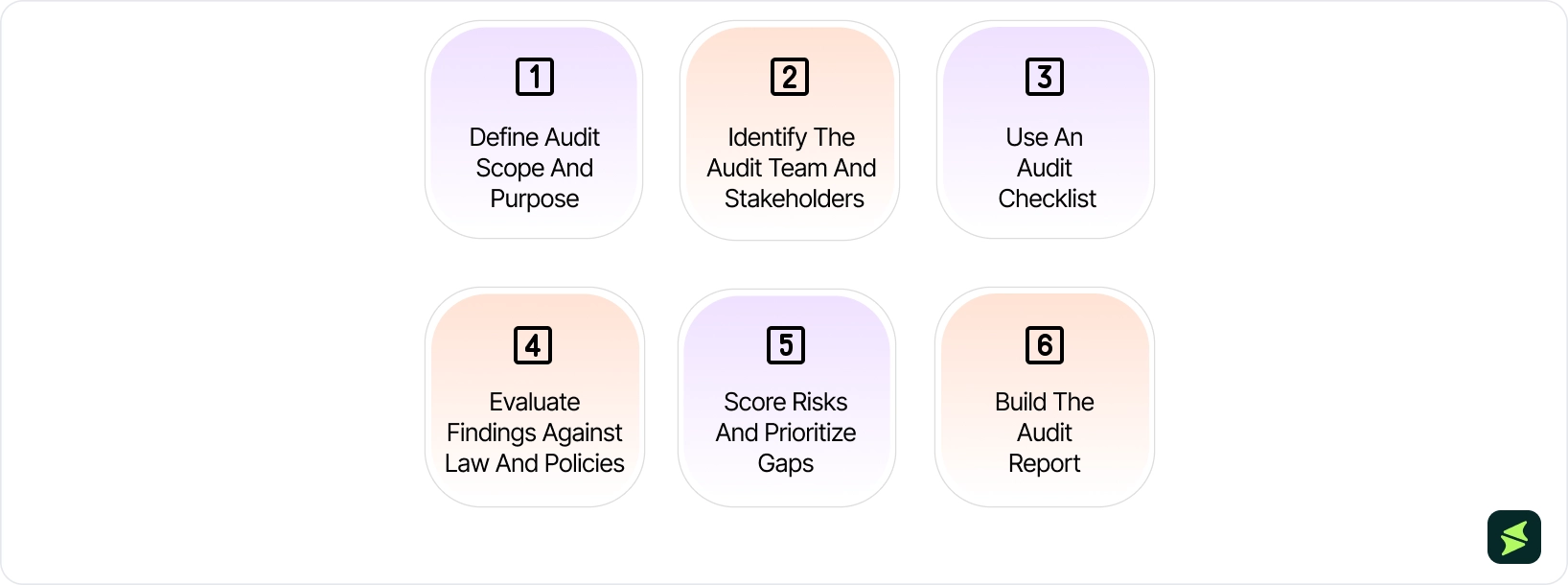
HR audits are widely recognized as important, but they are often difficult to execute. Teams may try to review too much at once, work with incomplete information, or struggle to act on what they find. The steps below are designed to make the process simpler.
Before reviewing any documents, the audit team needs to be clear on two things: what exactly are we auditing, and what’s the goal? A full HR audit looks at every area, while a targeted audit focuses on specific high-risk areas or recent issues. Trying to cover everything in detail at once is usually unrealistic, especially for teams without dedicated audit resources. Start by clearly defining the scope:
Who conducts the audit is just as important as what you’re auditing. If the same HR team reviews its own work, it’s easy to miss gaps; people rarely spot issues in processes they’re closely involved in. For internal audits, assign a lead (usually a senior HR generalist, HR director, or chief human resources officer (CHRO) and divide responsibilities based on expertise.
When you bring in an external auditor, the review is handled by a consultant or law firm. The biggest advantage is a fresh set of eyes. They’re more likely to spot gaps an internal team might miss and usually stay up to date with changing regulations. The tradeoff is cost, along with the time it takes for them to get familiar with how your organization works.
A practical middle ground is a hybrid approach; your internal team gathers the data, and an external expert reviews it and provides compliance insights. This often balances speed, cost, and objectivity.
Instead of building a tool from scratch, use a structured audit checklist to guide the process. HR tools can also help organize and streamline the audit process, while the checklist acts as your working document, helping you stay consistent, organized, and focused across each area being reviewed.
Try not to rely on a generic, one-size-fits-all checklist. It should reflect your company’s size, location, workforce, and industry. What works for a large manufacturing firm won’t always apply to a smaller service-based business.
With documentation in hand, the audit team evaluates each item against the applicable standard. This is the analytical core of the audit, comparing what exists against what should exist.
For compliance-related items, the benchmark is legal; does the practice meet requirements under laws like the Fair Labor Standards Act (FLSA), Family and Medical Leave Act (FMLA), and relevant state regulations? For operational items, the standard is more about how well things are working. This could mean following best practices, aligning with internal policies, or maintaining consistency.
Once the data is collected, the real work begins, making sense of it. Look for patterns, repeat issues, and areas where processes aren’t holding up. Go through your HR practices in detail and compare them with legal requirements and common best practices. This is where gaps, inconsistencies, and potential risks usually start to stand out.
The audit report is the formal deliverable of the process. It should be structured for two audiences: the HR team that will execute remediation plans, and leadership that needs to understand the organization's risk posture.
A well-structured HR audit report should be clear, focused, and easy for leadership to act on. It typically includes:
The audit itself only tells you what is wrong. The real value comes from fixing those issues. Many organizations do the hard part; they complete the audit, prepare the report, and share it with leadership, but then the findings lose momentum. Other priorities take over; deadlines slip, and the same risks remain unresolved months later.
That is why post-audit follow-through needs to be treated as part of the process, not something extra.
Even when companies do HR audits regularly, they often make similar mistakes. These mistakes can weaken the audit and leave bigger risks unresolved. Here are some of the most common ones and how to avoid them.
A lot of companies focus only on collecting documents and checking whether the files are complete. But having the right paperwork does not always mean the process is working properly in real life. Your policies may look fine on paper, but managers may not actually follow them. That gap often becomes clear only when a complaint or lawsuit happens.
What To Do Instead:
Do more than review documents. Include manager interviews, employee feedback, and a review of how things actually work in practice.
Policies alone do not create compliance. Managers are the ones who apply them every day. A company may have a strong written policy, but if managers handle complaints informally or inconsistently, the real risk is still there.
What To Do Instead:
Review how managers respond to issues, how they document actions, and whether they apply policies consistently across teams.
When employees work in different states, they may be covered by different employment laws. Many companies still treat everyone as if the same rules apply. This can create compliance issues around leave laws, pay requirements, training rules, and other state-specific obligations.
What To Do Instead:
Keep an updated list of where employees are working and review compliance requirements for each state, not just federal law.
A basic template can help you start, but it should not be used as-is without review. Generic templates may miss state laws, industry-specific rules, and risks unique to your workforce.
What To Do Instead:
Customize the checklist to fit your company’s size, locations, industry, and workforce structure.
Some companies mark an item as complete once the assigned action is done, but never go back to confirm whether the issue is truly resolved. Problems tend to resurface when corrective actions address the surface issue rather than the root cause.
What To Do Instead:
Schedule a follow-up review to confirm that corrective actions worked and the gap has actually been closed.
An HR audit is a way to catch issues early, before they turn into bigger problems. Most companies already have policies in place, but that doesn’t guarantee they’re being followed consistently. Risks tend to build over time—through outdated policies, inconsistent decisions, missed updates, or roles that no longer match how employees are classified.
An HR audit helps bring those issues to light while they can still be fixed. It gives organizations a chance to correct gaps before they turn into legal claims, compliance problems, or employee trust issues.
Organizations that treat HR audits as a regular part of how they operate, not just something they do when a problem appears, are usually better prepared, more consistent, and more trustworthy. That is not only good for compliance. It is also good for business.