
Article
HR Benchmarking: Complete Guide To Metrics, Process, And Future Trends (2026)
10 mins read
Last Updated


By Laiba Laeeq and


Article
10 mins read
Last Updated
By Laiba Laeeq and

Human Resources (HR) is no longer a peripheral function focused on administration. It plays a central role in shaping business outcomes, and workforce decisions are now among the most critical drivers for organizational performance.
To make those decisions effectively, leaders need structured, reliable people data. However, data alone is not enough. Without context, numbers lack meaning. Metrics only become valuable when they are interpreted against relevant benchmarks. HR benchmarking provides that context.
This guide covers what HR benchmarking is, key concepts, types of benchmarking, essential metrics, implementation steps, practical examples, and some common challenges to help organizations make more informed, data-driven HR decisions.
HR benchmarking is the process of comparing your organization's core HR metrics, either against your own historical data or against external industry standards, to evaluate how well your HR function is performing and identify where improvement is needed.
Benchmarks are comparative reference points that transform transactional human resource information system (HRIS) or payroll data and descriptive analytics into meaningful context; they reveal how you compare to others by providing a reference standard against which to measure performance. In practice, this means measuring things like employee turnover rate, time-to-hire, cost-per-hire, absenteeism, or engagement scores, and then asking whether those numbers are good or bad.
HR benchmarking can be approached from different angles, depending on where you’re looking for insight. At its core, it’s about comparing people’s practices to highlight gaps, validate decisions, and identify opportunities for improvement.
Broadly, these approaches fall into two main types, those that focus on insights within your organization and those that draw comparisons from outside. Understanding both provides a more complete view and sets the foundation for effective benchmarking.
Internal benchmarking uses available data to evaluate how different departments, teams, or groups within an organization perform relative to one another. It can also compare the same team's performance across different time periods, year-over-year, quarter-over-quarter, or pre- and post-intervention.
Internal benchmarking is your go-to when you want to track the impact of a specific HR initiative, identify which departments or managers are outperforming others, or build an organizational baseline before reaching outward for external comparisons.
External benchmarking provides valuable context by measuring your HR metrics against those of comparable organizations. It allows you to understand your position, identify emerging trends early, and establish performance goals that are both realistic and challenging.
This type of benchmarking is useful for understanding broader industry standards, identifying emerging trends, and setting realistic, data-backed goals. It also helps determine where additional resources are needed and where reductions can be made.
This type of benchmarking is typically the starting point for any benchmarking initiative. It focuses on quantitative output, comparing KPIs like training completion rates, performance review scores, or productivity metrics. This helps identify where gaps are before deciding which other type of benchmarking to pursue.
Other Types Of HR Benchmarking Worth Knowing
One of the most practical questions HR leaders face when starting a benchmarking initiative is a deceptively simple one: where do you get the numbers? The quality of your benchmarking is only as strong as the quality of your data and knowing which sources to trust and when each is appropriate makes a significant difference in whether your comparisons are meaningful or misleading. Benchmarking data generally flows from distinct source categories like:
Your own HRIS software is often the most reliable and immediately available source of benchmarking data. It provides historical records on headcount, turnover, time-to-hire, compensation, absenteeism, and performance. Internal data is especially valuable for establishing baselines, tracking trends over time, and running internal benchmarking across departments or business units. While it doesn’t provide external context on its own, it forms the foundation that all other comparisons depend on.
Organizations like SHRM, Mercer, Deloitte, and McKinsey, publish annual benchmarking studies covering everything from cost-per-hire and time-to-fill to HR-to-employee ratios and Learning and Development (L&D) spend. SHRM's 2025 benchmarking reports, for instance, span 88 individual data sets broken down by industry, sector, organization size, and region, covering areas such as (Chief Human Resources Officer) CHRO metrics, L&D, recruiting, and talent management.
National labor bureaus such as the U.S. Bureau of Labor Statistics, publish workforce data covering employment rates, voluntary separation rates, compensation levels, and occupational wage surveys by industry and geography. This data is particularly useful for compensation benchmarking and turnover context.

Modern HR platforms increasingly include built-in benchmarking capabilities. Tools like Workday, ADP DataCloud, and SAP SuccessFactors aggregate anonymized data across their user base to provide real-time or near-real-time benchmarks.
Many HR service providers, such as payroll processors, benefits providers, and recruitment agencies—offer benchmarking insights based on aggregated client data. For example, payroll providers can offer compensation benchmarks, while recruitment firms can provide data on hiring timelines and candidate availability. These sources are often overlooked but can be highly relevant because they reflect operational, real-world data tied directly to specific HR functions.
Choosing the right metrics is what determines whether benchmarking delivers clarity or just confusion. A more effective approach is to group metrics by function, focus on those aligned with your current business needs, and track them consistently over time.
Below are six core categories, along with what each measure and why they matter in your benchmarking framework.
Recruitment metrics measure how efficiently and effectively your organization identifies, attracts, and converts talent. These recruitment HR metrics include acceptance rate, cost per hire, workforce demographics, total headcount, new-hire turnover, time to hire, and time to productivity. This together, measures hiring efficiency, costs, retention, and how quickly new employees become fully productive.
Metric | What It Measures |
Time-to-Hire | Days from application to accepted offer |
Time-to-Fill | Days from job opening to filled position |
Cost-per-Hire | Total recruiting spend ÷ number of hires |
Offer Acceptance Rate | % of offers accepted by candidates |
Source of Hire | % of hires from each sourcing channel |
Quality of Hire | Post-hire performance rating within 12 months |
Track how well you hold onto the people you've already invested in. Retention metrics include employee satisfaction, overall customer retention rate, retention rate per manager, time since last promotion, talent turnover rate, total turnover rate, and voluntary turnover rate.
Metric | What It Measures |
Employee Retention Rate | Percentage of employees staying over a time period |
Total Turnover Rate | Percentage of employees leaving (voluntary + involuntary) |
Retention Rate per Manager | Retention performance across different managers |
Time Since Last Promotion | Average duration employees stay in the same role |
Compensation metrics help examine whether your pay structures are competitive enough to attract and retain top talent. In a market where talent competition remains high, rising cost-of-living pressures have made compensation a top concern for employees. According to a study, over 53% of workers expect salary adjustments to keep pace with inflation. This makes it increasingly important for HR departments to conduct compensation benchmarking more frequently, rather than treating it as an annual exercise.
Metric | What It Measures |
Salary Competitiveness Ratio (SCR) | How salaries compare to market median |
Pay Equity Ratio | Salary comparison across demographic groups |
Benefits as % of Total Compensation | Benefits cost relative to total pay |
Compensation as % of Revenue | Total labor costs relative to revenue |
These metrics capture the qualitative and quantitative dimensions of how employees feel about their work, engagement, satisfaction, wellbeing, and sense of belonging. Evaluating these metrics helps organizations identify early signs of disengagement, improve retention, and create a more productive and motivated workforce.
Metric | What It Measures |
Employee Engagement Score | Overall engagement from surveys |
Employee Satisfaction | Likelihood of recommending company as workplace |
Absenteeism Rate | Unplanned absence frequency |
Internal Mobility Rate | Employees moving across roles internally |
Performance and productivity metrics measure how effectively employees and teams translate effort into output, quality, and business results. These metrics focus on both the quantity and quality of work, as well as how efficiently resources are being used to achieve outcomes.
Metric | What It Measures |
Productivity Rate | Output efficiency vs time/resources |
Goal Achievement Rate | Employees meeting KPIs/OKRs |
Utilization Rate | Time spent on productive work |
Quality of Work | Errors or rework in output |
Project Completion Rate | Projects delivered on time |
Overtime Rate | Extra hours worked |
DEI metrics measure representation, inclusion, and pay equity across demographic groups. Benchmarking in this space helps identify structural gaps that might otherwise be obscured by aggregate data.
Metric | What It Measures |
Workforce Diversity Ratio | Representation across gender, ethnicity, etc. |
Gender Pay Gap | Pay difference between genders |
Leadership Diversity | Representation in leadership roles |
Inclusion Index Score | Employee perception of inclusiveness |
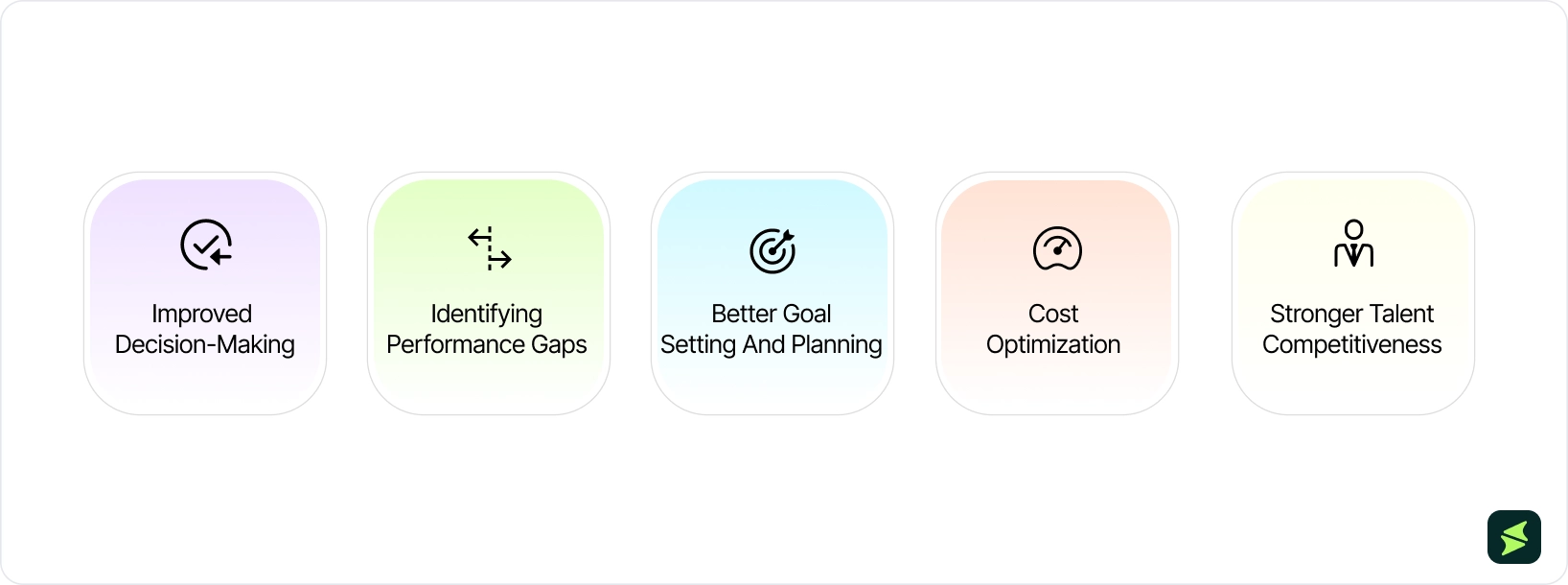
HR benchmarking is a practical way for organizations to make smarter, quicker, and more confident workforce decisions. When used regularly, it can create real, measurable impact across different areas of HR. Some major benefits include:
HR benchmarking can bring a lot of value, but it is also important to recognize that it comes with both direct and indirect costs that need to be planned for. Some main areas include:
When done well, though, benchmarking stops being just another expense. It becomes a smart investment that helps organizations make better decisions and use their resources more effectively.
Benchmarking only delivers value when it follows an intentional, well-defined process. Below is a step-by-step breakdown of how to conduct effective HR benchmarking in a clear and actionable way:
Before touching a single metric, be explicit about what problem you're trying to solve or what question you're trying to answer. Are you trying to reduce voluntary turnover in a specific business unit?
Are you trying to understand why your time-to-fill is running longer than the industry average? Or are you evaluating whether your HR team is appropriately resourced for your organization's size? The sharper your objective, the more focused and actionable your benchmarking will be.
Once your objective is clear, choose only the metrics that directly measure progress toward it. Prioritize metrics where you already have reliable, consistent data collection in place. A metric you can measure accurately and repeatedly will always be more useful than a theoretically superior metric you can't track well.
Decide which reference points you'll compare your metrics against and be deliberate about the source for each. Internal sources, your HRIS historical dashboards, year-over-year reports, and department-level breakdowns can be your starting point.
External sources might include SHRM's published benchmarking reports, government labor statistics, compensation databases, or built-in benchmarking features within your HRIS platform. The key discipline here is matching your benchmark source to your comparison goal.
Inconsistent data definitions are one of the most common reasons benchmarking efforts produce misleading conclusions. Before comparing your numbers to any external standard, audit how your metrics are being calculated across systems and teams.
Run a basic data quality check: look for missing values, duplicate records, and unusually large outliers that might signal a data entry error rather than a real pattern. The goal at this stage isn't perfection; it's confidence that your internal data is clean enough to support a meaningful comparison.
The goal here isn't to find every place where you fall short; it's to understand why a gap exists before deciding whether it requires action. Distinguish between the gaps before moving to action. A gap that reflects a conscious strategic choice is very different from one that reflects a process breakdown.
Benchmarking analysis that doesn't result in a specific, owned action plan is just an expensive reporting exercise. Each meaningful gap you identify should translate into a concrete initiative with a clear owner, defined success criteria, and a realistic timeline.
Don’t try to tackle every gap at once. Use the priorities you identified in the analyzing the gaps stage to decide what comes first and plan your initiatives in a sequence that matches your team’s capacity and your organization’s ability to handle change. One thoroughly executed retention effort will create a measurably greater impact than several that are only partially complete.
Once you've implemented the action plan, set a regular cadence to re-measure your metrics and compare them against the same benchmarks. Quarterly reviews work well for fast-moving metrics like time-to-fill or survey participation rates. Bi-annual reviews are more appropriate for slower-moving metrics like compensation competitiveness or HR cost ratios.
Benchmarking may appear structured and straightforward in theory, but it can encounter resistance at nearly every step, from data collection to how insights are interpreted and accepted internally. While anticipating these challenges won’t eliminate them, it equips HR teams to build a more resilient and effective benchmarking approach that can navigate and endure these obstacles. Some challenges include:
Even with a solid benchmarking framework in place, many organizations find it difficult to keep the process going over time. Issues like misalignment between teams, low data maturity, and cultural resistance tend to get in the way. Common barriers include:
The way organizations benchmark their HR performance is evolving rapidly, driven by advances in HR technology, analytics, and data availability. The shift from annual static reports to continuous, AI-assisted measurement isn't just a technology upgrade; it's a fundamental rethinking of how benchmarking fits into the HR operating model. Here's what's shaping the next phase of practice:
A significant shift is the rise of AI-powered benchmarking. AI is gradually transforming benchmarking from static reporting to pattern-driven insights, though adoption across HR remains uneven. Most organizations are still in early-stage experimentation, particularly in employee relations and investigations, and only a small percentage have reached maturity. Organizations with clear, structured processes are about twice as likely to succeed, showing that being prepared matters just as much as the technology itself.
At the same time, data maturity is becoming a practical advantage in HR benchmarking. HR analytics show that organizations with standardized KPIs and well-structured data are better able to identify patterns, diagnose issues, and act on insights quickly. As a result, effective benchmarking is increasingly shifting toward a smaller set of well-defined, high-quality metrics rather than large volumes of inconsistent data.
Another emerging trend is the integration of benchmarking into real-time decision-making systems. Instead of quarterly or annual reviews, benchmarking insights are increasingly embedded into dashboards and workflows, allowing HR leaders to act immediately
In practical terms, HR benchmarking is becoming faster, smarter, and more strategic. Organizations that invest in clean data, AI-driven insights, and experience-focused metrics move from simply measuring HR performance to actively shaping it.
HR benchmarking is one of the clearest ways for HR to show it is operating strategically rather than simply reacting. It helps answer a fundamental question for leadership: are our HR practices working, and how do we know?
By comparing internal metrics with past trends and external benchmarks, organizations gain the clarity needed to spot gaps, focus on the right priorities, and make a stronger case for people's investments.
However, its impact depends on how consistently it is applied. The most effective organizations treat benchmarking as an ongoing discipline, they standardize data, act on insights, and regularly review results to ensure real progress.
If you’re starting out, focus on a few key metrics aligned with your most urgent business goals and build from there.