Article
Human Resource Planning: A Complete Guide For Modern Organizations
10 mins read
Last Updated

Writer


Article
10 mins read
Last Updated
Writer

Absence of effective HR planning can lead to costly errors, including skill gaps, unexpected employee turnover, and operational disruptions that hinder productivity and business growth. Human resource (HR) planning ensures that the right people are available at the right time. It involves evaluating current roles, anticipating future workforce needs, and identifying required skills to sustain productivity, manage costs, and support long-term organizational stability.
Modern businesses use proactive HR planning and human resources software to keep teams productive while controlling expenses. In this guide, we'll explore what human resource planning is, why it matters, and how organizations put it into practice.
Human resource planning is a forward-looking process that assists organizations in making sure that their employees are compatible with both current and future business needs. It’s about evaluating available skills and predicting changes in demand. In addition, it involves planning workforce development, reskilling, and role adjustments to support strategic organizational objectives.
When done correctly, HR planning induces clarity while bettering staffing decisions, while increasing the productivity of existing talent. It also keeps staffing costs predictable while improving the project's execution. Moreover, it strengthens the link between workforce decisions and overall business targets. Businesses that take a proactive approach can better respond to growth or change while maximizing team performance.
Without HR planning, businesses face significant operational and financial risks. Critical roles may remain unfilled, projects can be delayed, and skill gaps may create bottlenecks that slow growth. Overstaffing, unexpected turnover, or misaligned skills not only increase labor costs but also place added pressure on teams, leading to higher burnout and attrition.
Organizations that neglect regular workforce planning often find themselves reacting under pressure—rushing to fill roles or reassign employees at the last minute. In contrast, businesses that anticipate workforce needs in advance avoid costly emergencies, keep projects on track, and make more informed decisions around hiring, reskilling, and role adjustments.
The contrast is clear: organizations with strong HR planning are able to handle change with confidence, whereas those without it are constantly facing challenges, which affect growth alongside performance.
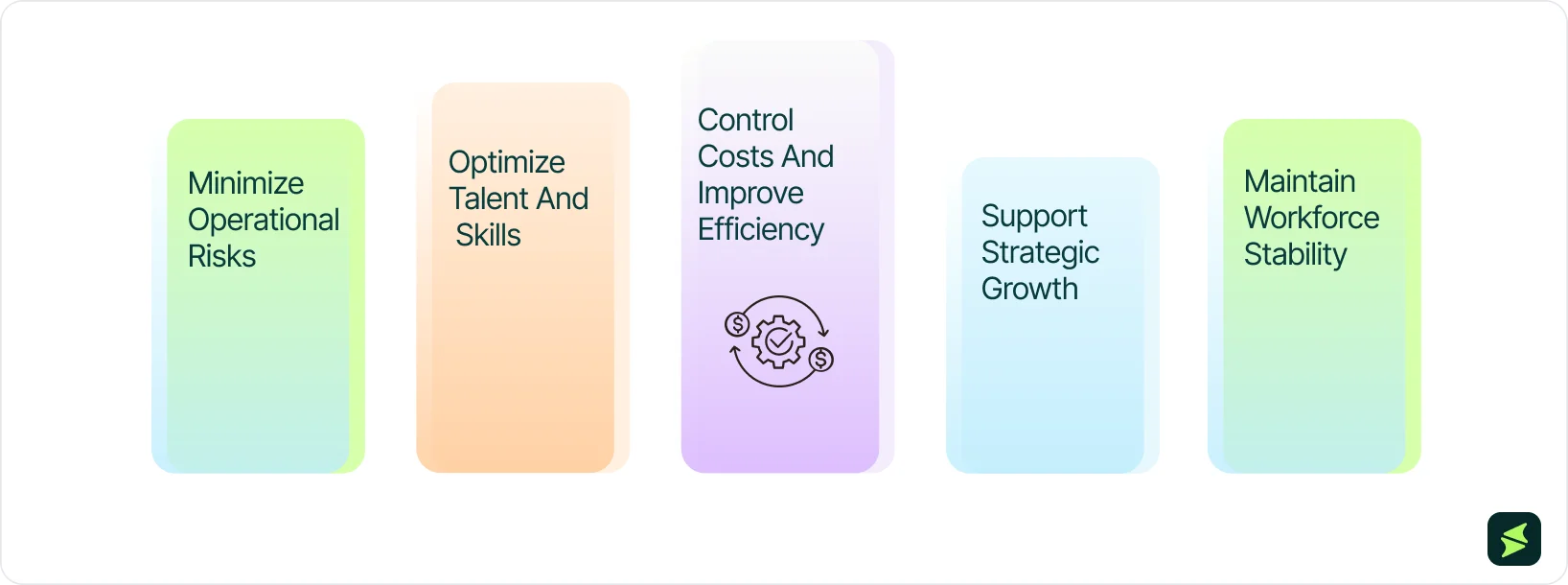
Human resource planning is structured around key components that guide workforce decisions and manage staffing risks. Each part tackles a task that keeps teams productive and in line with business priorities.
This factor looks into reviewing and understanding the current workforce, including roles, skills, performance levels, and capacity. This highlights underutilized talent and critical skill gaps. In case such issues are not addressed, then important projects may get delayed.
Demand forecasting focuses on predicting future workforce requirements based on new business projects, market changes, or operational shifts. What poor demand estimates create is rushed hiring, overstaffing and delivery delays.
Supply forecasting assesses how workforce availability changes over time, taking into account different factors, like turnover, retirements, internal promotions, and resignations. Weak supply visibility increases the risk of sudden shortages or team overload.
Future demand to project supply can be compared to determine where hiring, reskilling, or redeployment is necessary. This keeps workforce capacity in line with business goals and reduces the chances of critical role gaps.
Construct calculated strategies that can find gaps. This includes role-specific hiring, scheduling reskilling programs, or redesigning responsibilities. The ongoing review of these plans promotes workforce readiness with changing priorities.
Together, these components shift HR from reactive problem-solving to proactive workforce management. As a result, there are fewer staffing issues, and teams perform more effectively.
Human resource planning is a structured process that helps companies move from business goals to clear workforce decisions. Every organization does it its own way. Still, this process gives them a real plan. It essentially helps stay organized while staying flexible when things get somewhat chaotic.
Human resource planning begins with understanding where the organization is heading. Growth strategies, new markets, operational changes, and cost-control objectives all have an impact on future workforce requirements. Without this context, people’s decisions risk being misaligned with business priorities.
The next step is to review the current workforce, including headcount, roles, skills, performance levels, and capacity. This allows organizations to see what talent is currently available and how effectively it is being used.
Demand forecasting seeks to estimate the number and type of employees required in the future. These projections are influenced by expected workloads, expansion plans, technology advances, and productivity targets.
Supply forecasting looks at how the workforce is likely to change over time. Employee turnover, retirements, internal promotions, and planned exits are all considered when assessing future availability.
At this stage, organizations compare future demand to expected supply. This gap analysis identifies potential shortages, skill mismatches, or surplus roles that could have an impact on operations if not timely addressed.
Organizations plan specific actions based on identified gaps, such as targeted hiring, employee development, role redesign, or workforce restructuring.
Human resource planning is a continuous process. Organizations review workforce outcomes on a regular basis to monitor changes in business conditions. The output data can help them modify their strategies, all whilst adhering to the ever-changing goals.
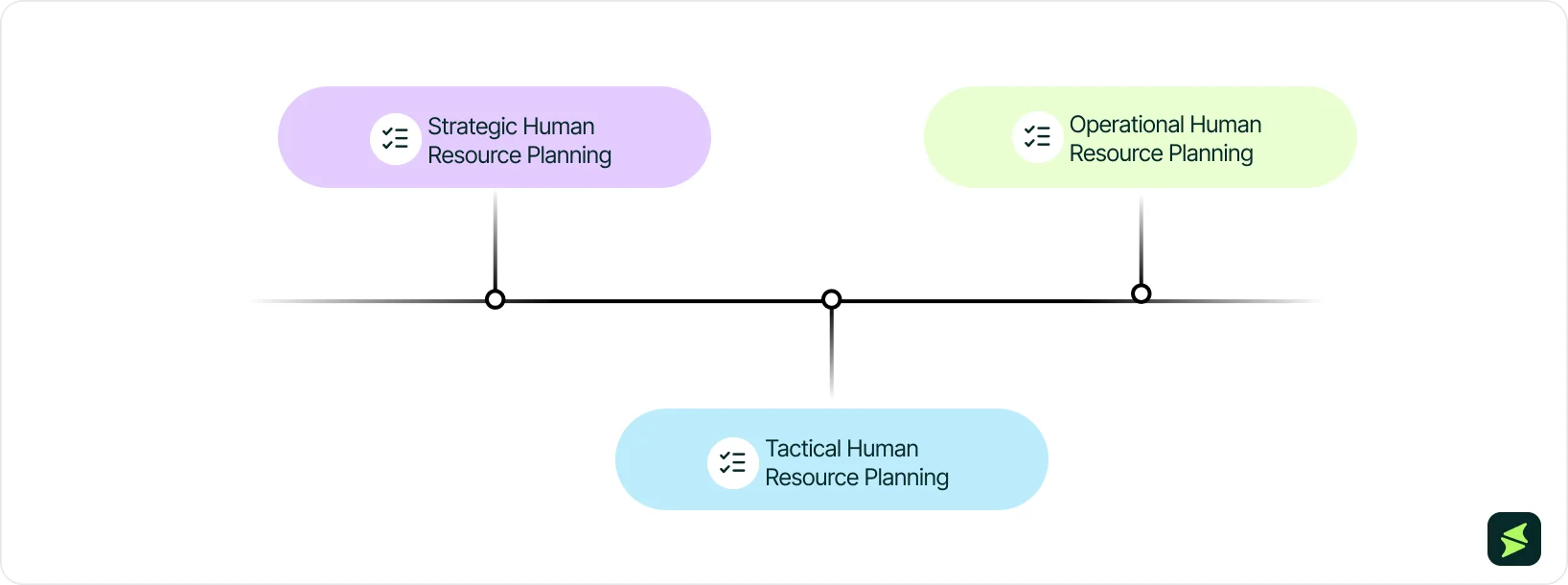
HR planning is not a one-size-fits-all activity. Companies use different types of HR planning depending on their size, business maturity, and time frame. Each type focuses on a specific level of decision-making, which allows businesses to manage long-term strategy, mid-term execution, and short-term workforce requirements in a coordinated manner.
Strategic human resource planning promotes long-term workforce alignment with business strategy. It assists in decisions concerning expansion, entry into new markets, major operational changes, and future skill requirements. At this level, organizations plan leadership pipelines, anticipate critical skill gaps, and verify that talent availability is in line with the company's long-term objectives.
Tactical human resource planning converts long-term strategy into medium-term workforce actions. It is typically used for annual or multi-quarter planning cycles and includes department-level hiring plans, training programs, role changes, and workforce budgeting. This way, a team is sure that they have the right tools and enough hands on deck to actually hit the next big milestones without burning out.
Operational human resource planning addresses short-term and daily workforce needs. It prioritizes scheduling, role coverage, workload distribution, and meeting immediate staffing requirements. This type of planning maintains continuity in daily operations and ensures that short-term workforce decisions support tactical and strategic plans rather than operating independently.

Effective human resource planning adds measurable business value. It does so with an action-driven roadmap alongside the predictability of workforce decisions. Instead of reacting to hiring pressures, organizations should plan to gain a better understanding of costs, talent deployment, and operational risk.
Stronger Cost Control And Efficacy
With the help of HR planning, organizations can forecast workforce requirements using actual demand instead of projections. This reduces overhiring, limits last-minute recruitment costs, and facilitates accurate management of training and development budgets. Over time, predictable staffing decisions lead to consistent labor costs and fewer financial surprises.
Better Utilization Of Existing Talent
By matching current skills to future role requirements, organizations can make better use of their existing talent. Human resource planning also identifies any chances for reskilling, internal mobility, and role realignment. This eliminates unnecessary external hiring and shortens the time required to fill critical roles.
Reduced Hiring And Workforce-Related Risks
Getting ahead of the curve means identifying talent gaps or missing skills before they disrupt day-to-day operations. It helps organizations avoid panic hiring or relying on short-term fixes that often compromise quality. Proactive planning also makes transitions smoother as teams grow or employees move on.
Clear Alignment With Business Priorities
When workforce decisions are consistent with business objectives, hiring and development efforts directly support operational goals. In turn, this kind of alignment helps leaders in making informed decisions about growth, cost control, and workforce stability, rather than reacting to problems that short-term staffing might encounter.
Keeping things consistent with HR planning is difficult when the market keeps shifting. Most companies know they need it, but actually making it work on the ground is where things usually fall apart.
Limited Or Inaccurate Data
It’s hard to map out future needs when the data on roles and skills is out of date. Guessing based on wrong information means that HR will likely end up with too many people on payroll or a team that lacks the right skills.
Resistance To Change
At times, employees, managers, or entire departments may be hesitant to adopt new workforce planning strategies, such as restructuring or role changes. This resistance can slow implementation and reduce the overall effectiveness of HR planning initiatives.
Rapid Business And Market Changes
Unexpected growth, technology adoption, or shifts in demand can make previously developed workforce forecasts outdated. Organizations may struggle to adapt quickly, which can result in affected operations or delayed projects.
Challenges In Forecasting Of The Skills
Estimating what the future staffing truly needs can be quite hard. This happens when roles change with new technologies and business strategies. Poor forecasting puts companies at risk of having unprepared teams or underutilized talent.
Resource And Time Constraints
Collecting detailed workforce data, coordinating across departments, and maintaining forecasts can be costly and time-consuming. Smaller organizations, in particular, may struggle with dedicating the necessary HR resources for regular future planning.

Human resource planning today looks very different from how it was done in traditional office-based settings. Organizations gravitating towards work-from-home approaches necessitate workforce planning. This should focus on where employees work, how teams collaborate, and how roles function across locations. Forget just filling empty desks. In fact, planning is also about structuring work in a way that allows for flexibility without impacting productivity.
Skilled-Based Planning
Modern organizations primarily focus on skills over job titles. As roles change and business needs evolve, HR teams need to have clear visibility into both current and future skills. This allows for better decisions about training, reskilling, and internal mobility without relying on outside help.
Data-Driven Decision Making
HR planning is becoming more data-driven, with HRIS software solutions helping teams access insights from performance metrics, turnover trends, and workforce availability. Organizations shouldn’t depend on old data. By looking ahead, they can actually get a jump on staffing needs and tweak their teams before the market shifts.
Sync With HR Systems
While planning is not about promoting tools, a limited use of HR technology can improve forecasting, reporting, and workforce insights. Tools for tracking employee skills, performance, and availability facilitate faster, more accurate decisions while maintaining a human-centered approach to workforce management.
Modern HR planning emphasizes that workforce decisions are in line with business priorities, responsive to change, and adaptable to flexible work environments.
Human resource planning looks different for each organization, but real-world examples show how it connects workforce decisions to business strategy and outcomes.
Google’s HR teams use data-driven workforce planning. This helps in the review of employee performance trends as well as skill data. In turn, the company maintains leadership in competitive talent markets, all while forecasting future talent needs.
Procter And Gamble (P&G)
P&G combines HR planning with long-term talent development. P&G creates a reliable pipeline of skilled workers and leaders by identifying high-potential employees early on and providing structured growth and learning opportunities to support current needs and future roles.
Walmart
For large, diverse workforces like Walmart, workforce planning is essential for balancing staffing levels within its retail network. The company uses trend analysis and bottom-up forecasting to estimate demand for various roles and adjust hiring and scheduling in advance, especially around peak periods such as holidays.
Unilever
Another example is Unilever, where HR planning is integrated into larger strategic human resources (HR) processes. Unilever carefully plans staffing levels and skill development so that people are matched with business priorities. Recruitment, training, and workforce decisions correspond with corporate goals and long-term growth plans.
These examples show that effective human resources planning is both strategic and practical, which allows organizations to align talent with business needs. It also helps them plan for growth as well as adjust to ever-changing workforce demands.

Starting with human resource planning does not require a perfect long-term strategy from the start. A good first step is to start small and align with leadership and business goals, so the HR planning supports where the company is heading. Understanding priorities such as growth targets, new product launches, and operational changes gives HR planning a clear direction from the beginning.
Assess Your Current Workforce
Begin by reviewing existing workforce data. Take into account the headcount, role distribution, skill sets, and performance/turnover trends. This baseline shows what the company currently has and highlights areas for development or potential pressure points.
Set Priorities And Small Initiatives
Focus on areas where HR planning can have an immediate impact, such as critical roles, high turnover positions, or upcoming projects. Small initiatives can help streamline HR processes while giving HR teams room to learn, adjust, and scale planning over time.
Adopt Continuous Review
Treat HR planning as a continuous engagement rather than a one-time project. Regularly revisit workforce insights and leadership objectives to ensure that plans evolve in response to business conditions. As a result, organizations remain both responsive and agile.
Even modest planning sharpens hiring decisions, reduces workforce risks, and ensures employees are in the right roles at the right times. Starting small and iterating provides a solid foundation for long-term, effective human resource planning.