


Contract lifecycle management (CLM) exists to prevent agreements from becoming difficult to find or enforce. When contracts are not managed properly, organizations may face disputes such as disagreements over contract terms, breach of contract claims, and the loss of enforceable rights.
A signed contract doesn’t end at execution; it starts a series of ongoing responsibilities. Payments come due, work is delivered – all while renewal dates are sneaking up when no one is paying close attention. Along the way, performance issues and changes need to be noted in real-time. When these details aren’t tracked, it becomes difficult to confirm what was agreed to or whether commitments were met or not.
This is exactly where contract lifecycle management comes into play. It brings structure and accountability to the entire process while ensuring that the contracts remain clear and enforceable from start to finish.
Legal contract lifecycle management (CLM) refers to each stage of the life of a legal contract, from preparation, negotiations, and execution through compliance and final liquidation. It brings structure to contracts for control and visibility throughout their lifecycle, while ensuring compliance with applicable laws and organizational policies.
Organizations looking to implement this structure operationally often turn to dedicated contract lifecycle management software, which centralizes all agreement stages — from drafting and negotiation through obligation tracking and renewal — on a single platform.
Contracts are both critical to a business and notoriously difficult to manage well. Yet many organizations still handle it in a disorganized manner. The table given below provides a glance at the specific problems that arise because of that, how they manifest in real-world operations, and the factual financial and regulatory consequences organizations face.
The Problem | What It Looks Like In Practice | The Real Cost |
Lost Contracts And Zero Visibility | Contracts scattered across email threads, shared drives, and filing cabinets. No one knows where agreements are or what's in them |
|
Legal Bottlenecks | Legal teams must review every contract—even routine NDAs and standard vendor agreements. Simple contracts get the same scrutiny as complex deals, creating massive backlogs and delays |
|
Compliance Blind Spots | Obligations buried in PDFs across the organization. No tracking of deliverables, deadlines, or performance requirements |
|
Reinventing The Wheel | Each contract created from scratch or copy-pasted. No standardized templates or approved language library |
|
Version Control Chaos | Multiple stakeholders editing different versions via email. "Contract_final_FINAL_v3_revised.docx" everywhere |
|
Costly Contract Disputes | Disagreements escalate because no one can find the authoritative version. Legal teams reconstruct terms from email threads and memory |
|
Incomprehensible Contract Language | Overly complex contracts that companies or lawyers sometimes use can slow negotiations, frustrate customers, and create internal confusion |
|
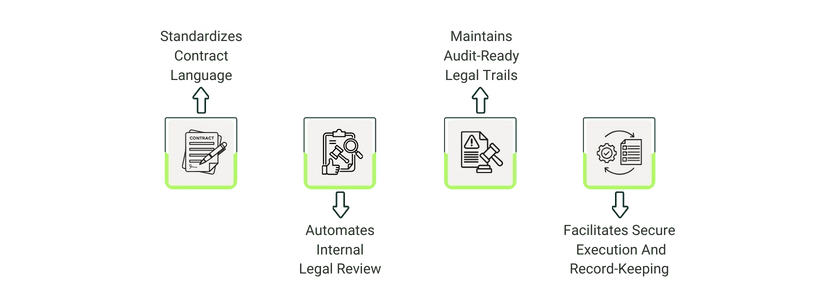
Organizations can gain numerous advantages from CLM that extend far beyond solving immediate pain points. Based on what we've observed, here are the most significant benefits you'll experience:
- Win Disputes With Accessible Proof: Courts can only enforce what can be proven. CLM ensures the actual signed version exists and is accessible
- Defend Against False Claims With Clear Records: Proper version control establishes a definitive record when counterparties deny agreed terms or signatures
- Prove Breaches With Documented Performance: Courts require evidence that a violation occurred and when it was first identified. CLM provides timestamped documentation of performance against contract terms
- Institutional Memory That Survives Turnover: When any employees leave, their knowledge of contract terms and verbal agreements leaves with them. CLM contains all that knowledge systematically
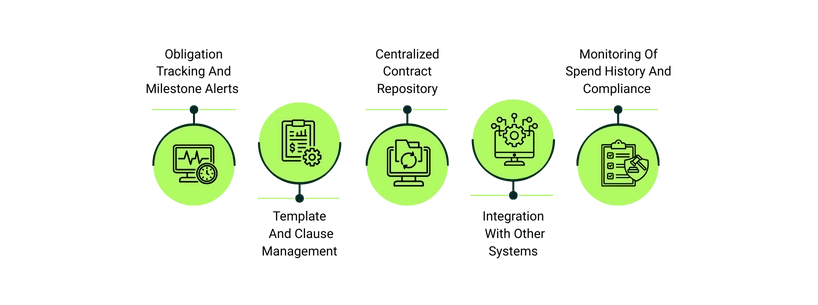
To provide a clear understanding of the contract lifecycle, all its stages are discussed below, along with the issues that can arise within them:
Stage 1: Drafting
Drafting is the initial creation of contract terms, obligations, and protections. Contract requests route to the organization's contracts team - typically legal, procurement, or a dedicated contracts division.
They look at what's being requested and decide whether to choose a template vs. a custom draft. Standard contracts (Employee Offer Letters, NDAs for vendors) typically use templates when speed and consistency are priorities, teams working without dedicated tools can explore free legal document drafting software to build and maintain these templates efficiently.
Common Bottlenecks:
- No approved template library accessible to business teams
- Outdated clauses in existing templates creating compliance risk
- Unclear business requirements from requesting departments
- Multiple teams using different template versions
Stage 2: Negotiation
The draft goes to the other party. Their legal team (or principals, if smaller) reviews it and sends back proposed changes. The organization's legal team then evaluates these changes and can accept the contract if the terms align with business requirements.
If some agreements cross a business's red lines, they can reject them outright. But there is a smart way to handle such situations. One approach is to use the alternative language. For instance, if the other party requests unlimited liability, it can be countered with a higher cap, but not unlimited. Similarly, if a five-year term is proposed, a three-year term with an option to extend can be suggested as well. This iterative process continues until both parties reach acceptable terms.
Stage 3: Internal Review And Approval
Once the negotiation settles the terms, the contract requires internal approval based on deal size and type before execution.
Usually, smaller contracts with minimal amounts only need the department head and legal to sign off. Larger contracts trigger additional reviews. For example, it has to go through finance checks to see whether the budget actually exists for this commitment. Sometimes the CFO handles this kind of contract or if the deal carries unusual risk, it lands in the CEO's hands for final approval.
Stage 4: Execution
After internal approvals, both parties sign the contract using the standard execution method, which may be DocuSign, Adobe Sign, or wet signatures for certain contract types. As soon as you get the counterparty signatures, the contract becomes legally binding.
Execution Compliance Warning:
Certain contract types require specific signing authority to be legally enforceable. Most corporate contracts require that authorized officers sign as part of the execution process. According to California Corporations Code Section 313, valid corporate signatures must include two officers, one from the operational group (Chairman, President, or Vice President) and one from the financial group (Secretary, CFO, or Assistant Treasurer).
Real estate leases, banking agreements, and government contracts usually need corporate officer signatures (CEO, CFO) or a board resolution. If you do not have appropriate authorization for an individual to sign a contract, then the contract will be invalidated.
Stage 5: Obligation Management
The contract contains specific obligations that both parties must meet. They are usually deliverable deadlines, payment schedules, insurance certificate submissions, performance guarantees, compliance audits, and data security requirements. Someone needs to track these to ensure all obligations are met on time.
For Example: It’s common for software and vendor agreements to include obligations in a contract such as requiring the vendor to provide an annual SOC 2 Type II audit report within a set period after the fiscal year-end and for the client to maintain a specified level of cyber liability insurance (often in the $1 million - $5 million range depending on the parties’ negotiation).
What should happen is that legal reviews the signed agreement, identifies these obligations, and assigns clear ownership - vendor management gets responsibility for tracking the SOC 2 submission, risk management handles the insurance requirement. Both teams calendar the deadlines and verify compliance before they're due.
What actually happens without legal CLM is that there is nobody who is responsible for systematically extracting the obligation. The SOC 2 requirement is never tracked or followed up. The insurance policy lapses in year two. An audit catches the noncompliance. The material breach clause triggers. The vendor terminates.
Stage 6: Renewal Or Termination
Most B2B contracts have auto-renewal clauses that require 30, 60, or 90 days' written notice if you want to cancel. Someone on the team needs to put these dates on the calendar and make a renewal decision early enough to either send the termination notice or negotiate better terms for the next contract period.
Financial Impact Of Missed Renewals:
Research reveals the true cost of poor renewal management:
- Companies With $50M Revenue: Potential $4.5 million annual loss from missed renewals
- Auto-Renewal Price Increases: Typically, 5% annually when renewals occur without negotiation
- Average Time To Renew Contracts: 97 days - nearly 3 times longer than initial approval
Stage 7: Amendment
Businesses needs can change during a contract’s life cycle; services may be added or removed, volumes increased, terms modified, or pricing changed. In order to facilitate these changes, both parties must amend their respective agreements by creating a formal written amendment signed by both parties using the same approval process as the original agreement.
Amendment Vs. New Contract Decision Logic:
- Use Amendment When: Modifications of an existing contract (i.e., changes to pricing, volumes, durations, etc.) or when additional or fewer services need to be added or deleted. Or to clarify any ambiguous wording contained in the original contract
- Require New Contract When: Whenever the scope fundamentally changes beyond the original intent, or when a different legal entity enters into the new, modified agreement. Especially when changes are so extensive that they can change your business relationship
Stage 8: Closeout
At the end of the contract, there are some final duties that must be completed. First is paying any outstanding invoices; second is ending services; third is returning or destroying proprietary data; and lastly assisting with the transition if specified in the contract. Finally, it is also important to confirm any post-termination obligations that still apply, such as ongoing confidentiality obligations.
Closeout Failures:
- Ongoing confidentiality obligations forgotten after the contract ends
- Data not properly deleted, creating GDPR or regulatory violations
- Post-termination disputes arise with no accessible contract record
- Vendor continues billing after termination due to poor communication
AI is now becoming a part of our lives. First, it became a trend; now we need AI to run our businesses. It is always okay to take help, even in managing your legal contract lifecycle, but there should be human oversight. Because AI can misinterpret contract language or miss contextual nuances.
When it comes to the numbers, many procurement professionals are already using AI to enhance their workflow. As per the Ironclad study, 73% of procurement professionals report that they're already using AI for procurement use cases.
That means the majority of your competitors can draft contracts faster, identify risks earlier, and manage obligations more systematically.
Entrepreneurs know the ideal business runs through automation. As noted by Jack Newton, CEO of Clio:
"Legal is outpacing other industries when it comes to adopting AI; whether it is document drafting, client communications, or legal research, we are seeing lawyers realize the value of AI in a concrete way, further reaffirming that if you don't embrace AI, you're at a fundamental, competitive disadvantage."
That is the reason companies are now using legal contract management software to handle the entire contract lifecycle, which we have discussed in the previous section. In fact, the Global Contract Lifecycle Management Software Market was projected to exceed 1.62 billion USD by 2024 and increase to 3.24 billion USD by 2030, demonstrating a compound annual growth rate of 12.7% from 2025 to 2030.
The industry will continue to grow, and businesses need to grow with it by adopting competitive software.
You now understand what contract lifecycle management is, why it exists, and what happens when contracts aren't properly managed. Before you start evaluating CLM software, we would suggest that you identify your specific contract problems because different issues need different solutions.
If your company's contract volume is high, you might need a system with automation and AI capabilities. But if your company’s contract volume is low, you might prefer an affordable solution with simple templates and centralized storage.
By understanding the legal and business needs, the chosen software is more likely to address them effectively.
Many businesses often confuse CLM platforms with full legal workspaces, but there are key differences in functionality—this breakdown of CLM vs legal workspace explains it clearly.
To make that evaluation easier, explore our curated guide to the best legal contract management software, where we compare top-rated platforms by features, pricing, and use case fit so you can shortlist with confidence.
To help you get started, explore our curated list of top legal software that covers a range of tools suited for different firm sizes and practice areas.