



Investing in a Learning Management System (LMS) can streamline training delivery, reduce administrative time, and improve workforce performance through measurable efficiency gains. Yet, when the time comes to assess its effectiveness, are you equipped with the data to demonstrate the impact? Measuring LMS ROI helps clearly show how learning initiatives align with, and contribute to business objectives, whether through increased productivity, reduced errors, or enhanced skills development.
To evaluate the financial and operational return accurately, it is first important to understand what LMS ROI represents and how it is calculated.
LMS ROI involves calculating the financial return your organization gains as compared to the expense incurred to install and sustain the LMS. This measures how the platform reduces training costs, improves productivity, and streamlines learning operations in ways that generate measurable financial value.
Tangible outcomes include savings from replacing instructor-led sessions and shortening onboarding time, as these can be directly linked to monetary impact. Morale and knowledge retention improvements achieved from the system are intangible impacts that should not be included when calculating LMS ROI. Collectively, these explain the different aspects of the advancement an LMS supports without confusing financial return with cultural benefits.
Assessing LMS ROI helps organizations understand how training performance translates into measurable business outcomes. For L&D teams, ROI analytics become the link between training activities and operational results that can be measured.
- Justify training budget allocations with measurable outcome data
- Determine which learning programs result in the highest performance impact
- Align learning outcomes with KPIs such as productivity, quality, and compliance
- Improve the content, training methods, and overall training spend
By framing ROI in these terms, leadership can understand that the LMS is not a cost, but an enabler of efficiency, enhanced workforce capability, skills development, and long-term workforce readiness.
The simplest formula is:
ROI = (Benefits - Costs) / Costs x 100
In your organization, the first step to calculating LMS ROI is to identify all the potential costs, which can include, but are not limited to, the following items:
- Licenses and subscriptions
- Initial implementation and configuration
- Integration with HR or payroll and other systems
- Creation and transfer of existing content
- Time spent by administrators and trainers
- Support and maintenance
After that, the next step is to quantify the measurable benefits your LMS generates. The following items can provide a great starting point:
- Time saved through self-paced or automated learning
- Reduced travel, classroom, or instructor-led training expenses
- Faster onboarding and reduced time-to-productivity
- Fewer compliance violations or operational errors
- Lower turnover due to improved training experience
An LMS ROI calculator is a valuable tool that many organizations use to simplify financial analysis. Estimating the learning programs' financial return is possible by inputting costs, level of user participation, completion rates, and performance improvements linked to training outcomes.
For example, when your LMS saves you $40,000 in instructor cost and costs you $20,000 to run, your ROI will be 100 percent.
The first step towards improving ROI would be to tie learning objectives to the actual business objectives. Focus on performance outcomes rather than simply tracking course completion rates.
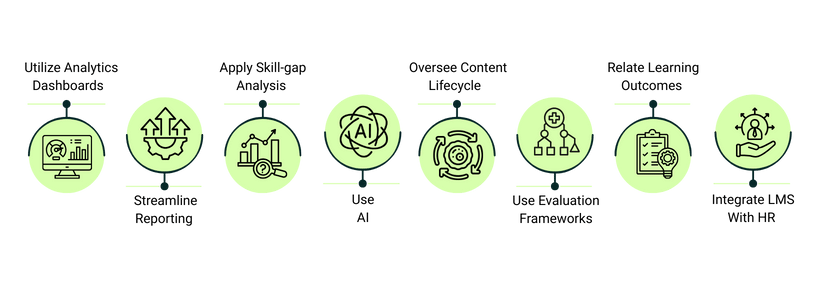
- Utilize analytics dashboards to track skill development and productivity
- Streamline reporting to improve accuracy and cut back on admin time
- Apply skill-gap analysis to identify high-impact learning needs that directly influence operational performance.
- Use AI to customize learning pathways to increase engagement and retention
- Oversee the full content lifecycle to ensure relevancy and focus on performance
- Use evaluation frameworks such as Kirkpatrick or the Phillips ROI Methodology to measure learning effectiveness and financial impact
- Relate learning outcomes to financial indicators like cost savings or time deduction
- Integrate your LMS with HR or performance systems for better data synergy
The more your LMS is related to organizational objectives, the greater your payoff will be.

Measuring LMS ROI includes more than just analyzing the financial implications; quantifying and qualifying the impact of training on productivity, employee engagement, and sustained growth of the organization is necessary. LMS ROI calculators along with tracking both quantitative and qualitative outcomes help HR and L&D illustrate the value of training programs to key stakeholders by converting training data into actionable insights.
When organizations correctly align and optimize LMS ROI, training transforms from a support activity to a measurable input of organizational performance. This is in conjunction with business performance, supporting strategic workforce planning and long-term organizational development.