


Buying enterprise software has become a high-stakes, high-effort process for modern organizations. Evaluating tools across HR, LMS, and EHR categories often requires balancing competing priorities, stakeholders, and long-term business needs. To better understand this experience, a survey of 502 U.S. software buyers examined the time, friction, and emotional toll behind these decisions. The findings highlight a growing challenge for businesses: software selection is no longer just complex; it is exhausting.
Software selection often stretches far beyond initial expectations, turning what should be a structured evaluation into a prolonged and demanding process.
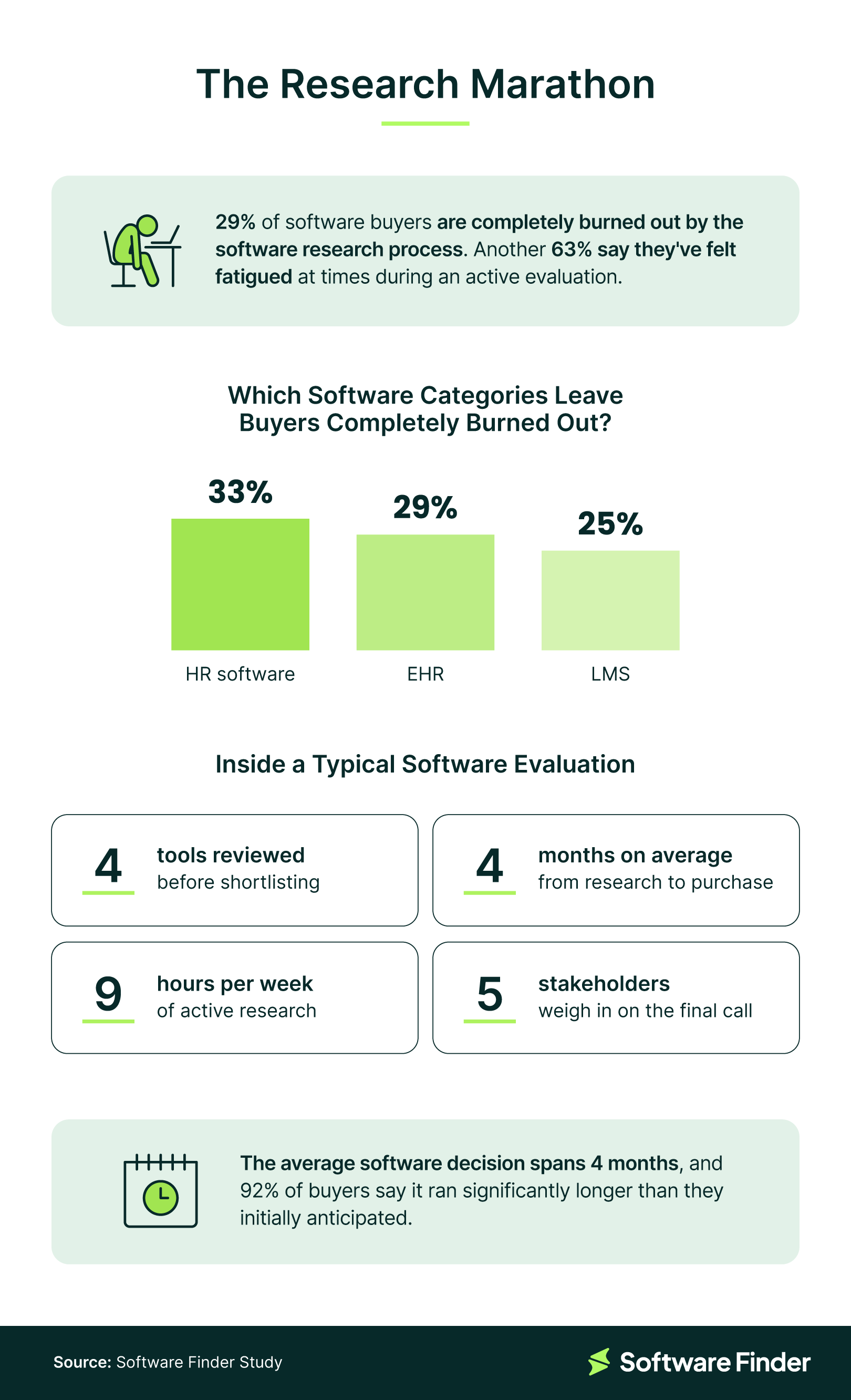
Research fatigue was nearly universal among buyers, with 92% reporting that they experienced it and 29% reaching complete burnout. The intensity varied by industry, with these top 5 most likely to be completely burned out:
- Professional Services (41%)
- Finance/Insurance (39%)
- Healthcare (33%)
- Manufacturing (27%)
- Education (25%)
These numbers suggest that complex operational requirements and compliance demands may amplify the strain.
Timelines further contributed to the pressure. The average software decision took four months, and 92% of buyers said the process lasted significantly longer than expected. Millennials experienced the longest timelines at four months on average, while Gen X reported slightly shorter cycles at three months, indicating generational differences in approach or organizational roles
Barriers in the evaluation process often slow momentum, leaving buyers uncertain about how to move forward.
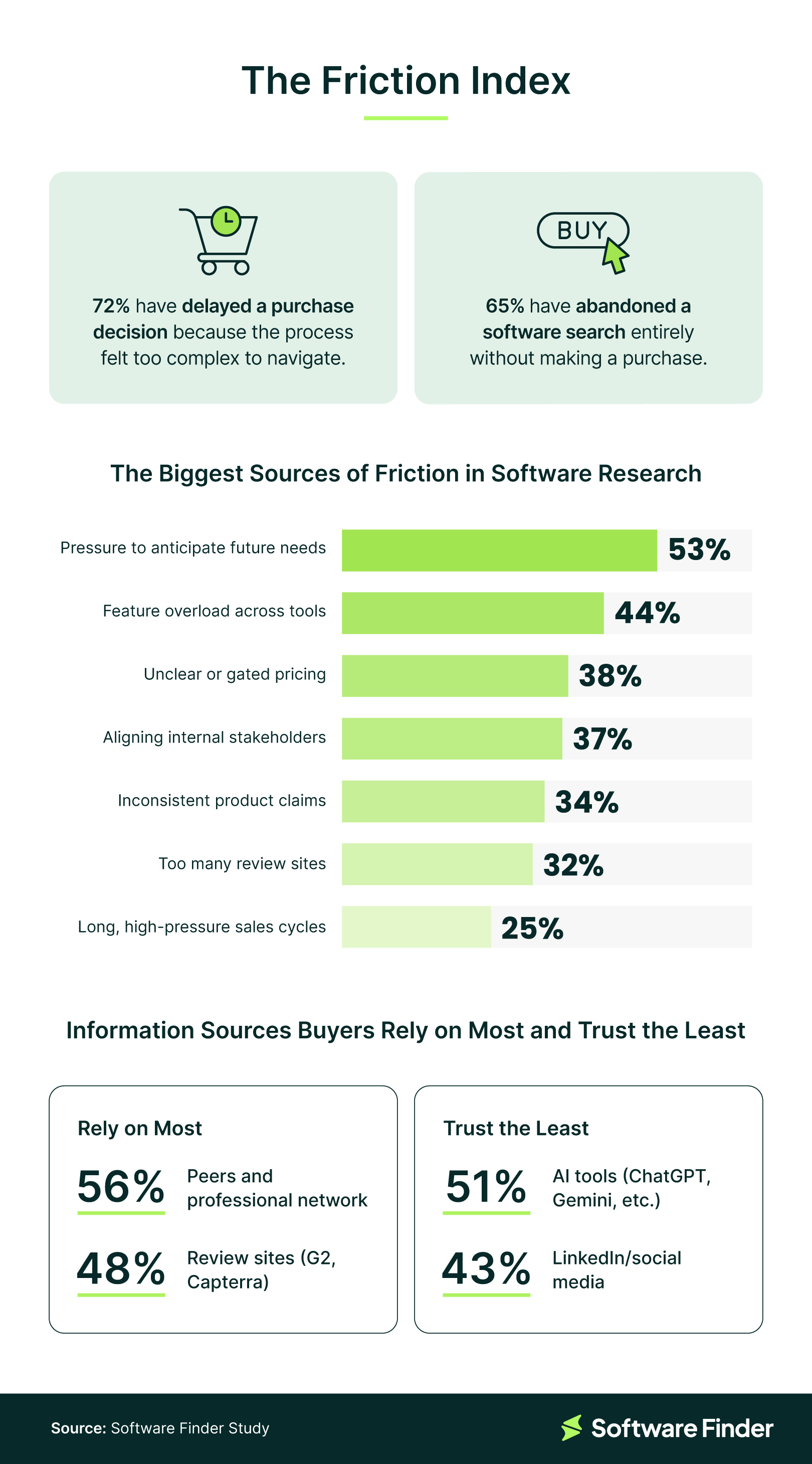
Complexity played a major role in stalled decisions. About 72% of buyers delayed purchases because the process felt too difficult to navigate, while 65% abandoned their search altogether without selecting a solution. Delays were most common in the following industries:
- Technology/Software (79%)
- Professional Services (74%)
- Finance/Insurance (72%)
- Healthcare (70%)
- Education (66%)
These findings highlight how even tech-savvy industries face friction.
Generational trends revealed subtle differences in behavior. Millennials were the most likely to abandon a search (66%), while Gen X was the least likely (62%). At the same time, 53% of buyers identified the pressure to anticipate future needs as the biggest challenge, showing how long-term planning complicates present-day decisions.
Trust also influenced the process. Around 51% of buyers expressed distrust in AI tools such as ChatGPT, Gemini, and Perplexity when researching software. Gen Z showed the highest skepticism (55%), while Gen X reported the lowest (43%), suggesting that familiarity with technology does not always translate into trust.
When buyers walked away from a search, unmet requirements were the top reason (24%), followed by budget changes (20%), lack of stakeholder alignment (16%), and the difficulty of comparing options (12%). These factors illustrate how both organizational and informational challenges contribute to stalled outcomes.
The emotional weight of software decisions often lingers long after the purchase is complete.
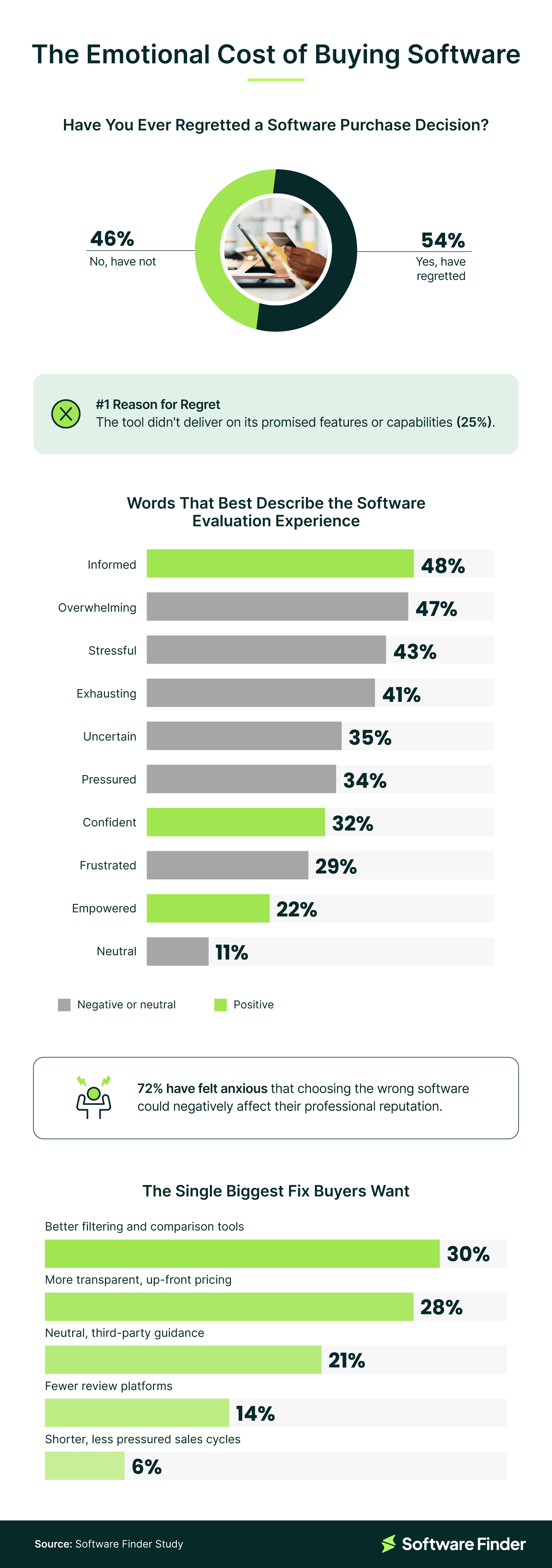
Concerns about professional consequences were widespread, with 72% of buyers fearing that choosing the wrong software could harm their reputation. High-accountability environments intensify this pressure, as seen in the industries most likely to experience this anxiety:
- Finance/Insurance (84%)
- Healthcare (76%)
- Professional Services (74%)
- Technology/Software (73%)
- Education (71%)
Regret was also common. More than half of buyers (54%) said they regretted a past purchase, most often because the software failed to deliver on promised features. Millennials reported the highest regret levels (58%), while Gen Z reported the lowest (46%), suggesting varying expectations or evaluation approaches across age groups.
Even after decisions were finalized, uncertainty persisted. About 79% of buyers second-guessed their choice, with Gen Z (85%) most likely to question their decisions and Gen X (74%) the least likely. This ongoing doubt highlights a broader issue: software buying does not end with implementation, it continues to impact confidence and performance.
The findings point to a clear reality: software selection has evolved into a complex, emotionally taxing process that extends beyond traditional procurement challenges. Buyers faced long timelines, overwhelming options, and significant professional pressure, often leading to delays or abandoned decisions. Even after choosing a solution, doubt and regret remained common.
As organizations continue to rely on software to drive growth, simplifying the buying journey will become increasingly important. Reducing friction, improving transparency, and aligning stakeholders earlier could help transform a stressful process into a more strategic advantage.
Methodology
We surveyed 502 U.S. software buyers evaluating or recently responsible for evaluating HR, LMS, or EHR software about their experience researching and purchasing enterprise software. The study explored research effort, decision timelines, friction points, emotional experience, regret, and what buyers say would most reduce the difficulty of software buying.
Respondents were distributed across genders (49% men, 49% women, 1% non-binary, 1% prefer not to answer), software categories (HR software 42%, LMS 41%, EHR 17%) and buying roles (key influencer or recommender 54%, researcher or evaluator 27%, primary decision-maker 19%). The survey was conducted online in April 2026. All percentages are rounded to the nearest whole number.
About Software Finder
Software Finder helps businesses simplify the software selection process by connecting them with tailored solutions across industries. From HR and healthcare to education and enterprise tools, the platform provides expert guidance, comparisons, and insights to support confident decision-making.
Fair Use Statement
This content is available for noncommercial use only. If shared, please include proper attribution with a link back to SoftwareFinder.com.