


Comparison
Westlaw Vs Lexis: A Practical Comparison For Modernized Legal Research Teams
6 mins read
Last Updated

Writer
Selecting a legal research provider is a huge step in the direction of law firms, corporate and government legal departments, and law schools which may offer legal scholarships. Westlaw and Lexis have defined how these sectors search and comprehend legal study, huge primary law collections, powerful analytics, and more sophisticated AI applications.
Both assist legal practitioners with check authority, find cases, review statutes, and access trustworthy analysis. Their variations indicate how they organize search results, evaluate citations, and share commentary.
This Westlaw vs Lexis comparison shows the features available on each platform that are used daily by research teams based on vendor information and user responses over time as well as guides you to choose which platform fits your research aims and workflow.
Features | Westlaw | Lexis |
AI Assisted Legal Research | AI-assisted search grounded in proprietary Westlaw authority with direct links to the case | Conversational AI via Lexis+ AI with drafting and summarization support |
Search Capabilities And Database | Highly structured Boolean and deep primary-law coverage | Flexible natural-language and Boolean search with easy jurisdictional filtering; strong cross-disciplinary content, including news and public records |
Litigation Analytics | Comprehensive judge, court, motion, and timeline analytics integrated with Westlaw Edge | Lex Machina and Lexis Analytics offer behavior insights for judges, counsel, and parties; strong for business development and specific practice areas |
Secondary Sources | Extensive library widely praised for depth and clarity | Broad collection including Matthew Bender, treatises, and law reviews |
Westlaw is Thomson Reuters’ main legal research platform. It comes in different versions, including Westlaw Edge and Westlaw Advantage, each delivering a different degree of depth. In firms and corporate departments, Westlaw is meant to do more than basic lookups. It assists with wider law provision using statutory comparison tools, jurisdictional scanning, and automation of legal work.
Unique Features Of Westlaw
- KeyCite: This feature identifies the reliability and relevance of cases and regulatory guidelines. Its flags and treatment notes show whether something has been questioned, limited, or overruled, and the ‘Overruling Risk’ feature highlights authority that may be unstable
- Key Number System: This is Thomson Reuters’ classification map of U.S. law. It breaks legal issues into hundreds of topics and thousands of specific points, which makes it easier to move through intricate questions
- Litigation Analytics: These dashboards give information about the judges, courts, firms, attorneys, and types of cases. The metrics allow lawyers to create a strategy based on the way similar issues have unfolded
Westlaw Pros And Cons
Pros
- Advanced AI tool enhances research speed and accuracy
- Well-organized formatting makes case details and key information easy to access
- Secondary sources and complete search results extend practical support for in-depth legal research
Cons
- Limited search refinement options with less choices to sort or save query results efficiently
- The extensive number of tools may be confusing, particularly to users who are moving over to a new legal research service
Lexis, usually accessed through LexisNexis platforms, is used by law firms, in-house counsel, government offices, and law schools. It brings together primary law, secondary sources, and research tools that support day-to-day legal work.
The platform also gives users broad access to legal news, decisions from many jurisdictions, statutes, practice guides, and other research materials. Within a professional workflow, Lexis is built for users who need broad jurisdictional coverage and seamless integration with their existing legal research software stack.
Unique Features Of Lexis
- AI Research Assistant: Protégé is the platform’s built-in AI assistant. It helps draft documents, summarize legal materials, and pull relevant authority from both firm data and LexisNexis content
- Shepard’s Citator: Lexis uses Shepard’s module to check the validity of cases. It's ‘At Risk’ alerts show when a case may be weakened or heading toward negative treatment, giving researchers a clear read on authority strength
- Regulatory And Legislative Tracking: Modules such as State Net offer real-time monitoring of statutes, regulations, bills, and related analysis. This is especially useful for in-house teams and regulatory practices
Lexis Pros And Cons
Pros
- Simple client assignment to enable correct cost reimbursement
- Powerful search features with deep search through a comprehensive legal library
- Searching is simple and easy through browser-style navigation
Cons
- Excessive focus on cases being overruled may lead to time wasted on insignificant issues
- Search narrowing options are comparatively limited as compared to competitors like Westlaw
AI-Assisted Legal Research

Westlaw’s ‘AI-Assisted Research’ assists you in getting clearer answers to your legal questions and backs them up with direct links to trusted Westlaw sources. This results in it being easier to check the underlying authority and move through the rest of your research faster. Its tools cover a range from jurisdictional surveys to ‘Quick Check’ for brief analysis and litigation analytics.
A user on Reddit stated that Westlaw’s AI-assisted research feels more reliable in everyday practice because every AI-generated point links straight to the underlying cases, making it easy to confirm citations on the spot.
In contrast, Lexis+ AI is a full legal research platform with an interactive assistant built to make legal work smoother. It uses advanced AI, encompassing natural language processing and machine learning, to help with research, drafting, summarizing, analyzing documents, and handling conversational search.
This feature differs in terms of user review. It is said to be more active, less instinctive, and less likely to hallucinate. However, some people say that the system will give some false answers and applications that are not relevant to the question. In comparison with Westlaw, which is more likely to provide more consistent citation-linked results. Lexis is more usable and has more capabilities such as summarizing and drafting.
Search Capabilities And Database
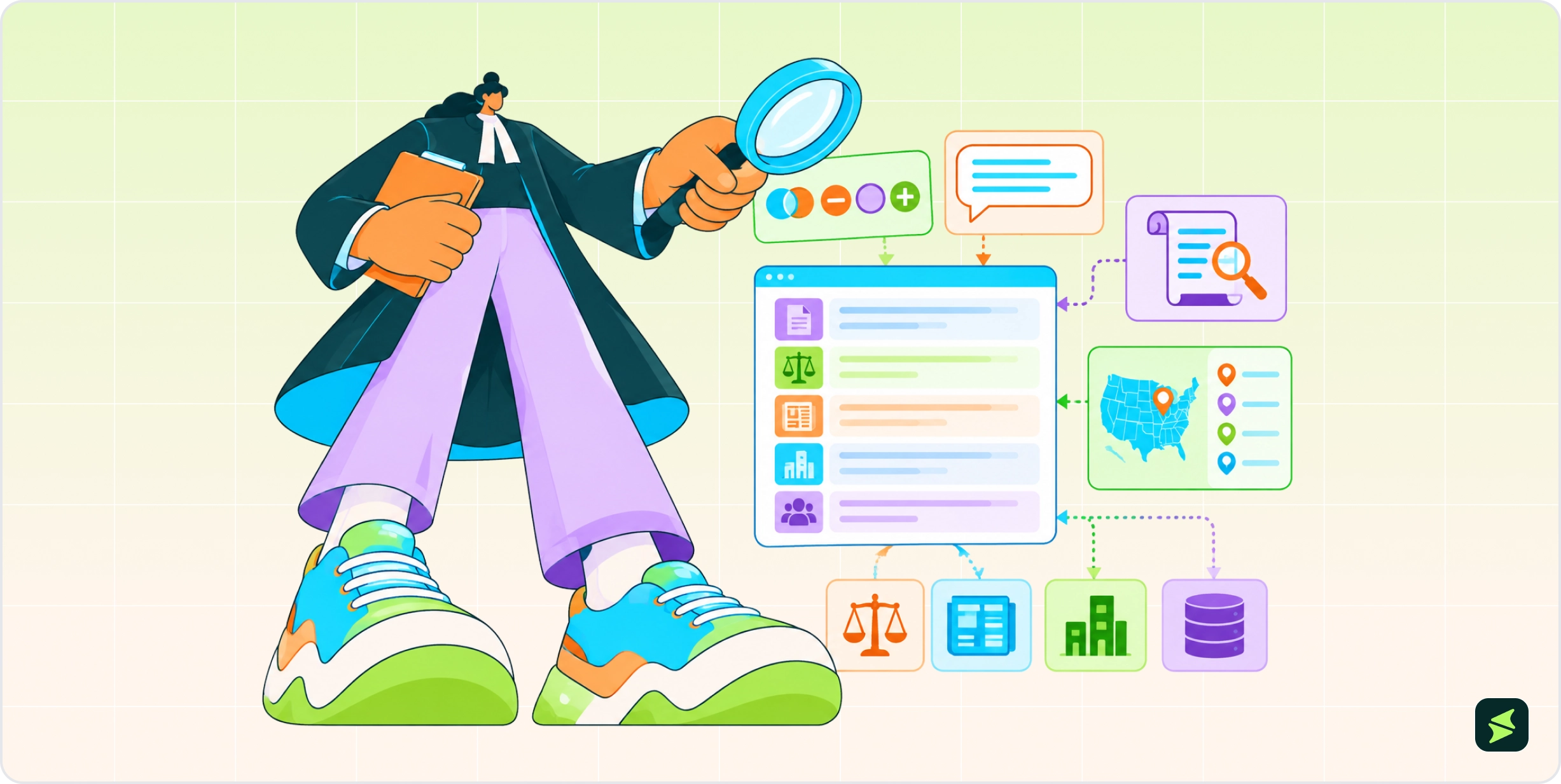
Westlaw supports granular searching by ‘Terms and Connectors’, letting users run full Boolean and proximity queries across its large, unified database. Its search tools are flexible. Users can look up material by citation, browse by topic, run natural language queries, or depend on Boolean to narrow or expand results.
Lexis offers a flexible search setup where users can start with an in-depth natural language query, jump straight to a citation, or run a Boolean search with connectors. It also covers both legal and non-legal material, including news, business information, and public records, and can pull in internal firm content through ‘Search Advantage.’
Many users say Lexis makes case-level searching feel especially easy, which helps newer researchers and interns. They like that it allows narrow results by state, city, year, court level, or sources, which keeps the process transparent.
Lexis is perceived as more user-friendly with general exploration and user-friendly with novice law firms than Westlaw.
Litigation Analytics

Westlaw Edge includes a strong ‘Litigation Analytics’ module that tracks data on judges, courts, attorneys, firms, damages, and case types. Attorneys can see how often a judge grants certain motions compared to the court's average and review damages.
Users report that litigation analytics available in Westlaw make case preparation more strategic and efficient, particularly among brief preparers. They appreciate the fact that it brings together cases and secondary sources that are relevant in a single location; they can be able to evaluate precedents, locate arguments that are stronger, and other related issues that have been dealt with previously.
LexisNexis markets ‘Lex Machina’ and its own ‘Litigation Analytics’ to learn the behavior of judges, lawyers, parties, and courts. The system works with a rich set of historical cases, findings, motions, and representations, identifying patterns and relationships that would be difficult to determine by traditional research.
Lex Machina is strong for high-level pattern recognition. Westlaw, though, offers more litigation-focused detail than Lexis, facilitating clearer understanding.
Secondary Sources

Westlaw presents its secondary sources as a core part of legal research. Thomson Reuters explains that users can navigate the full secondary sources library through the ‘Content Types’ tab and narrow results segmented by publication type, jurisdiction, topic, or series, such as encyclopedias or treatises. Users frequently describe Westlaw’s secondary sources as genuinely helpful in day-to-day practice.
Compared to Lexis, Westlaw structures its secondary material more tightly around real practice needs while offering in-depth commentary within many treatises.
Lexis provides a similar range of secondary content, including Matthew Bender treatises, law reviews, journals, digests, restatements, and dictionaries. Its material is geared toward implementation, using practice notes, model documents, checklists, and step-by-step guides. The content is useful, but its analysis provides only a basic level of detail.
Many users say Lexis Advance makes accessing secondary sources especially intuitive, which helps interns and newer researchers. They like that it allows filtering by state, city, year, journal, court level, or other primary and secondary sources, making comparisons across cases straightforward.

Westlaw offers the following subscription levels. The pricing varies depending on the number of attorneys at the law firm and the jurisdiction.
- Westlaw Edge – Custom pricing
- Westlaw Edge with AI-Assisted Research – Custom pricing
- Westlaw Advantage – Custom pricing
Lexis offers subscription plans ranging from 1 year to 3 years. The following pricing is based on its 1-year plan:
- Essential – $171/month
- Enhanced – $418/month
- Professional – $658/month
- Lexis+AI – Custom pricing
The vendor also offers a free trial for its Lexis+AI module.
Disclaimer: The pricing is subject to change.
The right legal software may depend on what your team needs, and your approach to research in your law firms or law schools. Both platforms discuss the necessities, yet each of them shines differently.
Westlaw is frequently superior in multi-layered primary law research and complex litigation. Lexis can be a more suitable solution for teams that prefer dynamic pricing, navigation, and a combination of legal and non-legal solutions.
The most appropriate choice would be with regard to what you practice, the level of content that you require, and the amount of investment that you are willing to make in a system that suits your daily work routine. For a broader comparison, see our best legal research software.