






If you have ever posted a job and had to sift through a pile of resumes, you already know the reason behind the existence of an Applicant Tracking System (ATS). It assists recruiters in organizing and automating the process of hiring, from posting to onboarding. It stores candidate information securely, centralizes communication, and streamlines the hiring workflow. Recruiters save time and eliminate human mistakes, while also concentrating on top talent, rather than managing applications across multiple systems.

On average, recruiters receive hundreds of resumes each time an opportunity is available. In the absence of a system, applications accumulate across inboxes and tools, and critical tasks like organization of interviews or compliance monitoring (EEO, GDPR) will fall out of place.
ATS consolidates all applications in one system and automates key tasks. It centralizes communication with applicants, job postings, and reporting. Rather than switching between several tools, teams access all applicant progress in one place.
With ATS, recruiters can:
- Organize and track every application in one centralized dashboard
- Schedule interviews and send reminders automatically
- Ensure compliance with hiring regulations like EEO and GDPR
- Collaborate easily with hiring managers through shared updates
- Gain instant visibility into hiring progress and candidate status
Ultimately, an ATS helps recruiters cut manual tasks and maintain structured hiring pipelines, allowing them to move qualified candidates through each stage with greater accuracy and consistency.
An ATS handles the recruitment process by automating key stages of hiring and being integrated with various other tools such as the HRIS, background checks, and onboarding systems. The typical ATS workflow includes these six stages:
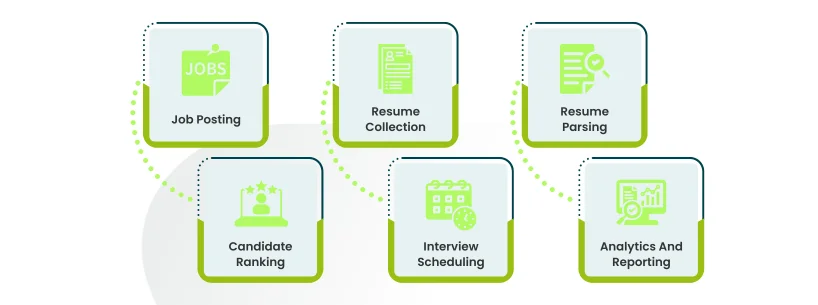
By understanding these steps, recruiters will be able to optimize filters, analytics, and communication methods to make data-driven and human-centered decisions about hiring.

Recruiters should customize their ATS to match their hiring process to use it effectively. Identify every step, from sourcing to onboarding, and develop screening questions and tags that simplify the filtering process. Follow-ups, reminders, and updating of the candidates can be done by automation to save time.
To avoid common ATS mistakes and maintain hiring fairness, keep these practices in mind:
Do’s And Don’ts:
- Do set consistent scoring criteria in the ATS to ensure fair evaluation
- Do train your team to use the system correctly and follow structured workflows
- Don’t rely only on default filters that may overlook qualified candidates
- Don’t skip analytics that measure time-to-hire and source performance
Most recruiters do not understand the actual functionality of ATS software and end up not utilizing it to its potential or having the wrong expectations. Here’s a quick look at common myths and facts:
Myth | Fact |
ATS automatically rejects resumes | Recruiters set the filters and ranking criteria manually |
ATS is only for large organizations | Scalable versions make it accessible for small and mid-sized businesses |
ATS replaces recruiters | It supports human decision-making through organized, data-driven insights |
Smart Practices:
- Regularly review filters to avoid bias and missing qualified candidates
- Keep candidate data clean and updated for accurate analytics
- Train teams to use reports for continuous improvement
- Conduct periodic audits to maintain compliance and system efficiency
- Combine automation with human judgment for fair and effective hiring

Modern ATS platforms use AI screening, DEI analytics, and predictive tools to support fair and data-driven hiring decisions. These tools help recruiters identify qualified candidates faster and reduce hiring bias. ATS enables strategic, data-driven recruiting while keeping human judgment at the center of hiring decisions.