



Software Finder helps businesses find and evaluate new workplace tools every day. But choosing the right software and successfully rolling it out are two very different things. We surveyed 1,006 U.S. professionals to understand what employees experience during a software transition. Many reported facing pressure, uncertainty, and gaps in support that can hinder adoption.
Key Takeaways

- 42% of employees have pretended to understand a new workplace tool when they actually didn't.
- Over two-thirds of employees (69%) do not receive enough time and support before performance expectations are set during software rollouts.
- 49% of employees feel less confident in their ability to do their job after a software transition.
- 53% of employees feel concerned that AI tools will make their role feel less necessary, and they cited ChatGPT (35%) and Google Gemini (18%) most often.
- 59% of employees feel evaluated on their performance while they are still learning a new system.
- Senior managers/executives are most likely to say AI is increasing their value (45%), compared to individual contributors (15%).
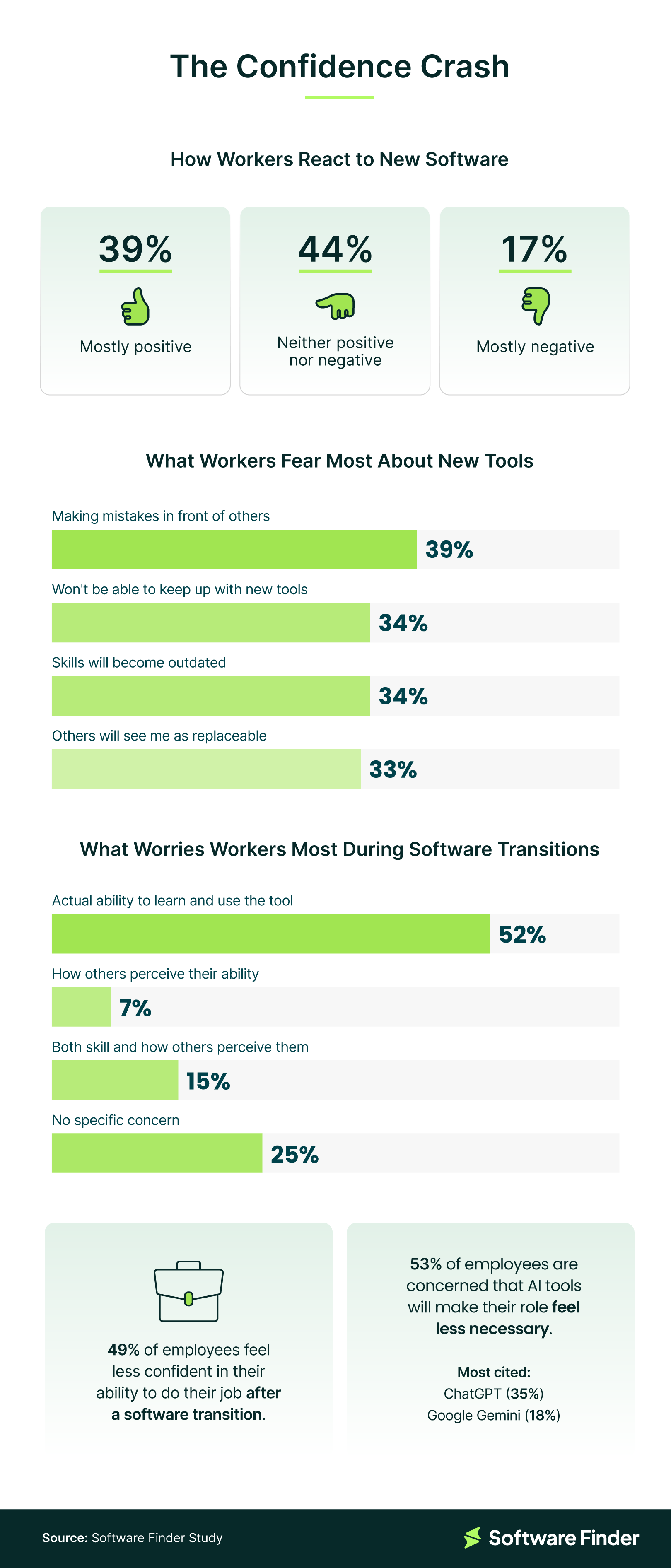
- 39% of employees react mostly positively when new software is introduced, while 44% feel neutral and 17% react mostly negatively.
- Making mistakes in front of others is the most widely shared worry with new software (39%), ranking above concerns about keeping up (34%), becoming outdated (34%), or being seen as replaceable (33%).
- Gen X workers are the most likely generation to worry they won't keep up with new tools (40%), compared to Gen Z (31%), millennials (32%), and baby boomers (35%).
- Female workers are more likely than male workers to worry about making mistakes in front of others (44% vs. 35%).
- 49% of employees feel less confident in their ability to do their job after a software transition.
- 53% of employees feel concerned that AI tools will make their role feel less necessary, especially ChatGPT (35%) and Google Gemini (18%).
- Workers with less than 1 year of tenure are the least likely to react positively to new software (25%), compared to those with 10+ years of tenure (43%).
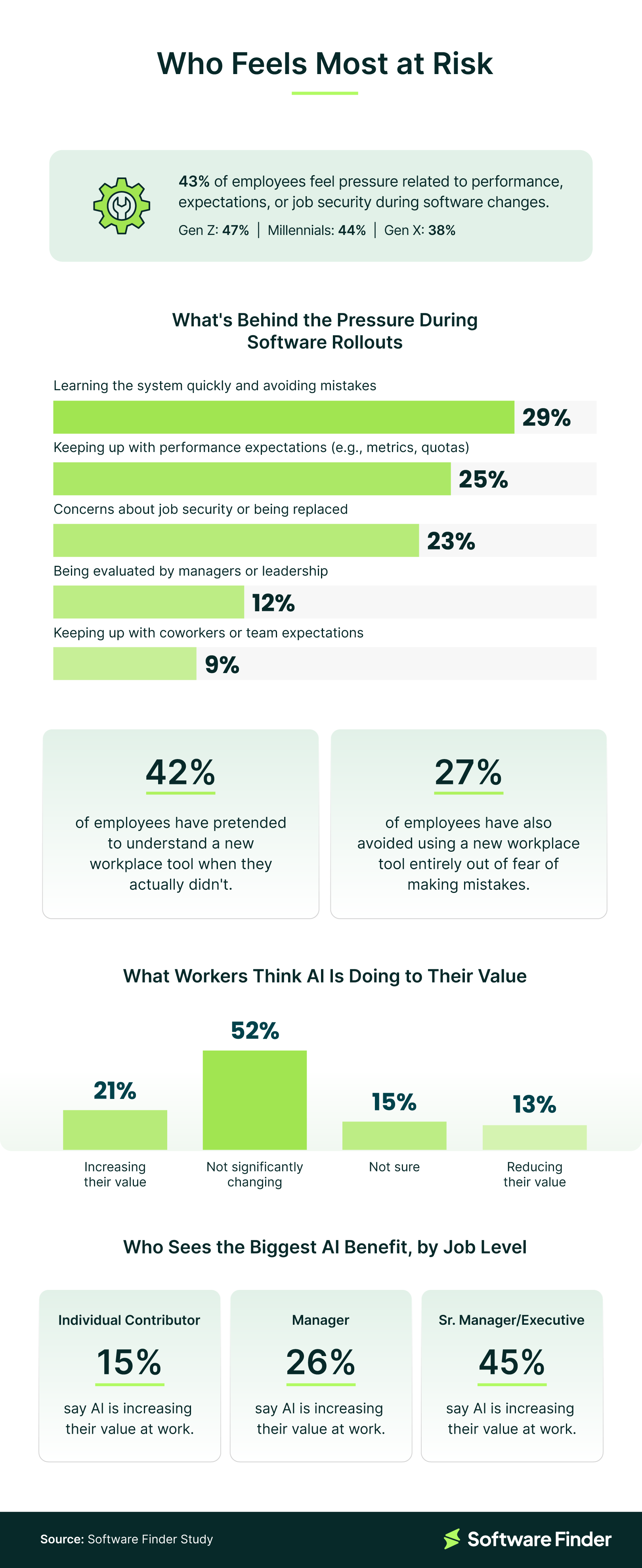
- 43% of employees feel pressure related to performance, expectations, or job security during software changes. Among technology industry workers, 46% report feeling this way.
- Managers are the most likely job level to cite job security or being replaced as their top pressure source (27%), compared with individual contributors, whose top pressure source is learning quickly (30%).
- Gen Z workers are the most likely to feel pressure during software changes (47%), with learning quickly as their top pressure source (35%).
- 42% of employees have pretended to understand a new workplace tool when they actually didn't. Gen Z workers are most likely to do so (53%), compared to millennials (42%) and Gen X (38%).
- 27% of employees have also avoided using a new workplace tool entirely out of fear of making mistakes.
- 52% of employees say AI tools are not significantly changing their value, while 21% say they increase their value. Senior managers/executives are most likely to say AI is increasing their value (45%), compared to managers (26%) and individual contributors (15%).
- Workers with 4–6 years of tenure are more likely than those with less than 1 year to say AI is increasing their value (26% vs. 15%).
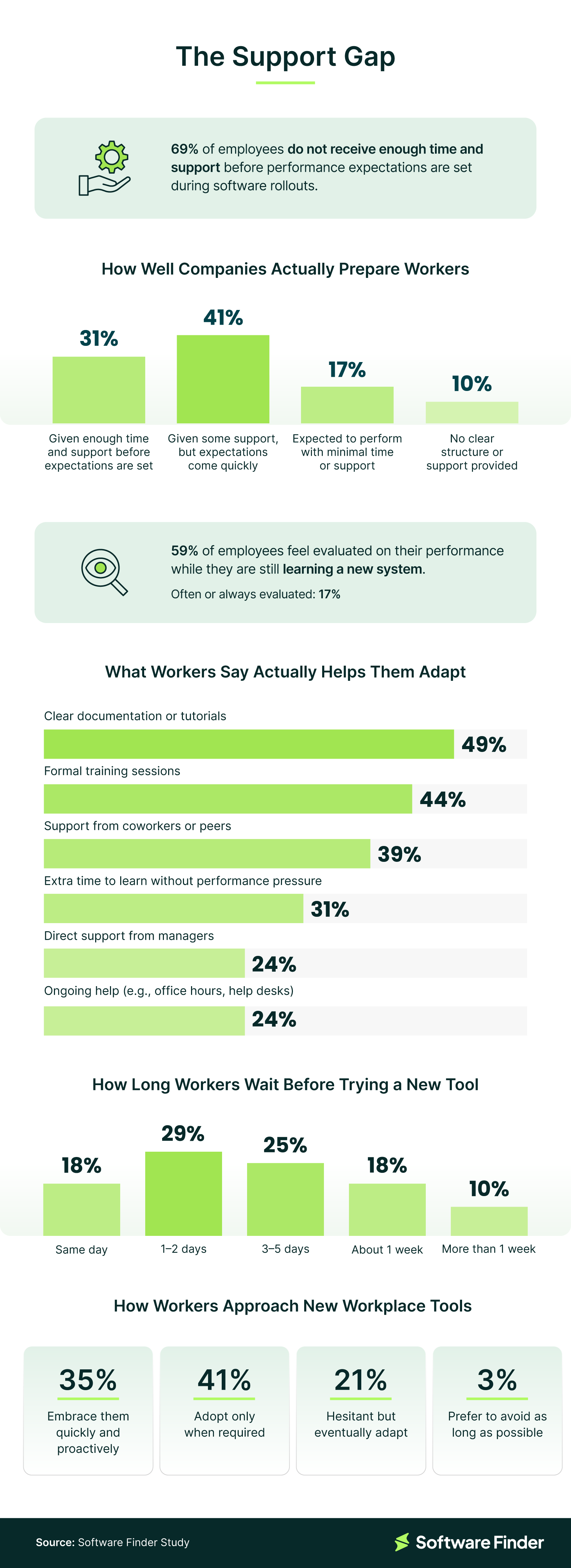
- Over two-thirds of employees (69%) say they don't receive enough time and support before performance expectations are set during software rollouts.
- Workers say clear documentation or tutorials (49%) are the most helpful type of support when learning new software at work, followed by formal training (44%) and peer support (39%).
- Female workers are more likely than male workers to report that peer support is helpful (42% vs. 36%).
- Workers most often report starting to learn new software at work within 1–2 days (29%), while another 25% do so within 3–5 days.
- 59% of employees feel evaluated on their performance while they are still learning a new system; 17% said they are often or always evaluated.
- 41% of employees adopt new tools only when required, while 35% say they embrace them proactively.
Employees don't resist new software because they're unwilling. They struggle because they're under-supported. Here's how to fix that:
- Decouple learning from performance evaluation. Set a defined grace period after go-live and communicate it clearly before launch.
- Prioritize documentation and structured training. Cover real workflows, not just features, and make resources easy to find after the training session ends.
- Designate peer champions. Internal power users give employees a low-pressure place to ask questions from someone who knows their day-to-day context.
- Create psychological safety around mistakes. Managers set the tone. Model curiosity, keep troubleshooting private, and make it easy to ask for help.
- Communicate AI's role explicitly. Employees at all levels need to understand, in specific, concrete terms, how a new tool is meant to help them, not replace them.
A well-planned rollout protects productivity and builds the trust that makes your next transition easier, too.
Methodology
We surveyed 1,006 U.S. adults who use software at work to understand how workplace software changes affect employee confidence, behavior, and performance. The survey examined how employees emotionally and behaviorally respond to new software at work, including their fears, coping strategies, support experiences, and attitudes toward AI.
The average age of respondents was 40. The gender breakdown was 53% women, 46% men, and 1% nonbinary. Millennials made up the largest share of respondents (59%), followed by Gen X (24%), Gen Z (12%), and baby boomers (4%). Job levels included individual contributors (61%), managers (33%), and senior managers/executives (7%). The survey was conducted online in March 2026.
About Software Finder
Software Finder helps businesses discover, compare, and select the right software solutions to improve efficiency and performance. From HR and CRM platforms to AI-powered tools, we connect decision-makers with expert insights and tailored recommendations.
Fair Use Statement
This material is intended for noncommercial use. When referencing or sharing it, please credit SoftwareFinder.com and include a link to the original source.