Last Updated
Overview
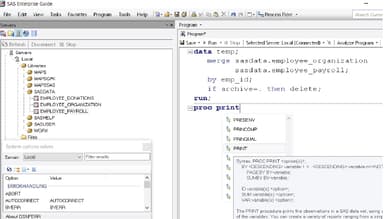
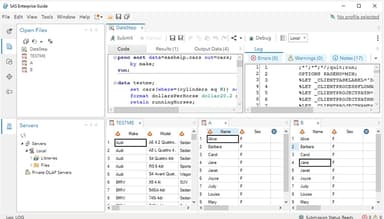
SAS Enterprise Guide software provides a user-friendly point-and-click interface for accessing SAS's full capabilities. It allows seamless data access, analysis, and export through intuitive menus and wizards for efficient result sharing. Although there is a learning curve, it excels in machine learning with fast data processing.
Overall Rating
Based on 34 users reviews
4.5
Rating Distribution
Positive
94%
Neutral
6%
Negative
0%
Starting Price
$1,500
per user
SAS Enterprise Guide Specifications
- Data Visualization
- Data Analysis And Reporting
- Scheduled Reporting
- Advanced Analytics And Forecasting
What Is SAS Enterprise Guide Software?
SAS Enterprise Guide is a comprehensive data management tool that enables end users to access, analyze, and share data through an intuitive interface. IT managers can centrally manage security and automatically deploy tailored solutions across various devices. Key features include a graphical user interface, visual data management, result distribution, and data processing. When paired with SAS Grid Manager, it offers dynamic load balancing, resource allocation, and job prioritization for optimized performance.
What Is SAS Enterprise Guide Software Best For?
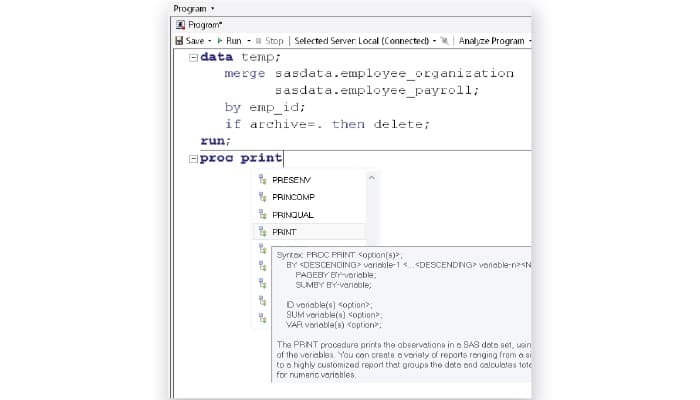
SAS Enterprise Guide is best known for its visual, point-and-click analytical workflow that simplifies data preparation, analysis, and reporting. The interface allows users to build repeatable processes without writing extensive code, while advanced users can customize tasks with SAS programming. This makes complex SAS analytics more accessible and helps teams manage structured data workflows more efficiently.
How Much Does SAS Enterprise Guide Software Cost?
SAS Enterprise Guide pricing starts at around $1,500/user for select offerings, but the actual cost varies based on licensing model, user count, processing capacity, deployment type, and organizational requirements. SAS provides customized quotes based on business needs. Enterprise deployments can scale from capacity-based pricing of around $10,000 to multi-million-dollar implementations depending on scope and usage.
The following are estimated additional costs based on enterprise analytics software benchmarks, SAS implementation patterns, and typical deployment requirements.
- Implementation And Configuration: $10,000–$100,000+ one-time depending on deployment complexity, security setup, user configuration, and analytics workflows
- Data Migration And Data Preparation: $5,000–$100,000+ one-time depending on data volume, cleansing requirements, and number of connected data sources
- Integration With Databases And Enterprise Systems: $10,000–$150,000+ depending on ERP, CRM, cloud platforms, data warehouses, and external system connections
- Training And User Enablement: $1,000–$5,000 per user or $10,000–$50,000+ for organization-wide training and adoption programs
- Custom Reporting And Analytics Development: $10,000–$200,000+ depending on dashboards, automated reporting, analytical models, and workflow customization
- Cloud Hosting And Infrastructure Costs: $10,000–$250,000+ annually depending on storage, computing needs, security requirements, and deployment approach
- Additional User Licenses And Capacity Expansion: Variable pricing depending on added users, increased processing capacity, and additional SAS capabilities
- SAS Certification And Professional Training (Optional): Approximately $120–$250+ per certification exam depending on exam type and region; training programs may add additional costs
- Premium Support And Consulting Services: Typically 15%–25% of annual licensing cost depending on support tier, consulting needs, and dedicated assistance
Disclaimer: The pricing is subject to change.
SAS Enterprise Guide Software Integrations
The software comes with diverse third-party integrations, including:
- Snowflake
- Cloudera
- Teradata Vantage
- AWS
- Microsoft Azure
- SingleStore
How Does SAS Enterprise Guide Software Work?
Here is the workflow for using SAS Enterprise Guide Software:
- Access SAS Enterprise Guide through an available SAS environment and workspace
- Connect to data sources including databases, data warehouses, cloud platforms, and local files
- Import and review datasets, tables, and available data structures
- Prepare data by applying filters, transformations, calculations, joins, and quality checks
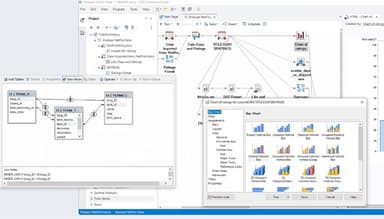
- Create visual workflows by arranging analytical tasks and connecting process steps
- Configure analytical processes and automate data preparation without extensive coding
- Run statistical analyses, forecasting, and predictive models to evaluate business data
- Develop advanced analytics by using SAS procedures or integrating external programming tools when needed
- Generate reports, summaries, and visual outputs from analytical results
- Schedule recurring processes and report generation for ongoing analysis
- Share insights through reports, exports, dashboards, or connected systems
- Deploy completed workflows for repeatable analytical operations
- Monitor analytical processes, outputs, and workflow performance
- Customize solutions using SAS code, procedures, and reusable analytical components for advanced requirements
Who Is SAS Enterprise Guide Software For?
SAS Enterprise Guide software caters to various industries, a few of which include:
- Agriculture
- Banking
- Capital markets
- Education
- Healthcare
- Hospitality
- Insurance
- Manufacturing
SAS Enterprise Guide Software Use Cases
Based on our analysis of SAS Enterprise Guide capabilities and common enterprise analytics workflows, we have identified key scenarios where this software is a good fit for organizations managing large-scale data analysis, statistical modeling, and reporting requirements:
1. Retail Banks Building Credit Risk Models For Lending Decisions
Risk management teams at retail banks often turn to SAS Enterprise Guide when they need to analyze large customer datasets and develop credit risk models for lending decisions. Analysts use the platform to work through structured modeling workflows involving historical account activity, repayment behavior, and customer risk indicators. This makes SAS Enterprise Guide a suitable choice for financial institutions that require consistent analytical processes and documented model development for internal reviews and regulatory requirements.
2. Insurance Providers Investigating Fraud Patterns Across High-Volume Claims
Insurance organizations use SAS Enterprise Guide to examine large volumes of claims data and identify patterns associated with suspicious activity. Fraud analysts can apply statistical analysis workflows to compare claim characteristics, customer histories, and past fraud indicators when reviewing potential cases. The software fits insurers that need repeatable analytical processes for fraud investigation while maintaining clear documentation around their decisions.
3. Healthcare Networks Evaluating Patient Outcomes And Operational Performance
Healthcare analytics teams use SAS Enterprise Guide when they need to evaluate patient outcomes, treatment trends, and operational performance across complex healthcare environments. Analysts can work with clinical and administrative datasets to study areas such as readmission patterns, care effectiveness, and resource utilization. This scenario is particularly relevant for hospitals and health systems that rely on structured analysis to support quality improvement initiatives and operational planning.
4. Government Research Teams Managing Large-Scale Statistical Programs
Government agencies and research organizations often rely on SAS Enterprise Guide for analyzing large public datasets used in reporting, research, and policy analysis. Data teams working with population studies, economic indicators, or recurring statistical programs can use the platform to organize analytical workflows and maintain consistent reporting processes. This makes it a strong fit for public-sector environments where data governance and repeatable analysis are important.
5. Pharmaceutical Companies Analyzing Clinical Trial Data For Regulatory Submission
Pharmaceutical and clinical research teams use SAS Enterprise Guide when working with statistical analysis processes involved in clinical studies and drug development. Researchers apply the software to analyze trial datasets, review study results, and prepare analytical outputs used throughout research workflows. This use case applies to organizations that need controlled and well-documented analysis processes when working with regulated clinical data.
Is SAS Enterprise Guide Software Right For You?
SAS Enterprise Guide is a suitable choice for organizations that need a structured environment for data preparation, statistical analysis, predictive modeling, and reporting workflows. The software is commonly used by analysts, data teams, and enterprise organizations that work with complex datasets and require repeatable analytical processes. Its guided interface, SAS programming support, workflow management capabilities, and integration with SAS analytics tools make it a strong fit for teams that need both accessibility for analysts and control over advanced analytical tasks.
Organizations in regulated industries may also benefit from SAS’s focus on data governance, security, and compliance across its analytics ecosystem. SAS Enterprise Guide is particularly well suited for businesses that require reliable statistical analysis and documented workflows rather than a simple self-service reporting solution.
Do you still need to learn about SAS Enterprise Guide software? Call our team at (661) 384-7070 for expert guidance on your questions.
SAS Enterprise Guide Features
Data Management
The solution empowers organizations with flexible data management solutions, enabling seamless connectivity, streamlined preparation, and robust governance. With tools for data pipelines, compliance, and transparency, SAS supports businesses in optimizing their AI-driven strategies.
Augmented Analytics And Business Intelligence
SAS Enterprise Guide software features and enhances analytics and business intelligence through augmented analytics, leveraging AI and machine learning to deliver fast, automated insights. Features include low-code interfaces, embedded analytics, AI-powered insights, streamlined processes for data scientists, and location intelligence.
Risk Management
The software offers advanced risk analytics solutions, empowering financial institutions to optimize capital, manage liquidity, and meet regulatory demands. Its proven methodologies support risk-aware cultures, enabling efficient, transparent decision-making and balancing short- and long-term strategies.
Data Access And Preparation
SAS Enterprise Guide allows analysts to connect, access, and prepare data from multiple sources within a single analytical environment. Users can import datasets, perform data cleaning tasks, join tables, and organize preparation workflows before analysis. This supports organizations working with large and complex datasets that require structured data preparation processes.
Statistical Analysis And Predictive Modeling
The platform provides access to SAS statistical procedures for tasks such as regression analysis, forecasting, predictive modeling, and data exploration. Analysts can build analytical workflows through a guided interface while applying SAS methods for advanced statistical analysis without writing all code manually.
Pros And Cons of SAS Enterprise Guide
Pros
Offers low-code and drag-and-drop features
High performance and efficiency, even with large datasets
Excellent for machine learning, with fast data processing
Facilitates seamless integration with clients' tools in consultancy work
Cons
There’s a learning curve in navigating the platform
Limited table filtering options
SAS Enterprise Guide Reviews
Total 34 reviews
4.5
All reviews are from verified customers
Rating Distribution
5
Stars56%
4
Stars38%
3
Stars6%
2
Stars0%
1
Stars0%
Share your experience
Joao A.
Insurance, 101-500 employees
More than a year
“Data analysis hub”
Pros
Visual interface makes it simple to plan and move through each ETL step, ending up with tables and data that are clear to read and easy to export. On top of that, it still lets you use SQL within the workflow which makes the tool feel flexible, practical and very user-friendly.
Cons
There aren't many issues but a few bugs can still cause small inconveniences. Also, when a query takes a long time to complete, the progress or status feedback can sometimes be unclear.
Rating Distribution
Ease of use
8
Value for money
7
Customer Support
8
Functionality
7
Anonymous
Healthcare, 51-100 employees
More than a year
“Useful and effective”
Pros
The point and click feature is super helpful and makes it really easy for beginners to understand.
Cons
Some of the point-and-click methods take wayyy longer than just programming it out.
Rating Distribution
Ease of use
8
Value for money
10
Customer Support
10
Functionality
10
Anonymous
Finance, 51-100 employees
More than a year
“Easy and simple app for analytics and SAS code development”
Pros
I like the way the data and macro/program workspaces are organized and how you can do basic analysis either through the wizard or by coding.
Cons
The UI feels a bit outdated compared to other analytics tools, and it doesn't directly connect to version control systems like Git.
Rating Distribution
Ease of use
9
Value for money
10
Customer Support
10
Functionality
9
Frequently Asked Questions
Does SAS Enterprise Guide software offer an API?
Yes, SAS Enterprise Guide provides an API.
What language does SAS Enterprise Guide software support?
SAS Enterprise Guide software supports multiple languages, including simplified Chinese, traditional Chinese (Taiwan), English, Korean, and Japanese.
What other apps does SAS Enterprise Guide software integrate with?
The software supports various third-party integrations, including Snowflake, Cloudera, Teradata, AWS, Microsoft Azure, and SingleStore.
What types of pricing plans does SAS Enterprise Guide software offer?
The SAS Enterprise Guide software price model offers flexibility, with options based on users, core capacity, total revenue, transactions, and more. Pricing varies across SaaS, on-premises, and cloud options. SAS Enterprise Guide software costs range from $1,500 per user or $10,000 for core capacity to multimillion-dollar full-scale implementations. Request a detailed SAS Enterprise Guide software cost estimate to find the licensing option that best suits your needs.
Who are the typical users of SAS Enterprise Guide software?
SAS Enterprise Guide software serves a wide range of industries, including agriculture, banking, capital markets, education, healthcare, hospitality, insurance, and manufacturing.
What level of support does SAS Enterprise Guide software offer?
SAS Enterprise Guide software provides support through phone, a knowledge base, and FAQs/forums.
Does SAS Enterprise Guide software offer a mobile app?
No. SAS Enterprise Guide is primarily a Windows-based desktop application and does not offer a dedicated mobile app for iOS or Android. Organizations needing mobile analytics access may use other SAS products that support mobile reporting and dashboards.