


Last Updated
Overview
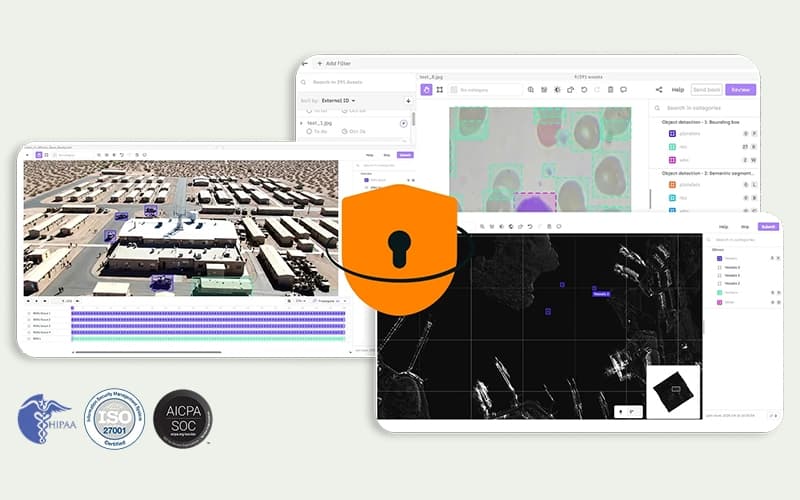
Kili helps businesses manage complex AI datasets with precision. Teams can coordinate large-scale labeling, monitor quality, and ensure consistency across projects. While some advanced labeling formats may require technical familiarity, Kili is well-suited for organizations seeking reliable datasets that improve model accuracy and accelerate AI development without constant oversight.
Kili Specifications
- Visual Recognition
- Automation
- Predictive Capabilities
- Anomaly Detection And Predictive Maintenance
Kili Features
Custom Workflows
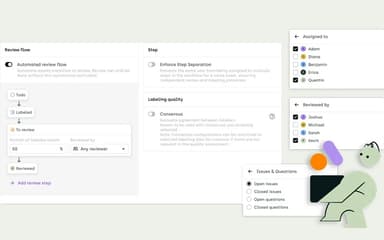
This feature helps businesses orchestrate complex annotation workflows and manage teams of any size. Teams can assign roles, optimize task queues, and ensure consistent throughput. It also enables project managers to maintain quality and efficiency from start to finish, keeping large-scale operations running smoothly.
Quality Monitoring
Businesses can use this tool to monitor annotation quality in real time. Consensus scoring and inter-annotator agreement tracking highlight discrepancies early, while automated anomaly detection flags potential errors. This proactive approach helps maintain high-quality datasets and prevents downstream issues in model training.
ML Integration
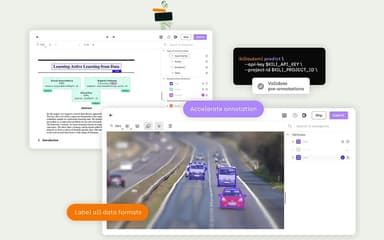
This feature helps accelerate model iteration cycles by automating data flows across your ML stack. Businesses can import raw data or model predictions, route tasks with custom rules, and export labeled datasets directly into training pipelines. It also enables continuous improvement through tight feedback loops and streamlined operations.
Pros And Cons of Kili
Pros
Stable performance ensures high-volume annotation under tight deadlines
Workflow feature enables stepwise, customizable project labeling
Keyboard shortcuts boost annotation speed and task efficiency
Cons
Geospatial label extraction is complex and requires technical skills
Auto-labeling options are limited to semantic and video boxes
Kili Reviews
Total 10 reviews
4.4
All reviews are from verified customers
Rating Distribution
5
Stars40%
4
Stars60%
3
Stars0%
2
Stars0%
1
Stars0%
Share your experience
Anonymous
Computer Software, 51-100 employees
“excellent cloud annotation”
Pros
Getting started with Kili was very simple and connecting it with cloud storage providers was simple as well. The scalability is another big advantage especially for data annotation work. Ive used it for both text and image annotation in my semi-supervised learning project and it has worked really well.
Cons
Something I'd still like to see is a higher annotation limit in the Community edition.
Rating Distribution
Ease of use
10
Value for money
9
Customer Support
9
Functionality
10
Richardo R.
Not Specified, N/A employees
“Satisfied with it”
Pros
Working with it on 3D point clouds has been a really good experience especially because annotation feels very fluid. I don't run into lag or slowdowns which makes the whole process much more efficient. Kili is one of the simplest annotation tools to get installed and up and running.
Cons
The downside is that it feels fairly expensive compared with other annotation platforms. It would be much better if they offered special pricing for users who stay with the product long term.
Rating Distribution
Ease of use
10
Value for money
8
Customer Support
9
Functionality
9
Lantosoa V.
Not Specified, N/A employees
“Made workflow efficient”
Pros
This software is pretty user-friendly and well designed. The layout is ergonomic and the various options and buttons are easy to reach which helps annotators work faster and more efficiently. Getting Kili set up in the first place is also very simple.
Cons
They can improve the interface itself. It would be even better if a built-in guide were included directly in the interface.
Rating Distribution
Ease of use
10
Value for money
10
Customer Support
10
Functionality
10
Frequently Asked Questions
Does Kili offer an API?
Yes, it offers API access.
What types of pricing plans does Kili offer?
The vendor offers two Kili price plans, including Grow and Enterprise, both available on custom pricing. A free trial is also available. Contact us to get a tailored Kili cost estimate.
What level of support does Kili offer?
It offers support through documentation and ticketing system.
What other apps does Kili integrate with?
Kili software integrates with platforms like AWS S3, Azure Blob Storage, and Google Cloud.
Who are the typical users of Kili?
Kili features serve diverse industries including financial services, insurance, national security, social media, and gaming.
Does Kili have a mobile app?
No, it does not have a mobile app?
What language does Kili support?
Kili software is primarily available in English.