

Last Updated
Overview
EMQX is a distributed MQTT messaging platform designed for massive-scale IoT connectivity. While the initial setup may be complex for new users, it delivers unmatched scalability, sub-millisecond latency, and robust security. The software is ideal for mission-critical applications, including fleet management, ensuring reliable real-time communication across devices and cloud systems.
Be the first one to leave a review!
No review found

Starting Price
Custom
EMQX Specifications
- Vehicle Tracking (GPS)
- Maintenance Scheduling
- Driver Management
- Route Optimization
EMQX Features
Real‑Time Vehicle Tracking
The platform enables precise, continuous monitoring of each vehicle’s location, operational status, and movement in real time. Fleet managers can track all assets simultaneously, improving dispatch efficiency, reducing delays, and providing accurate estimated arrival times for better operational planning and customer satisfaction.
Two‑Way Telematics Communication
EMQX supports fully bidirectional telematics communication, allowing commands to be sent to vehicles and live telemetry data to be received, including location, sensor readings, and engine diagnostics. This functionality ensures uninterrupted data flow, even over unreliable networks, and allows fleet operators to respond quickly to operational needs.
Predictive Maintenance
By continuously analyzing real-time telemetry from vehicles and trailers, EMQX can detect early signs of mechanical or operational issues. This predictive maintenance approach helps prevent costly breakdowns, reduces unplanned downtime, improves asset lifespan, and enables proactive scheduling of service interventions for better fleet reliability.
Driver Behavior Monitoring
The software monitors detailed driving behaviors such as speeding, harsh braking, rapid acceleration, and cornering patterns. This information helps fleet managers enhance driver safety, enforce compliance policies, reduce risk, lower insurance premiums, and encourage safer, more efficient driving habits across the fleet.
Route Optimization
EMQX uses real-time traffic and vehicle data to dynamically optimize routes, reducing delays, fuel consumption, and operational costs. Fleet operators can adapt to changing road conditions, prioritize urgent deliveries, and improve overall scheduling efficiency, resulting in faster deliveries and higher customer satisfaction.
Asset And Trailer Tracking
Beyond vehicles, EMQX provides full visibility for trailers, containers, and high-value mobile assets. Fleet managers can monitor utilization, prevent unauthorized usage, ensure timely deliveries, and maintain control over all critical equipment, enhancing operational efficiency and security across the entire fleet network.
Pros And Cons of EMQX
Pros
Centralized platform improves workflow and information management securely
Supports massive IoT scalability, handling thousands of devices simultaneously
Intuitive dashboard visualizes data flow and node connections clearly
Cons
Initial setup and cloud integration can be complex
Customer support is sometimes slow or unresponsive
Short free trial limits full testing of features
Advanced configurations require significant technical knowledge
EMQX Reviews

No reviews yet!
Be the first to review this product
Frequently Asked Questions
Does EMQX software have a mobile app?
EMQX itself is a backend broker, but it provides the MQTTX tool, which includes a mobile-friendly client for testing and debugging MQTT connections.
What language does EMQX software support?
The platform supports English, Japanese, and Chinese.
Does EMQX software offer an API?
Yes, EMQX provides a rich HTTP API that allows for automation, management, and integration with third-party monitoring tools and applications.
What types of pricing plans does EMQX offer?
EMQX offers four main plans: Serverless at $0/month, Dedicated Flex starting at $234/month, BYOC (Bring Your Own Cloud) with custom pricing, and Self-Managed Enterprise with custom pricing. Get an EMQX price quote.
What other apps does EMQX integrate with?
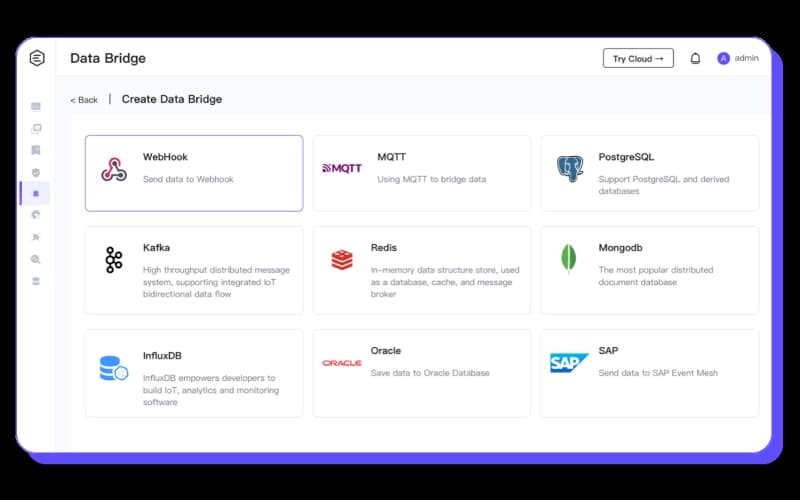
The platform supports integrations with systems like Snowflake, Azure, Oracle Cloud, and Kubernetes.
What level of support does EMQX offer?
EMQX provides support via phone and contact form.
Who are the typical users of EMQX software?
Typical users include IoT developers, system architects, and enterprises in sectors like automotive, manufacturing, and smart energy.