Last Updated
Overview
Swiss Re offers risk management software that provides tools for analyzing insurance, climate, and catastrophe risks. While implementation may involve technical setup and data integration work, its risk models, data platforms, and reporting tools support insurers and risk professionals in evaluating exposure.
Be the first one to leave a review!
No review found
Starting Price
Custom
Swiss Re Specifications
- Underwriting Management
- Risk Assessment And Analysis
- Reinsurance Management
- Reporting And Analytics
What Is Swiss Re?
Swiss Re's Risk Data Solutions is a platform used by insurers who are managing accumulation risk and portfolio-wide exposure across regions. It includes the NatCat Modelling Engine for catastrophe risk pricing and the Portfolio Insights tool for real-time accumulation monitoring, which flags breach risks before binding. The platform also offers Rapid Damage Assessment, using satellite and aerial imagery to speed up post-event claims triage. These tools help insurers tighten pricing accuracy and cut down manual review during underwriting and claims.
What Is Swiss Re Best For?
Swiss Re is best known for its location-based catastrophe and hazard exposure intelligence for insurance professionals. It is particularly known for its ability to assess multi-peril risk, including flood, wildfire, earthquake, and storm exposure, at a precise, location-specific level through its CatNet® tool. The software is a strong fit for insurers and risk teams managing large or geographically distributed portfolios, moving away from manual exposure tracking, or covering multiple markets at once.
How Much Does Swiss Re Cost?
Swiss Re pricing starts at $158.02/month. In addition to the base subscription costs, organizations should account for the following expenses:
- Implementation: Usually priced between $25,000–$150,000 (one-time), covering platform setup, system configuration, deployment preparation, and adapting risk assessment processes to match the organization’s current operations
- Data Migration: Commonly priced in the range of $10,000–$75,000 (one-time), depending on the amount, format, and complexity of transferring exposure data and past risk records into the platform
- Training And Onboarding: Typically falls around $5,000–$30,000 (one-time), covering training for administrators, underwriting teams, risk managers, and analytics users as they learn to use the platform
- Integrations: Often comes in between $15,000–$100,000 (one-time), depending on the number of connected systems and the complexity of linking underwriting platforms, data sources, and internal tools
- Customization And Configuration: Generally ranges from $20,000–$150,000 (one-time), depending on the need for custom risk models, dashboards, reporting formats, and workflow changes
- Premium Support: Usually costs around $10,000–$75,000/year, covering priority assistance, technical guidance, and dedicated support for enterprise users
Disclaimer: Pricing references are based on publicly available third-party information and industry benchmarks. Actual costs may vary.
Swiss Re Integrations
The software supports integration with multiple underwriting systems.
How Does Swiss Re Work?
Log in to your Swiss Re Risk Data Solutions account to access the platform and follow these steps to use its features:
- Set up your portfolio by entering property locations, asset values, and policy details into the system
- Run hazard models to assess flood, wildfire, earthquake, and storm exposure for each location
- Monitor accumulation by tracking risk concentration across your portfolio and reviewing alerts for potential breaches
- Use catastrophe model outputs to support pricing and underwriting decisions
- Process claims by using imagery-based damage assessment after a catastrophic event
- Track climate exposure by reviewing sustainability and supply chain risk data tied to specific assets
- Generate reports with portfolio-level dashboards to review exposure trends and support regulatory or internal reviews
Who Is Swiss Re For?
Swiss Re is suitable for organizations, teams, and professionals involved in insurance risk assessment, including:
- Primary insurance carriers
- Reinsurance companies
- Underwriting teams
- Risk managers
- Exposure management teams
- Insurance brokers
Swiss Re Use Cases
Based on our analysis of Swiss Re’s current capabilities, we have identified key scenarios where this software is a good fit for insurance carriers, reinsurers, and organizations managing physical risk exposure:
Insurers Expanding Into New Geographic Markets
Carriers moving into unfamiliar regions usually lack the local risk knowledge needed to underwrite with confidence. Historical loss data and regional hazard patterns take years to build internally, and that gap becomes a real liability when expansion moves faster than institutional knowledge. Swiss Re may be a suitable fit for underwriting teams needing consistent, location-specific hazard data for flood, wildfire, earthquake, and storm exposure before entering new territory.
Reinsurers Monitoring Portfolio-Wide Accumulation Risk
Large carriers and reinsurers holding exposure in multiple regions deal with a problem that builds quietly. Risk concentration can build unnoticed until a single event threatens capital reserves or treaty terms. Swiss Re may be relevant for risk teams managing diversified books of business, particularly those that need real-time visibility into accumulation thresholds and early warning before exposure limits are breached.
Insurers Responding To Active Catastrophe Events
After a hurricane, wildfire, or other large-scale event, claims teams face pressure to assess damage quickly. Adjuster access to affected areas is frequently delayed or restricted, and that bottleneck slows claims resolution at the moment speed matters most. Swiss Re may support claims teams by using satellite and aerial imagery to estimate property damage and speed up initial claims triage.
Corporates Assessing Physical Climate Risk To Assets
Organizations with assets spread over multiple climate zones tend to struggle when quantifying how extreme weather could disrupt operations. Physical risk data is rarely centralized or location-specific, which complicates resilience planning and disclosure requirements alike. Swiss Re may be worth considering for sustainability and risk teams that need digital twin modeling to evaluate climate exposure in distributed facilities or supply chains.
Underwriting Teams Pricing Catastrophe-Exposed Policies
Underwriters' pricing policies in catastrophe-prone regions face a persistent challenge. Relying on historical loss assumptions alone tends to misprice risk as climate patterns shift, and that gap between past data and present exposure creates real pricing uncertainty. Swiss Re can help underwriting teams handling high policy volumes in recurring catastrophe zones, where model-based loss estimates inform more consistent risk selection.
Is Swiss Re Right For You?
If you are an insurer or risk team that needs location-specific catastrophe data backed by over 160 years of underwriting expertise, Swiss Re could be a strong fit. Its standout strength, CatNet®, has over 10,000 registered users worldwide and a track record of more than 20 years, with clients such as Steadfast Group and Golden Bear Insurance.
Organizations needing deeper risk selection support can also turn to the NatCat Modelling Engine, which adds proprietary models covering six major perils and 160+ catastrophe risk models worldwide. This combination makes Swiss Re well suited for teams that require detailed risk assessment and global hazard coverage.
Still unsure about Swiss Re? Connect with us at (661) 384-7070 for further guidance.
Swiss Re Features
Portfolio Insights
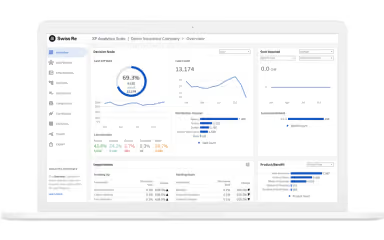
Insurers can upload entire portfolios and analyze millions of data points within seconds, using customizable charts and map-based visualizations to spot what matters. An API or frontend interface enriches that data with catastrophe risk layers and building characteristics. Optimization models then surface accumulation risks across business lines, geographies, and catastrophe zones, pointing toward an ideal portfolio mix.
NatCat Modelling Engine
This feature gives underwriters access to a suite of more than 160 proprietary natural catastrophe risk models, covering six major perils worldwide. Each model accounts for full exposure information and insurance conditions, and pricing quotes come back automatically within seconds. The engine plugs into existing digital systems through API technology, with a customizable consumer-facing front end available on request.
Rapid Damage Assessment
Proprietary hazard models pair with artificial intelligence on aerial imagery to assess property damage as natural catastrophe events unfold. Three phases of claims response are built in: monitoring probable portfolio impact before an event, prioritizing property inspections afterward using imagery analysis, and enabling remote triaging with filterable loss reports for faster claims settlement.
Property Exposure Management
A digital twin of single properties or entire portfolios puts risk into one centralized view, ready to visualize and explore. Layering in expert data on natural hazards and other risk factors reveals exposure clusters and loss patterns that might otherwise stay hidden. From there, teams can model future scenarios, monitor real time events, and send alerts to stakeholders as conditions change.
Sustainability Compass
Property and project data feeds into a digital twin built to support climate-related risk reporting under frameworks such as EU Taxonomy, TCFD, and CSRD. Natural catastrophe layers and climate modeling simulate future scenarios and quantify value at risk. Built-in templates and expert collaboration tools then help shape that work into reporting for internal and external stakeholders.
Pros And Cons of Swiss Re
Pros
Improves risk selection with clearer exposure understanding
Strengthens pricing decisions with more accurate risk evaluation
Reduces portfolio concentration through better risk awareness
Speeds up claims handling after catastrophe events
Increases visibility into property and climate exposures
Cons
May require specialist insurance knowledge to interpret risk outputs
Data coverage may vary by region and peril
Advanced features might require additional data inputs
Swiss Re Reviews
No reviews yet!
Be the first to review this product
Frequently Asked Questions
What level of support does Swiss Re offer?
Swiss Re offers support via phone and email.
What other apps does Swiss Re integrate with?
Swiss Re software integrates with multiple underwriting systems.
Who are the typical users of Swiss Re?
Swiss Re features are used by primary insurance carriers, reinsurance companies, underwriting teams, risk managers, exposure management teams, and insurance brokers to assess catastrophe risks, analyze portfolios, and support risk decisions.
Does Swiss Re have a mobile app?
No, Swiss Re does not offer a dedicated mobile app.
What language does Swiss Re support?
Swiss Re's global website is available in English, with dedicated regional sites in local languages such as Portuguese and Chinese.
Does Swiss Re offer an API?
Yes, Swiss Re offers an API.
What types of pricing plans does Swiss Re offer?
Swiss Re is available starting at $158.02 per month. Get a detailed Swiss Re cost breakdown to make an informed decision.