Article
How To Improve Your Brand's AI Visibility And Get AI Recommendations
20 mins read
Last Updated


By Rohab Tariq Hanjra and


Article
20 mins read
Last Updated
By Rohab Tariq Hanjra and
AI can recognize your brand without ever recommending it. That's the bottom line.
According to a 2026 study published in Search Engine Journal, AI models accurately identified brands 96% of the time when asked about them directly. But when the question changed from recognition to recommendation, such as “what are the best [category] brands for [use case]?” 89% of brands were never mentioned.
This difference in AI recognizing your brand vs recommending your brand is what marketers should be fighting for today. This guide focuses on exactly that part: how to increase your brand’s visibility in AI-generated answers and improve your chances of being recommended when buyers are ready to choose.
To understand what drives AI visibility and recommendations, Software Finder spoke with Kelsey Libert, co-founder of Fractl and Harvard Business Review columnist. The insights throughout this guide are informed by that discussion, alongside current research, studies, and analysis of AI search behavior.
'AI brand visibility is how often, and how favorably, your brand appears in AI-generated answers when asked about something relevant to your category, product, or expertise.'
This might be the simplest working definition of AI brand visibility but at its core, it's made up of four different but key dimensions:
Of the four, recommendations are the most commercially valuable. They put your brand forward as the solution to users who are already ready to buy.
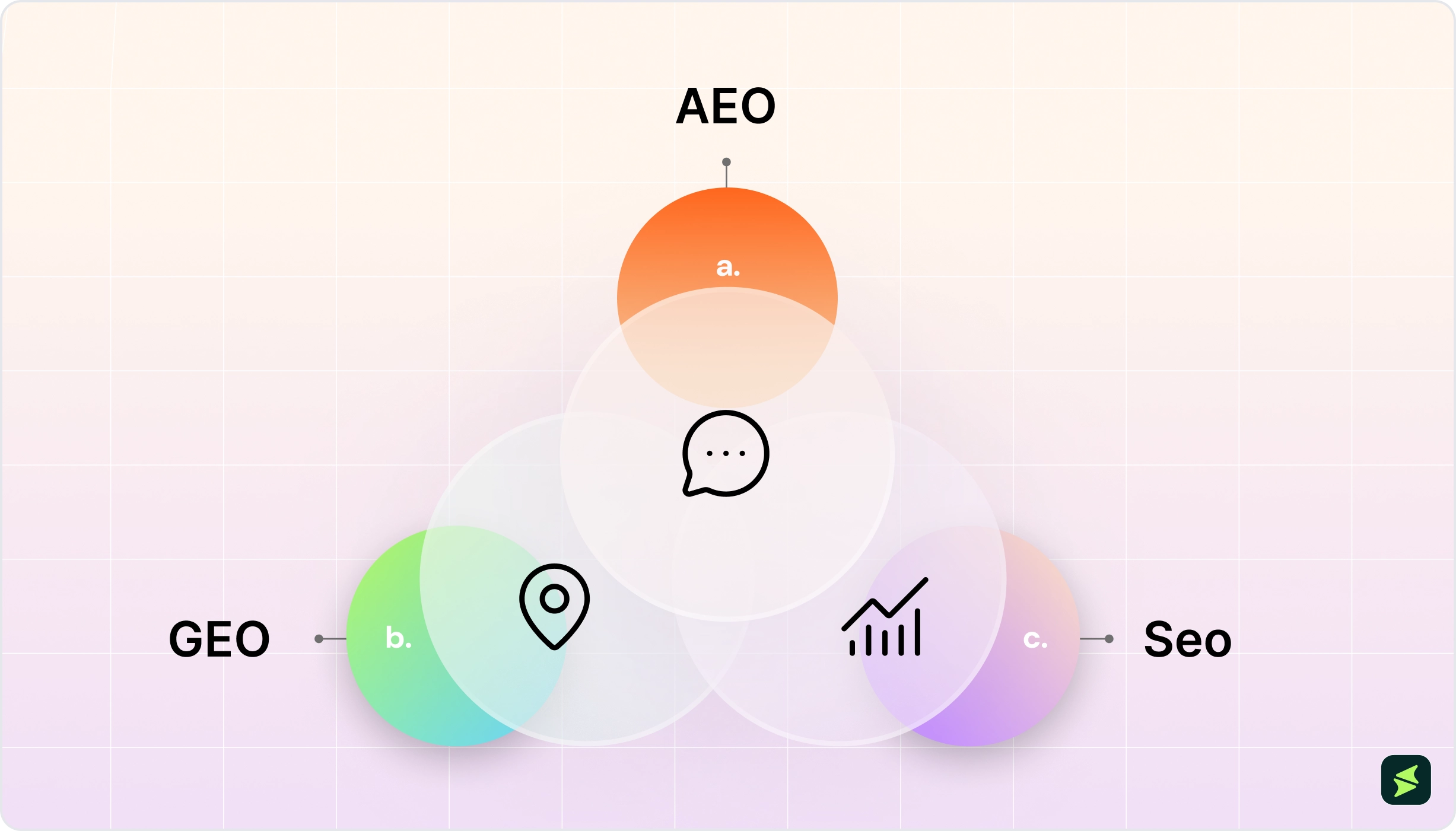
You must have already heard these terms recently. Still, to help put things into perspective, let's go through them once.
SEO | AEO | GEO | |
|---|---|---|---|
Primary goal | Rank higher in search results | Become the direct answer to a query | Get mentioned, cited, or recommended in AI-generated answers |
Where it appears | Traditional search results | Featured snippets, answer boxes, voice assistants | ChatGPT, Claude, Gemini, Google AI Overviews, etc. |
What you're optimizing for | Clicks and rankings | Answers and visibility | Mentions, citations and recommendations |
Typical user experience | User searches → sees links → clicks your page | User searches → gets a direct answer | User asks AI → AI synthesizes an answer using multiple sources |
Example | Ranking #1 for “best payroll software” | Winning the featured snippet for “how does payroll work?” | ChatGPT recommending your payroll software when asked for the best options |
Within this triangle, AI brand visibility is essentially the outcome GEO is built to produce. But before understanding how AI recommends your brand, let's look at how brand visibility works in AI search engines.

For AI, your website is not static. It's an entity, a personality. One useful way to think about this is the 'Entity Authority'. It's simply what the internet, as a whole, says about you and what you're known for.
It is the accumulated signals across the web that help AI systems understand what your brand is known for, how credible it is, and where it fits within a category.
Your own homepage claiming you're the best carries almost no weight here. What matters is whether reviews, publishers, forums, and other third parties back that claim up. There are two ways AI builds and checks your entity authority:
First – Model's Training Data: This is everything the AI learned before it was released. It is its memory that it built once and can't easily update. If your brand was well-known online back then, it remembers you. If not, it simply doesn't know you exist and there's no quick way to fix that once the model is live.
Second – Live Retrieval: This is the AI checking the internet in real time. The moment someone asks it a question; the model runs a search in the background. Instead of relying only on memory, it quickly looks at a handful of current web pages and builds its answer from what it finds there.
Kelsey draws the same distinction from the vendor side of the industry:
Essentially speaking, live retrieval is where you actually have a say. You can't rewrite the AI's memory, but you can absolutely influence what shows up when it searches live and that's where real, fast progress happens.
Catch the full webinar with Kelsey Libert below.
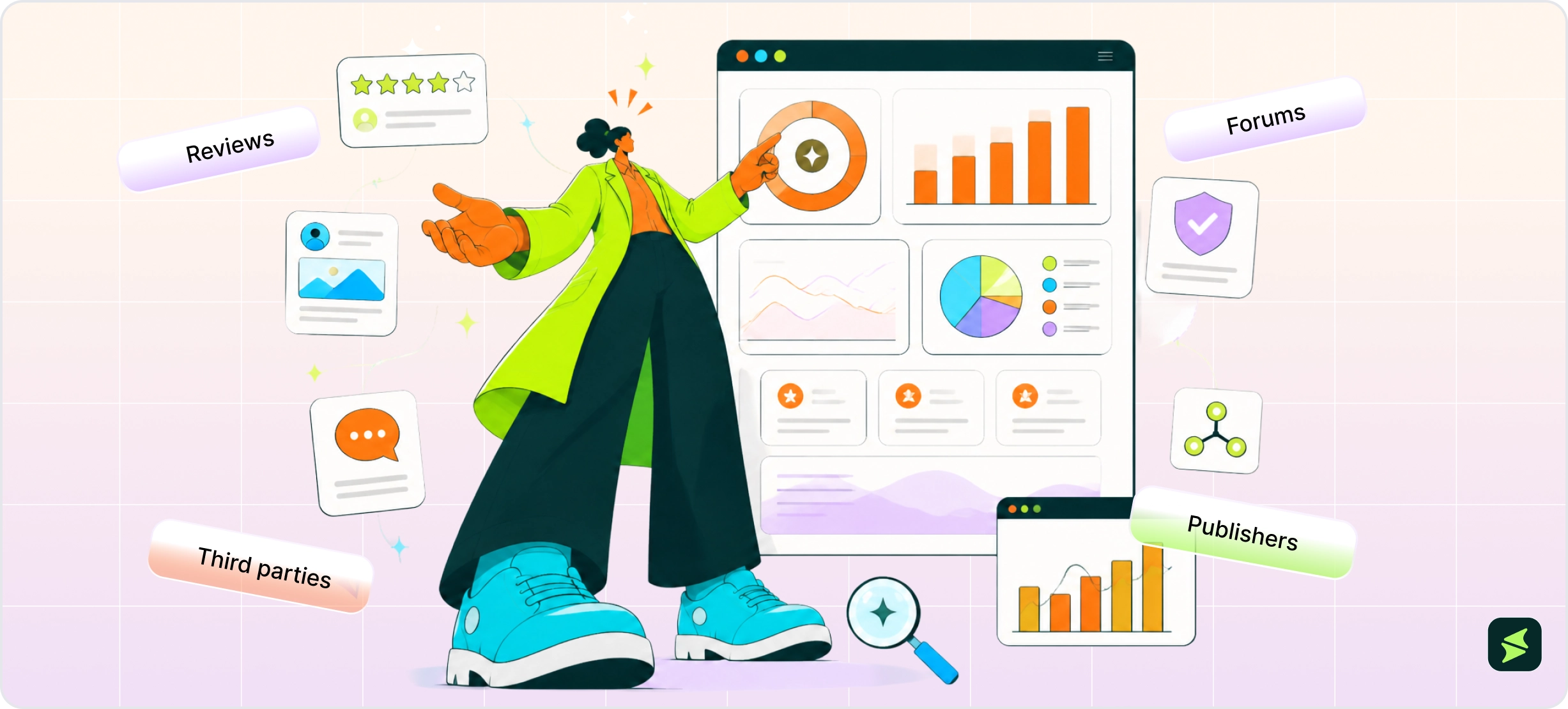
Recognition and recommendation both trace back to one thing: entity authority.
If this sounds familiar, it should. It's not a new concept. It is not an official framework, but it works a lot like E-E-A-T, the experience-expertise-authoritativeness-trustworthiness framework Google uses to evaluate content quality. Think of entity authority as E-E-A-T applied to how a generative model chooses what to cite.
It has two distinct parts:
Neither one substitutes for the other. A brand with deep expertise but zero outside citations is invisible to AI, no matter how good the insight is. A brand with wide but shallow mentions is recognizable but doesn't earn the trust that gets it recommended. Kelsey describes entity authority as a combination of depth and breadth:
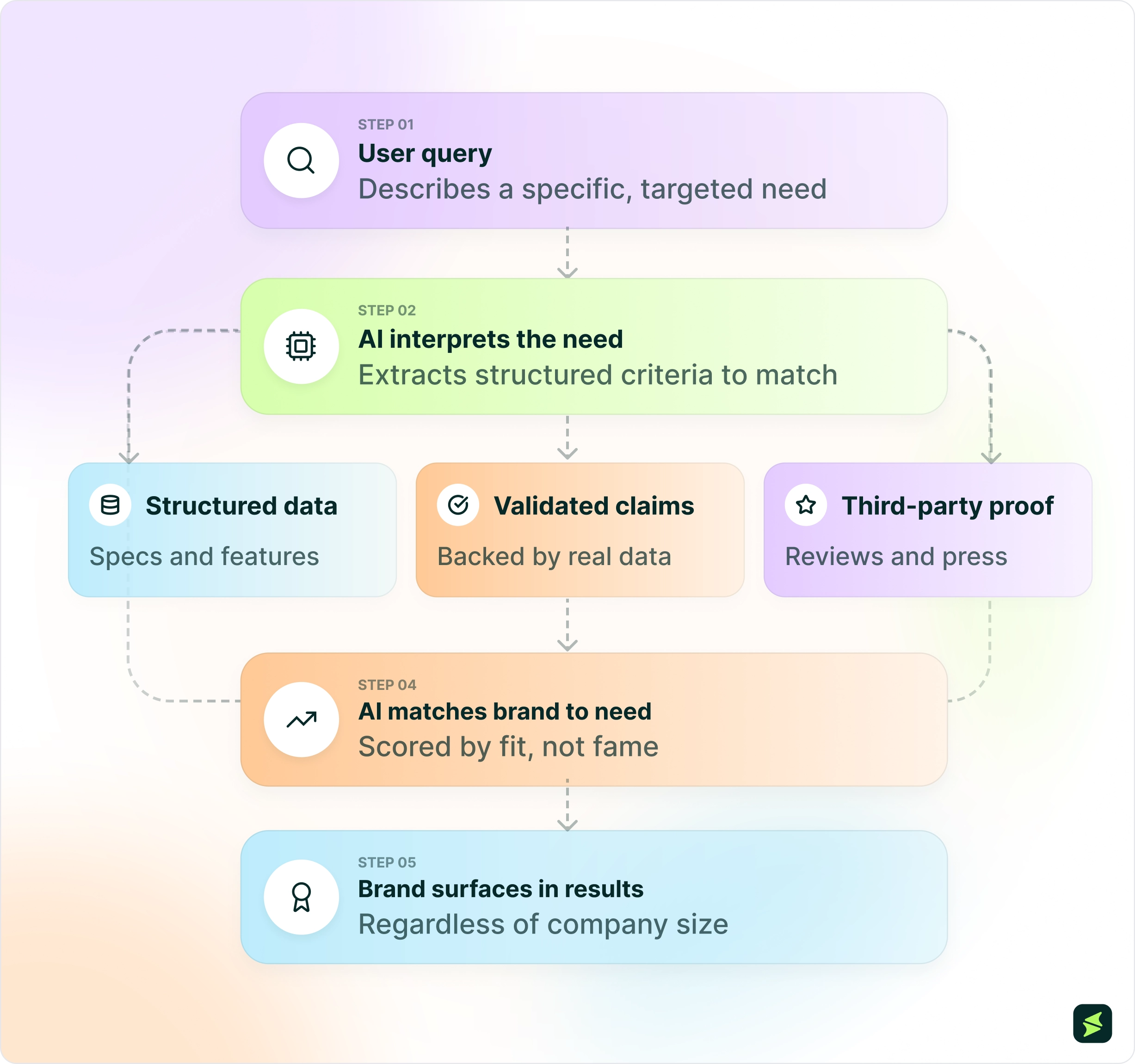
When an AI platform recommends a brand, brand awareness alone isn't necessarily what gets it there. The brand has to be easy for the AI to understand, compare, and connect to a specific customer need.
A June 2026 Harvard Business Review study by John Gale, Luca Cian, and Luc Wathieu demonstrates why this matters. The researchers asked ChatGPT, Claude Anthropic, and Google Gemini to recommend running shoes, and found that Brooks appeared consistently across the platforms. Nike, the world's largest athletic footwear and apparel brand, appeared much less often. Across 15 retail categories, only 8.4% of brands appeared consistently in recommendations from all three AI platforms.
The researchers describe this advantage in terms of interpretability: how easily an AI system can understand a brand's attributes and determine whether those attributes match what a customer is looking for. A brand, therefore, needs more than awareness. Its products, differentiators, and customer benefits need to be explicit enough for an AI system to identify and compare them.
Three factors are particularly important:
Clearly Defined Product Attributes: AI needs factual details it can use to compare one product with another. If we take an HR software platform as an example, that could include supported employee counts, payroll capabilities, attendance tracking, integrations, pricing structure, mobile availability, and compliance features. These details give AI specific attributes to match against a user's query instead of forcing it to infer what the product does from vague marketing language
Benefits Tied To Specific Use Cases: AI can recommend a product more confidently when its benefits are connected to a particular customer problem. If we move with the HR software example, a 'saves time' attribute tells an AI very little. 'Automatically calculates overtime and generates payroll reports for hourly employees' gives it a specific capability that can be matched to a query about reducing manual payroll work. The more precisely a benefit describes what the product does, for whom, and in what situation, the easier it is for AI to connect that benefit to a user's needs
Claims Supported By Independent Sources: Finally, it's important for an AI model to validate your brand's claims using information beyond your own website. If your product page says your software is easy to use, that claim becomes more meaningful when third-party review sites, customer reviews, case studies, or analyst publications describe the same strength. Kelsey makes the same point from the perspective of AI visibility research:
Important Note: In one of its articles, McKinsey & Company highlighted that, in many cases, only 5–10% of the sources referenced by AI search come from a brand’s own website, while the remaining 90–95% come from third-party sources. This shows how important off-site brand presence is for AI visibility.
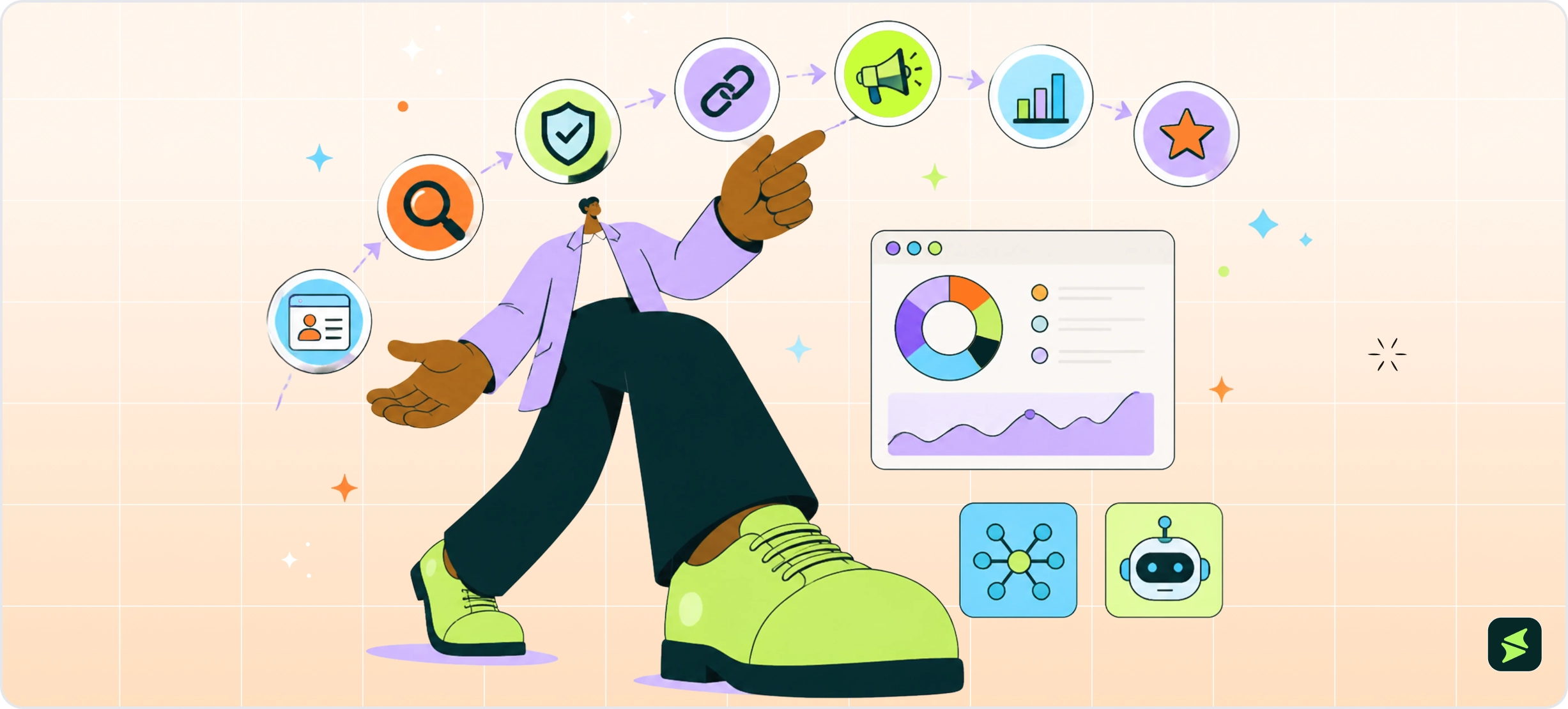
AI visibility isn't something you create by sprinkling a few keywords across your website or publishing dozens of AI-generated articles. You need to make your brand easy to identify, easy to understand, easy to verify, and easy to recommend.
The strategy below focuses on the signals AI systems can actually use: your technical accessibility, the specificity of your product information, evidence supporting your claims, third-party coverage, original data, community discussions, and the depth of your content.
Before changing anything, establish how AI systems currently describe and recommend your brand.
Run the same set of prompts across ChatGPT, Claude, Perplexity, and Google AI Overviews. Don't limit the test to searches containing your brand name. Ask both brand-specific questions and category-level questions, such as:
Such prompts will record two separate outcomes: recognition and recommendation.
Recognition tells you whether AI systems understand that your brand exists, what it does, who it serves, and what differentiates it. Recommendation tells you whether that understanding is strong enough for the system to actually put your brand forward when a buyer is choosing between alternatives.
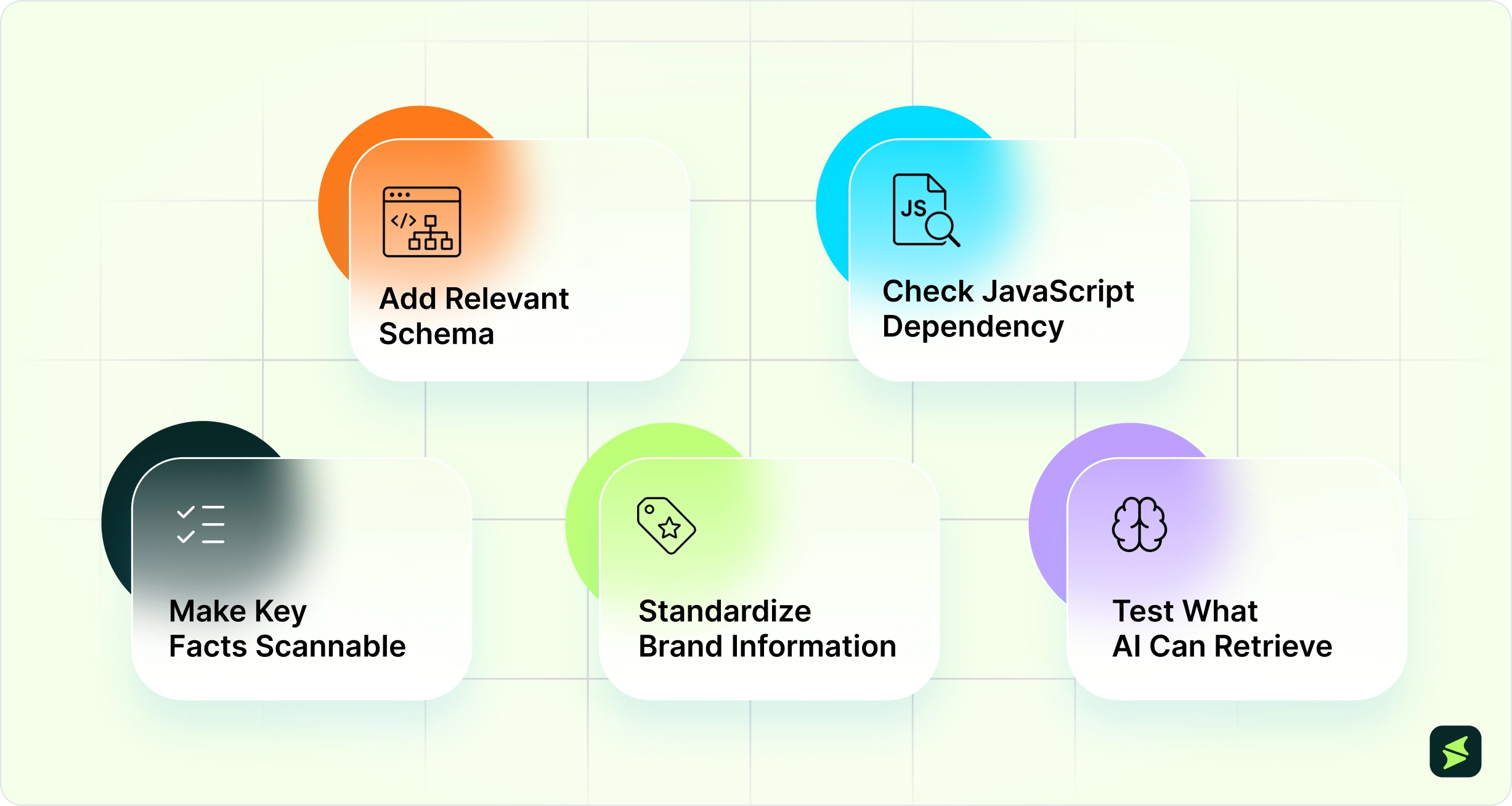
Before trying to build authority elsewhere, make sure AI systems can actually access and interpret the information you already publish. Your goal is to remove unnecessary ambiguity or any scattered, misleading, or inaccessible information about your business.
You can use a technical foundation checklist to make sure of this:
'Industry-leading,' 'powerful,' 'easy to use,' and 'trusted by thousands' are claims. On their own, they give an AI system little concrete information to use when comparing your brand with another.
A 2024 GEO study (KDD, tested on 10,000 queries) found that adding statistics, quotes, and citations to credible sources produced up to a 40% lift in AI citation, while keyword stuffing performed worse than doing nothing at all.
Kelsey has watched this play out across client sites:
Replace generic claims with solid evidence.
Use review ratings, review counts, customer numbers, performance data, survey results, implementation outcomes, security certifications, uptime figures, and named case studies where you can substantiate them.
Your website isn't the only place AI can learn what your product does. For software brands especially, review sites, comparison platforms, directories, analyst publications, and buyer's guides can provide third-party information that AI systems use when evaluating vendors. Kelsey's own research backs this up directly:
Here's how you can use third-party presence as a strategic extension of your website:
For an SMB, this doesn't have to become an expensive backlink campaign. Start with free listings and the platforms that already influence your category's AI answers. Pay for premium placements only when you can demonstrate that the platform reaches your buyers or contributes to visibility.
If your website simply repeats information already available on hundreds of other pages, AI has little reason to treat it as a distinctive source. The stronger opportunity is to publish information that you created, collected, measured, or observed yourself.
That could mean (again using our example of a SaaS product such as an HR Platform):
On what separates data that gets covered from data that gets ignored, Kelsey said:
For example, 'Most companies struggle with employee retention' isn't particularly useful. It is an obvious conclusion repeated across thousands of articles.
'42% of the 500 HR managers we surveyed said their biggest retention problem occurs within the employee's first six months' is different. It contains new data, a defined sample, a measurable finding, and a specific insight that other sources may not have.
Original research can earn AI visibility in two ways. AI can cite the research itself when answering a relevant question. Second, other publishers can reference your findings, creating additional third-party mentions and citations around your brand.

Community platforms can give AI something a corporate website often cannot: evidence of how real people discuss a product, problem, or category.
Reddit and YouTube, for example, have emerged as major sources in AI-generated answers, although the importance of each platform varies by engine and query type. A 2026 analysis of 30 million AI sources by PEEC AI found Reddit was the most-cited domain overall, with YouTube a close second.
But this does not mean creating Reddit accounts to repeatedly post links to your own website. That approach can backfire. Communities recognize promotional behavior, and a stream of obvious self-promotion creates the opposite of the authentic discussion you're trying to build. Kelsey is open about why this backfires:
Instead, participate where your expertise genuinely belongs. Answer questions about problems your team understands. Explain how a product category works. Correct misconceptions. Share useful experiences. When your own product is relevant, disclose your affiliation and contribute information rather than turning every answer into a sales pitch.
A product page explains what you sell. A resource hub demonstrates that you understand the problem your product exists to solve. This is why the strongest AI-visibility strategies treat a brand more like a publisher than a catalog. Kelsey Libert recommends taking the same approach:
If you sell payroll software, don't stop at pages describing payroll features. Build resources around payroll compliance, payroll calculations, implementation, payroll errors, integrations, employee classifications, reporting, and the questions buyers ask before choosing software.
Cover the category from multiple angles, with clear explanations, original data, expert input, examples, and comparisons where appropriate. The goal here should be to create a body of content that gives AI systems multiple opportunities to encounter your brand while researching the same broader topic.
This becomes even more important as AI systems expand a single prompt into related searches. Kelsey describes this as “query fan out,” explaining that brands can improve their visibility by covering the subtopics and questions surrounding the primary query. It's better than creating a thin page focused on one term.

You don't need an expensive AI visibility platform to know whether your brand is becoming more visible in AI search. In fact, you should have a measurement framework in place before you go out buying any visibility tools.
Start by expanding the prompt set from your initial audit into a baseline of roughly 20-30 prompts across different search intents, including:
Keep these prompts unchanged when you measure progress. Otherwise, you risk comparing two different sets of questions and mistaking a change in the sample for a change in visibility.
A simple spreadsheet is enough to establish your first baseline.
1. Mention Rate
How often does the AI platform mention your brand?
If your brand appears in 12 of 30 relevant prompts, your mention rate is 40%.
This tells you whether the brand is entering the answer set at all.
2. Citation Rate
How often does the AI platform link to or cite your website as a source?
This is different from being mentioned. An AI engine might recommend your product while citing a third-party review, directory or publication instead of your own website.
3. Share Of Voice
How often does your brand appear compared with the competitors you care about?
For example, if your brand and four competitors are mentioned across your tracked prompts, record which brands appear and how prominently. This gives you a competitive benchmark rather than an isolated “we were mentioned” metric.
4. Accuracy And Sentiment
Record how the AI describes you, not just whether it names you.
Is the pricing correct? Are the features current? Does it associate you with the right category? Does it describe your product positively, neutrally or negatively?
5. Recommendation Rate
How often does AI recommend your brand when the prompt asks for products, vendors, tools, or solutions?
For example:
If your brand is recommended in 9 of 30 category-level prompts, your recommendation rate is 30%.
Don't panic because an AI platform failed to mention your brand today when it mentioned you last week. Establish a measurement cadence. Run your fixed prompt set weekly or monthly, depending on how actively you're working on AI visibility, and compare the results against your previous baseline.
For example:
Metric | Baseline | Month 1 | Month 2 |
|---|---|---|---|
Brand mention rate | 24% | 31% | 38% |
Citation rate | 10% | 16% | 22% |
Share of voice | 8% | 11% | 15% |
Accurate descriptions | 62% | 74% | 86% |
The important signal isn't that your brand appeared in one particularly good answer. It's that visibility, citation frequency, and positioning are improving across the same set of commercially relevant questions.
There's also an important distinction between measuring AI answers and measuring traffic generated from AI search. For Google, you no longer have to rely entirely on third-party estimates. Google Search Console now has a dedicated ‘Generative AI performance’ report that shows impressions from AI Overviews and AI Mode, including which pages receive those impressions and where they originate.
A spreadsheet starts becoming inefficient when you have hundreds of prompts, multiple markets, several competitors, and frequent measurement cycles. That's when an AI visibility platform can earn its place in the budget.
The tool should reduce manual work, not replace your measurement strategy. Before paying for one, check whether it lets you:
This is the exact checklist Kelsey also recommends brands run before signing any contract:
For years, winning search, traffic, and ultimately buyers, meant publishing more content, building more backlinks, and spending more ad budget for the number one spot. AI is quietly rewriting that rule.
Strong traditional search visibility does not automatically translate into strong visibility inside AI-generated recommendations. Traditional search rankings and AI citations overlap far less than you might expect. In a 2026 analysis of 4 million Google AI Overview URLs, Ahrefs found that only 37.9% of cited pages also ranked in Google's top 10 for the same query.
That gap is exactly where the opportunity sits, especially for small and midsize businesses. For greater AI Visibility, they don't need a bigger budget than the market leader in their category. They need to be easier for AI to understand than their competitors.

