


B2B software buyers increasingly start with Google or AI chatbots rather than aggregator sites, shifting traffic and influence along the buying journey. This report analyzes website traffic, AI citations, and survey data, revealing that the most-referenced platforms by AI suffer the largest traffic drops, while those addressing buyer needs gain ground.
Visibility alone is no longer enough. What matters now is how directly you meet buyer intent.

- 68% of B2B buyers begin their software research with Google or AI tools.
- 82.5% of buyers under 40 have used AI chatbots for software evaluation, compared with 65% of buyers 40 and older.
- The five most AI-cited aggregator platforms lost an average of 67% of their organic traffic over 48 months.
- Legacy aggregators (established sites) collectively lost approximately 2.9 million monthly visits, while intent-first challengers (newer sites) grew 37%.
- Category-page models are declining as AI tools extract structured data without requiring site visits.
The most consequential finding in this analysis isn't about traffic or algorithms . It's about people.
A survey of 556 B2B software buyers reveals that younger workers now ascending into enterprise purchasing roles have fundamentally different discovery habits than their predecessors.
For aggregator platforms built on the assumption that buyers begin with category browsing, these behavioral shifts represent an existential threat.
Where B2B Buyers Now Start Their Software Search
Discovery no longer begins on category pages. It begins with search engines and AI.

When asked where they first go to research workplace software, buyers responded:
- Google search: 48%
- AI tools (ChatGPT, Perplexity, etc.): 19.8%
- Peer recommendations: 14.7%
- Vendor websites: 8.5%
- Aggregator sites: 5.4%
- Social media: 2.3%
- Industry publications: 0.9%
A combined 68% start with Google or AI.
Decision patterns reinforced this shift. A majority (60.4%) said they begin with Google or AI and then conduct deeper product research. Another 22.1% rely primarily on peers. Just 10.6% said they mainly depend on aggregator sites.
Aggregators have shifted from entry points to optional checkpoints.
The Age Divide in AI Adoption
AI usage in software research is no longer experimental behavior. It's standard practice.

Across all respondents, 74.5% reported using an AI chatbot to evaluate or compare workplace software.
The age divide is significant:
- Under 40: 82.5%
- Age 40+: 65%
Among the 414 buyers who used AI for research, they most often did so for:
- Comparing tools side by side: 66.7%
- Summarizing reviews: 53.1%
- Explaining how tools work: 48.8%
- Finding pricing and feature details: 48.8%
- Identifying alternatives: 41.1%
A full 92.2% found AI useful.
These activities mirror the traditional functions of aggregator sites. The difference is that AI delivers fast answers without requiring users to visit the original source.
What Content Actually Influences Purchase Decisions
Buyers were asked which content types are most helpful when making a software purchase decision. Here's what they said:
- User reviews from real customers: 47.5%
- Feature-by-feature comparisons: 39.2%
- Pricing details and transparency: 35.6%
- Free trials or demos: 35.3%
- Video walkthroughs: 25.4%
- Analyst reports: 23%
- AI-generated summaries or comparisons: 21%
- Case studies: 18%
- Webinars: 9.9%
- Social media posts: 9.9%
- Blog/long-form content: 7.2%
AI-generated summaries rank seventh , below video walkthroughs and analyst reports. This suggests that while buyers use AI as a research accelerant, they do not yet trust it as a primary decision input. Reviews, comparisons, and pricing remain the decisive content types.
When asked which tools they use to compare B2B software, the hierarchy again points to the aggregator's declining role.

Aggregator sites rank fifth among comparison tools , below Google, AI chatbots, peer input, and even AI overviews.
For most trusted sources when building a software shortlist, peer input leads at 43.5%, followed by online communities (36.7%), demos/trials (31.7%), and ChatGPT/AI chatbots (31.3%). Aggregator sites rank ninth at just 13.5%.
Trust in Aggregators: Stable but Shallow
Trust in aggregator platforms hasn't collapsed , but it hasn't deepened either. When asked how their trust in B2B software aggregator and review sites has changed over the past two years, 16% trust them more, and 69% trust them about the same as before.
Combined, 85% of buyers trust aggregators the same or more than two years ago. That sounds reassuring , until you note that trust does not equal usage. Buyers may trust these platforms in the abstract while increasingly routing around them in practice.
Attitudes toward AI comparisons are nuanced: 42.1% find them helpful but do not actively seek them out, while 30% actively seek AI-generated comparisons.

On the question of how AI affects their understanding of software tools, 38.7% said AI helps them understand tools better. Another 26.1% said it speeds up research, 22.7% treat it as just another input, and 12.6% expressed concern about bias, hallucination, or outright distrust.
If AI chatbots are becoming a primary research channel for B2B buyers, one might expect that the platforms most frequently cited by those chatbots would benefit from increased traffic.
But the data shows the opposite.
More AI Visibility, Less Website Traffic
We analyzed citation patterns across five major generative AI tools ( Google AI Overview, ChatGPT, Perplexity, Gemini, and Microsoft Copilot) to measure how frequently each aggregator platform is referenced in AI-generated responses to software-related queries.
We then cross-referenced these citation counts with 48-month organic traffic trends from Ahrefs.
The results are counterintuitive.
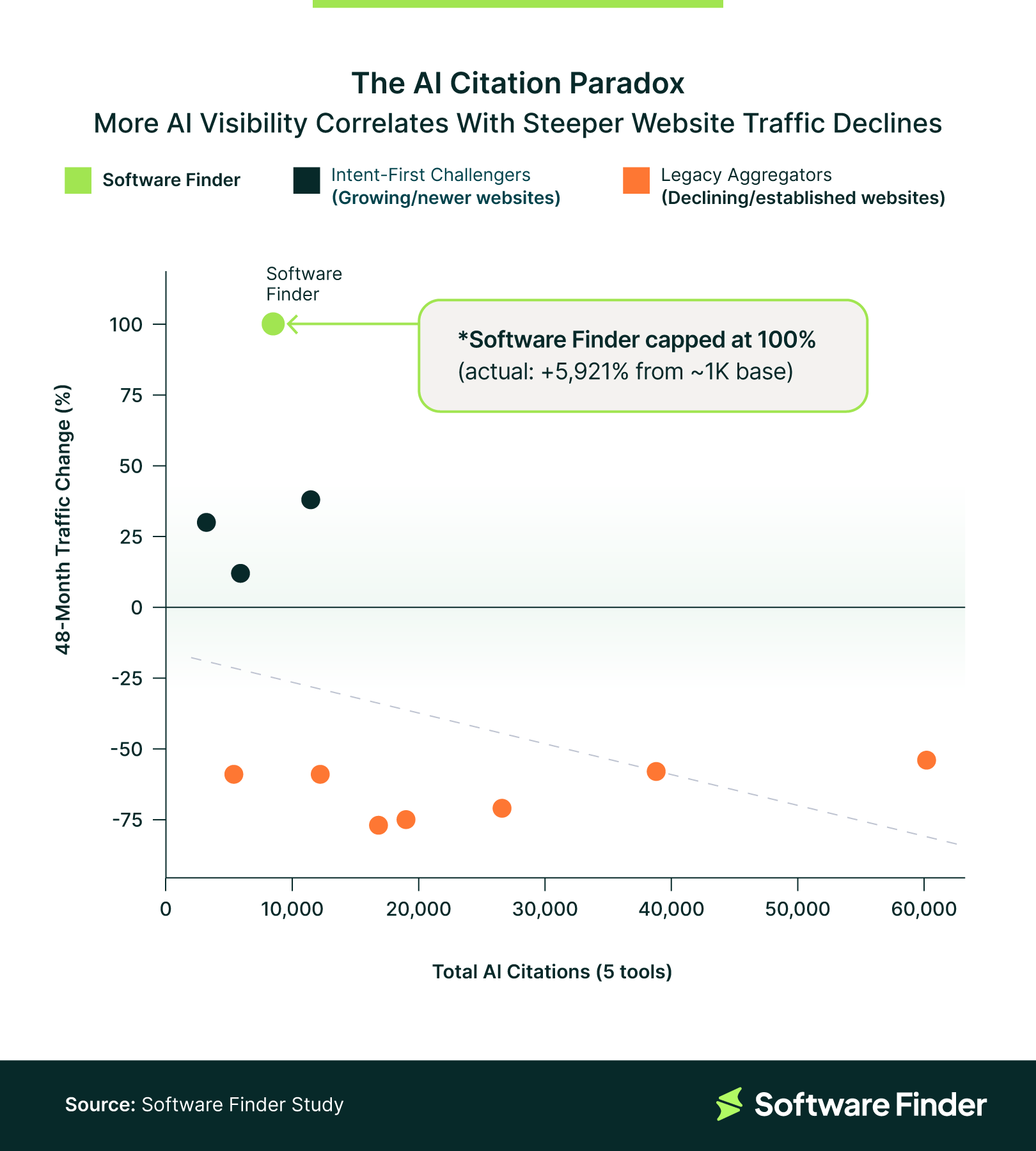
The five most AI-cited platforms lost an average of 67% of their organic traffic.
By contrast, the platforms with fewer AI citations experienced growth or moderate stability. This inverse correlation suggests that AI tools are functioning as an extraction layer . They surface aggregator data in chatbot responses, while eliminating the need for users to visit the source platforms.
The Extraction Layer Hypothesis
The AI Citation Paradox can be understood through what we term the "extraction layer" model.
In traditional search, the value chain was: vendor data → aggregator curation → Google ranking → buyer visit
Generative AI tools have inserted a new layer that compresses this chain: vendor data → aggregator curation → AI ingestion → AI-generated response → buyer decision
The aggregator still contributes data, but the buyer no longer needs to visit the aggregator to access it. This dynamic is self-reinforcing. The more comprehensive an aggregator's review corpus, the more useful it is to AI tools, and the more frequently it is cited.
But each citation represents a query that might previously have led a buyer to visit an aggregate's website directly. High AI citation counts appear to be a trailing indicator of content value rather than a leading indicator of traffic growth.
With the behavioral context in mind, the traffic data tells a coherent story. The decline of legacy B2B software aggregators is not a temporary algorithmic fluctuation , but a structural shift driven by changing buyer behavior, AI extraction, and Google's evolving approach to content quality.
We categorized the 11 platforms into two groups based on a 48-month trajectory and content model:
- Legacy aggregators (declining): G2, Capterra, Software Advice, GetApp, TrustRadius, SaaSworthy, SoftwareWorld
- Intent-first challengers (growing): Software Finder, Crozdesk, TechnologyAdvice, Slashdot
What's the Difference?
Legacy aggregators are established B2B software marketplace and review sites that built their traffic primarily through broad, category-based pages such as "best CRM software." These platforms traditionally focused on ranking for high-volume discovery keywords and organizing vendors into comparison lists.
Intent-first challengers are newer or more adaptive platforms that prioritize answering specific buyer questions. Instead of broad category pages, they focus on product-level explainers, pricing breakdowns, implementation guides, and head-to-head comparisons designed to match high-intent searches.
Category-Level Decline: ~2.8 Million Monthly Visits Erased
Across all legacy aggregators, approximately 2.9 million monthly visitors were lost over 48 months, a 61% decline. In contrast, intent-first challengers saw 37% growth.
Aggregator Type | Jan 2022 | Jan 2026 | 48-Mo Change |
Legacy | 4,763,453 | 1,854,373 | -61% |
Intent-First | 392,431 | 535,822 | +37% |
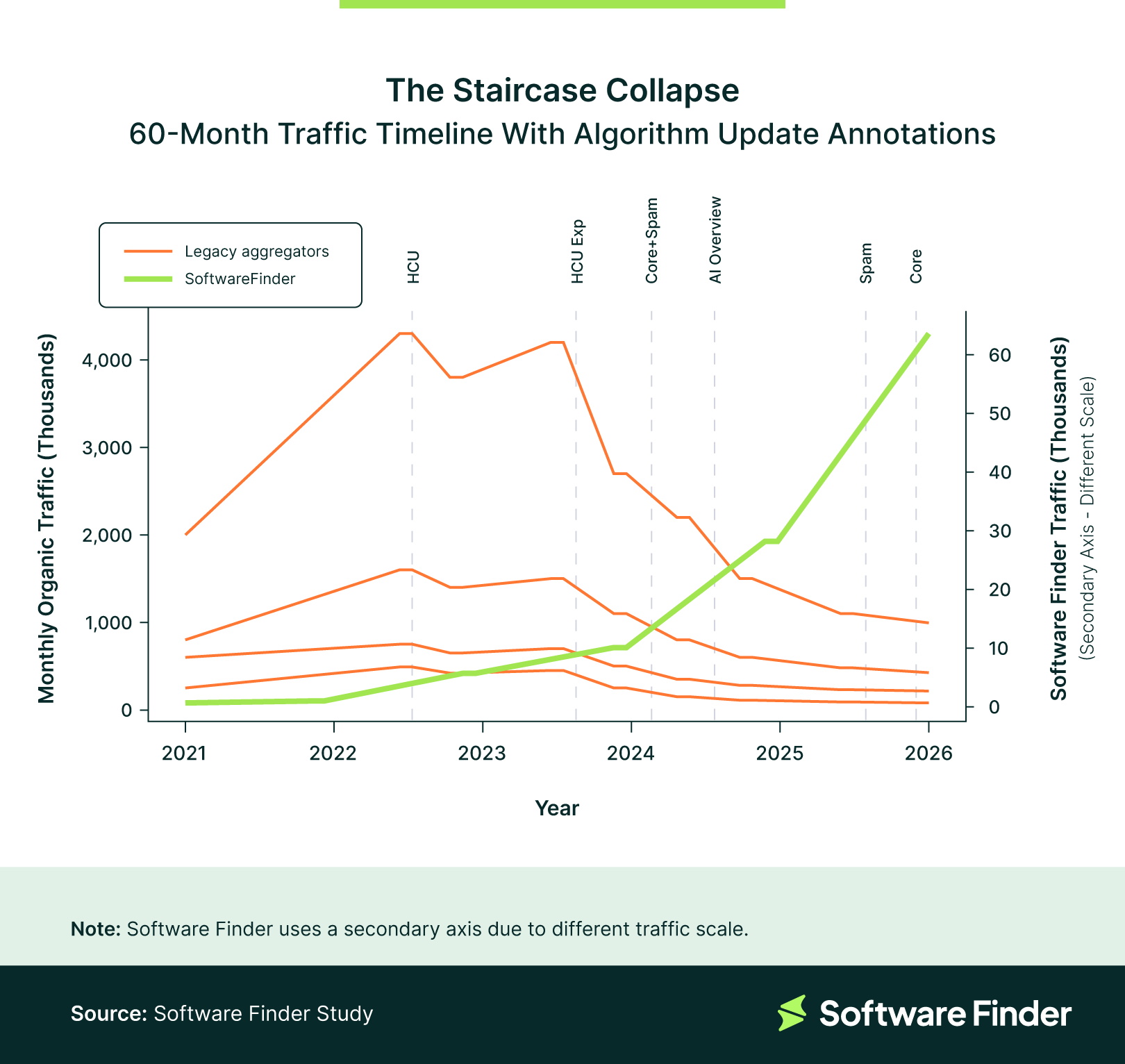
The Staircase Collapse: Algorithm Updates as Accelerants
The traffic decline was not a single event, but a series of drops aligned with major Google algorithm updates, as follows:
- Aug 2022 — Helpful Content Update: The single largest inflection point for legacy aggregators. The HCU explicitly targeted sites with content perceived as created for search engines rather than people.
- Sep 2023 — HCU Expansion: Extended the HCU's reach, compounding the damage to category-page models.
- Mar 2024 — Core + Spam Update: A second leg down for most legacy aggregators.
- Aug 2024 — AI Overview Expansion: Coincided with Google's expansion of AI Overviews into commercial queries. This particularly affected category-level pages, like "top project management tools."
- Aug 2025 — Spam Update: Further penalties for low-quality or thin content at scale.
- Dec 2025 — Core Update: The most recent update in the analysis window. Traffic loss decelerated for most platforms, suggesting a new, lower equilibrium rather than continued freefall. None showed recovery to pre-HCU levels.
Each algorithm update removed a layer of low-differentiation aggregator content from competitive rankings, while AI Overview expansion simultaneously reduced click-through rates on queries where aggregators still ranked.
Keyword Erosion: The Visibility Collapse Behind the Traffic Collapse
Behind the traffic decline is a deeper erosion of keyword visibility. The loss of top-3 ranking positions represents a structural loss of future traffic potential:
- G2: lost 72,798 top-3 positions (414,087 total keywords)
- Software Advice: lost 42,039 top-3 positions (113,331 total keywords)
- Slashdot: lost 165,042 top-3 positions , the largest absolute loss, indicating a catastrophic algorithm penalty or significant content quality issues
By contrast, TechnologyAdvice gained 8,286 top-3 positions, and Software Finder gained 3,543. The keyword movement data confirms that legacy platforms are not merely experiencing lower click-through rates . They are losing ranking positions entirely.
If the legacy aggregator model is structurally declining, what explains the four platforms that grew? Analysis reveals two distinct but viable content models, along with a shared principle: alignment with specific buyer intent rather than broad category organization.
Intent-First Content vs. Category-First Content
Legacy aggregators built their content around category pages that target high-volume, broad-intent keywords that are easily synthesized by Google's AI Overviews.
The intent-first challengers target specific buyer questions at the bottom and middle of the funnel, such as:
- "What does [Product X] do?"
- "How much does [Product X] cost?"
- "[Product X] vs. [Product Y] for [specific use case]"
- Implementation cost guides and how-to tutorials
As a case study, Software Finder's top-performing pages illustrate the pattern. Analysis of our top 15 pages reveals a deliberate focus on buyer-intent content rather than discovery-stage lists.
Our highest-traffic resources include:
- Product-specific explainers ("What does Paylocity do?" at 2,165 monthly visits and position #5)
- Implementation cost guides ("cost to implement a top EMR" at 832/mo, position #2)
- How-to tutorials for specific products
Eight of our top 15 pages focus on the healthcare/EMR vertical , a deliberate bet on vertical depth over horizontal breadth.

This content is harder for AI to displace because it addresses questions requiring nuanced, context-dependent answers. AI cannot reliably answer "How much does Meditech cost?" without access to verified, current pricing data, which requires a site visit.
Behavioral shifts, AI extraction, and algorithmic re-prioritization have created a fundamentally different competitive landscape for B2B software aggregators.
The New Rules
The 48-month period from January 2022 to January 2026 transformed B2B software discovery. The patterns that separate winners from losers can be distilled into five principles:
- Vertical depth over horizontal breadth
- Buyer-intent content over discovery-stage listicles
- Original data AI cannot fabricate (real pricing, verified implementation costs, expert product deep-dives)
- Brand building that creates direct traffic
- Content requiring site visits, not just AI citations
For Software Vendors
Vendors who have relied on aggregator platforms for lead generation face a diversification imperative. With legacy aggregator traffic declining 54–77%, the cost-per-lead from these channels will likely increase. Vendors should invest in:
- Creating direct-response content that answers the specific questions buyers are asking AI chatbots
- Building presence in peer communities and AI-optimized documentation
- Ensuring product data is accurate across AI training sources
For Aggregator Platforms
The data suggests the category-page model is approaching the end of its viability as a traffic acquisition strategy. Platforms face a strategic fork:
- Differentiate through data that AI cannot replicate: verified reviews, real-time pricing APIs, interactive comparison tools
- Pivot to becoming AI data suppliers: formalize the extraction relationship by licensing structured data to AI platforms
- Invest in brand: platforms with the strongest branded traffic ratios are least affected by algorithm changes
The 2027 Question
If current trends continue, the B2B software aggregator landscape will look fundamentally different from 2022 by 2027. The aggregator platforms that defined B2B software discovery for over a decade are in structural decline, and the forces driving that decline ( generational behavior change, AI extraction, and algorithmic re-prioritization ) are accelerating, not abating.
Methodology
This report combines three data sources:
Organic Traffic Analysis
Ahrefs Site Explorer was used to analyze 11 B2B software marketplace domains. The primary comparative analysis covers a 48-month period (January 2022–January 2026), evaluating historical organic traffic estimates and more than 1.2 million tracked keywords to assess visibility and ranking trends.
A supplemental 60-month timeline (February 2021–January 2026) was used to contextualize traffic patterns against major Google algorithm updates.
AI Citation Analysis
Citation frequency was measured across Google AI Overview, ChatGPT, Perplexity, Gemini, and Microsoft Copilot by testing software-related queries and recording referenced domains.
Buyer Survey
A survey of 556 B2B software buyers was conducted in January 2026. Respondents represented multiple generations and decision-making roles. The survey measured research entry points, AI usage, content preferences, and trust dynamics.
About Software Finder
Software Finder is a B2B software discovery platform built around buyer-intent content and verified product insights. By focusing on vertical expertise, pricing transparency, and product-level guidance, Software Finder aligns with how modern B2B buyers research software in an AI-shaped discovery environment.
Fair Use Statement
This report contains proprietary research conducted by Software Finder. The information may be used for noncommercial purposes only. If shared, proper attribution with a link to SoftwareFinder.com is required.