Article
ChatGPT for Clinicians: Usage, Application, And Limitations For Healthcare Providers
7 mins read
Last Updated

Writer


Article
7 mins read
Last Updated
Writer
Physician burnout in the United States has reached a crisis point. And the leading cause is not patient care; it is administrative work. For every one hour spent at patient care, physicians spend around 2 hours on clinical documentation work. This administrative overload is so demanding that approximately 47% of healthcare providers reported being burnt-out in a 2025 report by Medscape.
Against this backdrop, OpenAI launched ChatGPT for Clinicians in April 2026, a specialized version of ChatGPT designed for healthcare providers to save time with Artificial Intelligence (AI) assistance. But is it worth the shot?
This article breaks down what ChatGPT for Clinicians actually is, who is its ideal user, what it can and cannot do, and whether it is the right choice for your practice or organization.
ChatGPT for Clinicians is a specialized AI chatbot that supports the day-to-day work of healthcare providers. It has been configured to handle clinical queries and generate outputs that are relevant and verifiable in a clinical context.
It is currently available free of charge to verified clinicians in the United States, including physicians, nurse practitioners, physician assistants, pharmacists, and psychologists. Verification is done via the National Provider Identifier (NPI) system, which ensures the platform is only accessible to licensed practitioners.
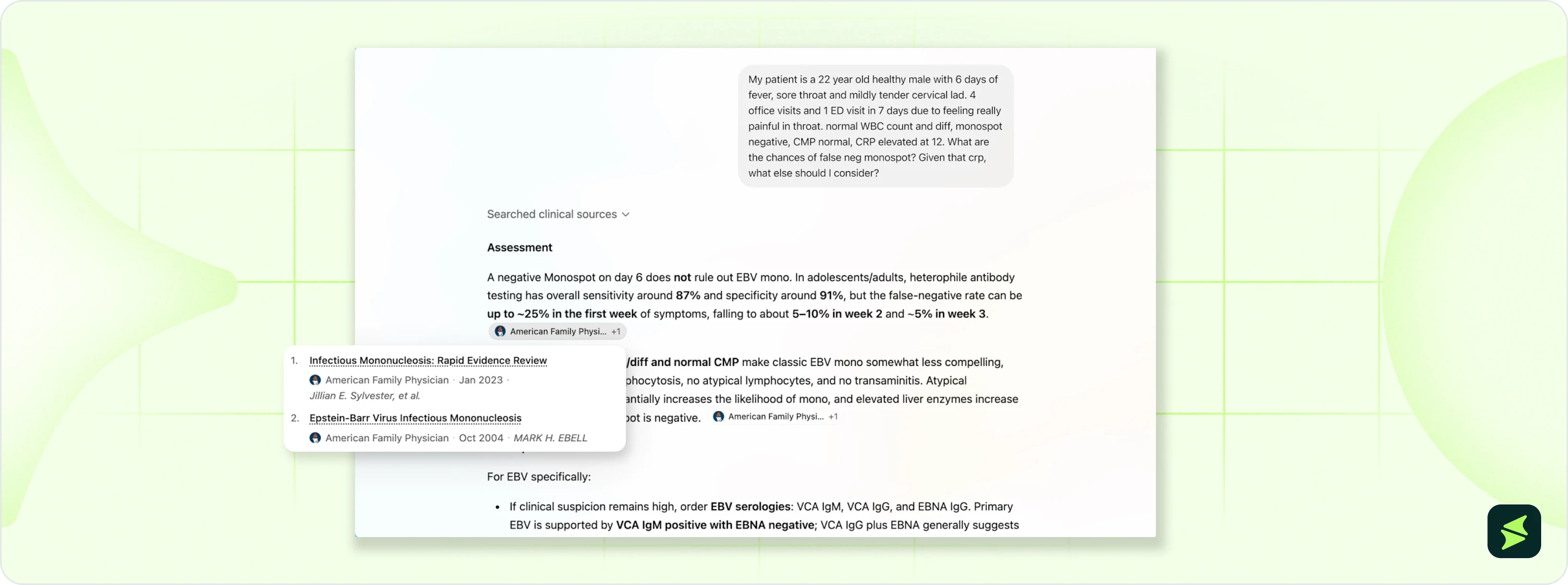
What separates ChatGPT for Clinicians from the standard ChatGPT interface is a handful of features built specifically for clinical use. Most importantly, every response in GPT for Clinicians includes citations to journals. Conversations are also not used to train AI models, adding a layer of privacy.
These features make it different from the regular GPT and more apt for healthcare professionals.
All in all, ChatGPT for clinicians is made to address the real, operational pain points healthcare providers face daily. There is, however, an important distinction that you need to keep in mind.
It is important to note that ChatGPT for Clinicians is distinct from two related OpenAI software products: ChatGPT for Healthcare and ChatGPT Health.
The first one is an enterprise-grade, HIPAA-compliant tool for hospitals and health systems deploying AI at scale. The latter is a consumer-facing product that helps individuals navigate their personal medical records. ChatGPT for Clinicians sits between these two and is designed for individual clinicians whose hospital or clinic has not yet adopted a centralized AI system.
The case for adopting ChatGPT for Clinicians is grounded in measurable outcomes, not just convenience. Based on several previous studies, it is expected to deliver some concrete benefits to its users:
With all the positive talks on one side, no clinical tool should be adopted without a clear understanding of where it falls short. ChatGPT for Clinicians is no exception.
ChatGPT can support clinical reasoning, but it cannot replace it. Legal and ethical liability for diagnosis and treatment decisions still remains entirely with the clinician. The tool is designed to help judgment, not substitute for it.
Large language models can generate plausible sounding but incorrect information; in tech, we call it hallucinations. A 2024 study found that ChatGPT's diagnostic utility dropped significantly with atypical presentations. This means clinicians should treat AI-generated outputs as a starting point, not a final answer.
While conversations in ChatGPT for Clinicians are not used to train models, it is still not HIPAA compliant. Period. Clinicians must still exercise caution. They should avoid inputting identifiable patient information and follow their organization's data governance policies before using any AI tool with patient-related content.
Another point worth noting is that ChatGPT for Clinicians currently offers no native Electronic Health Record (EHR) integration. It means that clinicians must operate across two separate environments. First, their charting software and second, a browser tab running ChatGPT, with no direct connection between the two. This added workflow friction is a major limitation, if not an outright deal breaker for solo practitioners and small practices.
A 2024-2025 systematic review from the Journal of Cureus on ChatGPT's applications in emergency medicine found something interesting. While the AI bot performed well on language and administrative tasks, its ability to support complex clinical decision-making was found to be still emerging. It was concluded that it was not yet powerful enough to be relied upon without clinician oversight. Can ChatGPT for clinicians prove otherwise? We will have to see.
According to a 2026 American Medical Association (AMA) survey, physician use of AI is now at an all-time high. More than 80% of physicians reported using AI in clinical practice, double from when it was first surveyed in 2023. The demand is clear. The question is no longer whether clinicians should use AI in clinical settings or not, but which tool is worth using. Is ChatGPT for Clinicians from OpenAI's arsenal an answer to that question?
In times like this, ChatGPT for clinicians actually looks like a practical, even better tool for healthcare providers than regular AI bots.
It is built on ChatGPT’s ultra powerful models like GPT‑5.4, which indicates that it can take on administrative burden, documentation overload, and literature review easily. The diagnostic support capabilities, while promising, require clinician oversight.
The key takeaway is this: ChatGPT for Clinicians works best when the clinician remains in the driver's seat. Use it correctly and it will save you time, energy, and will deliver evidence-backed support. Remember, any ethical or legal obligation related to your patient care is still your responsibility to handle.