
Article
ERP Cost: A Complete Breakdown Of Pricing, Implementation, And Total Cost
7 mins read
Last Updated


By Hina Anwar and


Article
7 mins read
Last Updated
By Hina Anwar and

Enterprise Resource Planning (ERP) is not just a software purchase; it is a major operational investment. Total costs can vary by company size, operational complexity, deployment model, and system scope. Because the price depends on these factors, many businesses ask - how much does an ERP system cost?
Cloud ERP usually costs $70-$150/user/month for small and medium-sized businesses; on-premises licenses cost around $10,000 upfront, and enterprise implementations often cost more than $500,000 based on scope. However, licensing represents only part of the cost. Implementation, data migration, integrations, training, and ongoing support make up a major part of this investment. Technical and operational requirements typically reveal hidden costs; factors that organizations initially overlook.
Careful evaluation of an ERP system and its impacts on business workflows and future growth can help companies establish realistic targets.
Disclaimer: Pricing references are based on publicly available third-party information and industry benchmarks. Actual costs may vary.
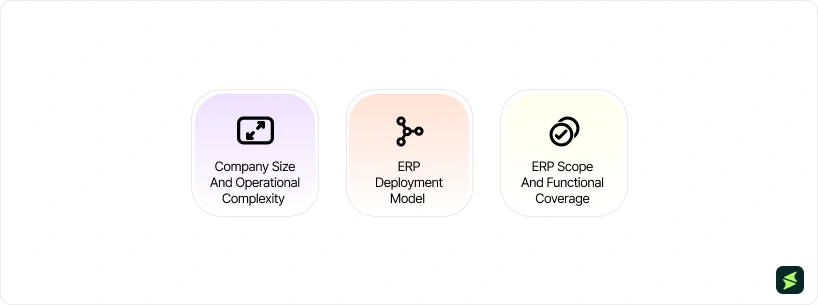
Total investment is shaped by operational scale, deployment model, and functional scope. Identifying these factors early on can help organizations plan better and avoid any unexpected budget overruns.
The number of users, legal entities, and their locations, as well as industry-specific requirements, such as compliance reporting or specialized workflows, directly impact the licensing and support costs. When businesses expand, ERP systems must support multi-entity consolidation, multi-currency accounting, and expanded reporting, which increase configuration effort and implementation scope.
Smaller businesses with fewer users and simpler workflows tend to invest between $20,000 and $75,000. Mid-market companies with various entities usually spend between $50,000 and $200,000. Large corporations with international business operations and advanced compliance needs can go over $1,000,000 and can sometimes reach several million dollars, depending on the scope.
The deployment model directly determines the cost structure and financial timeline.
Cloud ERP usually costs $70-$150/user/month for small and medium-sized businesses, with enterprise plans costing $200-$400+/user/month, which include hosting and upgrades. On-premises licenses can start around $10,000 upfront, with an annual maintenance fee of 15-25% in addition to infrastructure and IT support.
Hybrid deployments combine on-premises and cloud components, which can lead to some extra costs for integration and coordination, resulting in a higher overall investment.
A broader functional scope directly multiplies implementation cost and timeline. Core finance modules require minimal configuration, while manufacturing, HR, supply chain, and analytics modules significantly increase implementation effort.
Expanding ERP coverage beyond core modules requires additional consulting, training, and implementation efforts, especially when workflows are complex or you have extensive integration requirements.
The total investment covers implementation, integration, data migration, training, and regular support costs. The following sections explain how ERP costs get higher throughout the system's complete lifecycle:
ERP pricing is determined by user access, module selection, and functional depth, not company size alone. Subscription-based pricing spreads costs over a period of time, whereas perpetual licensing demands a significant upfront investment plus annual maintenance fees. Software pricing provides only the baseline - total investment is determined by the scope of implementation and operational challenges.
Often, the cost of implementation is higher than the software price. The primary cost drivers are process complexity, data readiness, integration scope, and governance structure, but not the ERP brand.
Implementation models vary:
General implementation ranges:
In most ERP projects, implementation costs rise with the organizational complexity. Organizations that lock scope early and use fixed-fee models typically control budget overruns more effectively.
Companies usually underestimate data migration complexity. The primary cost drivers are data quality, the number of legacy systems, regulatory validation requirements, and the required transformation logic. Early data audits can notably lower unexpected migration costs.
Typical data migration cost estimates:
Configuration assists in improving workflows and permissions based on what the system can do by default. Customization changes the core code or adds new logic, which can lead to higher costs both upfront and in the long run.
Typical cost ranges:
Primary cost drivers include:
Excessive customization creates technical debt. Organizations usually achieve higher long-term ROI by prioritizing configuration where possible.
Most ERP systems integrate with CRM, payroll, eCommerce, business intelligence (BI), and industry-specific tools. Integration complexity directly multiplies total cost.
Typical ranges:
Key drivers:
The costs of integration go beyond the initial development. API updates and vendor changes result in recurring maintenance expenses.
Training plays an important part in how quickly people adopt new tools and the overall return on investment (ROI). Not putting enough resources into this module can slow down stabilization and make the system less effective.
Typical investment ranges:
Phased rollouts across multiple regions and workflow changes increase training investment proportionally. When companies put enough resources into training, they usually see a quicker ROI.
ERP costs extend well beyond implementation. It's important to consider these ongoing costs when calculating the total cost of ownership (TCO).
Here are the ongoing costs to keep in mind:
Over a period of three to five years, recurring costs take up a large part of the total ERP investment. Thinking ahead about growth and system development helps in making costs more predictable in the long run.

ERP systems require a substantial upfront and ongoing investment, but the real benefits come from increased productivity, accurate data, and effective cost control, rather than just focusing on short-term savings.
ERP ROI is realized through measurable process improvements rather than uniform cost savings. Recent ERP industry benchmarks suggest that most organizations recover their ERP investment within 12 to 36 months, with significant returns depending on deployment and adoption strategies.
Finance and operations usually experience ROI first, followed by HR and procurement, as these areas generally experience the quickest process improvements. Companies quantify ERP value by tracking cycle time reduction, error elimination, and reporting accuracy.
Organizations should measure ROI through:
These operational metrics present a clearer picture of ERP value than isolated cost savings.
Start by outlining your core requirements, which include software modules, the number of users, integration requirements, and the expected training scope. Create a structured budget by mapping these to projected costs over the next 3-5 years.
Total project costs (software + implementation + integrations + services) may fall roughly within the following ranges: Small businesses range from $25,000 to $150,000, mid-market companies from $150,000 to $750,000+, and large enterprises from $1.5 million and up.
ROI success depends on user adoption rates, process alignment, and implementation quality. Companies that connect their ERP investments to clear business targets, like faster close cycles or fewer reconciliation cycles, are likely to experience more noticeable results.
Contingency planning for integrations, phased rollouts, and understanding internal workload capacity can help keep costs in check while raising long-term value.
Effective ERP cost planning involves a structured, forward-thinking approach rather than simply reviewing pricing ranges. Companies should start by clearly defining:
Vendors normally provide estimated pricing based on users and modules, but accurate budgeting demands detailed workflow documentation and process mapping. To avoid unnecessary budget increases, companies need to:
By setting precise requirements, expecting integration and data challenges, and planning contingencies, organizations can get more accurate proposals and maximize long-term ROI.

