


ERP implementations are often framed around complexity and cost, but new data from Software Finder presents a more optimistic story. Businesses across the United States report strong satisfaction, measurable ROI, and meaningful operational improvements from their ERP systems, showing that the right software choice and implementation strategy can make all the difference. For organizations still searching for a better fit, these findings offer a useful benchmark for what success can look like. And for teams already seeing strong results, they create an opportunity to share their experience and help others choose an ERP system that delivers lasting value.

- Businesses that are "very satisfied" with their ERP system are 4 times more likely to report stronger employee retention and hiring appeal than dissatisfied ones (67% vs. 17%).
- Businesses satisfied with their ERP system are 3 times more likely to realize measurable ROI than dissatisfied ones (76% vs. 25%).
- Nearly 1 in 2 businesses (43%) say choosing the right vendor or platform is the #1 factor behind a successful ERP implementation, outpacing all other success factors by 11 points.
- More than three-quarters of businesses (77%) say their ERP system allows their team to focus on higher-value work instead of repetitive administrative tasks.
- Nearly 3 in 4 businesses (72%) use AI-powered features inside their ERP system.
- About 1 in 4 businesses (24% to 26%) say integration challenges are the most underestimated aspect of ERP, regardless of how long they have had the system.
Survey findings highlight clear connections between ERP usage, satisfaction, and measurable business impact. The data also reveals differences across company size and workforce demographics.
- Nearly half of businesses (46%) use between 51% and 75% of their ERP features, and that group reports 84% satisfaction, compared with just 47% satisfaction among the 9% of businesses using a quarter or fewer of their features.
- On-premise ERP users are most likely to realize measurable ROI (78%), compared to hybrid users (75%) and cloud-based users (58%).
- Mid-size companies (501 to 1,000 employees) report the highest ROI realization rate at 77%, while enterprises with more than 5,000 employees report the lowest at 48%.
- Gen Z ERP users report the highest AI adoption rate at 78%, compared with 72% for Millennials and 65% for Gen X.
- Data accuracy and reliability see the highest rate of significant improvement (28%), ahead of overall productivity (19%) and operational efficiency (18%).
High ERP satisfaction tends to follow clear implementation priorities and sustained adoption over time. Survey responses emphasize key success factors, including vendor selection, strategic usage, and effective change management.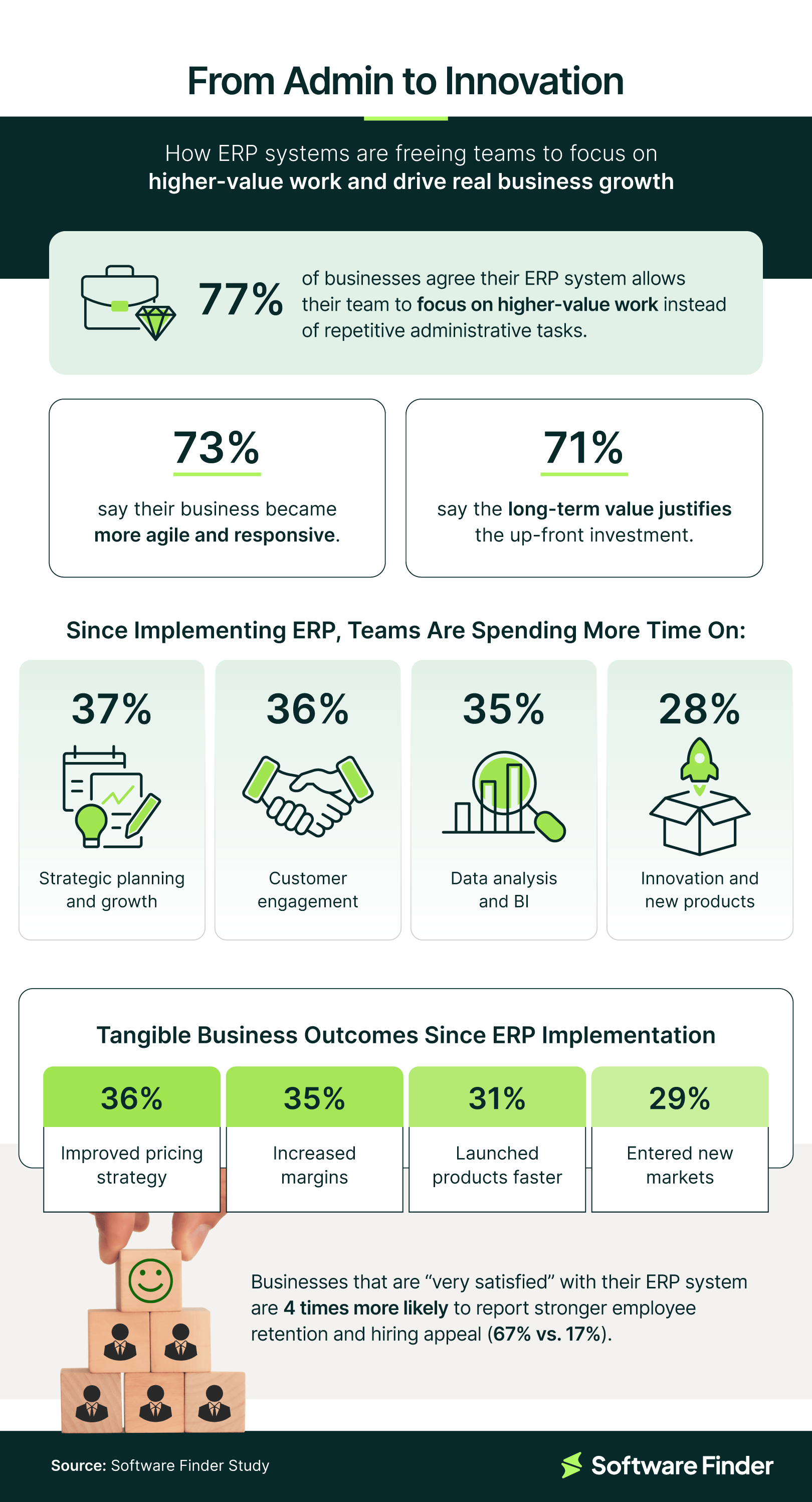
- Choosing the right vendor or platform is the top success factor (43%), outpacing clear pre-implementation goals (32%) by 11 percentage points.
- Finance and banking companies are most likely to report increased margins (55%), nearly double the rate of manufacturing (36%).
- More than half of hybrid ERP users (53%) report spending more time on strategic planning since implementation, compared to 32% of on-premise users and 30% of cloud users.
- Among businesses using their ERP for more than 5 years, 13% report using 76% to 100% of features, compared to just 2% of those with 1 to 2 years of tenure, showing that deep adoption takes time.
- Effective change management and employee training rank third among success factors (27%), yet change management is the least cited underestimated aspect (6%), suggesting businesses may not fully recognize its importance early on.
Methodology
For this study, we surveyed 222 business professionals across the United States to understand how enterprise resource planning (ERP) systems are performing in terms of satisfaction, ROI, and business impact. Respondents were asked about their ERP deployment models, feature usage, implementation challenges, AI adoption within their systems, and how ERP has influenced productivity, team focus, and measurable business outcomes.
About Software Finder
Software Finder helps business leaders find and compare the best software solutions for their unique needs. From HR platforms to project management tools, Software Finder connects decision-makers with in-depth insights and tailored recommendations to make smarter software investments. Learn more about our HR software rankings today.
Fair Use Statement
If you'd like to share or reference this report for noncommercial purposes, please link back to Software Finder and include proper credit.