Article
Generational Tech Literacy at Work
8 mins read
Last Updated


Article
8 mins read
Last Updated
Technology is the backbone of modern workplaces, but not everyone navigates it with the same confidence. As digital tools evolve, generational gaps in tech literacy — the ability to comfortably use and adapt to new systems — can widen, leading to noticeable differences in how workers approach challenges. In this article, we explore how these tech divides shape office dynamics and impact productivity and leadership.

Tech support has become an unofficial part of many employees' jobs, with workers across generations often stepping in to help colleagues navigate digital tools. Below, we explore how employees assist each other with tech and the impact it has on workplace productivity.
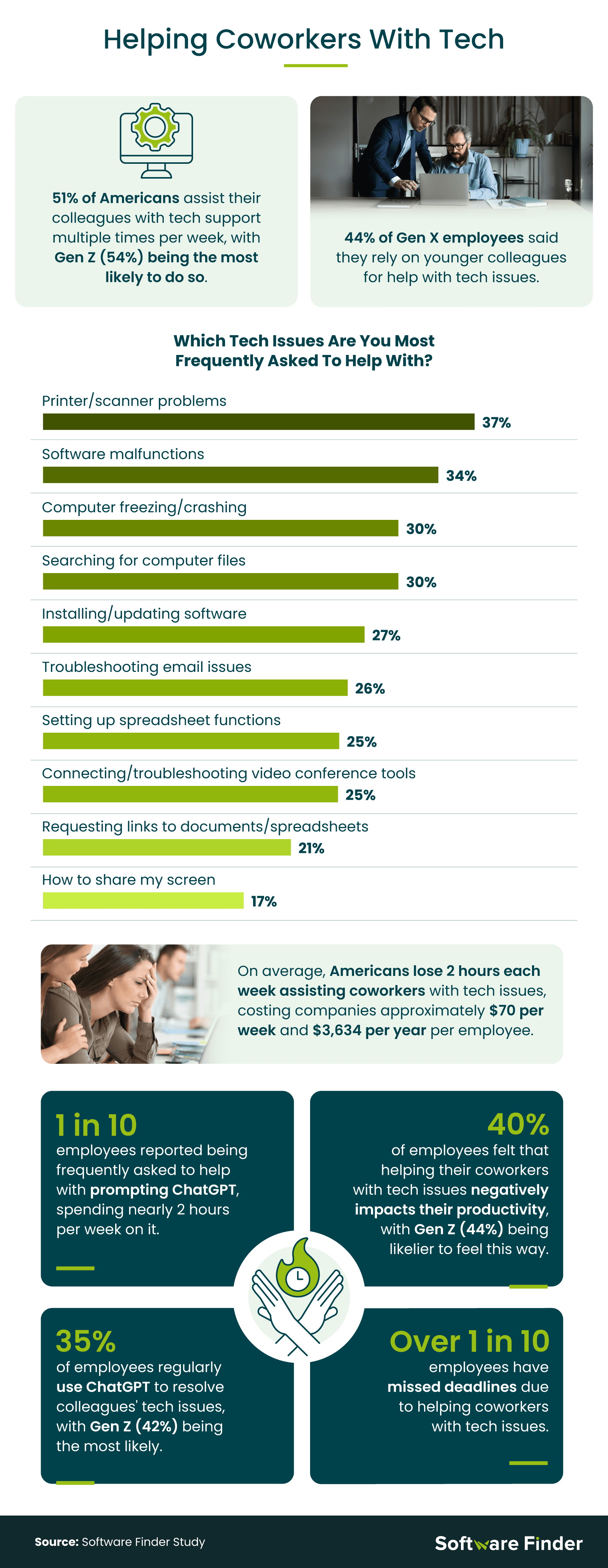
Over half of Americans (51%) reported assisting their colleagues with tech support multiple times per week, with Gen Z helping with tech the most at 54%. On average, employees lost 2 hours each week helping coworkers solve tech issues, costing companies around $70 per week or $3,634 per year per employee. This informal tech support role often disrupts workflow, with more than 1 in 10 employees missing deadlines due to assisting colleagues.
Younger workers are often relied upon for tech assistance: 44% of Gen X employees admitted they lean on younger colleagues for help with tech problems. In addition, 1 in 10 employees said they spend nearly 2 hours per week assisting coworkers with prompting ChatGPT, a task that 10% of millennials and 7% of Gen Z frequently handle.
When seeking tech solutions, employees rely heavily on digital tools. For instance, 85% of workers constantly use Google to troubleshoot tech issues, with usage rates staying fairly consistent across generations — 87% for millennials, 83% for Gen Z, and 81% for Gen X.
ChatGPT was another go-to tool for tech support, with 35% of employees using it regularly to solve technical problems. Gen Z led with 42% relying on ChatGPT, followed by millennials (38%) and Gen X (27%).
Beyond the time spent helping coworkers with tech issues, many employees experience frustration and even embarrassment related to their tech skills. Next, we explore how these feelings affect workplace dynamics.
"Tech shame" refers to the embarrassment or insecurity employees feel when they struggle with technology, particularly when compared to more tech-savvy colleagues.
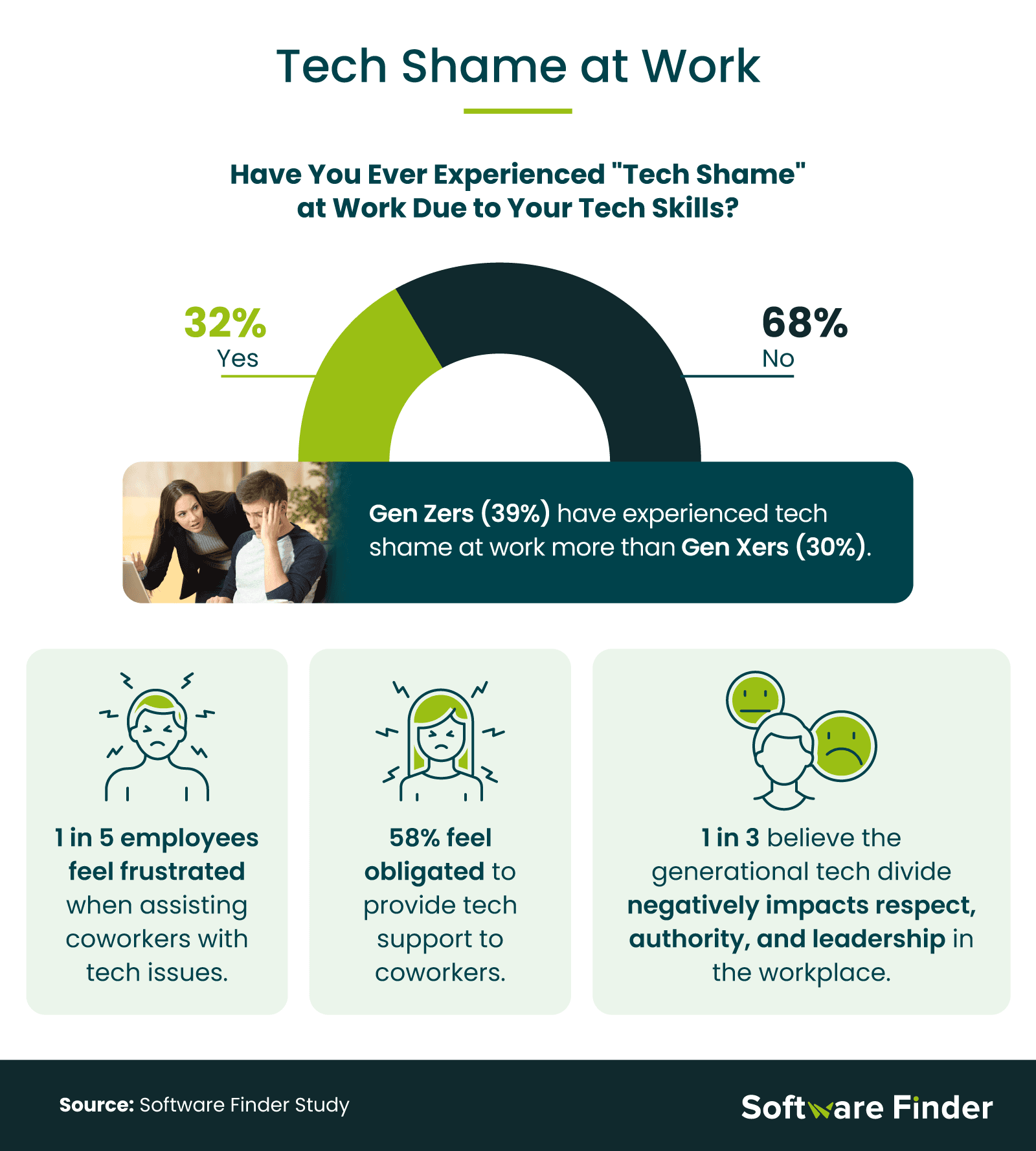
Nearly one-third of employees (32%) reported experiencing tech shame at work, with Gen Z feeling this the most at 39%, compared to 30% of Gen X. This sense of embarrassment can lead to decreased confidence and hesitancy in navigating new systems, impacting productivity across the board.
Frustration also played a role when helping others with tech in the workplace. Among millennials, 22% reported feeling frustrated when assisting coworkers with tech issues, while 17% of Gen Z felt the same. Despite this, millennials were the most likely to feel obligated to provide tech support, with 60% stepping in to help colleagues even when it disrupted their own work.
The generational tech divide can also impact how employees view their leaders: 1 in 3 believe this skills gap undermines respect, authority, and leadership in the workplace. Gen Z workers (39%) were the most likely to hold this view, seeing leaders who lack tech skills as less competent and commanding less respect.
The idea of mandatory tech literacy tests can spark strong opinions, particularly across different generations in the workplace. Let's explore how employees feel about this issue.
A tech literacy test is designed to assess an employee's ability to use digital tools and navigate common workplace technology. These tests might cover basic software skills, troubleshooting, and the use of platforms essential to the company's operations.
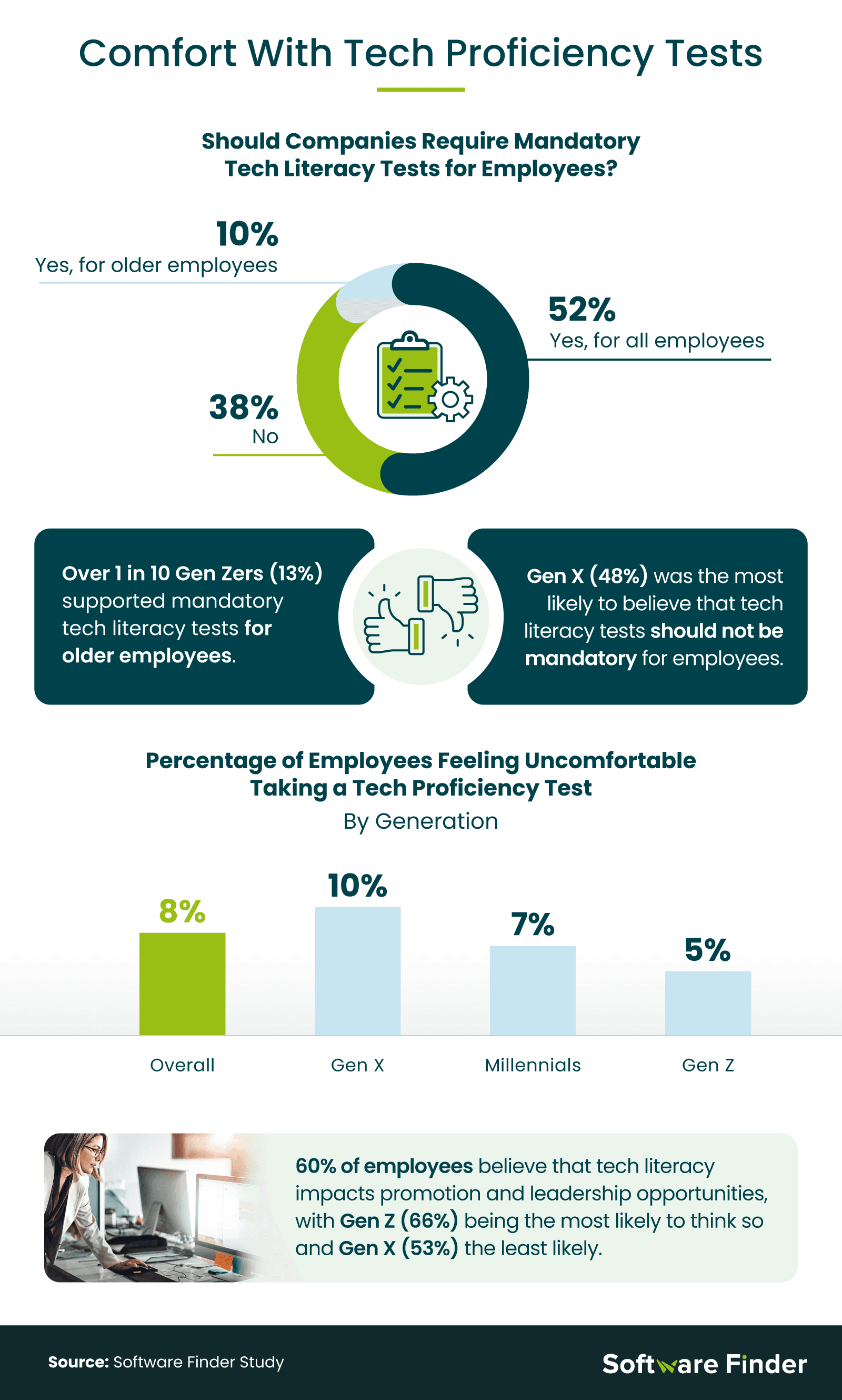
Over half of employees (52%) believe mandatory tech literacy tests should be required for all ages, while 38% feel no one should have to take them, and 10% think only older workers should be tested. Opinions varied significantly by generation: 13% of Gen Z said older employees should be required to take these tests, but nearly half of Gen X (48%) believed such tests shouldn't be mandatory for anyone.
The generational tech divide not only affects productivity but also how leadership is perceived in the workplace. As younger employees take on tech support roles, they may view leaders who lack tech proficiency as less competent. Bridging this gap is crucial for fostering respect and authority across generations. By promoting tech literacy and offering leadership training in digital skills, organizations can strengthen leadership effectiveness and build a more cohesive, tech-savvy workforce.
We surveyed 1,001 white-collar full-time employees to explore the role of technology literacy and how it affects workplace dynamics and productivity. Among them, the generational breakdown was as follows:
We collected the data in September 2024.
Software Finder helps businesses find the right software solutions by offering detailed comparisons, expert insights, and real user reviews. With a focus on streamlining decision-making, we connect companies with the tools they need to enhance productivity and efficiency.
You're welcome to use this content on the generational tech divide for noncommercial purposes — just be sure to credit this page with a link so others can join the conversation.