
Article
HR Software ROI Explained: Metrics, Benefits, And Calculation
8 mins read
Last Updated


By Rana Jazib Ali and


Article
8 mins read
Last Updated
By Rana Jazib Ali and

Every Human Resources (HR) professional has faced a moment where they walk into a budget meeting and immediately get asked for the numbers. This may include details on how much they are spending on HR software, and how much of it is being made back.
It's a fair ask, because HR software isn't cheap. Even a mid-sized company can expect to invest anywhere from $5 to $17/employee/month on a modern HRIS platform, and that’s before implementation, training, and integration costs.
But here's what most HR teams get wrong: they try to justify the investment by counting the time saved on data entry and paperwork. The real ROI of HR software isn't measured in hours; it's measured in prevented turnover and productivity unlocked, as well as faster decisions.
This guide exists to show you exactly how to calculate ROI on your HR software.
Return on Investment, or simply ROI, measures the financial and strategic benefits generated by an HR system relative to its total cost. In theory, the formula is pretty simple:
ROI = [Net return on investment (which is total gains – total investment cost) ÷ Total Investment Cost] × 100
In practice, the challenge here is that HR software delivers value across two categories:
Both of these fronts matter, but when you're making a business case to a CFO or a board, you need the numbers first. Given below are the five core areas where HR software generates measurable and calculable returns.
The most immediate and easiest ROI to calculate comes from time recovered. The average HR professional spends five to six hours/day on administrative tasks like data entry, compliance management, responding to routine employee queries, and transferring information between different systems. Cloud-based HR platforms with self-service tools typically reduce this time by a lot.
As an example, suppose your team has an HR staff of three members, and they save two hours each/day. That's thirty hours/week. At an average hourly rate of, let's say, $28 for four weeks, the ROI would look like:
30 hours × $28 × 4 weeks = $3,360/month. That means your yearly savings come down to $40,320 on just two hours saved/employee
Disclaimer: The figures mentioned are based on ideal scenarios to explain what ROI calculation looks like; real returns might depend on individual factors.
Replacing an employee can cost anywhere between 50% and 60% of their annual salary, with total cost ranging up to 120%, depending on the role. For a $60,000 position, you could be absorbing anywhere from $30,000 to $120,000 in recruiting, onboarding, and lost productivity costs when someone walks out the door.
We see this in organizations that implement a structured onboarding plan through HR software. A clearly outlined action plan, with progress tracking features for employee and manager accountability, can lead to a reduction in yearly turnover.
Annual Turnover Savings = (Previous Annual Turnover Rate – New Turnover Rate) × Total Employees × Average Cost Per Replacement
For example, a company with 200 employees has a 20% annual turnover rate. This means 40 employees leave annually. If this company can reduce that rate to 14%, which means 28 departures a year, at an average replacement cost of $45,000, we get can get the added ROI by:
12 fewer departures × $45,000 = $540,000 saved annually
Errors in payroll can cost a lot when it comes to making corrections and management, and that's before you factor in compliance penalties. A reliable HR tool with automated payroll validation, overtime tracking, and real-time compliance alerts can reduce payroll error rates significantly.
On the compliance side, the average cost of a single employment-related compliance fine by the IRS is around $845, depending on severity. HR software that tracks certifications and flags expiring documentation, while maintaining audit trails, can provide risk mitigation that absolutely adds to how much money you can make back
Most all-in-one HR platforms come with built-in recruitment modules, which reduces time-to-hire. This is an important metric that has a direct dollar value. Every day that a critical role sits vacant, it carries a significant productivity cost. For a revenue-generating position, that can cause problems. Consider using the formula:
Recruitment Savings = Days Reduced in Time-to-Hire × Daily Productivity Value of the Role
As an example, consider a company that needs to hire a senior sales executive, who typically generates $150 in daily revenue. Now, normally, without a dedicated system, it could take, let's suppose, 60 days to fill this role manually. With an HRIS recruitment module, the company could reduce that time to 40 days, hypothetically. Now, let's run the calculations:
Additionally, organizations that use HR software for internal succession planning data to promote from within, rather than hiring externally, save on hire cost.
Unplanned absenteeism also drains productivity in ways that can compound quietly. Most organizations don't realize how much time fraud compounds this problem. Research by the American Society of Employees estimates that 20% of every earned dollar can be lost to time buddy punching and time theft.
Biometric verification, geofencing, and integrated audit trails in modern HR software reduce these inaccuracies significantly. This can be calculated by tracking the hours that you don’t have to pay for, post-implementation.
ROI Calculation: 20 days × $150 = $3,000 in recovered revenue/hire.
Benefit Area | Tangible | Intangible |
Admin efficiency | Hours saved × hourly rate | Reduced HR burnout and stress |
Turnover | Cost/replacement × fewer exits | Stronger team culture and morale |
Payroll accuracy | Error reduction × payroll volume | Employee trust in compensation |
Compliance | Fines avoided | Reduced legal and reputational risk |
Recruitment | Days-to-hire × productivity value | Better candidate experience |
Absenteeism | Absence rate improvement × daily cost | Higher engagement and accountability |
Internal mobility | Cost savings vs. external hire | Career growth visibility for employees |
Now, both of these columns matter, and while tangible benefits make the business case, intangible benefits explain why implementation quality and adoption rates are just as important as the software itself.
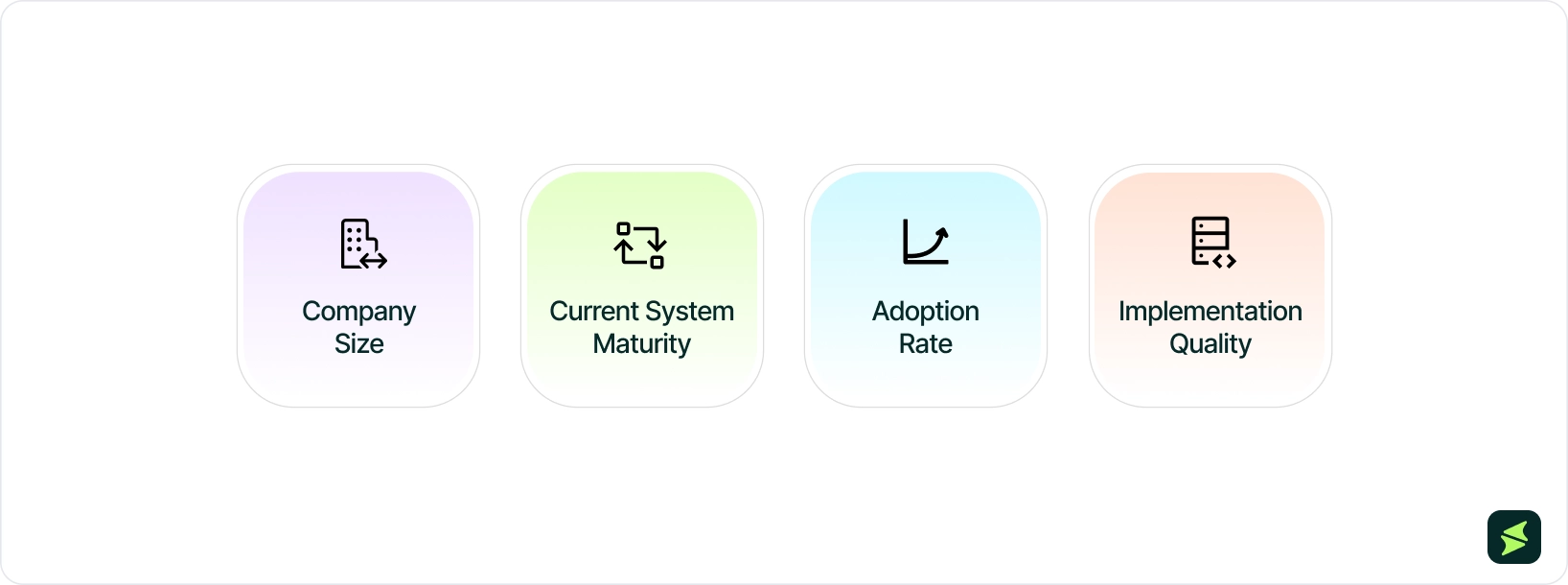
A good range of ROI for HR software ranges from 5% to 20% in the first year, but this number grows substantially as implementation costs decrease and adoption settles in. Consider keeping track of how much time, and resources you are saving as time goes on. Some platforms also offer ROI calculators to make things easier.
The key variables that shape your ROI can include:
Rather than going over software features when it comes to ROI, consider trying to understand the cost of inaction. Ask your teams questions like:
Once you have the answers to these questions, build scenarios based on conservative as well as extreme ends of the pricing range, and present these to leadership. This range-based framing is more credible than a single number and shows you've stress-tested the assumptions.
Your ROI presentation should answer these three questions:
For example, a 200-person company that prevents just 12 extra departures and recovers 30 hours of admin time/week has likely already surpassed the total cost of the software before the year is out.

HR teams can use three standard financial models to estimate the value-for-money they earn on their investment. These include:
This is the simplest metric as it calculates how much time it takes for the system’s savings to cover its initial cost, as in literally pay the investor back.
Formula: Initial cost divided by annual savings = time taken to break even
This accounts for the value of money given by the platform by discounting future savings to today’s dollar value. If the NPV is positive, the investment is a financial win, meaning you’re saving money.
This identifies the efficiency of the investment by evaluating the interval savings generated by the platform within your organization. If the IRR exceeds your company’s cost of capital, the HRIS is considered a profitable use of funds.
When building your case for ROI analysis, you need to categorize your data into two distinct sections of value:
Consider how much you save in labor reduction as automation reduces manual data entry, allowing your HR team to improve operations without adding headcount. Evaluate how digitization removes expenses related to paper and physical storage, and note how the HR software prevents expensive legal penalties and audit fines.
Monitor how integrated applicant tracking and performance tools help your team attract and retain high-performers, and how much that saves you in the cost of turnover. Also consider how giving staff direct access to pay stubs and benefits info through self-service features increases morale while decreasing the administrative load.
Measuring ROI isn't always as easy as you’d think. Two major hurdles that often mess with the results include:
HR software isn't just an internal expense for the HR department; it's an organizational performance investment. The numbers are there if you look for them, in your turnover reports, your payroll error logs, your time-to-hire data, and your compliance incident history. Once you translate those numbers into dollars, the ROI conversation stops being difficult and starts being pretty obvious.
Measure before you implement and set baselines while you revisit the numbers at 6 and 12 months post-investment. The organizations that get the most value from HR technology are the ones that treat ROI measurement as an ongoing discipline.