




Claim denials are a growing problem for physician practices across the US. In 2024, 60% of medical group leaders reported an increase in their practices' claim denial rates compared to the same period in 2023, according to a March 2024 MGMA Stat poll.
The impact goes beyond billing. Denials create administrative rework, disrupt revenue, and in some cases delay care that patients need. Most of them are also preventable. ModMed's RCM services and practice management tools are built to catch the conditions that cause denials before a claim is ever submitted. This guide walks you through how ModMed does it.
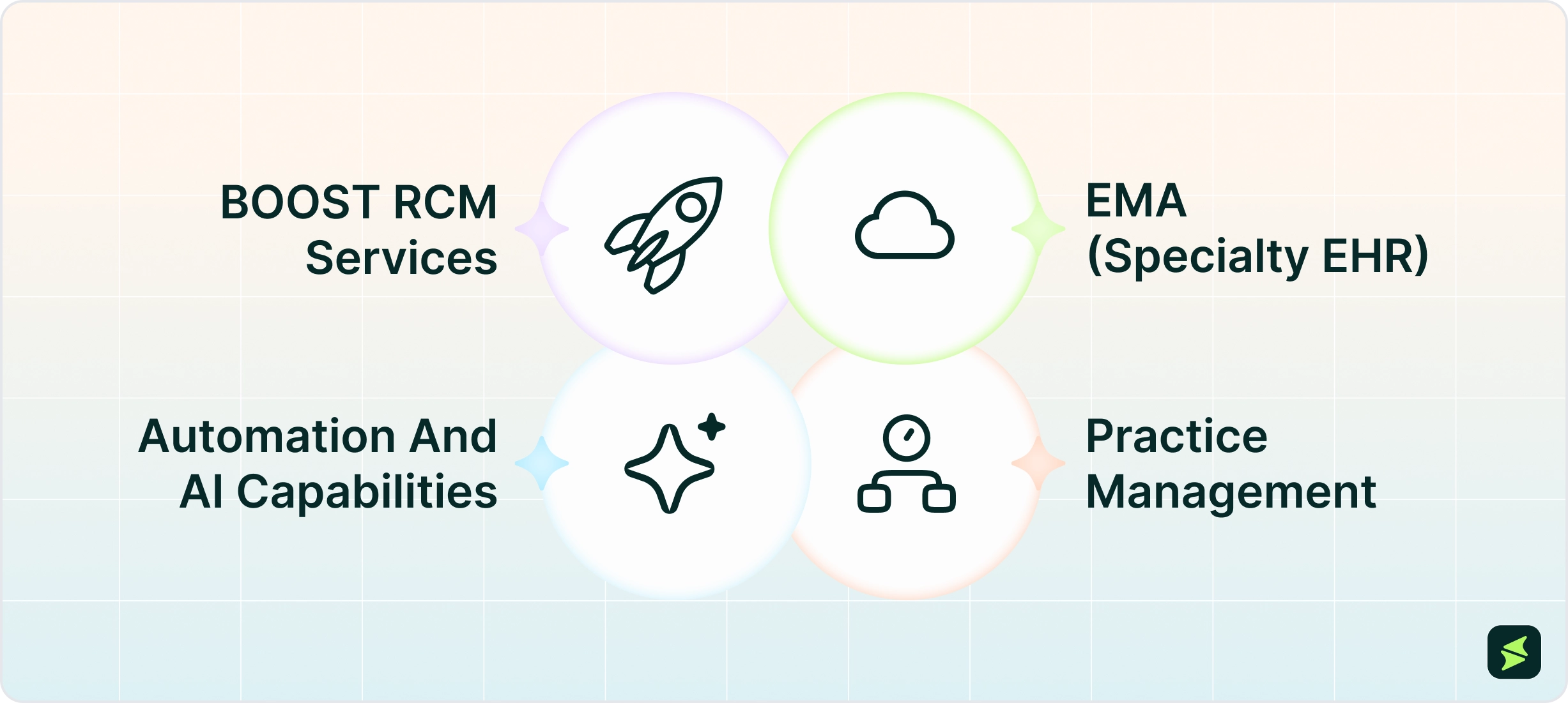
Before getting into how ModMed EMR addresses denials, it helps to understand how the system is structured. The platform operates through the following four interconnected components:
EMA (Specialty EHR)
ModMed's EMA is a specialty-specific electronic health record system and ranks among the largest EHR vendors. It captures what happened clinically: the visit, the documentation, and the diagnosis. The platform’s AI ambient listening technology, ‘ModMed® Scribe 2.0,’ helps improve documentation and coding accuracy. Not to mention that since EMA is built for specific specialties rather than just adapted from a general system, the clinical documentation it produces is structured to translate more cleanly into billing.
Practice Management
Practice management takes what EMA EHR captures and turns it into a billable claim. It handles scheduling, insurance verification, coding, claim scrubbing, and submission. Because practice management software works directly alongside EMA rather than operating as a separate system, information recorded during the visit can flow into the billing process without manual re-entry.
BOOST RCM Services
BOOST is ModMed’s managed billing service. A team of billing specialists helps handle the healthcare claims process, including checking insurance details, reviewing claims before submission, following up on denials, and managing unpaid accounts.
The BOOST team works directly within ModMed Practice Management to keep everything in one system. Practices can still see what’s happening with their billing and stay in control, while the day-to-day work is handled by the BOOST team.
Automation And AI Capabilities
Automation is embedded throughout the ModMed platform. AI-powered capabilities support tasks such as patient scheduling, eligibility verification, prior authorization workflows, and denial appeals. The AI features essentially help medical administrators and practitioners flag high-risk claims, analyze emerging payer patterns, and address billing issues proactively to achieve improved first-pass claim acceptance rates.
With the ModMed RCM foundation in place, the next step is identifying where denials actually originate. Not all of them have the same cause and treating them as a single problem is one reason prevention strategies often fall short.
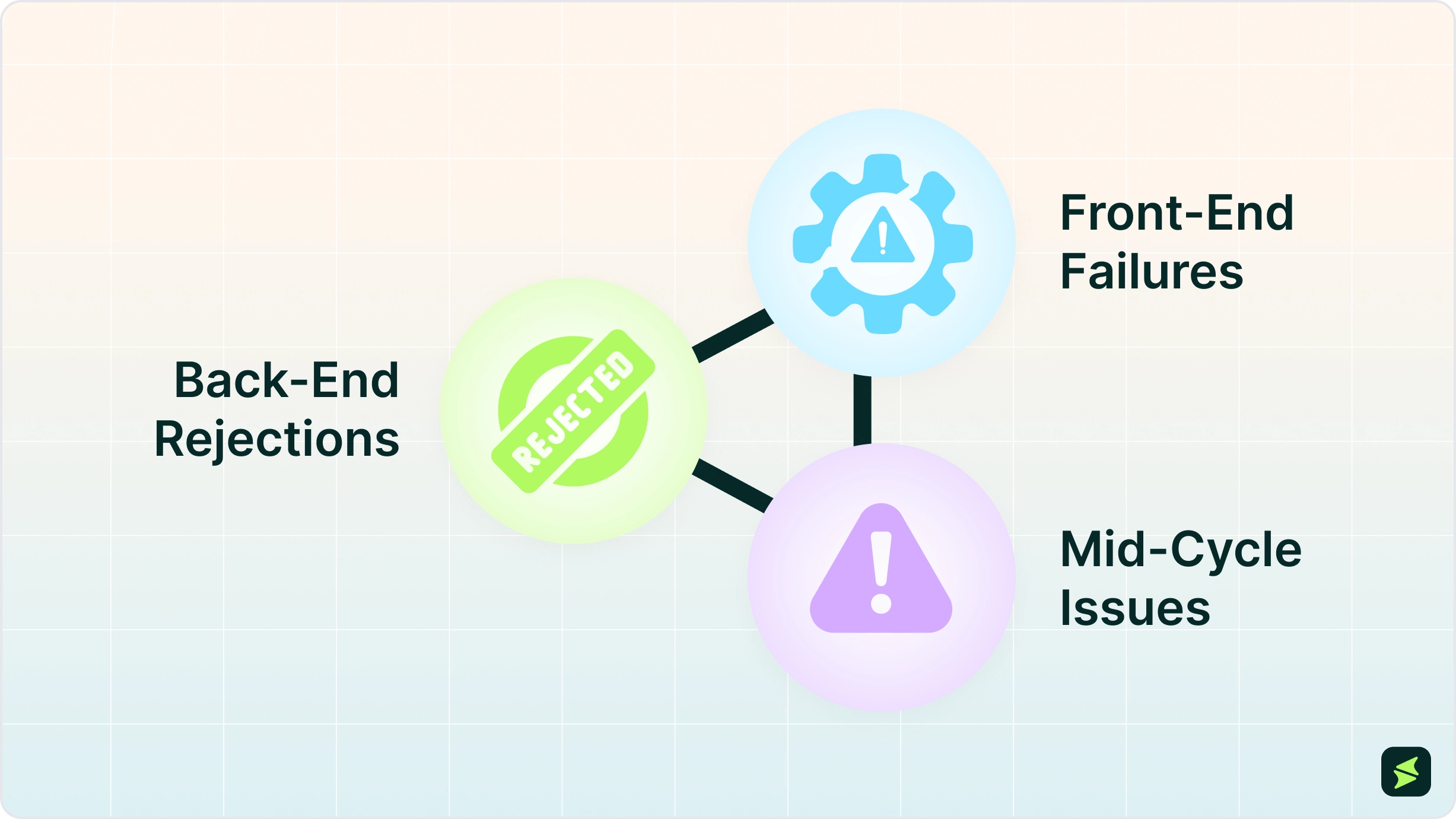
Denials typically enter the revenue cycle at three distinct points:
Front-End Failures
Front-end failures like eligibility errors and unresolved prior authorizations occur before a claim is ever submitted. The information needed to prevent them is available ahead of the appointment, but without a structured pre-visit verification process, these gaps reach billing unchecked.
Mid-Cycle Issues
Mid-cycle issues like coding mismatches and insufficient medical documentation develop during the documentation and coding phase. In specialty practices, these are particularly complex because payer-specific code requirements, modifier rules, and medical necessity thresholds can differ significantly even for the same procedure.
Back-End Rejections
Back-end rejections like timely filing violations and duplicate billing errors arrive after submission, often when the correction window is already narrow. Once the deadline passes, the denied revenue is generally unrecoverable, regardless of whether the original claim was correctable. At this stage, options become limited – prevention strategies are geared towards catching these errors before the claim is ever transmitted.
Each category requires a targeted prevention strategy. Correcting a coding issue will not resolve eligibility verification issues, and vice versa. A system without specialty-specific coding logic and payer-aware scrubbing may lead to gaps across these points. That is the problem ModMed's integrated RCM approach is built to address.

Across front-end, mid-cycle, and back-end stages, each carries its own failure points. ModMed's integrated approach addresses that full span, and the sections below break down how.
Front-End Eligibility Verification
ModMed's automated insurance verification checks patient benefits and financial responsibility upfront, so coverage gaps surface before the visit rather than after a claim is submitted. For practices on BOOST, that automated check is followed by the team's 48-hour pre-visit review, during which the BOOST team reconciles eligibility reports and flags any discrepancies to ensure a smooth patient check-in. Addressing coverage gaps and inaccurate patient details early on helps reduce claim rework effort and prevent delays in reimbursements.
Tracking metrics like eligibility error rate, pre-visit verification completion rate, and same-day rejection volume helps identify front-end gaps before they compound across billing cycles.
Prior Authorization Management
ModMed centralizes the entire prior authorization process inside EMA's built-in ePA queue. Without it, tracking requests across multiple systems becomes unreliable, and an unresolved authorization typically ends in a denial before a claim is filed.
From the ePA queue, providers can track pending requests, respond to payer questions, upload supporting documentation, and appeal denied authorizations, all without logging into individual payer portals. For high-volume specialty practices, ModMed AI Assistants handle multi-step authorization tasks automatically, keeping the queue from backing up.
The scale of that queue is significant. A recent AMA survey found that practices handle an average of 39 prior authorization requests per physician per week. Without a system to track and resolve each one, unresolved requests become denials by default.
Specialty-Specific Coding Accuracy
EMA's coding suggestions come directly from what the provider documented during the visit. Rather than selecting codes manually after the visit, the system ties billing to clinical notes in real time. This helps lower denial rates by ensuring medical coding accuracy. In specialty medicine, where modifier usage and diagnosis specificity vary significantly by payer, that direct connection matters more than it would in a general practice setting.
Many claim denials result from coding inaccuracies and insufficient documentation. A system that generates code suggestions from the clinical record rather than relying on manual selection addresses that risk at the source.
Claim Scrubbing And Clean Claims Submission
ModMed's customizable scrubbing rules and built-in clearinghouse review each claim before it reaches the payer. On top of standard scrubbing, the AI-powered Denial Assessment feature runs a second evaluation pass, flagging claims with a higher likelihood of denial so issues can be resolved before submission rather than after a rejection lands.
The case for that pre-submission checkpoint is well established. Automated claim scrubbing and predictive validation, according to Deloitte's 2024 Healthcare Revenue Cycle Reinvention report, can prevent up to 85% of avoidable denials and cut administrative cost per claim by nearly one quarter. Even a well-coded claim fails if it does not meet payer-specific formatting requirements, which is exactly the category of error this layer is built to catch.
Analytics-Driven Denial Pattern Recognition
ModMed's drill-down dashboards break down denials by payer, code, and provider, giving practices the visibility to spot patterns rather than just process individual rejections. For practices on BOOST, that data feeds into monthly client manager reviews, where the team discusses denial trends and identifies process-level opportunities to improve billing performance across billing cycles, not just within them.

Even the most effective strategies to reduce denials in hospital revenue cycle management cannot catch everything. And so, when a denial comes through, the first step is to determine which category of denial it falls into:
Hard denials are typically caused by non-correctable issues but often can still be appealed. Soft denials, on the other hand, have the potential to be paid in full with the right follow-up. They can usually be overturned by submitting a corrected claim or additional information. The catch is that soft denials often have short correction windows, sometimes as little as 30 days. Acting on them fast is not optional.
The BOOST team handles resubmissions and appeals directly, and denial data feeds into the monthly client manager reviews covered earlier, so recurring patterns get caught before they compound across multiple billing cycles.
Running billing in-house gives a practice direct control, but that control comes with some costs and vulnerabilities. The question for most specialty practices is not which model sounds better, but which one their current staffing and denial volume can actually support. Here is a side-by-side comparison to help make the right decision.
Factor | Traditional In-House RCM | ModMed BOOST |
Who manages billing? | Practice's own staff | ModMed certified billing specialists |
Specialty coding expertise | General billers; depends on who the practice hires | Specialty-specific billers across derm, GI, ophthalmology, ENT, ortho, and other specialties |
Staffing continuity | Billing positions see around 20% annual turnover rate, which disrupts cash flow and claims cadence | ModMed team covers continuity with no recruitment or training burden on the practice |
Financial visibility | Depends on internal reporting tools | Real-time drill-down dashboards built into ModMed PM |
Cost structure | Fixed costs: salaries, benefits, software licenses, and ongoing compliance training | Custom pricing |
BOOST is not the right fit for every practice. For instance, a larger practice with a stable, experienced billing team and consistently low denial rates may get full value managing billing internally. However, practices dealing with staff turnover, growing claim complexity, or denial rates above benchmark can find BOOST more valuable.
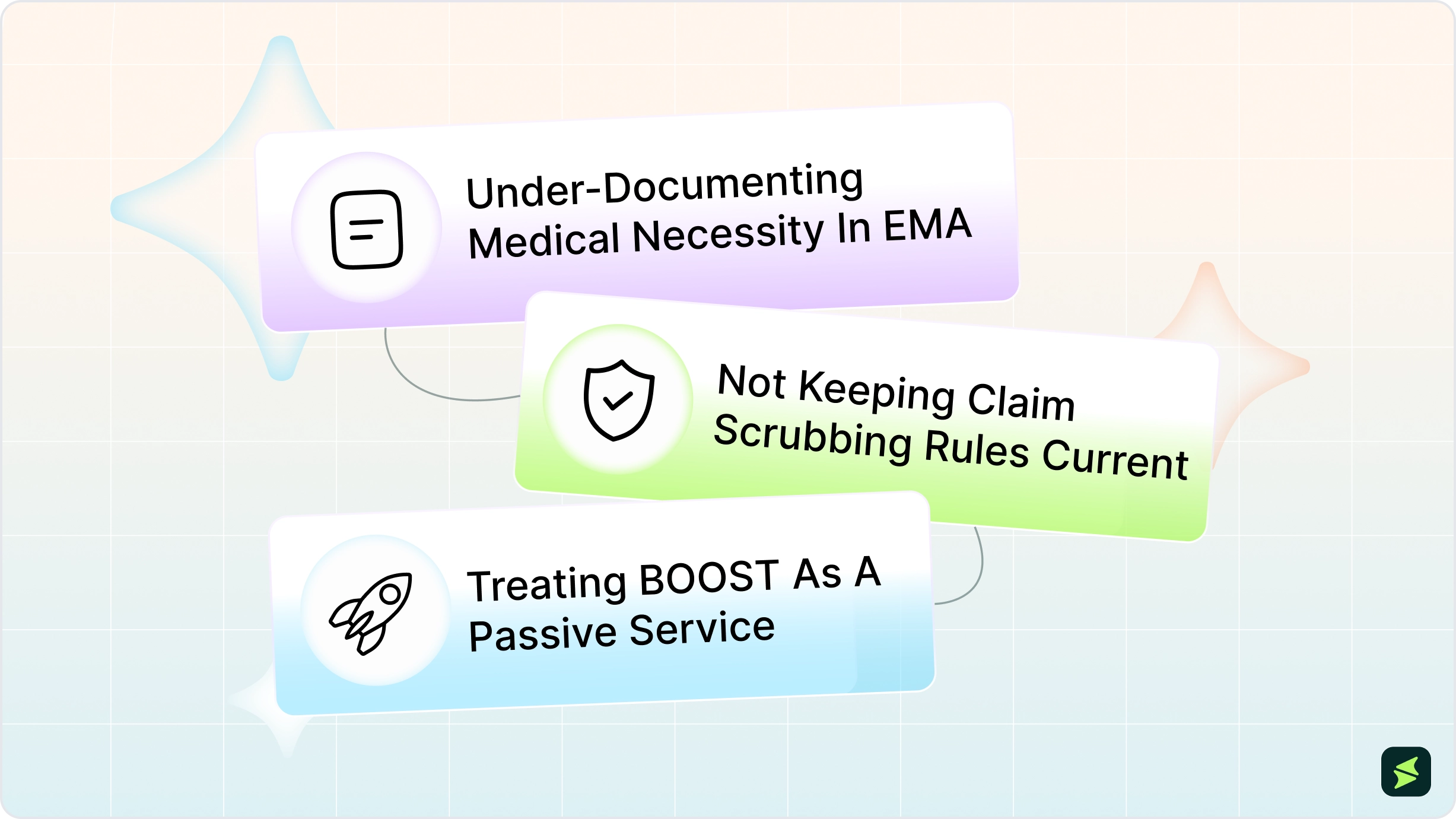
Having ModMed in place doesn't automatically prevent denials. How the tools are used matters just as much as having them. Here are the most common mistakes ModMed users make.
Under-Documenting Medical Necessity In EMA
EMA's coding suggestions are only as strong as the clinical notes behind them. The growing use of AI in claims processing is raising the bar for medical necessity documentation, which is making it harder for providers to secure reimbursement. ModMed Scribe 2.0 can translate provider-patient dialogue into suggested notes, but providers still need to confirm that documentation explicitly supports what is being billed. Thin notes produce denials that no scrubbing tool can prevent.
Not Keeping Claim Scrubbing Rules Current
Scrubbing rules configured at setup can go stale as payer requirements shift. Submitting clean claims has become increasingly challenging for healthcare providers as payer requirements continue to change and claim errors become more common. ModMed's scrubbing rules are customizable, but they need to be reviewed and updated whenever payer contracts or coverage policies change, not treated as a one-time configuration.
Treating BOOST As A Passive Service
Scrubbing rules configured at setup can go stale as payer requirements shift. Submitting clean claims has become increasingly challenging for healthcare providers as payer requirements continue to change and claim errors become more common. ModMed's scrubbing rules are customizable, but they need to be reviewed and updated whenever payer contracts or coverage policies change, not treated as a one-time configuration.
Treating BOOST As A Passive Service
BOOST is designed as a collaborative model, with client managers regularly reviewing KPIs, discussing trends, and identifying opportunities to improve billing processes. One common mistake is treating the service as a hands-off outsourcing arrangement and waiting for monthly reports without acting on the recommendations provided. Practices get the most value from BOOST when they review feedback, address identified issues, and work with their client manager to continuously refine revenue cycle workflows.
Getting full value from ModMed goes beyond turning the features on. These are three practices that consistently move the numbers for specialty practices on the platform:
Collect Patient Balances At The Time Of Service
ModMed PM surfaces co-pay, deductible, and coinsurance details at check-in so staff can collect balances before the patient leaves. Balances left uncollected become a collections problem, not a billing one. For practices that need additional support, ModMed BOOST handles inbound patient balance inquiries and payment processing directly.
Benchmark Your Key Metrics Against MGMA Standards
While benchmarks vary by specialty, target thresholds often include a Days Sales Outstanding (DSO) of 45 days or less and a net collection rate of 96% or above. ModMed BOOST advisors monitor these metrics and flag when a practice drifts outside the acceptable range.
Track MIPS Performance In Real Time
Merit-based Incentive Payment System (MIPS) is a Medicare program that rewards or penalizes practices based on quality, efficiency, and patient care measures. ModMed tracks estimated performance against MIPS benchmarks in real time, which reduces the need for manual tracking. This way, compliance gaps can be flagged early, giving practices time to address them before they affect reimbursement.

Denial prevention is not a feature you turn on. It is a discipline built into how a practice operates, from the moment a patient schedules to the moment a claim clears. The practices that consistently outperform when it comes to denial rates are not the ones with the best billing staff. They are the ones that stopped treating billing as a back-office problem.
ModMed's value is not in any single tool. It is in what becomes possible when eligibility verification, clinical documentation, coding, and claims management are all pulling from the same data, in the same system, toward the same outcome.