Specialty clinics tend to face operational hurdles associated with the management of patient care, billing complications, and disjointed patient communication. Interoperability and compliance concerns can make day-to-day operations even more stressful. This is where Nextech and ModMed can assist.
Both are specialty-focused Electronic Health Record (EHR) systems that address these challenges. However, they tackle them in different ways.
This guide compares Nextech vs ModMed across key factors, including features, pricing, user feedback, and overall functionality, to help practices determine which platform best aligns with their operational needs and growth objectives.
Nextech EMR is a specialty-specific EHR and AI scribe solution designed for ophthalmology, dermatology, plastic surgery, and med spas. The platform combines EHR functionality with practice management, patient engagement, and revenue cycle management. Its single-screen workflow lets doctors see the most relevant patient information at the top of the chart, which reduces the number of clicks. Nextech is trusted by more than 16,000 medical practices and received the Best in KLAS 2026 award for ambulatory ophthalmology solutions.
ModMed EMR is also a cloud-based, specialty-specific EHR and practice management software, complemented by RCM, patient experience, analytics, reporting, and telehealth tools. The platform is designed with specialty-specific workflows tailored to fields such as allergy, dermatology, ENT, gastroenterology, OB-GYN, ophthalmology, and orthopedics. Additionally, ModMed has also received recent recognition from Black Book Research across 11 specialty EHR categories in the 2026 Black Book Awards, based on independent physician surveys.
Nextech Vs ModMed: At A Glance
Feature
Nextech
ModMed
Telehealth
✓
✓
AI Documentation
✓
✓
Lead Management
✓
✗
Mobile App Access
✓
✓
Patient Portal
✓
✓
Integrated Eligibility Checks
✓
✓
Billing Specialist Support
✗
✓
Photo Management
✓
✓
Built-In CRM
✓
✗
Comparing Strengths And Weaknesses
Side-By-Side Feature Comparison
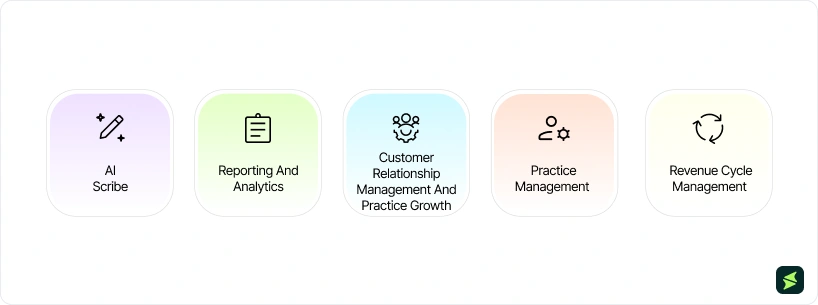
AI Scribe
Nextech’s AI-powered Cora Scribe captures physician-patient conversations in near real time and converts them into structured clinical notes within the chart. It offers two-way integration, allowing the system to read, write, and update notes for both new and existing patients. Currently designed for ophthalmology workflows, Cora Scribe maps clinical findings directly into the appropriate chart fields and surfaces the most relevant patient information at the top of the record to help reduce clicks. The tool includes security and patient consent controls, supports Spanish translation, and plans to expand to over 100 languages.
Similarly, ModMed also incorporates AI across its platform through ModMed AI, including its documentation tool ModMed Scribe 2.0. The system employs ambient listening to record clinical discussions and convert them into computer-generated notes in the Electronic Medical Assistant (EMA) platform. Moreover, the software places its scribe directly within examination workflows, classifying findings, assessments, and treatment plans based on specialty logic, enabling faster and more accurate documentation. ModMed also offers AI-enhanced faxing that categorizes documents and converts important details into structured data.
Winner:ModMed has a slight edge due to its deeper workflow integration and specialty-driven AI capabilities.
Reporting And Analytics
Nextech’s analytics and reporting capabilities bring together data from its EHR and practice management system, offering providers operational, clinical, and financial visibility. The platform provides real-time access to data along with pre-configured KPIs, customizable dashboards, and alerting features. These tools help administrators monitor trends in scheduling, revenue performance, and clinical activity without relying on external intelligence tools. Its reporting framework focuses on surfacing patterns within the practice’s own historical data, such as identifying overdue procedures or irregular revenue cycle activity.
ModMed integrates its tools for analytics and reporting directly into its EHR platform, offering dashboards that span clinical, operational, and financial performance. Practices can configure reports around their own KPIs and drill down from high-level summaries into providers, visits, or patient-specific data to better understand performance drivers. Reporting flexibility is also a primary focus, allowing administrators to categorize data according to operational planning and financial oversight.
Winner:Nextech holds a slight edge due to its real-time dashboards, built-in KPIs, and proactive alerting, which provide more actionable operational insight, giving practices stronger day-to-day visibility.
Revenue Cycle Management (RCM)
Nextech’s RCM is designed to simplify billing and claims operations by closely integrating financial workflows with its EHR and practice management system. The platform supports claims submission and ensures collection and reimbursement rates remain high, cutting down administrative duties and strengthening cash flow. Its billing functionality operates within the same interface as clinical documentation, using specialty-specific logic to align charges with what is recorded in the EHR.
ModMed’s RCM combines software functionality with service-based support to deliver a comprehensive financial workflow spanning pre-visit eligibility verification. In addition to its practice management and claims processing tools, ModMed also offers ‘BOOST RCM’ services, which integrate automation with human billing expertise and certified coders who collaborate with practice staff.
ModMed also applies AI directly within billing workflows. Its ‘Denial Assessment’ capability analyzes claims after standard scrubbing and flags those with a higher likelihood of denial before they are submitted, allowing billing teams to correct issues and improve clean claim rates.
Winner:ModMed edges ahead due to its combination of AI-assisted billing and integrated ‘BOOST RCM’ services that blend automation with human billing expertise.
Practice Management
Nextech’s practice management platform is purpose-built for high-volume ambulatory specialty clinics. It focuses heavily on front-desk efficiency, scheduling control, and integrated billing workflows. Its scheduling tools include a drag-and-drop functionality, streamlined check-in and check-out workflows, and appointment confirmations, supporting both single-location and multi-location practices. From a financial operations perspective, Nextech focuses on generating bills directly from documentation captured in the integrated EHR, enabling practices to standardize coded services with patient encounters.
ModMed’s practice management solution works as a central administrative layer, covering scheduling, office flow coordination, document management, and billing. Integrated with EMA, it promotes smart scheduling, offering tools such as an ‘Appointment Finder’ and automated waitlists designed to minimize unused appointment slots. It also incorporates real-time insurance eligibility verification before patient arrival, and billing management tools that assist practices in monitoring claims, reducing denials, and sustaining revenue cycle visibility.
Winner:Nextech wins in practice management due to its strong focus on front-office workflows and tighter integrations between clinical documentation and billing.
Customer Relationship Management And Practice Growth
Nextech offers a dedicated CRM module designed for specialty medical practices that want to manage patient relationships, marketing outreach, and lead conversion. The CRM component allows practices to track patient leads, automate follow-up communication, and manage marketing campaigns within the same ecosystem as Nextech’s EHR system. Additionally, the platform’s automated workflows can trigger appointment reminders, follow-up emails, newsletters, and targeted campaigns, helping practices maintain consistent engagement with both prospective and existing patients.
ModMed does not offer a standalone CRM module. Instead, it approaches patient relationship management through a patient engagement and communication framework that performs some relationship-management tools like APPatient, patient portal, automated messaging, and Klara communication platform. These offerings enable practices to automate appointment reminders, broadcast messages, and pre-visit instructions while also supporting features such as mobile check-in, telehealth communication, and digital intake forms. In addition to all this. ModMed also positions its patient communication tools as part of a broader strategy to support practice growth.
Winner: Nextech has the advantage in this category because, unlike ModMed, it offers a dedicated CRM module with built-in marketing automation and campaign analytics.
Pricing Plans For Nextech And ModMed
Nextech’s pricing is structured around specialty configurations with costs varying depending on whether a practice selects standalone modules.
ModMed follows a similar quote-based approach, with pricing influenced by specialty type, number of users, and whether services like RCM or patient collaboration tools are included.
Disclaimer: The pricing is subject to change.
What Users Have To Say
Many Nextech users describe the system as intuitive and comparatively easy to adopt. Users often say the move to Nextech EHR felt streamlined, with paper charts replaced by centralized electronic documentation. Although some users report occasional downtime associated with software updates, with a few mentioning workflow interruptions during update cycles.
Users of ModMed appreciate its specialty-specific charting and visual documentation tools, particularly in dermatology practices where the visual body mapping feature allows clinicians to compare patient photos across visits efficiently. At the same time, users mentioned some critiques around configuration and setup complexity. Some users share that deployment demanded considerable time, especially while configuring clinical and front-desk workflows.
Choosing The Right Specialty Platform
Choosing the right specialty-focused EHR and medical practice management platform depends on your practice’s operational priorities. Nextech is well-suited for high-volume ambulatory practices, especially ophthalmology clinics, that need a unified system to manage scheduling, documentation, billing, and reporting within a single workflow. ModMed, on the other hand, may be a stronger fit for organizations that prioritize RCM, coding, and clinical coordination through its specialty-intelligent EMA platform.
The final decision ultimately depends on which operational capabilities your practice values most and how each platform aligns with your clinical, administrative, and revenue cycle priorities.
Side-by-Side Review
Get a side-by-side overview of all the features you can expect with a Moodle or Canvas subscription. Enter the information below!
Side-by-Side Review
Get a side-by-side overview of all the features you can expect with a subscription. Enter the information below: