Article
Quiet Resistance: How Many Employees Are Rejecting AI?
13 mins read
Last Updated

Writer


Article
13 mins read
Last Updated
Writer
AI adoption has become a top priority for companies across the U.S., but not every employee is going along with it. Many workers are taking a quieter path: trying a new tool once, then returning to the workflows that already work, or skipping adoption entirely when no one is watching. The gap between what companies are rolling out and what employees are actually using is wider than most leaders realize.
To find out how common this is, Software Finder surveyed 1,005 employed U.S. workers about how they respond when new AI and workplace software tools are introduced at work. The results reveal a workforce that is more cautious, more skeptical, and more quietly resistant than the rollout numbers suggest.

AI resistance isn't concentrated in any one corner of the workforce. Half of all U.S. workers say they're holding back on new AI tools, and the pattern shows up across job levels, industries, and income brackets.
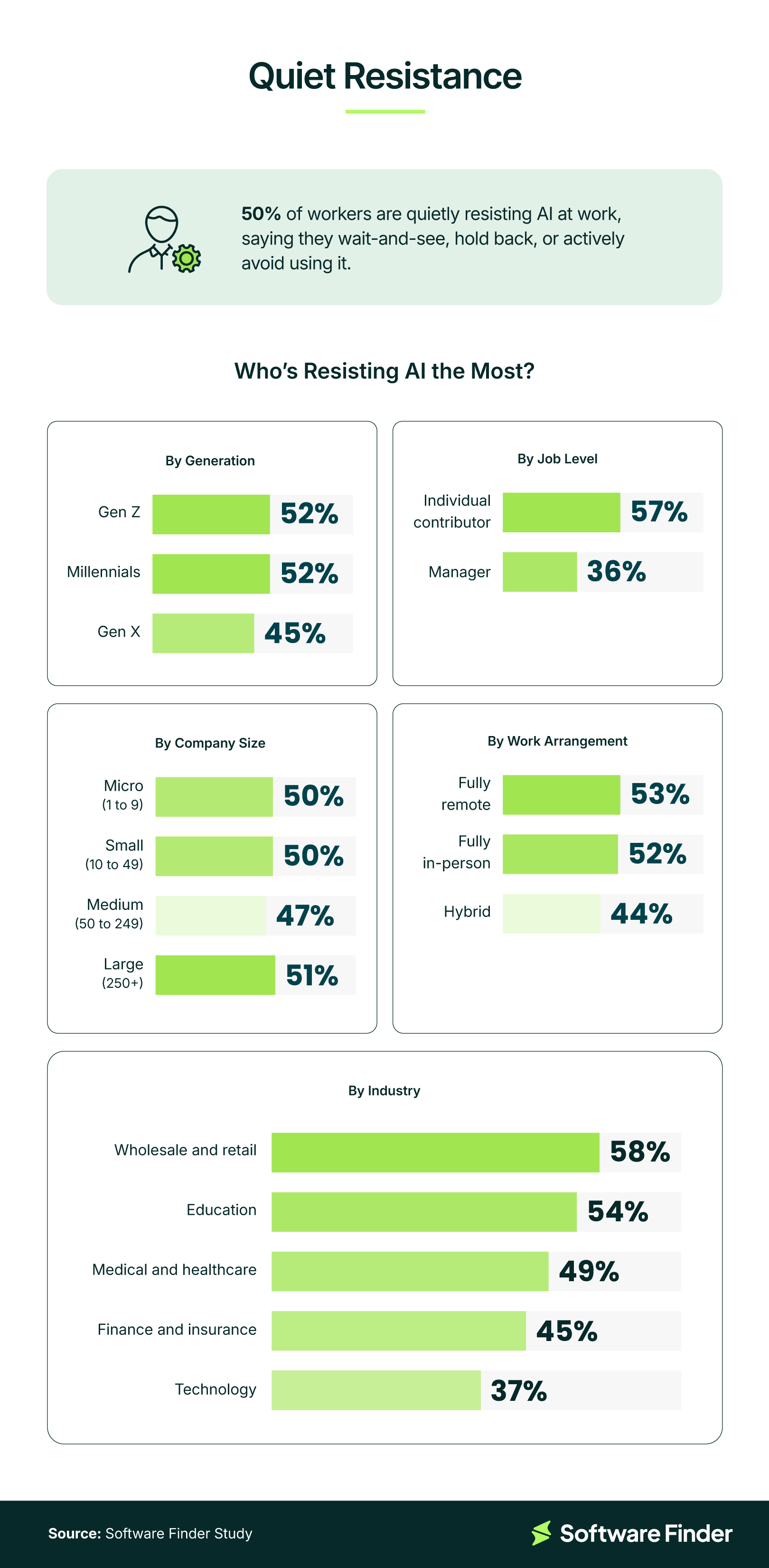
Half of U.S. workers described themselves as wait-and-see, reluctant, or active avoiders of new AI tools, evenly matching the 50% who identified as early or willing adopters. Resistance was highest among individual contributors (57%), 21 points higher than managers (36%). Workers in wholesale and retail reported the highest resistance rate among the top industries surveyed (58%), while technology workers reported the lowest (37%).
Generation and work arrangement also shaped the picture. Gen Z (52%) and millennials (52%) reported higher resistance than Gen X (45%). Fully remote workers (53%) led all work arrangements, while hybrid workers reported the lowest rate (44%).
The gender and income gaps were notable as well. Fifty-five percent of women described themselves as resistant to new AI tools, compared to 43% of men. Workers in the $35K-$49K income bracket reported the highest resistance rate (64%), while those earning $150K-$199K reported the lowest (36%). Workers who resisted AI also earned roughly 20% less on average than those who embraced it ($65,645 vs. $81,526).
Resistance rarely looks like open refusal. Workers stall, keep old workflows running, or perform just enough engagement to avoid scrutiny.
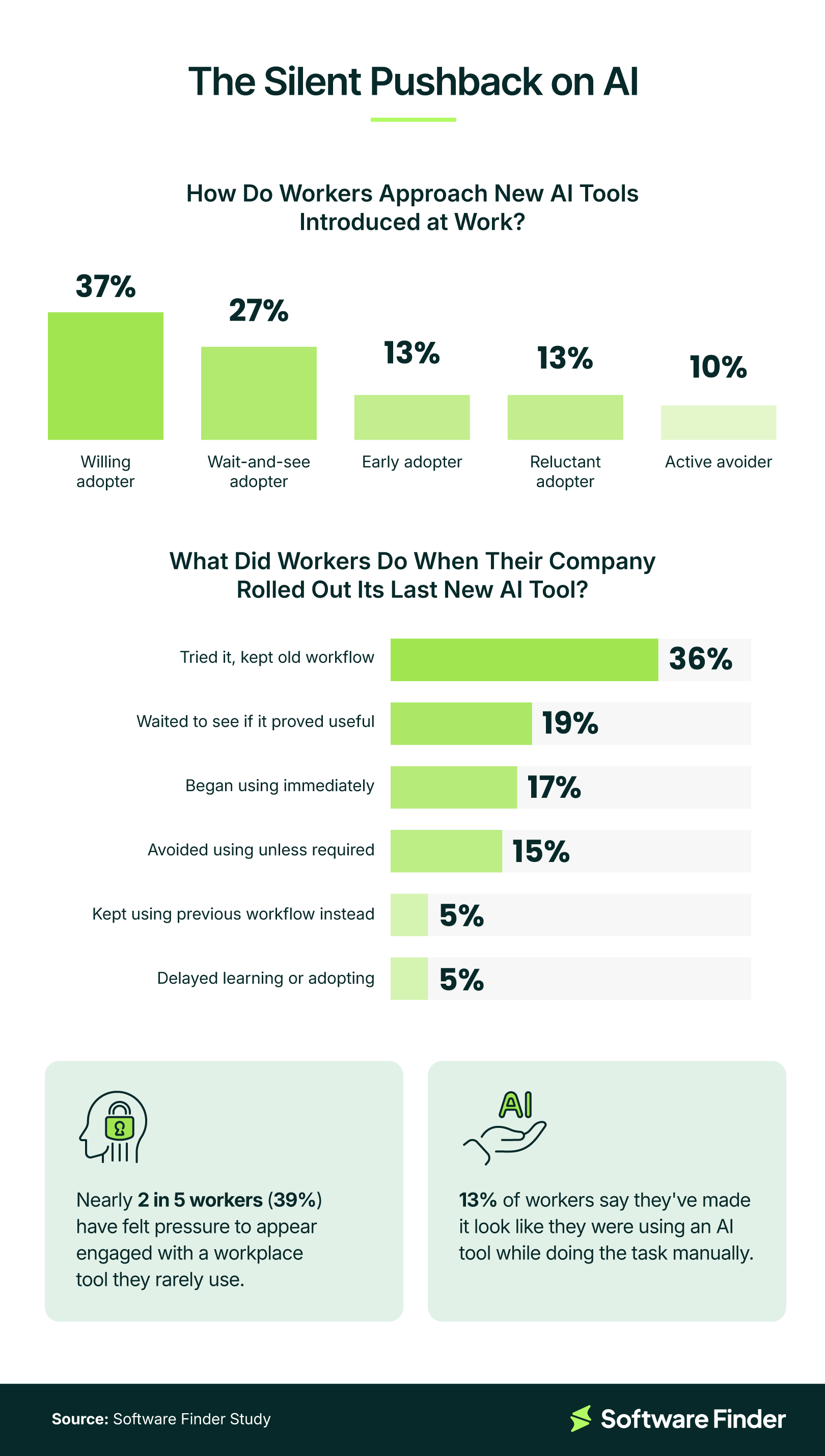
The most common first response when a new AI tool was introduced was to try it while keeping the old workflow in place, cited by 36% of workers. Only 17% said they began using it right away, and 15% said they avoided it unless required.
Social pressure complicated the picture. Thirty-nine percent of workers said they had felt pressure to appear engaged with a tool they rarely used, and 13% admitted to making it look like they were using AI while actually doing the task manually. Gen Z workers reported the highest rate of simulated AI use (18%), followed by millennials (13%) and Gen X (12%).
Larger companies generated the most pressure: 43% of employees at organizations with 250 or more workers said they felt pressed to appear engaged with a tool they rarely used, compared to 21% at micro employers. Women were also nearly twice as likely as men to say they avoided new AI tools unless required, at 19% versus 10%.
Not all workplace software generates the same friction, and the hesitation workers feel often goes deeper than a learning curve.
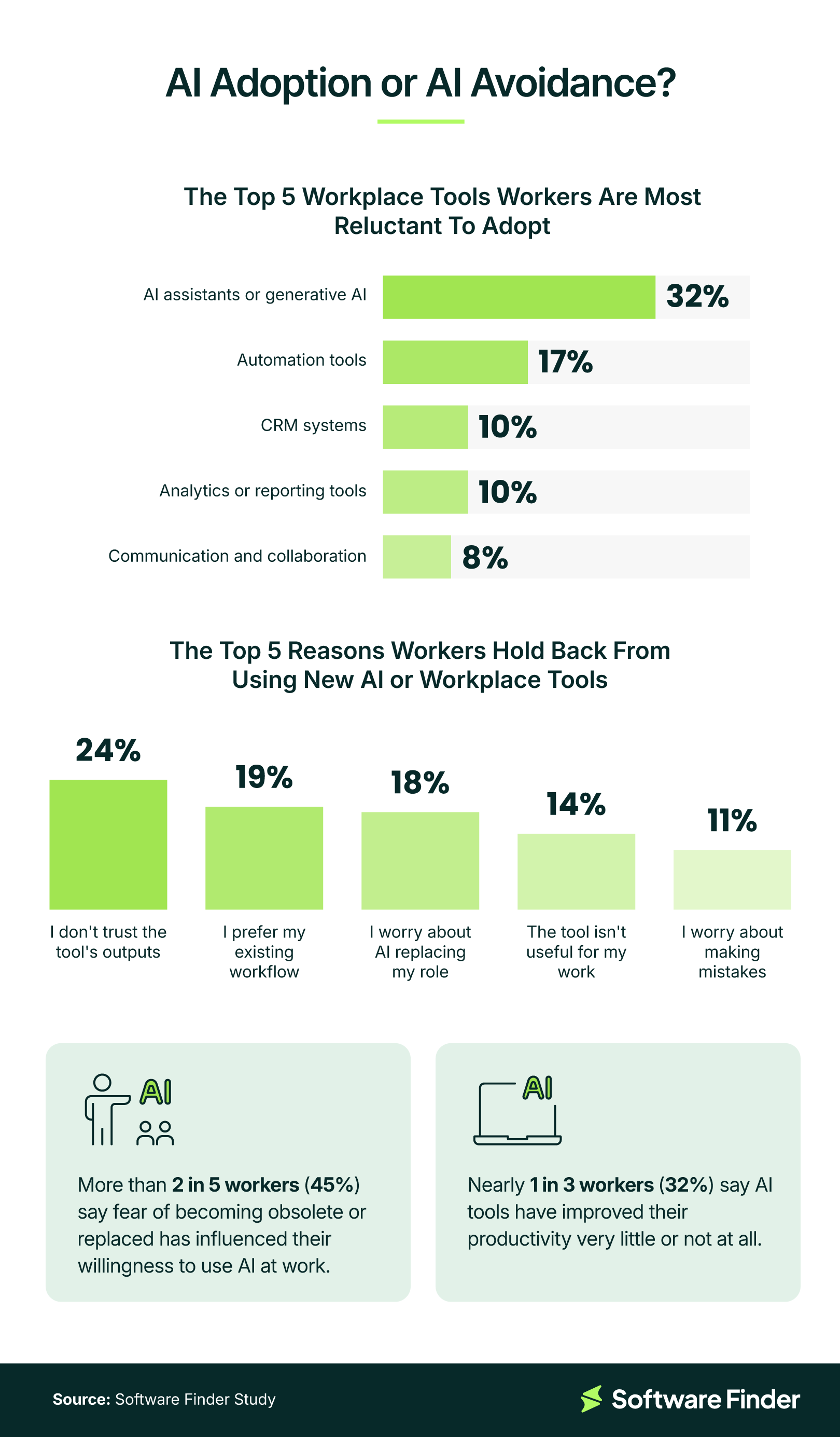
AI assistants and generative AI topped the list of technologies workers were most reluctant to adopt at 32%, nearly twice the share who named automation tools (17%). The top barrier was distrust: 24% of hesitant workers said they didn't trust the tool's outputs, followed by preference for existing workflows (19%) and concern about AI replacing their role (18%).
Fear of becoming obsolete shaped attitudes for nearly half of all workers (45%), with Gen Z reporting the highest rate of influence at 56% compared to 42% among Gen X. Individual contributors were nearly twice as likely as managers to name job replacement as their primary hesitation, at 20% versus 12%.
Perceived productivity gains were also limited. Thirty-two percent of workers said AI tools had improved their productivity or quality of work very little or not at all. Technology workers reported the highest rate of meaningful improvement (68%), while wholesale and retail workers reported the lowest (49%).
There's a meaningful difference between rolling out an AI tool and having employees actually use it, and most managers appear to be missing it.
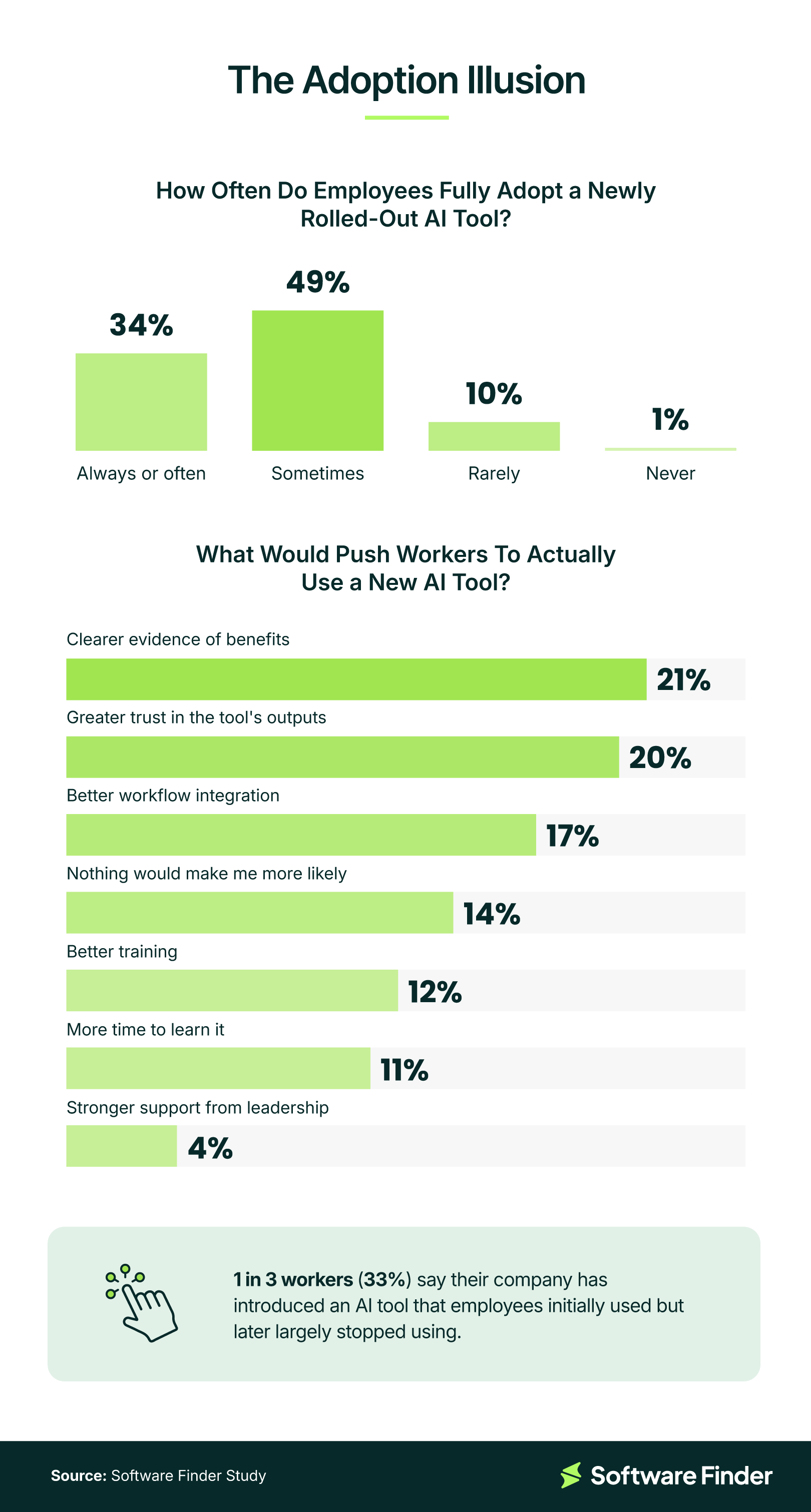
Only 34% of U.S. workers said employees always or often fully adopted a newly introduced workplace tool. Nearly half (49%) said adoption only happened sometimes, and only 6% believed their managers very accurately understood how often employees actually used new AI tools.
One in three workers (33%) said their company had introduced an AI tool that employees later largely stopped using. Nearly a quarter (24%) said they would feel uncomfortable telling their manager they'd rather not use a new AI tool, rising to 32% among remote workers and 28% at companies with 250 or more employees.
What would actually move resistant workers toward adoption? Respondents pointed to a few key factors:
Fourteen percent said nothing would make them more likely to use a newly introduced AI tool. Only 16% believed their company was adopting AI for meaningful business value; the remaining 84% pointed to hype, competition, or a mix of both.
The data makes one thing clear: in most workplaces, AI tool rollouts are running ahead of genuine employee buy-in. Workers are skeptical of the outputs, concerned about job security, and broadly unconvinced that their companies are introducing these tools for the right reasons. The workers most likely to resist are often those with the least leverage to say so openly, which is part of why so much of this resistance goes undetected. For companies hoping to close the gap, the findings suggest the barriers are less about learning curves and more about trust.
We surveyed 1,005 employed U.S. workers to understand how often employees quietly resist newly introduced workplace AI and software tools, what drives that resistance, and how accurately managers perceive real-world adoption. Respondents were required to be currently employed in the U.S. at the time of the survey.
The average age of respondents was 39. The gender breakdown was 57% women, 42% men, and 1% nonbinary. Millennials made up the largest share of respondents (57%), followed by Gen X (24%), Gen Z (15%), and baby boomers (5%). Two-thirds of respondents were individual contributors (66%), and one-third held manager or executive roles (34%).
Most respondents worked fully in-person (46%), while 29% were hybrid and 25% were fully remote. Employer size skewed toward large companies with 250 or more employees (54%), followed by medium (23%), small (15%), and micro (8%). The five largest industries represented were education (14%), medical and healthcare (14%), technology (12%), finance and insurance (10%), and wholesale and retail (9%).
This survey was conducted in June 2026.
Software Finder helps businesses research, compare, and choose software across dozens of categories, from HR and project management tools to healthcare, finance, and design solutions. For teams evaluating AI-powered workplace software, the platform offers detailed reviews, side-by-side comparisons, and expert guidance to support smarter decisions.
You are welcome to share this content for noncommercial purposes. Please include a link back to SoftwareFinder.com when doing so.