


RELEX
Last Updated
Overview
RELEX helps retailers, wholesalers, and manufacturers plan demand, automate replenishment, and optimize inventory across complex supply chains. Implementation may require dedicated resources and significant configuration time. However, AI agents within the platform identify forecast issues, unlock supply constraints, and stress-test plans before they escalate.
Be the first one to leave a review!
No review found

Starting Price
€3,000
per year
RELEX Specifications
- Inventory Management
- Demand Forecasting
- Supply Chain Analytics
- Collaboration Tools
What Is RELEX Solutions?
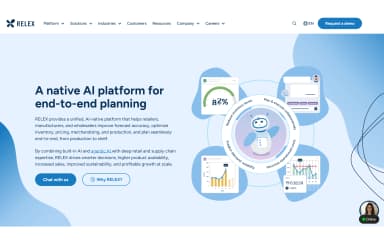
RELEX Solutions is an AI-native platform that connects supply chain and retail planning from raw materials to store shelves in one system. Retailers, wholesalers, and manufacturers use it to automate safety stock calculations, replenishment frequencies, and inventory optimization across distribution networks. ML-powered forecasting factors in promotions, seasonality, and moving holidays. Built-in AI agents find the root causes of stockouts, spoilage, and excess inventory, and turn inventory goals into actions across thousands of SKUs.
What Is RELEX Best For?
RELEX Solutions is best known for its ‘End-to-End Inventory Planning’. It calculates safety stock using demand, probabilistic forecasts, and lead times, while balancing safety stock, cycle stock, and shortage risks at the same time. Stock stays within set thresholds, and automated alerts fire when deviations occur. The Inventory Control AI agent runs scenario planning across thousands of SKUs and shows the real-time profit impact of each option, weighing availability, waste, and working capital together.
How Much Does RELEX Cost?
RELEX pricing starts at €3,000/year (approximately $3,400) for the Basic plan offering Artificial Intelligence and Data Management.
In addition to the base subscription costs, organizations should account for the following potential expenses:
- Implementation: €85,000–€425,000 for smaller deployments; €425,000–€850,000+ for complex enterprise rollouts (approximately $100,000–$500,000 and $500,000–$1,000,000+, respectively)
- Data Migration And Integration: €21,000–€170,000+, based on data volume, quality, and system complexity (approximately $25,000–$200,000+)
- Training And Change Management: €8,500–€64,000+, depending on user count and rollout scope (approximately $10,000–$75,000+)
- ERP, POS, WMS, And API Integrations: €21,000–€128,000+, varying according to the number of systems and integration requirements (approximately $25,000–$150,000+)
Disclaimer: Pricing references are based on publicly available third-party information and industry benchmarks. Actual costs may vary.
RELEX Integrations
The software integrates multiple third-party applications, including:
- SAP
- Oracle
- Microsoft Dynamics 365
- Visma.net
- IFS
- AS400
- Databricks
- Snowflake
How Does RELEX Work?
Here's how you can get started with the RELEX software:
- Log in to the RELEX platform and configure your business structure
- Import historical sales and operational data
- Set forecasting parameters and planning rules
- Connect supply chain systems such as ERP and POS
- Generate AI-driven forecasts and inventory plans
- Monitor performance using real-time dashboards
- Adjust planning strategies based on insights and analytics
Who Is RELEX For?
RELEX caters to various supply chain-driven businesses, including:
- Retail chains
- Grocery and fresh food retailers
- Wholesale and distribution businesses
- Consumer packaged goods manufacturers
- Specialty and home improvement retailers
- Pharmaceutical distributors
RELEX Use Cases
Based on our analysis of user reviews and RELEX features, we have identified key scenarios where the platform is a strong fit for retailers, wholesalers, and consumer goods manufacturers:
Convenience Retailers Managing Short-Shelf-Life Products With Unpredictable Demand
When demand for short-shelf-life products is hard to predict, procurement overshoots and products spoil before they sell. Weather changes buying patterns quickly, and manual planning cannot always keep up. RELEX’s ML-based demand forecasting captures demand drivers including weather patterns, seasonality, and pricing to generate more accurate daily forecasts. This helps convenience retailers improve in-store availability without increasing spoilage.
Retailers Running Multiple Disconnected Supply Chain Systems With No Central Visibility
If supply chain operations run across separate legacy systems, visibility gaps might appear. On-ground teams cannot see the full picture from one place, which leads to manual workarounds and slow responses to issues. RELEX’s Diagnostics feature automatically analyzes inventory and order data across all locations to identify where problems are occurring. It surfaces the root causes without requiring manual investigation across multiple platforms.
Home Improvement Retailers Managing Seasonal Replenishment Across Hundreds Of Stores
Seasonal demand cycles make replenishment planning complex for home improvement retailers. Products that sell heavily in one quarter need to be in the right stores at the right time, without overloading distribution centers. RELEX’s Automatic Replenishment and Allocation automates order proposals based on demand, capacity, and sourcing constraints. It handles allocation across a full store network and adjusts as demand signals change.
In-Store Fresh Food Producers Who Need To Optimize How Much They Make Each Day
Bakeries, prepared food sections, and fresh food producers inside retail stores face a daily production question: how much to make. Produce too much and it goes to waste. Produce too little and shelves go empty. The Inventory Control AI agent runs scenario planning across thousands of SKUs and shows the real-time profit impact of each option. Production teams can see how each scenario balances availability, waste, and working capital before committing.
Is RELEX Solutions Right For You?
RELEX is built for enterprises managing complex supply chains across retail, wholesale, and consumer goods manufacturing. It fits best when planning spans multiple channels, store networks, or distribution tiers, and when the volume of SKUs and locations makes manual forecasting unworkable.
The platform holds ISO 27001:2013 certification and SOC 2 Type I and Type II attestation for its Inventory and Supply Chain software. It is also GDPR compliant, with compliance details published on the official privacy trust center.
RELEX was named a Leader in the 2026 Nucleus Research Enterprise Supply Chain Planning Value Matrix for the second year running. Named clients include Lowe’s, Rossmann, One Stop, and Family Dollar. In H1 2026, RELEX launched productized AI agents that help planners identify forecast issues, unlock supply constraints, and accelerate decisions across supply chain operations.
Teams with simpler inventory needs or limited implementation capacity may find the platform difficult to get full value from without dedicated resources.
Still unsure whether RELEX software is the best fit for your business? Call us at (661) 384-7070, and our team will help you decide based on your requirements.
RELEX Features
Demand Planning
RELEX Demand Planning uses ML to anticipate demand drivers including promotions, pricing, and seasonality. The Product Attribute AI agent automatically matches new products to reference products for day-one forecasts. Probabilistic modeling converts supply and demand uncertainty into automated, transparent actions across merchandising, supply chain, and operations planning.
Distribution Planning
Precise quantities for each distribution link are calculated automatically, factoring in demand, network structure, capacity, sourcing rules, and supply penalties. RELEX Distribution Planning also automates delivery flow optimization and time-phased replenishment. Teams compare customer prioritization and inventory policy scenarios before committing, with automated alerts based on order proposals and master data.
Master Planning
RELEX Master Planning removes guesswork by automatically calculating production and purchase order proposals based on demand, material capacity, and supply constraints. Cyclical planning locks production sequences for consistency. What-if scenario testing lets teams compare options before committing, and proactive alerts flag issues early before they affect operations.
Predictive Inventory
RELEX True Inventory tackles phantom inventory by building perpetual inventory records from POS transactions using ML that continuously learns from new data. The Store Support AI agent delivers instant order explanations within RELEX Mobile, and cycle count recommendations cut the time spent on manual stock checks.
Diagnostics
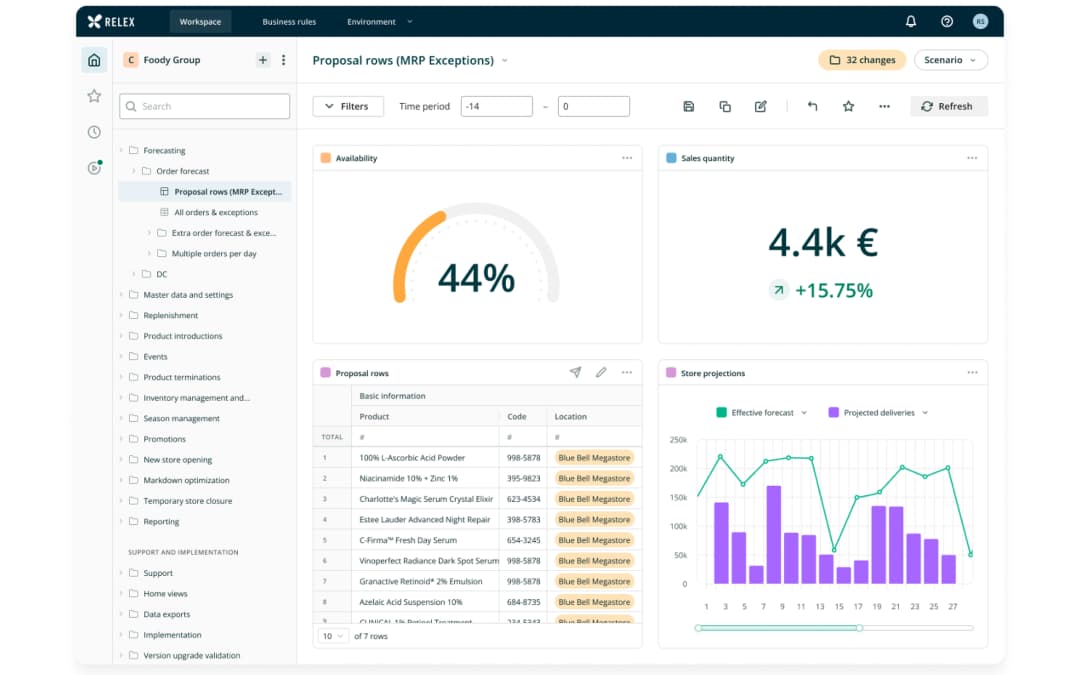
The AI-Assisted Diagnostics agent continuously analyzes lost sales, spoilage, and excess stock, pinpointing root causes in seconds. RELEX Diagnostics prioritizes issues by impact and surfaces corrective actions by reviewing order proposal data and inventory levels. KPI dashboards track availability, inventory value, and spoilage.
Channel Planning
Channel Planning in RELEX generates separate forecasts for each sales channel including individual B2B customers, customer groups, e-commerce, and in-store demand. Inventory is virtually ringfenced in distribution centers to protect stock per channel. ML accounts for channel-specific demand patterns, capacity restraints, and service level requirements.
Pros And Cons of RELEX
Pros
Multi-store replenishment forecasts adjust to different business models and needs
Automates centralized purchasing and makes key KPIs like stock reach easy to steer
Store teams gain capacity to focus on customer service instead of manual planning
Environment is customizable at both user and company level without coding
Product team responds quickly to new feature suggestions and requests
Cons
Advanced functionality requires existing supply chain methodology knowledge from users
Merchandise financial planning capabilities are limited within the platform
Complexity requires dedicated resources and expertise to implement fully
RELEX Reviews

No reviews yet!
Be the first to review this product
Frequently Asked Questions
What level of support does RELEX software provide?
RELEX provides support via help desk, contact form, and live chat.
Does RELEX provide user training?
Training is part of RELEX’s implementation and customer support offering. Reviewers note the platform is accessible to planners, merchants, and allocators with basic training.
Does RELEX require coding knowledge to configure?
No. The platform uses a no-code configuration approach, according to the official platform page. This allows customers to adjust workflows and settings without development resources.
What language does RELEX support?
RELEX supports multiple languages to serve global users, including English, German, Spanish, Italian, French, Finnish, Swedish, Norwegian, Danish, Portuguese (Brazil), Japanese, and Chinese.
Does RELEX software have a mobile app?
Yes, RELEX offers a mobile app for iOS and Android users.
Does RELEX offer an API?
Yes, RELEX does offer an API.
What is the difference between RELEX and SAP?
SAP is a broad enterprise platform covering finance, HR, procurement, and supply chain. RELEX is purpose-built specifically for retail and supply chain planning. It is designed to sit alongside SAP rather than replace it, connecting to existing SAP infrastructure through integration.
Does RELEX work with existing ERP systems?
Yes. RELEX is designed to work alongside existing ERP and enterprise systems without replacing them. The no-code configuration reduces the time needed to connect the platform to current infrastructure.