Last Updated

Key Takeaways

Generated from the text of customer reviews

Looker software is a cloud-based business intelligence platform used by data analysts, finance, and operations. Multi-source data connectivity is its most praised capability; however, limited data transformation is a recurring complaint. Looker launched BI Agents at Google Cloud Next’26, introducing conversational and dashboard-level AI built on its semantic layer.

Our Verdict

Looker software is well-suited for large enterprises and data-heavy teams managing complex, multi-source reporting across teams. Several users view its pricing as premium, but worthwhile for scalability and modern cloud environments. We recommend it for organizations where governed; real-time analytics across business units is a priority.

Overall Rating

Based on 15 users reviews

4.6

Rating Distribution

Positive

93%

Neutral

7%

Negative

0%

Starting Price

Custom pricing
Looker Software Specifications

  • Data Visualization
  • Customizable Dashboards
  • Data Analysis And Reporting
  • Scheduled Reporting
View All Specifications

What Is Looker Software?

Looker software is a leading business intelligence and data analytics platform developed by Google Cloud that helps businesses transform data into meaningful insights, such as real-time KPI time tracking, cross-channel performance reporting, and trend analysis across business units. It is suitable for a range of users, from analysts to decision-makers, and is built around LookML, a proprietary semantic modeling language that standardizes how businesses’ metrics are defined and queries across teams. The platform offers powerful visualization tools, dashboards, and extensive customization options. With Google Gemini AI integrated directly into the Looker platform, users can explore data, build reports, and generate visualizations using natural language. It possesses a cloud-based architecture and offers collaborative features, helping users gain data exploration, drive smarter decisions, and foster teamwork.

What is Looker Software Best For?

Looker is best known for its ability to connect multiple data sources into a single, automatically updating dashboard environment. It is well-suited for data analysts, operations managers, and finance teams at mid-to-large organizations, particularly those using Google Cloud or BigQuery as their primary data warehouse. Teams managing high volumes of recurring reports, tracking KPIs across departments, or enabling non-technical business users to access data without involving a development team tend to get the most consistent value from the platform.

How Much Does Looker Software Cost?

The starting price of the software is $2,000/month. Looker pricing varies depending on the unique needs of your business. The vendor offers the following plans with custom costs for each:

  • Standard
  • Enterprise
  • Embed

Beyond the base subscription fee, organizations using Looker may have to incur additional, hidden costs, including but not limited to the following:

  • Implementation And Data Modeling: Typically falls in the range of $3,000–$25,000, depending on dashboard complexity and semantic layer setup
  • Data Warehouse Costs: Costs may vary around $500–$10,000+/month based on query usage and storage volume
  • Custom Integrations And API Development: Generally expected to range between $2,000–$15,000, depending on connected systems and automation needs
  • Training And User Enablement: Organizations can anticipate costs of approximately $1,000–$8,000 for analyst, admin, and stakeholder onboarding
  • Premium Support And Managed Services: Ongoing expenses are often estimated at $500–$5,000/month, depending on SLA level and external consulting needs

Several users view Looker’s pricing as premium, but often consider the cost worthwhile for advanced features and scalability with modern cloud data environments. Several users view Looker’s pricing as premium, but often consider the cost worthwhile for advanced features and scalability with modern cloud data environments.

Get the Looker cost that suits your business requirements and budget.

Disclaimer: Pricing references are based on publicly available third-party information and industry benchmarks. Actual costs may vary.

Looker Software Integrations

The platform integrates with multiple third-party applications, such as:

How Does Looker Software Work?

Here is how you can get started with the software after logging in and onboarding is complete:

  • Access the admin console to configure user roles, permissions, and data access controls
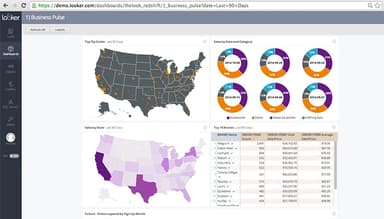
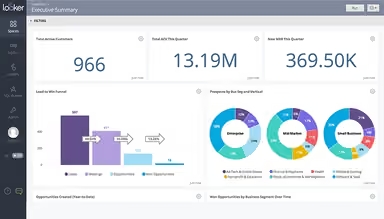
  • Open the main Looker dashboard to view key metrics, reports, and saved explores
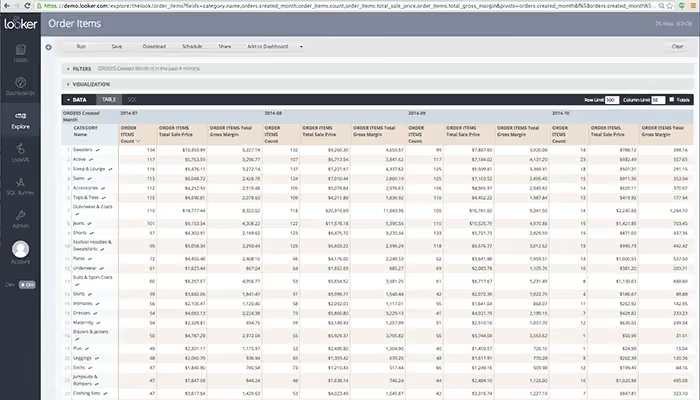
  • Navigate the Explore section to query datasets and build custom reports using the semantic layer
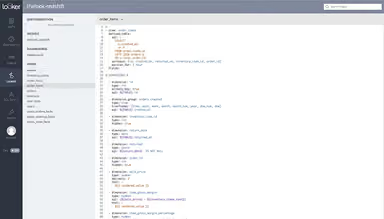
  • Use the LookML project area to manage data models and define business metrics
  • Create and organize dashboards to visualize insights across departments and teams
  • Share reports and dashboards with users based on role-based access permissions
  • Schedule automated reports and alerts for real-time business monitoring
  • Integrate embedded analytics into workflows or applications for contextual insights
Schedule a free Looker demo to learn more about its capabilities.

Who Is Looker Software For?

Looker software is ideal for a wide range of industries and sectors, including:

  • Retail
  • Media and entertainment
  • Supply chain and logistics
  • Consumer packaged goods
  • Telecommunications
  • Financial services
  • Education
  • Healthcare and life sciences

Looker Software Use Case

Based on the analysis of user reviews and Looker’s current capabilities, we have identified key scenarios where this software is a strong fit for data-driven organizations, enterprises, and product-led companies:

Enterprise Teams Centralizing Metrics Across Departments

Large organizations running several business units often reach a point where finance, operations, and leadership teams are each working from different reports, different definitions, and different numbers. This makes it difficult to align on performance at the executive level. The problem is rarely a lack of data; it is that the same metric means different things depending on who built the report. Looker may be a suitable fit for enterprise teams in this position, particularly where standardizing how metrics are defined and accessed across the organization is a higher priority than building more dashboards.

SaaS Companies Embedding Analytics Into Customer Products

Product teams building data-heavy applications frequently face a choice between directing users to an external BI tool or investing significant engineering resources in building reporting functionality from scratch. Neither option scales well, the first creates friction, and the second pulls engineering capacity away from core product development. Looker could be worth considering for SaaS companies in this situation, given its Embed edition is specifically designed for teams that need to deliver interactive analytics inside their own applications without rebuilding the underlying data infrastructure.

Retail And E-commerce Teams Monitoring Sales And Demand Trends

Retail organizations managing both online and in-store operations commonly struggle with data living across separate systems, point-of-sale, e-commerce platforms, and marketing tools that rarely speak to each other by default. When sales performance, customer behavior, and channel data sit in different places, the time it takes to pull a coherent picture slows down decisions that need to happen quickly. Looker may suit retail teams dealing with this fragmentation, particularly where the priority is getting a consolidated, real-time view of performance across channels without relying on manual data pulls.

Finance And Operations Teams Tracking Performance And Forecasting

Finance and operations teams in mid-to-large organizations often spend a disproportionate amount of time maintaining spreadsheets, reconciling figures from different systems, and rebuilding the same reports on a monthly or quarterly basis. The underlying issue is that static reporting cycles create a lag between when something happens in the business and when decision-makers see it. Looker could be a practical fit for teams looking to move away from this pattern, replacing periodic manual reporting with continuously updated data models that reflect current performance without requiring someone to rebuild the report each time.

Data Teams Standardizing Self-Service Reporting For Business Users

Data and analytics teams at growing organizations frequently face hindrances from a high volume of one-off reporting requests from business stakeholders who need data but lack the technical background to query it themselves. The result is a backlog that slows both the data team and the business users waiting for answers. Looker may be worth considering for data teams in this position, where the goal is to build reusable data models that business users can explore independently - reducing the volume of ad hoc requests while maintaining control over how the underlying data is defined and interpreted.

Is Looker Software Right For You?

Looker software can be an ideal choice if you are looking for a powerful data exploration and analytics tool with easy integration into Google Cloud products. It’s great for teams seeking real-time insights, customizable reports, and a flexible platform that empowers both technical and non-technical users to make smarter decisions effortlessly. Additionally, the software is HIPAA-compliant and maintains several ISO and SOC security certifications, ensuring the privacy of confidential user data.

Still doubtful if Looker software is the ideal solution for you? Contact us at (661) 384-7070 for further guidance.

Looker Software Features

Build Custom Data Experiences And Apps

Looker features offer Building Custom Data Experiences and Apps that allow users to embed dynamic, interactive dashboards seamlessly into apps. With extensive API support and Vertex AI integration, users can build personalized workflows, unlock advanced analytics, and transform raw data into actionable, valuable experiences.

See How It Works
Unified And Trusted Data With Looker’s Semantic Layer

This feature centralizes key metrics into one reliable source, ensuring consistent, trusted data across your organization. Whether integrated with partner tools or used directly in Looker, it empowers teams with reliable insights for both AI-driven and human analysis.

See How It Works
Out-of-the-Box Visuals And Real-Time Self-Service Analytics

This feature helps users create engaging, real-time dashboards with Looker or interactive reports using Looker Studio. From enterprise-level analysis to quick, drag-and-drop reporting, it makes data exploration intuitive and accessible for all levels of users.

See How It Works
Gemini In Looker: AI-Powered Analytics

This offers assistance to users with AI-driven workflows like building reports, creating formulas, and configuring visualizations. Gemini combines advanced AI models with an intuitive, conversational interface, making complex data tasks simple and accessible to everyone.

See How It Works
Conversational Analytics

It allows users to query data by asking questions in plain language, without writing SQL or LookML. Responses are grounded in the Looker semantic layer, meaning answers reflect the same governed metric definitions used across the rest of the platform. Users can also interact with data agents built on specific Explores, and agents can be shared across teams or embedded into external applications via the Conversational Analytics API.

See How It Works

Pros And Cons of Looker Software

Pros

  • Speeds up reporting for faster decision-making

  • Real-time data syncing keeps analytics consistently updated

  • Centralized dashboards improve cross-team collaboration

Cons

  • May have limited third-party integrations

  • Might require SQL or modeling knowledge for deeper functionality

Looker Software Reviews

Total 15 reviews

4.6

All reviews are from verified customers

Rating Distribution

5

Stars

67%

4

Stars

27%

3

Stars

7%

2

Stars

0%

1

Stars

0%

Share your experience

G

Gerrit

Computer Software, 51-100 employees

More than a year

5.0
December 2024

A tool that's extremely useful for my company

Pros

We can generate reports both internally and for customers quickly and these reports can be delivered regularly to external stakeholders whenever needed.

Cons

It's a feature rich software, which makes it complex so it's definitely not the easiest tool to hand over to an intern for them to learn.

Rating Distribution

Ease of use

8

Value for money

10

Customer Support

10

Functionality

9

L

Lucie

Insurance, 51-100 employees

Less than a year

5.0
December 2024

Data explore, analyze, and visualize easily with looker

Pros

Dashboard customization is the key feature I rely on Looker for. It integrates seamlessly with various data sources like Sheets, Analytics and Google Ads ensuring that my reports are always current.

Cons

For someone new, it can be quite overwhelming due to the numerous and complex options available.

Rating Distribution

Ease of use

10

Value for money

10

Customer Support

10

Functionality

9

I

Ian

Marketing and Advertising, 51-100 employees

More than a year

5.0
November 2024

Amazing for visualizing data insights

Pros

It is an excellent data visualization tool for presenting client data in a smarter, more insightful way.

Cons

The user interface is a bit basic but I appreciate that I can customize it to match my branding. However it can sometimes feel a little too basic.

Rating Distribution

Ease of use

10

Value for money

8

Customer Support

10

Functionality

9

Frequently Asked Questions

What level of support does Looker software offer?

Looker software offers support through chatbot, email/helpdesk, FAQs/forums, and knowledge base.

Who are the typical users of Looker software?

Typical users of Looker software include industries such as healthcare and life sciences, financial services, manufacturing, telecommunications, education, retail, media and entertainment, supply chain and logistics, consumer packaged goods, and government sectors.

What other apps does Looker software integrate with?

Looker software integrates with Google Analytics, Slack Software, BigQuery, and LookML Diagram.

What types of pricing plans does Looker software offer?

The platform’s starting cost is $2,000/month. The software has three pricing plans with custom quotation for each: Standard, Enterprise, and Embed. Get a personalized Looker cost according to your business requirements.

What language does Looker software support?

Looker software supports English, German, Spanish, French, and Indonesian languages.

Does Looker software have a mobile app?

Yes, Looker software has a mobile app.

Does Looker software offer an API?

Yes, Looker software offers an API.