


Socotra
Last Updated
Overview
Socotra software provides a comprehensive cloud-native core platform, aiding in policy administration, billing, and claims management through an agile, API-first architecture. While feature request implementation can take a long time, its rapid deployment capabilities and low total cost of ownership justify the investment.

Socotra Specifications
- Financial Management
- Customer Relationship Management
- Sales And Marketing Automation
- Business Intelligence
What Is Socotra?
Socotra represents the next generation of insurance core technology, functioning as a headless ERP system that separates back-end logic from front-end delivery. The platform offers a unified suite for policy lifecycle management, a robust double-entry accounting engine for billing, and a modular claims system, allowing carriers to launch products in record time. By utilizing a product-agnostic data model and JSON-based configuration, Socotra software empowers insurers to handle complex personal, commercial, and specialty lines on a single tenant.
Socotra Pricing
Socotra Integrations
The software supports integration with multiple platforms, such as:
- Snowflake
- Databricks
- Azure Data Factory
Who Is Socotra For?
Socotra is ideal for a wide range of industries and sectors, including:
- Personal lines carriers
- Commercial lines carriers
- Life and health
- Telematics and UBI
- Embedded insurance
- Parametric insurance
Is Socotra Right For You?
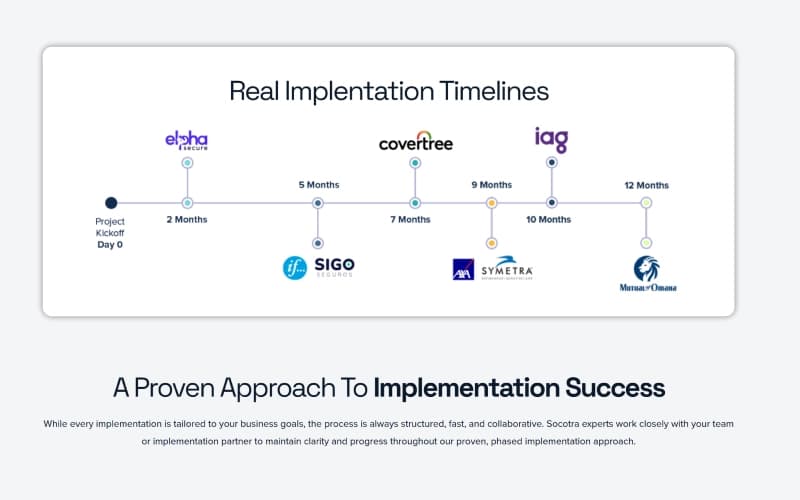
Socotra is a transformative choice for insurers that prioritize agility, technical independence, and rapid innovation. Socotra features, its cloud-native architecture, and API-first philosophy eliminate the legacy cloud issues that hamper traditional carriers, providing a foundation that actually improves with age through automatic, backward-compatible upgrades. The software is also trusted by leading insurers such as IAG, AXA, and Symetra, helping them launch products faster, reduce total cost of ownership, and improve operational efficiency.
Still doubtful if Socotra is the right fit for you? Connect with our customer support staff at (661) 384-7070 for further guidance.
Socotra Features
Policy
This core platform uses reusable configurations to deploy any insurance product across various geographies and distribution channels. It manages the entire policy lifecycle, including renewals and out-of-sequence changes. Its unique 6-stage model allows for specialized workflows without needing any manual custom code updates.
Billing
Built on a double-entry accounting engine, this system ensures financial integrity for complex insurance use cases. Users can preview the financial impact of any action before executing it. Every transaction is completely reversible with a full audit trail to reduce manual reconciliation tasks.
Data And Reporting
Built on a double-entry accounting engine, this system ensures financial integrity for complex insurance use cases. Users can preview the financial impact of any action before executing it. Every transaction is completely reversible with a full audit trail to reduce manual reconciliation tasks.
UI And Portals
The platform offers productized and custom digital experiences for agents and policyholders through a modular, headless architecture. Users can leverage the UI SDK with pre-made React components or connect existing portals via open APIs. Low-code options and operations workbenches further simplify policy sales and account management.
Pros And Cons of Socotra
Pros
Socotra offers a highly flexible and configurable policy administration system
The platform provides a single source of truth for product attributes and business rules
Users can import and manage insurance product data centrally within the system
Cons
Some requested features were not delivered within the committed timeframes
The platform lacks several common insurance features expected by enterprise users
Socotra Reviews
Total 10 reviews
4.3
All reviews are from verified customers
Rating Distribution
5
Stars40%
4
Stars50%
3
Stars10%
2
Stars0%
1
Stars0%
Share your experience
Insurance, 500+ employees
“API-driven configurability win”
Pros
Socotra's data model is genuinely expressive. The way it combines the policy/exposure/peril hierarchy with characteristic versioning makes it possible to model fairly complex insurance products through configuration instead of custom code. On top of that the versioning semantics bake in auditability across the whole policy lifecycle which is a huge win when you need to track changes over time. The platform is also very API first. Capabilities are consistently exposed via a structured API so it fits nicely into a microservices setup and doesn't pull you into a tightly closed ecosystem. Another strong point is product configurability. You can model and iterate on new products, coverages and rating structures without having to rewrite engineering solutions every time which noticeably speeds up the timeline for product updates.
Cons
There's a steep learning curve and a lot to wrap your head around. The model is powerful but it takes real time for both engineers and analysts to become fluent in the policy/exposure/peril concepts, characteristic versioning and renewal group semantics. While you're still building that shared understanding, configuration choices can look reasonable locally but turn out globally suboptimal and then refactoring becomes painful. Documentation is also a bit uneven for advanced scenarios. The coverage is fine on the happy path but edge cases aren't as well covered which means teams end up spending extra time rediscovering answers via support or experimentation. Finally the operator UX is pretty thin out of the box. The bundled UI works for configuration and inspection but it doesn't really cover production-grade servicing, underwriting, or exception workflows without additional effort.
Rating Distribution
Ease of use
7
Value for money
7
Customer Support
7
Functionality
7
Finance, 101-500 employees
“Fast rollout for new products”
Pros
It generally works really well. Deploying new products is noticeably faster more like weeks instead of months or even years which makes a big difference when we're iterating. Also it handles multiple product lines without much fuss and it integrates with our existing systems better than expected.
Cons
Well there are a couple areas that still need work. We're currently on the older version so some of the issues we see are known problems that the newer release has already addressed. Still managing large schedules can get a bit tricky and complex forms aren't always as comfortable to work with as they should be.
Rating Distribution
Ease of use
8
Value for money
8
Customer Support
7
Functionality
7
Insurance, 500+ employees
“Reliable platform with smart assistance”
Pros
High platform stability with consistently low downtime, plus a flexible product configuration and data model that fits changing needs. The support team is also pretty responsive and genuinely knowledgeable which makes troubleshooting much less painful when something comes up.
Cons
That strong stability comes with a trade-off such as the setup doesn't feel very flexible unless you invest serious time into the integration work. Also it requires highly skilled employees who can really understand the underlying model and know how to apply it correctly.
Rating Distribution
Ease of use
7
Value for money
8
Customer Support
8
Functionality
7
Frequently Asked Questions
What language does Socotra support?
Socotra is primarily available in English.
Who are the typical users of Socotra?
Socotra is well-suited for a variety of insurance segments, including personal and commercial lines carriers, life and health insurers, telematics and usage-based insurance providers, as well as embedded and parametric insurance models.
What level of support does Socotra offer?
Socotra offers support via email, phone, and online contact form.
What other apps does Socotra integrate with?
The vendor has not publicly disclosed specific information regarding third-party integrations for this software.
What types of pricing plans does Socotra offer?
Socotra Platform software uses a subscription-based pricing model. You can request a custom Socotra cost quote that meets your requirements.
Does Socotra offer an API?
Yes, Socotra offers robust, open RESTful APIs.
Does Socotra have a mobile app?
No, it does not have a mobile application.