



Picking new software sounds like it should be straightforward. Find a tool that solves your problem, get buy-in, and move on. In practice, it's rarely that simple. Between competing priorities, too many decision-makers, and a sea of similar-looking options, the process has a way of dragging out far longer than anyone expects.
Software Finder surveyed 402 U.S. software decision-makers about their evaluation timelines, biggest frustrations, and where things tend to stall. What we found is a significant gap between how urgently teams need a solution and how quickly they can actually get one in place.
If you've ever felt like your team's software search was taking forever, you're not imagining things, and you're far from alone.
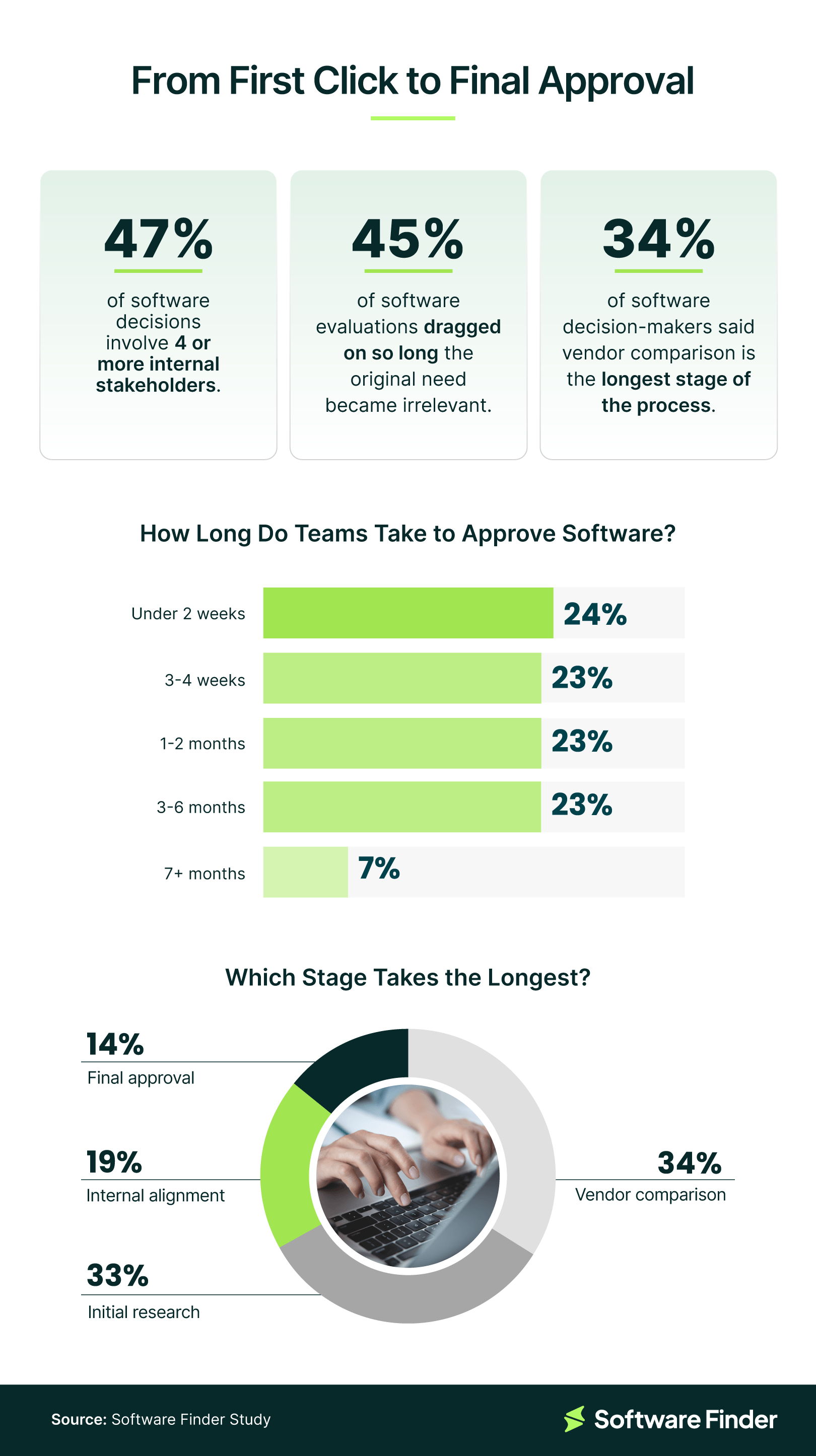
Here's the stat that really stands out: 45% of respondents said software evaluations dragged on for so long that the original business need became irrelevant by the time a decision was made. In other words, nearly half the time, teams are solving yesterday's problem, or no problem at all.
A big part of what slows things down is sheer stakeholder volume. The majority of decisions (72%) involved 2 to 6 internal stakeholders, which means more meetings, more opinions, and more rounds of "let me loop in one more person."
The comparison stage is where things really bog down. For 34% of decision-makers, vendor comparison was the longest phase of the entire process. Company size also plays a role:
- 40% of small businesses completed approvals in under 2 weeks, but only 12% of large companies did.
- At large companies, internal alignment alone accounted for 35% of bottlenecks, compared to just 7% at small businesses.
All told, only 23% of all teams finalized a decision within 1 to 2 months.
Even when teams are motivated and moving, the evaluation process itself can throw up walls that are tough to get past.
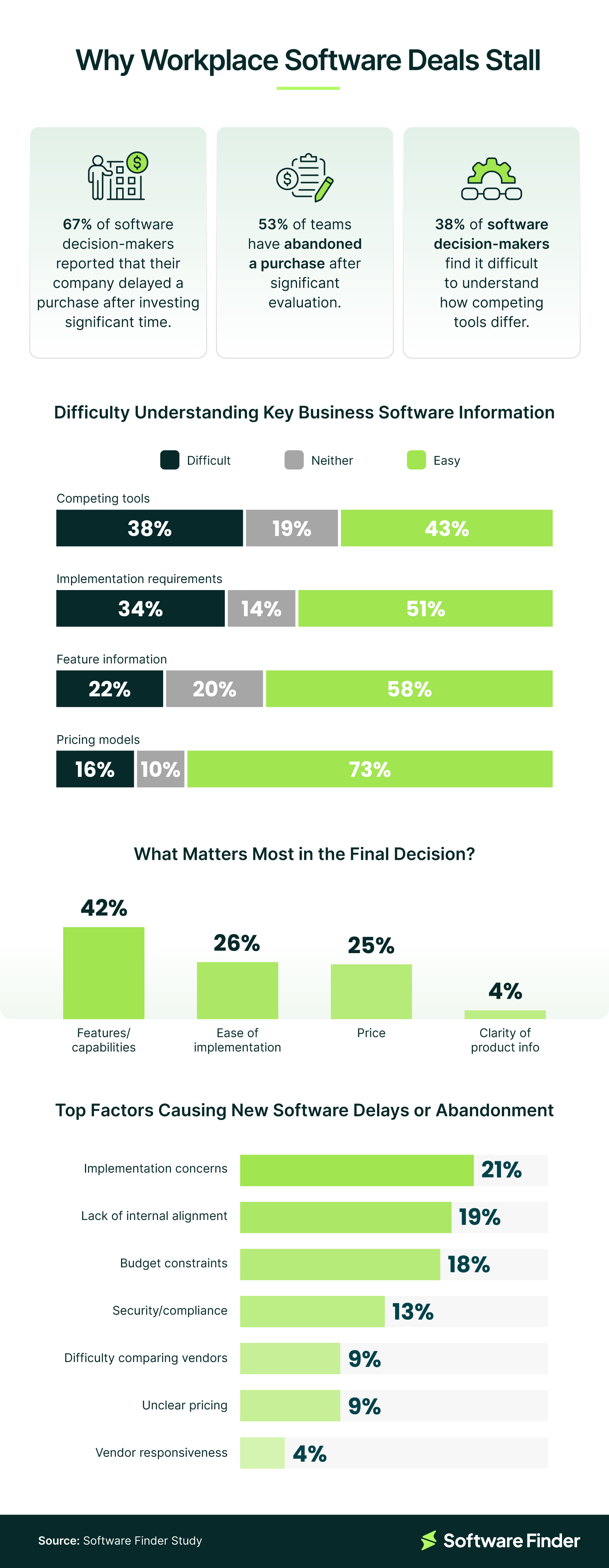
More than half of teams (67%) delayed decisions after putting in significant evaluation time, while 53% abandoned a software purchase altogether. That's a lot of wasted effort.
One of the core issues is that it's genuinely hard to tell tools apart. Over a third of decision-makers (38%) said they struggle to differentiate between competing products, which makes the comparison phase feel like it's going in circles.
When teams did reach a decision, features and capabilities were the deciding factor for 42% of them. That emphasis was even stronger among senior managers: 49% said features are the top priority, compared to 37% of individual contributors.
As for what actually killed deals or caused delays, implementation concerns topped the list at 21%, followed by lack of internal alignment (19%) and budget constraints (18%). It's a reminder that even when a tool looks right on paper, practical and organizational hurdles can still stop it in its tracks.
Not every department experiences the software buying process the same way, and that mismatch can create its own kind of friction.
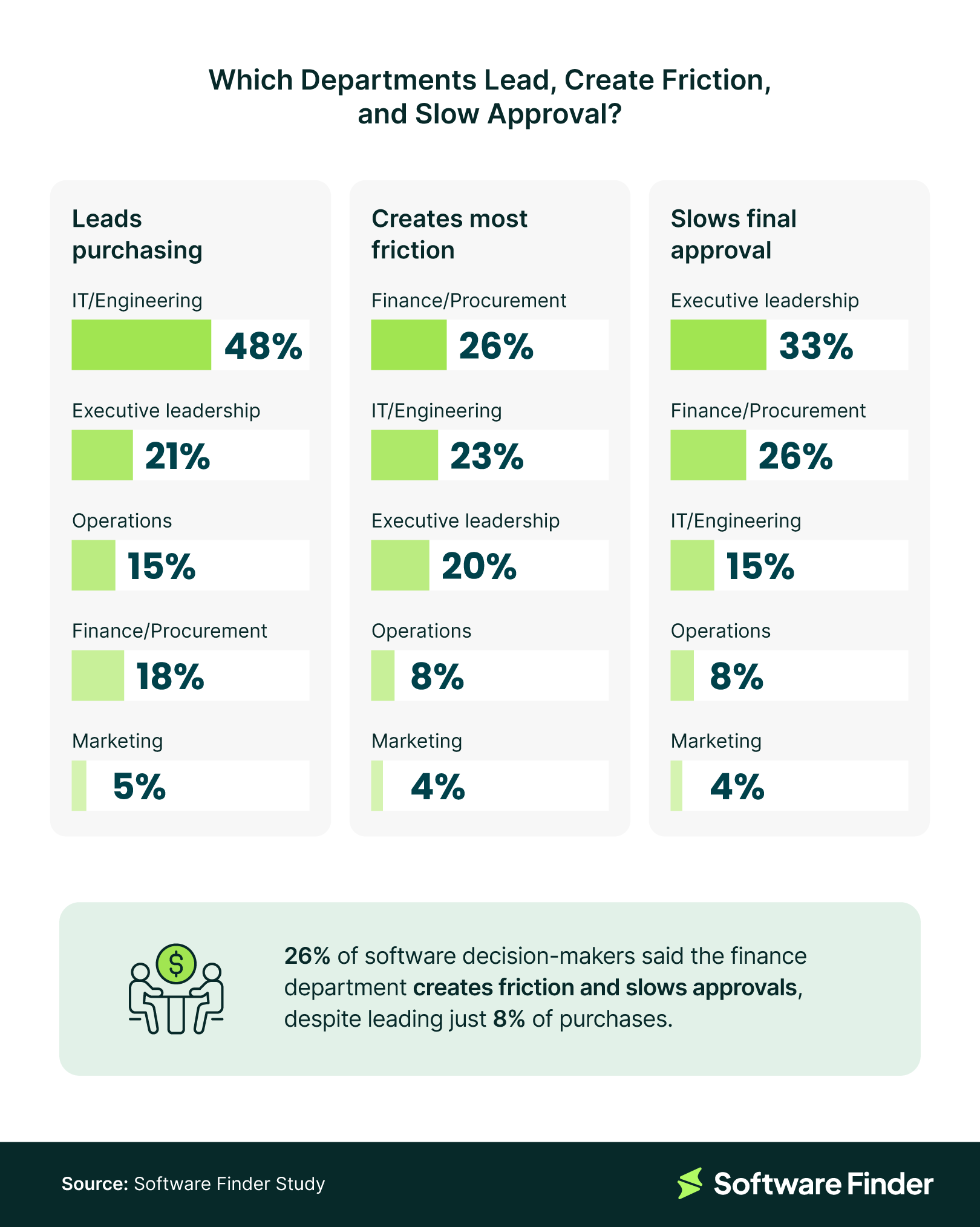
Finance departments have been a source of friction and slow approvals for 26% of software decision-makers. Smaller organizations had an easier time here, with 26% reporting no friction from any departments, compared to just 2% of large and medium companies.
Who actually leads the charge depends a lot on company size. At micro businesses, executives drove purchasing decisions 53% of the time. At large organizations, IT departments took the lead in 57% of cases.
And when it comes to final sign-off, executive leadership was the most common source of delays (33%). Finance and procurement teams followed at 26%. The people with the authority to green-light a decision are often the same ones who hold it up.
The good news is that most of these delays aren't inevitable. They come from process problems, not product problems, and that means they're fixable. Teams that get ahead of these issues by setting clear evaluation criteria early, limiting stakeholder sprawl, and building alignment before the final approval stage can shorten their timelines.
That's a big part of why Software Finder and our comparison tools exist. The software buying process shouldn't be this painful. With sharper processes, better data, and clearer comparisons, businesses can spend less time stuck in evaluation mode and more time using the tools they need.
Methodology
We surveyed 402 U.S. software decision-makers to understand how long it takes businesses to choose new software and the challenges they face throughout the purchasing process. The survey examined timelines, internal bottlenecks, information gaps, and the departments that drive or delay software buying decisions.
The average age of respondents was 40. The gender breakdown was 55% men, 44% women, and 1% nonbinary or not listed. Millennials made up the largest share of respondents (61%), followed by Gen X (23%), Gen Z (12%), and baby boomers (3%). Job levels included managers (42%), individual contributors (33%), and senior managers/executives (25%). Company sizes ranged from large/250+ employees (37%), medium/50-249 (28%), small/10-49 (19%), and micro/1-9 (17%).
Percentages throughout the study may not total 100 due to rounding or not all answers being shown. The survey was conducted online in March 2026.
About Software Finder
Software Finder helps businesses identify, compare, and choose the right software solutions for their needs. From CRM and ERP platforms to HR and accounting tools, we provide expert insights, user reviews, and tailored recommendations to simplify the software selection process.
Fair Use Statement
You may reuse this information for noncommercial purposes with appropriate credit. A link to SoftwareFinder.com must be included when sharing.