





At a certain growth threshold, pay stops being a simple task for the administration department. It becomes a high-stakes balancing act. When it comes to large businesses, Enterprise Compensation Management (ECM) is the formal framework which is used to design, execute, and govern pay strategies across the whole organization. It is not only about cutting checks, but rather about aligning a global workforce with a company’s financial goals while also staying competitive.
At an enterprise level, you are likely handling segmented job families, multi-location taxes, and conflicting pay philosophies to retain top talent. Therefore, for an enterprise, relying on manual sheets can turn out to be a huge risk. Research suggests that around 94% of spreadsheets contain errors. Considering it in the compensation context, a single broken formula is not just a typo – it can lead to massive budget overrun or pay equity liability.
Building on this set of information, this guide will walk through the core components of a modern strategy, from pay grades to the actual steps of a compensation cycle. We will also take a deep dive into the software landscape that makes this level of precision possible.
Enterprise Compensation Management is the architectural framework large-scale organizations use to design, distribute, and audit employee rewards. For a small business, 'compensation' might involve a monthly salary. However, at enterprise level, where headcounts can exceed 5,000 and span multiple regions, compensation is a multi-dimensional strategy. It includes managing base salaries, bonuses, incentives, benefits, and long-term rewards. This type of software also ensures compliance with labor laws while also adhering to internal pay policies.
Quite commonly, decision-makers confuse ECM with payroll software, SMB compensation tools, and spreadsheet-based planning. Here is a clear distinction between ECM and other solutions:
Tool | Primary Purpose | Limitations Compared To ECM | ECM Advantage |
Payroll Software | Downstream execution: calculates taxes, processes payments, ensures paychecks are delivered | Focuses on 'how' to pay; does not manage budgeting, pay philosophy, or compensation strategy | Determines “why” and “how much” before payroll, integrating strategy, budgets, and approvals |
SMB Compensation Tools | Designed for small-to-medium business compensation planning | Struggle with matrixed reporting, complex job architectures, multi-currency, and large-scale modeling | Handles thousands of employees, supports what-if scenarios, multi-currency normalization, and enterprise-level governance |
Spreadsheet-Based Planning | Manual planning using static data snapshots | Reactive, siloed, easily outdated, prone to errors, limited visibility | Provides a live, centralized environment where performance and market data updates across all departments in real-time |
Having discussed that, it is essential to understand the necessity of formalized governance. Without it, large firms risk “logic drift”, where pay decisions become inconsistent and disconnected from financial reality. Governance in ECM provides the rules, approval chains, and audit trails required for enterprise stability. Moreover, it enforces discipline by preventing departments from prematurely exhausting merit budgets, ensuring funds remain available for high performers year-round.
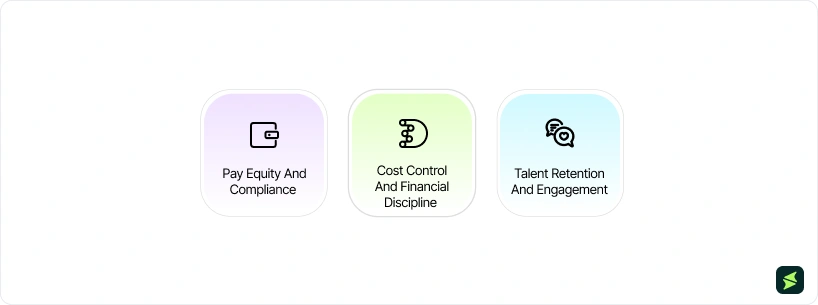
Organizations are moving toward ECM as a primary strategy and their “go-to” model to mitigate risks and stabilize their workforce. With global labor markets remaining unpredictable in 2026, the reason behind compensation governance generally boils down to three major pillars: equity, retention, and financial discipline.
Pay Equity And Compliance
Inarguably, the most urgent driver for formalized management is the shifting regulatory environment. We have been seeing a move from voluntary equity to mandatory transparency.
- Internal Vs. External Equity: Large enterprises must balance what is competitive in the market with what is fair internally. Misalignment in this regard can lead to compression, where new resources earn more than older employees, consequently, eroding morale
- Pay Transparency: As of early 2026, several U.S. states and numerous global jurisdictions have introduced strict pay transparency laws. These mandates typically require employers to inform the potential candidate the expected salary ranges in all job postings and in some regions, provide a detailed pay gap report to government agencies
Talent Retention And Engagement
Compensation is often considered a primary reason for turnover, but it is the perceived lack of consistency that usually does the most damage. When an enterprise lacks a centralized system, pay raises can feel abrupt.
Cost Control And Financial Discipline
From a purely fiscal point of view, ECM is about protecting the bottom line from budget creep.
- Preventing Overruns: When department heads don’t have access to real-time visibility into the data, they end up using their merit budgets early in the cycle – without intending to
- HR And Finance Alignment: Historically, HR and finance have functioned in isolation, but modern governance forces an alliance. When these departments share a single source of information, there is a higher chance for workforce investments to align with long-term profitability goals
Once companies carefully create these processes, they don’t just “manage pay”; they start building a defensive wall against litigation, turnover, and fiscal waste.
A mature enterprise compensation strategy is hardly ever a single policy, implemented across the department. It functions as a modular system where various components—ranging from base salary to complex equity vehicles—work in tandem. The goal for enterprises operating on a larger scale is to create a structure that is rigid enough to ensure equity but flexible enough to adapt to local market shifts.
1. Pay Grades And Salary Structure
The skeleton of any enterprise strategy is its job architecture. Without a proper system in place to put roles in their respective categories while also carefully analyzing their core impact and skill requirements, large organizations inevitably descend into chaos. The result is that you end up with title inflation – or even worse – a lack of pay equity for identical work.
- Job Architecture And Leveling: ECM systems allow you to establish universal levels – think L1 through L8 – that cut through the noise of local titles. It is about creating one universal truth for roles, so you can actually compare two leads operating in different regions without any guesswork
- Pay Bands And Ranges: Managing a global headcount is a nightmare of multi-currency normalization. The current and advanced ECM tools don’t just track this; they automate the math. By tethering pay bands to local cost-of-labor indices and live exchange rates, you make sure that your midpoint means something in the local market. Essentially, it could be the only way to stay competitive on the ground while protecting the global bottom line
- Market Benchmarking: Enterprises integrate multiple third-party data feeds simultaneously to assess the market shifts as they take place. The reason for this is to come up with a proper defense system. If you can see the market moving before your competitors do, you can spot the flight risk roles and intervene before your top talent starts walking out the door
2. Compensation Budgeting And Planning
The era of the top-down budgeting is no longer in place now for enterprises. Or at least, it should not be. The budgeting process of modern companies has morphed into a complex tug of war between HR, finance, and legal.
- Budget Allocation Across Departments: Forget the nightmare of manual data entry. Ever since ECM has firmly set its grounds in the industry, it has proven to be a gamechanger. These platforms now distribute merit and bonus pools based on pre-defined metrics, not manager intuition. It has now become all about enforcing discipline without the need for constant manual supervision
- Scenario Modeling: You have the system in place that backs the numbers, now comes the gut-check. You can run what-if simulations to see how today’s tweaks hit the 2026 bottom line. Ask yourself, if we increase the L3 engineering band by 5%, what does that do to our equity burn in the next few months? Having these answers in real-time replaces the weeks of manual modeling previously required
3. Incentives And Bonus Programs
At enterprise level, ‘discretionary’ could potentially be a dangerous word. For incentive programs to actually work effectively, they have to be tied to verifiable outcomes, not a manager’s gut feeling. This is where governance stops being a hurdle.
- Performance-Based Gatekeeping: ECM systems are designed in a way that they enable you to protect the bonus payouts based on organizational KPIs. If the company misses its Earnings Before Interest, Taxes, Depreciation, and Amortization (EBITDA) targets, the system can automatically throttle the bonus pool across more than 50 departments. As a result, it ensures that the math always aligns with the company’s actual ability to pay while removing the emotional burden from leadership
- Audit-Ready Approval Workflows: The reality of 2026 has settled in already – every pay decision is a potential legal liability. You need an audit trail that is essentially tamper-proof. This type of document can be a non-negotiable for “Say-on-Pay" votes and internal audits. It gives you a 360 view into the data point and the specific approver for every dollar moved
4. Perks, Benefits, And Total Rewards
Compensation is more than just the number on a paycheck. Total Rewards is the holistic view of everything an employee receives. This stage of the cycle is the delivery and communication of the rewards package.
- Executive Long-Term Incentives (LTI) Governance: Executive pay involves complex vehicles like Restricted Stock Units (RSUs) and Performance Shares. ECM systems manage the vesting schedules and tax implications of these grants across multiple jurisdictions, a task far beyond the capability of standard payroll tools
- Automated Total Rewards Statements: To improve retention, enterprises use digital dashboards that show employees the full value of their ‘hidden’ compensation, including employer-paid healthcare, retirement matches, and equity. These statements are often localized into multiple languages and currencies automatically
- Compliance And Pay Transparency: With 2026 regulations mandating clearer pay disclosures, ECM systems act as the "central hub" for reporting. They generate the data required for pay gap disclosures and ensure that salary ranges in job postings are always in sync with internal pay bands
5. Executive Compensation And Total Rewards
For most employees, compensation is a relatively straightforward calculation of salary and bonus. However, at the top of the organization, the model shifts significantly. Executive pay is arguably the most complex component of an enterprise strategy because it must balance high-stakes retention with intense shareholder and regulatory scrutiny.
- Complex LTI Management: Most executive value comes from LTI, like Performance Share Units (PSUs). ECM systems track these multi-year vesting schedules and their tax implications across various global entities, a task that exceeds the capability of standard HRIS tools
- Governance And Approvals: Executive pay adjustments are typically routed through a specific Compensation Committee workflow. This ensures that every grant or salary change is vetted against peer group data and shareholder-approved policies before it is finalized

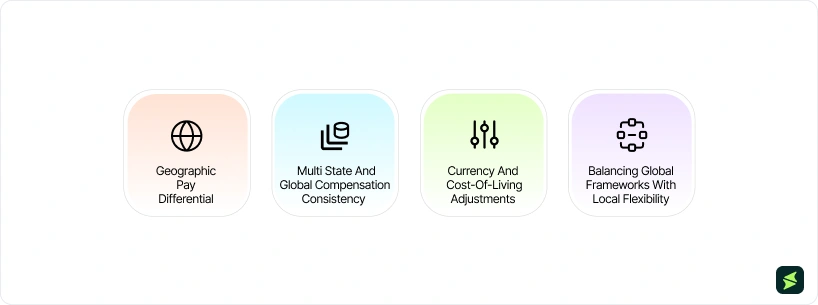
Global pay management has to deal with various compliances. You are not only handling different currencies but also navigating through local tax codes and shifting labor laws. A medium-sized company might get away with simple cost-of-living multipliers, but companies operating on a larger scale must change their approach. Manual tracking is no longer enough. Between currency volatility and sensitive local compliance, spreadsheets may not be the best idea.
For this, we have to look more closely at the workforce scattered around the globe. Managing it is not exactly a walk in the park – you have to maintain a cohesive corporate identity while respecting the hard economic realities of every talent hub you touch. The goal? It’s simple; stay fair to the employee without emptying the global budget.
That is where ECM systems come into play by making sure that such steps are taken timely. They replace manual calculations with automated, geography-aware logic.
Geographic Pay Differentials
In a distributed enterprise, a Senior Marketing Manager in Canada generally commands a different market rate than the same role in San Francisco. Geographic pay differentials are the formal structures used to account for these variations without breaking the internal leveling system.
ECM platforms automate this by grouping locations into geographic tiers based on local labor costs. This allows the firm to maintain a unified global job architecture while applying localized pay bands that update in real-time.
- System-Enforced Tiering: The software automatically maps employees to the correct pay band based on their physical location or cost-center entity
- Economic Normalization: These systems adjust for regional differences in taxes, social security, and mandatory benefits, ensuring the take-home parity where required
Multi-State And Global Compensation Consistency
Consistency is the bedrock of defensible compensation. If an enterprise pays differently in New York than it does in Texas, it must be able to prove with data that the difference is based on objective factors rather than bias. This becomes even more complex across international lines where fairness is defined by different cultural and legal standards.
Maintaining this balance requires a centralized system of record that enforces global governance. ECM systems consolidate multi-country data into a single source of truth, allowing leadership to run variance reports and budget adherence analytics across all regions simultaneously.
- Pay Equity Analytics: The system can run regression models across different countries to identify pay gaps before they become legal liabilities
- Auditability Of Decisions: Every local adjustment is logged. If a regional lead increases a budget for a specific market, the system captures the rationale and the approval chain. This provides an unchangeable record for global compliance audits
Currency And Cost-Of-Living Adjustments
One of the most volatile aspects of enterprise compensation is the management of multi-currency normalization. For instance, when a merit budget is set in USD but distributed across 10 different currencies, exchange rate volatility can inadvertently shrink or inflate a manager’s local budget.
Modern ECM systems solve this by locking in budget rates at the start of the planning cycle. This shields department heads from currency swings and ensures that an employee’s 3% merit increase remains 3% in their local currency, regardless of market shifts during the review period.
Balancing Global Frameworks With Local Flexibility
The ability to run what-if scenarios across multiple geographies is a core strength of enterprise-grade software. Leadership can model the total fiscal impact of a 5% merit increase in one country while adjusting for currency volatility and cost-of-living differences across 20 other regions.
For organizations with 10,000+ employees, these systems also handle matrixed reporting lines. A developer might report to a functional lead in the UK but work within a business unit based in Germany. The ECM system manages these cross-functional approval chains, ensuring the right stakeholders see the right data at the right time.
Moving away from static spreadsheets and towards a geography-aware ECM system helps the enterprise protect itself from financial waste and the legal risks associated with inconsistent global pay.
In large organizations, following a compensation strategy cycle acts as a recurring control framework. It is designed to align massive workforce investments with fiscal constraints and global regulatory mandates. While many models start at the point of distribution, a mature enterprise cycle begins months earlier with strategic recalibration and only concludes after a formal post-cycle audit.
This six-step process provides the details needed to manage thousands of records for different legal entities while maintaining audit defensibility. It helps ensure that pay decisions are not just administrative tasks, but a disciplined way to allocate capital across the organization.
Step 1: Strategic Planning And Calibration
The cycle starts by checking the company’s pay strategy against the current business outlook and hiring goals. During this stage, leadership sets the rules of the road that guide the rest of the process. A key task here is market recalibration—updating salary targets to match current trends. This helps ensure pay stays competitive, especially in fast-moving economies where standard yearly raises might fall behind inflation.
At the same time, the board decides the pay-for-performance balance. They determine how much of the budget goes toward fixed salaries versus performance-based incentives. This results in a total spending pool set by the finance team.
Before any raises are locked in, the company goes through a performance calibration step. Leaders review employee ratings across different teams to make sure everyone is being judged by the same standards. This prevents rating inflation, where one manager might give everyone top marks, which would unfairly drain the budget at the expense of other departments.
Step 2: Bonus Planning
Bonus planning is not a guessing game at the enterprise scale. It is a formula where the goal is simple; ensure performance-based pay remains untouched to the company’s actual financial health. Think of it this way, if the year was not so good financially for your company, then the bonus payout has to adjust automatically to protect it from any drastic cash flow.
Typically, it is managed through funding multipliers. It is like a pressure valve for the total bonus pot. If the company achieves 100% of its revenue and profit targets, the pot is full; if those targets are missed, the system might throttle the payout accordingly.
In certain high-stakes industries, these plans also include pay recovery rules. This is a safety measure that allows a company to theoretically reclaim bonus money if financial results are later found to be incorrect or if there was a serious compliance issue. While complex to enforce, documenting these rules upfront provides a necessary layer of protection for the business
Step 3: Equity And Long-Term Incentives (LTI)
Long-term incentives, like stock options or shares, are used to keep key talent focused on the company's success over several years. At a large scale, the focus is on rewarding people without giving away too much of the company's value.
The board typically approves strategic grants—specific amounts of stock that vest (become owned by the employee) over a three-to-five-year period. It is helpful to separate the planning of these grants from the administration. Even though a technical platform might track the shares, the compensation cycle is where leaders decide who earns them based on their future potential.
Global companies must be careful with the tax rules in different countries. A stock grant in the UK is taxed differently from one in the US. Structured proposition helps ensure that neither the company nor the employee gets hit with unexpected tax bills or social security costs because of how the shares were issued.
Step 4: Pay Equity Analysis And Adjustments
Before any pay changes are finalized, large companies perform a fairness check. This is a sensitive but necessary step to ensure people are being paid fairly for the same work, regardless of their background.
The team uses statistical modeling to spot any gaps. They look for outliers — people whose pay doesn't seem to match their experience or performance compared to their peers. To keep things legally safe, these reviews are often done with the help of lawyers under the attorney-client privilege.
If they find gaps, they use a specific part of the budget for remediation adjustments. This is about fixing the unfair gaps before the cycle ends. However, this can be tricky because fixing one person’s pay can sometimes make others feel left behind (known as pay compression). Managing this is a key requirement for meeting new transparency laws.
Step 5: Approvals And Governance
The final operational step is getting everything signed off. In a massive organization, a single pay raise might need to be approved by three or four different people—the manager, the department head, HR, and finance. This makes sure that no one has too much "say" over the company's money.
The biggest risk here is data integrity. If the underlying information like an employee's job title or location is wrong in the HR system, the pay calculation will be wrong too. Mature companies use a data validation checkpoint to catch these errors before the money is ever committed.
Once checked, the workflow routes the requests through the proper channels. This creates an audit trail, which is just a digital record of who approved what and why. This is vital for proving to auditors or shareholders that the company is spending its money responsibly.
Step 6: Employee Compensation Statements
The last step is explaining the win to the employee. In many firms, people only see their new salary on PDFs. Enterprises are moving toward Total Rewards Statements; digital dashboards that show a complete breakdown of what an employee earns.
These statements translate complex numbers into clear values. They show the base salary, while also highlighting the hidden value of things like:
- Company-paid healthcare premiums
- Retirement plan matches
- The estimated value of stock grants
- Performance bonuses
By showing the total amount, the company helps the employees realize that they are getting much more than just a monthly paycheck. This is a huge factor in keeping people from jumping to a competitor for a slightly higher base salary.
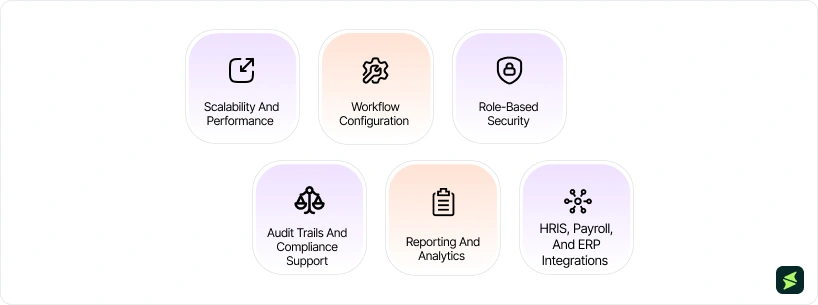
Selecting a compensation platform for a large organization is a different task than picking one for a mid-market company. When you are managing tens of thousands of employees across different countries, the software isn't just a calculator but a governance engine. If the tool fails to handle a specific currency or a complex union rule, the administrative fallout can cost weeks of manual work.
At this stage of the evaluation, it helps to move past basic features. You need to look at how a platform handles the friction of global scale, strict legal requirements, and the need for high-speed data processing. Here is a breakdown of what an ECM platform must be able to do.
Scalability And Performance
In a small company, performance means the software doesn't crash. In an enterprise, it means the system can process 50,000 merit increases and bonus calculations simultaneously without lagging. You might have thousands of managers logging in during the same 48-hour window to finalize their cycles.
A platform must take care of these peak load events smoothly. If a manager hits save on a department's merit increases and the system hangs, it creates more than just frustration. It can lead to data duplicates or missed deadlines. An enterprise tool should be able to recalculate the entire global budget in real time as individual managers make changes, rather than requiring a batch update overnight.
Workflow Configuration
Large organizations rarely have a single, straight-line approval process. You likely have different rules for different regions or business units. For example, your European office might require a three-step approval involving a local director, a regional VP, and a HRBP, while your North American branch only needs two.
The software should allow you to build these "branched" workflows without needing a developer to write new code. You need the flexibility to set different start and end dates for various cycles. If a manager is on leave, can the system automatically re-route their approvals to a delegate? This level of configuration is what separates an enterprise tool from a basic planning app. It ensures the software adapts to your existing business logic instead of forcing you to change your operations to fit the tool.
Role-Based Security
While interacting with sensitive pay data, getting access control is a major liability. Enterprise software must offer granular, role-based security. This means you can define exactly what a user can see and do based on their specific job function.
A line manager should only see the compensation data for their direct reports. A regional HR head might need view-only access to their entire territory but no ability to edit budgets. Meanwhile, your executive compensation team needs a "walled garden" where they can manage high-level LTI grants that are invisible to the rest of the HR team. This isn't just about privacy; it's about reducing the risk of accidental data leaks. The system should allow you to test these roles to ensure the permissions are perfect before the cycle goes live.
Audit Trails And Compliance Support
In this age, the legal landscape for pay transparency is tighter than ever. If a regulator or a former employee questions a pay decision, you need a defensible record of why that decision was made.
An enterprise platform is a digital paper trail that logs every single change: who made it, when they made it, what the value was before, and what it was after. Furthermore, the software should help you stay compliant with local mandates by flagging potential equity outliers before a pay cycle is even finalized.
Reporting And Analytics
Data is only useful if it’s actionable. An enterprise tool should move beyond static PDFs and offer dynamic, real-time dashboards. You need to be able to see, at a glance, how much of your budget has been spent and where.
Efficient analytics will let you dissect the data by department, gender, ethnicity, or tenure. This is how you spot systemic issues. For example, you might find that while your overall pay gap is small, a specific department in another state has a significant disparity. Real-time reporting allows you to fix these issues during the planning cycle, rather than finding out six months later during a post-mortem. Look for tools that allow you to model scenarios—such as "what happens to our budget if we increase the top-performer multiplier by 0.5?"—to see the financial impact before committing to a plan.
HRIS, Payroll, And ERP Integrations
A compensation system is only as good as the data flowing into it. If your team has to manually export data from your HRIS and upload it into your compensation tool, you’ve already lost the battle against errors.
You should look for deep integrations, not just simple file transfers. This means a two-way sync where employee data (job level, performance rating, hire date) flows into the compensation tool, and the finalized pay changes flow back into your payroll system automatically. This type of integration reduces the risk of manual entry errors, which are the leading cause of payroll discrepancies. It also ensures that your finance team can see the impact of compensation changes in their Enterprise Resource Planning (ERP) systems in real-time, helping with more accurate cash-flow forecasting.
Choosing the right platform often depends on whether you need comprehensive HR solutions or best-of-breed tools that can handle extreme complexity. Here is a high-level look at the leading providers in the enterprise space.
Workday
Workday HCM is best for Global Financial Integration in industries like professional services and finance. Its AI model called “Workday Illuminate” allows users to model what-if scenarios directly against their general ledger and live budgets to prevent overspending.
UKG
Best for Frontline and Hourly Workforces in retail, manufacturing, and healthcare, UKG features a unique “Compensation Card” that gives managers instant visibility into an employee’s full work history and performance ratings directly within the planning worksheet.
ADP Workforce Now
ADP Workforce Now is best for mid-to-large enterprises looking for data-driven benchmarking. It uses ADP’s massive proprietary “DataCloud” to provide real-time, industry-specific market pay data.
beqom
beqom is ideal for highly complex global operations in energy and pharmaceutical sectors. It offers a unique “Intentional AI” engine that handles intricate sales commissions, carried interest, and long-term incentives across different legal jurisdictions in one system.
HRsoft
HRsoft is best suited for various organizations and industries, such as, healthcare, education, and finance, providing a purpose-built platform that specializes in complex proration rules and “Carried Interest” tracking. It provides deep configuration without a full HRIS overhaul.
Transitioning to a dedicated platform is a significant move and involves more than just a software demo. It requires aligning different departments and rethinking how your company values its people. This isn't just an HR project; it is a business transformation.
Questions To Keep In Mind
When evaluating vendors, focus on control architecture and enterprise resilience rather than surface-level features. Ask how the system enforces guardrails (not just flags exceptions), how it handles multi-currency normalization, and whether it supports federated governance across regions.
Clarify integration depth with HRIS, payroll, and finance systems, and request evidence of data validation checkpoints before cycle launch. Assess scenario modeling capabilities for finance, pay equity support mechanisms, and how off-cycle adjustments are governed.
Internal Stakeholders To Involve
An ECM selection process must extend beyond HR. Finance should validate budget modeling, forecasting alignment, and variance reporting capabilities. Legal counsel must assess documentation standards, equity review structures, and regulatory exposure. HR leadership ensures alignment with compensation philosophy and workforce segmentation strategy, while IT evaluates data security, integration architecture, and system interoperability.
What’s more, regional HR leaders provide insight into local labor laws, union constraints, and compliance nuances. Excluding any of these stakeholders increases implementation risk and weakens governance integrity.
Implementation And Change Management Considerations
Successful implementation requires governance redesign, data cleansing, and disciplined change management. Before launching, organizations should reconcile job architecture, pay bands, and employee records to prevent systemic errors.
Approval chains and budget allocation logic should be formalized rather than simply automated. Manager adoption is often the largest risk; clear communication about guardrails and performance calibration processes is essential. Many enterprises mitigate risk through parallel cycle testing and iterative refinement after the first full rollout.
Timeline For Switching The Solutions
Organizations typically outgrow spreadsheets or mid-market tools when governance risk begins to surface. Persistent budget overruns, audit traceability gaps, rising regulatory scrutiny, and increasing multi-currency complexity are common inflection points. Rapid headcount growth across multiple legal entities further reveals the prominent lags in manual processes.
When compensation outcomes no longer clearly align with financial planning or performance differentiation, the organization has lost strategic control. At that stage, upgrading to a structured ECM platform becomes a risk mitigation imperative rather than a technology enhancement.
Relying on fragmented spreadsheets to handle thousands of employees across diverse tax zones and labor markets creates significant financial and legal risk. Enterprise Compensation Management (ECM) solves this by replacing manual spreadsheet chaos with a centralized governance engine. It ensures that your pay strategy is applied consistently.
By adopting a structured process, you move beyond just calculating raises. You gain the ability to model fiscal scenarios, enforce global guardrails, and prove pay equity. This transition turns compensation from a reactive, annual headache into a proactive tool for talent retention. In an era of strict transparency laws and intense competition for specialized skills, a mature ECM framework is the only way to ensure your workforce investments are both fair and fiscally responsible.
If you want to see this workflow in action, compare enterprise compensation management software options and request a demo.