


Comparison
PracticePanther Vs Clio: Which Legal Software is Actually Worth It?
12 mins read
Last Updated


By Ramla Shahid and


Every hour your team spends navigating the wrong software is an hour that is not billed. For law firms, that math adds up fast. And it is exactly the kind of invisible drain that the right practice management platform is supposed to eliminate. This can be done using advanced legal software.
PracticePanther and Clio are two names that come up in almost every legal software conversation, and for good reason. Both are mature, cloud-based platforms trusted by thousands of attorneys across the country. But they are built on fundamentally different assumptions about what a law firm needs, and those assumptions shape everything from pricing and onboarding to AI capabilities and long-term scalability.
So, let's break down the real cost of each platform, how they perform across different practice areas, and see which one earns its place in your workflow.
PracticePanther | Clio |
Starting Price: $59/user/month | Starting Price: $59/user/month |
Best For: Solo lawyers and small to mid-size law firms | Best For: Small to large law firms, growing practices |
Mobile App: Android, iOS | Mobile App: Android, iOS |
User Ratings: 4.6/5 | User Ratings: 4.6/5 |
Disclaimer: The pricing is subject to change | Disclaimer: The pricing is subject to change |
PracticePanther is a cloud-based legal practice management software built for solo practitioners and small-to-mid-size law firms. Founded in 2012, it serves tens of thousands of legal professionals across 170 countries. The platform centralizes case management, time tracking, billing, trust accounting, document management, and client communication under one roof.
Acquired by Paradigm in 2018, PracticePanther is known for its intuitive interface that requires minimal training and gets firms operational quickly. The platform integrates directly with Outlook, Google, Box, Dropbox, and QuickBooks for essential workflow continuity. More advanced automation and third-party connectivity, including the open API and Zapier, are available on the Business plan, allowing firms to connect thousands of additional apps. It also offers a native payment processor, PantherPayments, and built-in workflow automation for routine tasks.
Clio software is a comprehensive legal practice management platform catering to firms of all sizes, from solo attorneys to large enterprises. Founded in 2008, it is trusted by legal professionals worldwide. The platform covers the full client lifecycle, from intake to invoice, and integrates with hundreds of tools.
In 2025, Clio acquired vLex for $1 billion, launched a dedicated enterprise division, and evolved its AI assistant Clio Duo into Manage AI, further expanding its AI capabilities within the legal software space.
Features | PracticePanther | Clio |
Case/Matter Management | ✓ | ✓ |
Time Tracking | ✓ | ✓ |
Billing & Invoicing | ✓ | ✓ |
Trust Accounting | ✓ | ✓ |
Document Management | ✓ | ✓ |
Client Portal | ✓ | ✓ |
Mobile App | ✓ | ✓ |
Calendar Sync | ✓ | ✓ |
QuickBooks Integration | ✓ | ✓ |
Native Payment Processing | ✓ | ✓ |
Workflow Automation | ✓ | ✓ |
eSignature (Integrated) | ✓ | ✓ |
Two-Way Text Messaging | ✓ | ✗ |
AI Features | ✗ | ✓ (Manage AI add-on) |
Third-Party Integrations | ✗ | ✓ (extensive ecosystem) |
Intake Forms | ✓ | ✓ |
LEDES Billing | ✓ | ✓ |
Reporting | ✓ | ✓ |
Conditional Workflow Branching | ✓ | ✗ (limited compared to rule-based workflows) |
Free Trial | ✓ | ✓ |
Free Plan | ✓ | ✗ |
PracticePanther
PracticePanther's scalability is designed around the needs of solo practitioners and small-to-mid-size firms. The platform supports unlimited users with no hard cap, and its per-user pricing structure makes it straightforward to add team members without unexpected cost jumps. Pricing is transparent, which makes making it easier for firms to scale without unexpected costs.
However, reporting and analytics offer limited customization and only basic insights into firm performance. This can become a challenge for firms scaling beyond 10–15 attorneys that need deeper financial visibility. Attorneys looking for complex document creation may also want to review options beyond PracticePanther.
Clio
Clio is built to scale across all firm sizes, from solo practitioners to Am Law 200 firms. From the pioneer of cloud-based legal practice management to the central hub for your entire firm, Clio connects you to hundreds of tools and a robust API for custom workflows. As a firm grows, the platform grows with it, from Clio Manage at the individual level to full enterprise deployment.
In 2025, Clio launched a dedicated enterprise division, Clio for Enterprise, to serve the needs of large legal teams and corporate legal departments that often have complex workflows and need to integrate with dozens of existing tools.
The enterprise suite includes four key products:
- Clio Operate: an adaptive work management platform designed for large firms
- Vincent by Clio: an AI-powered solution built for Am Law 200 firms and Fortune 500 legal teams
- Clio Library: a tool for deep legal research
- Clio Docket: a platform offering court data and litigation insights
Together, these tools help enterprise teams manage work, access insights, and streamline operations at scale.
Clio Operate is specifically designed for firms with more than 200 users, particularly those operating across multiple jurisdictions, and uses low-code and no-code configuration tools. It allows internal teams to customize legal workflows without lengthy development cycles.
Our Take:
- PracticePanther scales reliably for solo to mid-size firms but hits a ceiling with reporting depth and integration flexibility as firms grow past 10–15 attorneys
- Clio is the stronger choice for firms planning aggressive growth or operating at enterprise scale, backed by a dedicated enterprise division and a rapidly expanding integration and AI ecosystem
Both PracticePanther and Clio use per-user, subscription-based pricing with tiered plans that scale based on features and firm size.
PracticePanther Pricing Breakdown
PracticePanther cost starts at $59/user/month for its Solo plan. It includes contact and matter management, time tracking, billing, document templates, calendaring, and native payment processing. The vendor also offers the following other pricing plans:
- Essential: $79/user/month
Everything in Solo, plus custom fields, custom security roles, automated payment reminders, recurring payment plans, batch billing, and email and calendar sync
- Business: $99/user/month
Everything in Essential, plus native two-way text messaging, intake forms, native eSignature, LEDES billing, Zapier and API access, attorney revenue reports, unlimited live trainings, and VIP support
- Business Pro: $124/user/month
Everything in business, plus PantherAccounting Plus, trust accounting, operating accounting, enhanced reconciliation process, GL/AR/expense management, and more
PracticePanther offers a 7-day free trial with full access and no credit card required. After the trial period, users can continue using the platform on a limited free plan, which allows up to 3 contacts (clients) and 3 matters (cases). This option is designed for solo practitioners who are just getting started. If users exceed these limits, they are prompted to upgrade to a paid plan.
Disclaimer: The pricing is subject to change.
Clio Pricing Breakdown
Clio pricing starts at $59/user/month for its EasyStart plan that covers Basic matter management, time tracking, document storage, and billing (no document templates, client portal, or live onboarding). The following are its other plans:
- Essentials: $99/user/month
Adds document templates, client portal, and basic onboarding
- Advanced: $139/user/month
Adds reporting dashboards, custom fields, and workflow automation
- Expand: $169/user/month
Full feature access including advanced automation and analytics
Disclaimer: The pricing is subject to change.
Payment Processing Fee
Every time a client pays an invoice online, both platforms take a cut. PracticePanther's PantherPayments charges 2.9% for all card transactions and 1% per eCheck. Clio Payments charges 2.95% for most cards and 1% per eCheck.
The gap widens when it comes to cash flow. PracticePanther processes payments within 2–3 business days, while Clio users have reported waiting 5–7 business days for online payments to clear. For a firm collecting $30,000/month in online payments, that processing delay is a meaningful cash flow difference.
Free Plan Comparison
Key Aspect | PracticePanther | Clio |
Availability | 7-day free trial + limited free usage after trial (if within limits) | Free trial only (no permanent free plan) |
Client/Matter Limit | 3 clients, 3 cases | N/A |
Feature Access | Full features within limits | N/A |
Trial Period | 7 days unlimited | Available (duration varies) |
Credit Card Required | No (for trial sign-up) | No (for trial sign-up) |
Our Take:
- PracticePanther is positioned as a more cost-predictable option due to its structured tiers and included features across plans
- Clio is positioned as a more scalable platform, where total cost and functionality depend more heavily on selected tiers and add-ons
PracticePanther
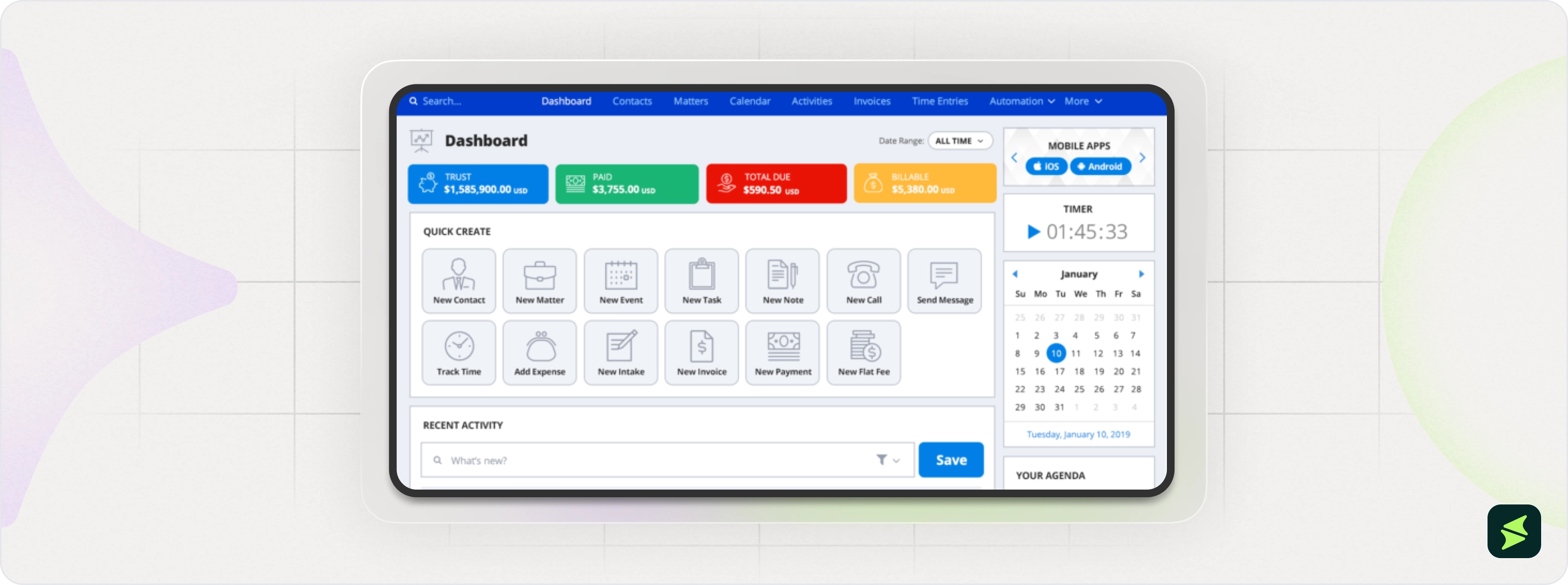
PracticePanther’s interface is structured for quick access to core features such as billing, time tracking, and case management, with users describing the layout as logical and easy to navigate. The dashboard gives a centralized view of all active matters, deadlines, billing status, and tasks that are all accessible within a few clicks from any screen.
Most firms can get up and running with PracticePanther fairly quickly due to its intuitive design and workflows that are built around how small law firms typically operate. This keeps the learning curve consistently shallow. It also offers a mobile app for iOS and Android, though some users note the mobile version does not carry the full feature set of the desktop platform.

Clio
Clio takes a more feature-rich approach to its interface. The interface is minimalist and clean, as matters are intuitively organized into tabs for contacts, appointments, tasks, and so forth, and Clio does a lot without overwhelming the user with options or buttons. Users can tailor their dashboards to fit their daily workflow; for instance, a lawyer focusing on billing can prioritize billing-related widgets while keeping less frequent tasks at bay.
However, given the sheer depth of features across Clio Manage, Clio Grow, and add-ons like Manage AI, new users should expect a longer ramp-up period. New users unfamiliar with legal practice management software may face a steep adjustment period when adapting to Clio's features and interface, as one user mentions: “It took me some time to get used to Clio, as I'm used to other software.” Source: Reddit


Our Take:
- PracticePanther is more streamlined and easier to adopt, with a focus on core legal workflows and quicker day-to-day usability
- Clio is more feature-rich and flexible, supporting more advanced workflows across the platform
PracticePanther
PracticePanther maintains compliance with HIPAA, GDPR, and PCI-DSS standards, with 256-bit SSL encryption protecting data both at rest and in transit. It uses Microsoft Azure infrastructure with continuous monitoring and threat detection to safeguard against common risks.
On the legal side, its trust accounting tools are built for IOLTA and state bar compliance that allows firms to manage client funds securely. The platform also supports role-based access, two-factor authentication, and audit trails for tracking activity. PantherPayments processes transactions in a PCI-compliant environment to ensure secure client payments.
Clio
Clio offers a similarly strong security posture, with additional certifications including SOC 2 Type II and SOC 1 Type II audits. It complies with GDPR, PCI, and HIPAA standards, and can enter into Business Associate Agreements (BAAs) for handling protected health data. In practical terms: if a client's medical records pass through your firm, Clio's HIPAA compliance ensures that data is stored and processed in a way that keeps you legally protected. Clio’s AI features are designed to align with privacy regulations like GDPR, and all actions remain permission-based and auditable.
Here is a summary of the compliance measures offered by PracticePanther and Clio and what it means for you.
Certification / Standard | What It Means for You | PracticePanther | Clio |
HIPAA | Safely handle client medical records and ePHI without violating federal law | ✓ | ✓ |
GDPR | Work with EU clients without breaching data privacy laws | ✓ | ✓ |
PCI-DSS | Secure processing of client payment and credit card data | ✓ | ✓ |
SOC 2 Type II | Independently verified security controls over time | ✗ | ✓ |
SOC 1 Type II | Verified financial reporting controls (important for trust accounting) | ✗ | ✓ |
IOLTA / State Bar Compliance | Proper handling of client trust funds as per bar regulations | ✓ | ✓ |
256-bit Encryption (at rest + in transit) | Data is protected both in storage and during transfer | ✓ | ✓ |
Two-Factor Authentication | Extra layer of security to prevent unauthorized access | ✓ | ✓ |
Role-Based Access Controls | Staff access is restricted based on roles | ✓ | ✓ |
AI Compliance (GDPR + UK DPA) | AI data handling aligned with privacy regulations | ✗ | ✓ |
BAA (HIPAA Business Associate Agreement) | Legal agreement for handling protected health data | ✗ | ✓ (add-on) |
Bar Association Endorsements | Recognized compliance by legal authorities | Limited | 100+ bar associations |
Our Take:
- PracticePanther is a solid choice for firms with standard domestic compliance needs
- Clio goes further, which makes it the stronger option for firms with complex, multi-jurisdictional, or medically sensitive caseloads
PracticePanther
PracticePanther provides live support via phone, email, chat, and an online knowledge base across all plans, along with data migration and onboarding assistance. Users can contact support via phone or in-app chat, while the knowledge base offers extensive help articles and training resources for self-service. Support is often praised by users for being fast and helpful, especially by solo and small firms. One user mentioned: “My experience with customer service has been that I just text questions to customer service from within the program, and I get good answers and offers of help.” Source: reddit
However, user reviews highlight some inconsistency in response times, particularly for complex issues. While general support is often well-reviewed, some users note that certain features or app-related issues can feel cumbersome and may require additional follow-up.
Clio
Clio offers support via phone, email, and live chat during extended weekday hours, along with a 24/7 AI support assistant for quick in-app help. It also provides Clio Academy, a free training platform with short tutorials, live sessions, and community-based learning resources. Mid-sized and larger firms may receive dedicated customer success support for more personalized guidance.
That said, some user reviews generally highlight helpful onboarding and accessible support resources. Though some feedback suggests that response quality can vary, particularly for more complex issues or at larger scale.
Our Take
PracticePanther wins for solo and small firms that want responsive, personal support without navigating a tiered system
Clio offers a deeper support infrastructure overall — 24/5 availability, an AI agent, Clio Academy, and dedicated success managers for larger firms — making it the stronger choice as firm size and complexity grow.
PracticePanther
PracticePanther takes a rules-based approach to automation, meaning it is powerful for predictable workflows, but without a native AI layer. Its conditional workflow system automates tasks based on triggers like task completion or set dates, which allows firms to chain actions together without manual input.
In practice, this means a completed task can automatically trigger the next step, assign staff, and set reminders. The platform also supports billing reminders, SMS notifications, and document templates with auto-filled fields. However, PracticePanther does not offer built-in AI; there’s no native assistant, document intelligence, or machine learning-driven automation.
Clio
Clio enters a different category entirely with Manage AI, which is a purpose-built legal AI layer embedded directly into Clio Manage. It can extract deadlines from documents, draft client communications, generate invoices, and organize matters automatically.
Unlike basic automation, these outputs are actionable inside the platform and remain reviewable by the user. Manage AI is available as a paid add-on, extending Clio’s capabilities beyond traditional rule-based systems.
Our Take:
- PracticePanther focuses on structured, rules-based automation that works well for consistent, repeatable workflows
- Clio combines automation with built-in AI capabilities, offering a more dynamic approach to handling tasks while still keeping user control over outputs
PracticePanther
Users switching to PracticePanther receive complimentary assistance from a dedicated migrations team, starting with a one-on-one meeting with a Customer Onboarding Specialist to discuss the process and timelines. Migration Specialists then prepare and import your data, followed by an accuracy review before you go live. The initial process typically takes 5 to 10 business days. PracticePanther can import data from Clio, MyCase, RocketMatter, CosmoLex, Abacus, and many other platforms.
Clio
For those moving to Clio, the platform's dedicated Migrations Team handles the transfer at no additional cost, regardless of which system you are coming from. The vendor helps migrate a variety of data including contacts, matters, calendars, tasks, and unbilled time and expense activities. A Migration Specialist is assigned to guide the entire process. For Clio, the data transfer timfeline may vary from a few days to a few weeks depending on the amount of data and complexity of the system.
Our Take:
- PracticePanther follows a structured and guided migration process with clear onboarding steps, making the transition feel predictable and hands-on
- Clio offers a similarly managed migration experience with broader data support, though timelines and document handling may vary depending on data complexity
Both Clio and PracticePanther support a wide range of practice areas including bankruptcy, civil litigation, criminal law, elder law, family and estate planning, immigration, intellectual property, labor and employment, personal injury, and real estate law. However, the fit within each area differs based on the software's strengths.
Practice Area | Better Fit | Why |
Personal Injury | Clio | HIPAA add-on, medical record management, settlement tracking |
Family Law | PracticePanther | Simple client portal reduces friction for stressed clients; flat-fee billing friendly |
Criminal Defense | PracticePanther | Desktop-focused workflow with basic mobile access for quick case reference between hearings |
Immigration | PracticePanther | Straightforward matter tracking, affordable for high-volume solo practices |
Corporate/Commercial | Clio | LEDES billing, integrations, enterprise-grade reporting |
Estate Planning | Both | Document templates and trust accounting are strong on both platforms |
Civil Litigation | Clio | More robust reporting and detailed financial analytics for complex, high-volume cases |
Real Estate | PracticePanther | Simple transaction tracking, fast setup, flat-fee billing support |
Bankruptcy | Both | Matter management and trust accounting covered on both |
Labor And Employment | Clio | Workflow depth and integration ecosystem better suited for multi-matter complexity |
Both PracticePanther and Clio are excellent in one or another. The wrong choice simply comes down to picking one built for someone else's firm. PracticePanther is built to be lean, fast, and affordable. Clio is built to scale, automate, and grow with you. Knowing which description fits your firm makes the decision straightforward.
Choose PracticePanther if you are:
- A solo attorney or small firm under 10 attorneys
- Prioritizing affordability, fast setup, and minimal training
- Wanting native eSignature, built-in texting, and flat-fee billing without costly add-ons
Choose Clio if you are:
- A growing or mid-to-large firm planning aggressive expansion
- Looking to leverage AI automation to recover billable hours
- Handling complex billing, enterprise integrations, or medically sensitive caseloads
The bottom line is that PracticePanther wins on simplicity and value. Clio wins on power and future-readiness. Pick the one that matches where your firm is today, and where you want it to be in three years.