


Obsidian Software
Last Updated
Key Takeaways
Generated from the text of customer reviews
Obsidian is a note-taking and knowledge management platform for organizing information and connecting ideas. Research, documentation, and knowledge teams use it to build linked knowledge bases, with education and research benefiting most. Users praise its flexibility and local data control, though collaboration tools receive less positive feedback. Obsidian launched Community in May 2026.
Our Verdict
Obsidian is best suited to individuals and small teams that manage substantial bodies of research or reference material and value ownership of their data. Reviews are broadly positive about its free core offering, with optional paid services viewed as reasonable. We recommend it for knowledge-focused teams that prioritize privacy and flexibility over intensive collaboration.
Overall Rating
Based on 12 users reviews
4.7
Rating Distribution
Positive
100%
Neutral
0%
Negative
0%
Starting Price
$5
per user per month
Obsidian Software Specifications
- File Sharing & Management
- Document Management
- Integration with Other Tools
- Mobile Accessibility
What Is Obsidian Software?
Obsidian is a note-taking and knowledge management app for organizing information in a way that makes connections between ideas easy to see. Users write notes in Markdown, then link them together to build a personal knowledge base. The app also supports plugins and templates for people who want more than its standard note-taking features. Because the files are stored locally, users can keep control of their notes without relying on a cloud-only system.
What Is Obsidian Software Best For?
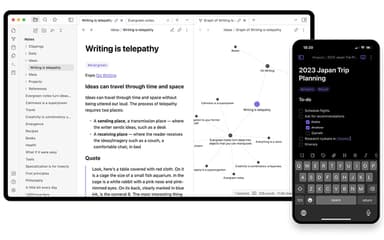
Obsidian is best for its graph-based data visualization clusters. This functionality gives knowledge workers a visual way to explore relationships between notes. Graph view displays connected information across a vault to help researchers spot clusters, patterns, and links between topics. It can also serve as another way to navigate a large collection of notes when individual pages become harder to keep track of.
How Much Does Obsidian Software Cost?
Obsidian pricing starts at $5/user/month for the Sync plan. This plan includes cross-device note syncing, end-to-end encryption, version history, collaboration on shared vaults, and priority support. Further pricing options for the software are as follows:
- Publish: $10/site/month
- Catalyst: $25 (one-time)
- Commercial: $50/user/year
Other than the base price, buyers should also consider the following additional costs:
- Commercial License: $50–$100/seat/year for business use
- Paid Community Plugins: $10–$50 (one-time) or $5–$15/month/plugin, for premium task management, database, or AI-assisted features
- Third-Party Sync Or Storage: $2–$15/month/user, for teams using Dropbox, Google Drive, or iCloud+ instead of Sync
- Setup And Migration Time: $200–$1,500 (one-time) equivalent in labor, for teams moving from tools like Notion or Confluence
Reviewers generally describe Obsidian’s pricing as highly favorable, with many praising its free core product and lack of paywalls or usage limits. They generally accept paying for optional Sync, calling the subscription reasonable, although some feel multi-device sync should be included in the standard license.
Disclaimer: The pricing is subject to change.
Obsidian Software Integrations
The software supports integration with multiple systems and platforms, such as:
How Does Obsidian Software Work?
Follow these steps to get started with Obsidian:
- Open Obsidian and select an existing vault or choose the option to create a new one
- Name the vault and choose where you want its files stored on your device
- Create a note by selecting the new-note command, then enter your content in the editor
- Format your content with Markdown shortcuts as you write headings, lists, bold text, or italics
- Link notes together by typing [[ and selecting the note you want to reference
- Open a linked note by selecting its internal link from the page
- Check backlinks from the backlinks panel to find notes that point to the page you are viewing
- Organize your notes by creating folders and moving related files into them
- Open Graph view to see the connections between your notes and select a page from the graph
- Set up Sync in Obsidian's settings if you want to use the same vault across devices
- Install community plugins from the settings menu when you need additional tools
Who Is Obsidian Software For?
Obsidian software mainly suits:
- Researchers
- Students
- Academics
- Developers
- Journalists
- Project managers
Obsidian Software Use Cases
Our review of these sources highlights the following business scenarios in which the platform is particularly well suited:
Writers Separating Fast Capture From Slow Thinking
Ideas can arrive faster than a writer can process them, and forcing every stray thought straight into a structured vault gets in the way of thinking. Obsidian lets writers capture fleeting notes in a lightweight tool first, then bring them into the vault later as atomic, permanent notes. This suits anyone who wants a clear line between jotting something down and working out what it means.
Researchers Building Connections Across Their Notes
Obsidian gives researchers a space where linking notes surfaces connections they would otherwise miss. As a vault grows, related notes sitting far apart from each other still get pulled together, without the researcher having to remember where each one lives. This works well for anyone whose thinking depends on finding links between older material and new ideas.
Academics Turning Source Material Into Usable Notes
Reading dense, reference-heavy material and turning it into something usable is a slow, manual task on its own. Obsidian helps academics pull citations and sources directly into notes, then distill that material down into permanent notes for later use. This benefits academics and researchers who read a high volume of papers and need a repeatable way to process them.
Writers Managing Drafts Through Standard Templates
Obsidian provides writers with a consistent process for tracking a manuscript through each stage, from first draft to submission to publication. Metadata for a new draft note fills in on its own, so a writer can move straight into writing instead of setting up the note by hand. This fits writers who revise often and want the setup work out of the way before they start writing.
Is Obsidian Software Right For You?
Obsidian is a good fit for teams and individuals who want tighter control over private information. Notes are stored locally on your device by default; no account is required. Obsidian says it does not collect telemetry data. For organizations concerned about where sensitive knowledge is stored, this approach can be an important consideration.
For businesses with stricter security requirements, Obsidian Sync uses AES-256 end-to-end encryption. It also uses open file formats, trusted encryption algorithms, and independently audited code. Its use by Amazon, Capital One, Shopify, Meta, and the UK government adds further evidence that the platform is trusted for working with private information.
Obsidian continues to expand its ecosystem, too. On May 12, 2026, it launched Obsidian Community, a new directory and developer dashboard for plugins and themes. The update gives teams a more practical way to discover extensions and build Obsidian around their own knowledge management requirements.
Still doubtful if Obsidian software is the right fit for you? Connect with us at (661) 384-7070 for further guidance.
Obsidian Software Features
Canvas
This visual workspace lets researchers create an open space for brainstorming, diagramming, and arranging ideas. Notes can sit alongside images, PDFs, videos, audio, and web pages, with connections between cards showing relationships. Canvas views can also be embedded in notes or other Canvases, and finished layouts can be exported as images.
Links
This knowledge management tool lets researchers connect notes, ideas, people, books, and other related information through internal links. A note can point directly to another note, creating a network of connected references. Over time, these links can turn separate pieces of research into a personal knowledge base that is easier to explore.
Sync
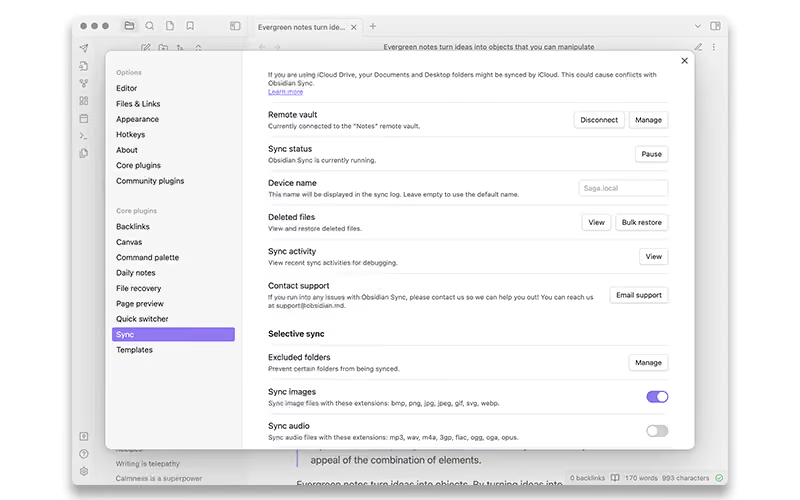
With cross-device sync, professionals can access their notes from different devices with end-to-end encryption. Obsidian also keeps one year of version history for each note, so earlier revisions can be reviewed. Users can choose which files and preferences sync to particular devices, providing more control over how their information is distributed. It also works when a user is offline or in a remote location, and the data syncs automatically when they go online.
Collaboration
Teams can use this functionality to work on shared files without exposing their entire private note collection. Shared content can be separated from personal notes, giving collaborators access to the information they need without requiring everything in a vault to be shared. This can suit projects that involve both private research and group work.
Publish
The software makes it possible to turn notes into an online wiki, knowledge base, documentation site, or digital garden. Content can be published directly from Obsidian, giving readers a way to browse related information online. Publishers can also use themes, custom domains, and password protection to shape how their sites look and who can access them.
Site Customization
The publishing platform gives businesses a way to control how their online knowledge base looks and who can access it. Custom themes can change the site's appearance, while custom domains provide a branded web address. Password protection adds another access option for documentation or knowledge sites that should not be publicly available.
Performance And SEO
Published knowledge bases come with built-in performance and search optimization. Obsidian Publish sites are designed to work across desktop and mobile devices, with SEO handled without additional configuration. This gives organizations a practical way to put documentation or reference material online without having to set up separate performance or search optimization tools.
Pros And Cons of Obsidian Software
Pros
Linked notes and tasks support connected project and note management
Plain-text file storage keeps notes portable across systems
Embedded media keeps related content directly inside notes
Cons
Limited real-time collaboration restricts multi-user editing
File management becomes harder as note collections grow
Obsidian Software Pricing
SyncBilled Annually | PublishBilled Annually | CatalystOne-Time Payment | Commercial |
|---|---|---|---|
$5 per user per month | $10 per site per month | $25 | $50 per user per year |
|
|
|
|
Disclaimer: The pricing details were last updated on Sep 25, 2026 from the vendor's website. Please contact us for a tailored pricing list.
Obsidian Software Reviews
Total 12 reviews
4.7
All reviews are from verified customers
Rating Distribution
5
Stars67%
4
Stars33%
3
Stars0%
2
Stars0%
1
Stars0%
Share your experience
Media Production, N/A employees
Less than 6 months
“Exactly the notes app I've needed”
Pros
It gives me full control over all my notes. I can save my markdown files wherever I want and depending on the devices I'm using, I can even set up my own sync solution without paying for Obsidian's subscription (although I do need to pay for sync if I'm using iOS). If I ever decide to switch to another Markdown app, I can just move my files. I sync my notes through Google Drive, so I can access them on both my desktop and my Android phone. For vaults I don't need to sync or want to keep offline, I can store them anywhere on my computer.
Cons
I'm not thrilled about having to pay for sync to access my notes on iOS but I can't really complain since Obsidian allows DIY syncing. The only reason it doesn't work on iOS is because of how Apple's OS is set up which isn't Obsidian's fault. Plus the subscription price is pretty reasonable. Personally I use Obsidian just for myself, so I don't need to collaborate with anyone else. If you want to use it with multiple people, that might be a bit more complicated.
Rating Distribution
Ease of use
9
Value for money
9
Customer Support
8
Functionality
10
Security and Investigations, 11-50 employees
Less than a year
“Overall good tool”
Pros
It's super easy for me to take and organize notes which really helps me get my thoughts in order.
Cons
It can be a bit tricky to use, especially if you're new to organizing and note-taking apps.
Rating Distribution
Ease of use
7
Value for money
10
Customer Support
8
Functionality
9
Marketing and Advertising, 1-10 employees
Less than 6 months
“Awesome but a bit tricky”
Pros
What I love most is the design and overall look of the app. It's beautifully laid out and just feels great to use.
Cons
It is difficult to use. I was a little confused about where the actual vaults are stored at first.
Rating Distribution
Ease of use
5
Value for money
10
Customer Support
10
Functionality
7
Frequently Asked Questions
Does Obsidian Software offer an API?
Yes, it offers an API.
What language does Obsidian Software support?
It supports English, German, French, Italian, Arabic, and many more.
Does Obsidian Software have a mobile app?
Yes. Obsidian has mobile apps for iOS, iPadOS, and Android.
What types of pricing plans does Obsidian Software offer?
Obsidian Software price plans start at $5/user/month. Contact us to get a tailored Obsidian Software cost estimate.
What other apps does Obsidian integrate with?
Obsidian integrates with Toggl Track, Plotly, and Vale.
What level of support does Obsidian offer?
It offers support through a community forum and a help center.
Who are the typical users of Obsidian Software?
It is mainly used by researchers, students, academics, developers, journalists, and project managers.