



Last Updated
Overview
PrestaShop is a self-hosted e-commerce platform ideal for businesses that want complete control over their online store. With thousands of modules and themes, it can be tailored to meet any specific requirements. If you want a store that works exactly how you imagine it, PrestaShop could be the right choice.
Overall Rating
Based on 13 users reviews
4.2
Rating Distribution
Positive
77%
Neutral
23%
Negative
0%
Starting Price
€24
per month
PrestaShop Specifications
- Order management
- Reporting/Analytics
- Shipping management
- Email marketing
What Is PrestaShop?
PrestaShop is a customizable e-commerce platform that helps merchants create and manage online stores. It gives users ownership of their store and data. Merchants can customize their storefronts using thousands of available modules and themes. PrestaShop also provides tools for payments, marketing, shipping, social selling, and automation. Businesses can choose between a self-hosted setup and a hosted option. The platform is designed to support merchants as their e-commerce operations grow.
What Is PrestaShop Best For?
PrestaShop stands out for its “Limitless Customization” capability. It allows users to choose from over 3,000 modules and 2,000 templates to personalize their storefronts. These options give merchants more control over how their store looks and functions based on their business needs. This makes PrestaShop well-suited to businesses that want greater flexibility in shaping their e-commerce storefront.
How Much Does PrestaShop Cost?
PrestaShop pricing starts with its Hosted plan at €24/month, excluding VAT. This plan includes hosting, support, and e-commerce services for launching an online store. PrestaShop also offers a free Classic plan for users who prefer to set up and host their own store.
It also offers a free trial. In addition to the base plan, the following costs may apply:
- Hosting: From €2.99/month (~$3.45/month), starting price for Hostinger, one of its hosting partners
- PrestaShop Social: €9.99/month excl. VAT (~$11.53/month)
- Domain Name: From €10/year (~$11.55/year)
- Premium Themes: €50–€200 (~$58–$231), depending on complexity
- Essential Modules: €100–€300 (~$115–$346) in the first year
- Quick Start Help Service: €50 excl. Tax (~$58), this installation service covers store setup on the selected server and theme installation
- Advanced SEO And Marketing: €20–€200/month (~$23–$231/month), for advanced SEO tools and marketing activities
Most users view PrestaShop as a cost-effective option for launching and managing e-commerce stores, particularly because of its open-source model. However, reviewers also note that paid modules, themes, and add-ons can raise overall costs as store requirements expand.
Disclaimer: The pricing is subject to change.
PrestaShop Integrations
The software supports integration with multiple systems and platforms, such as:
How Does PrestaShop Work?
Here's how you can get started with the software:
- Download Classic to self-host, or select the Hosted, ready-to-use option
- Install the store by completing setup yourself, or let Hosted handle installation
- Configure the storefront by selecting a theme and adjusting design, layout, and branding
- Build the product catalog by adding items, categories, and details in the back office
- Set up payments and shipping through options like Stripe, Klarna, Alma, and carrier partners
- Extend functionality by browsing the Marketplace for modules covering marketing, social selling, and automation
- Connect sales channels by syncing the catalog to Facebook, Instagram, or Google campaigns
- Manage and grow the store using support resources, community forums, or certified Experts
Who Is PrestaShop For?
PrestaShop is ideal for a wide range of industries and sectors, including:
- Cosmetics
- Fashion and apparel
- Food and beverage
- Consumer electronics
PrestaShop Use Cases
Based on our analysis of user feedback and PrestaShop features, we have identified the following key business scenarios where it may be a good fit:
Retailers Managing Large Product Catalogs
Retailers with extensive inventories can use PrestaShop to keep product and order activity organized within the same e-commerce environment. Reviews describe the platform as suitable for large catalogs and highlighted the back-office structure for managing products and orders. This makes it relevant for businesses handling a broad product range alongside regular order processing.
Businesses Selling Across Multiple Countries
For merchants operating internationally, PrestaShop supports multilingual store management along with logistics and tax requirements. User reviews highlighted these native options when discussing sales across multiple countries and languages. In this regard, the platform can suit businesses that need to manage regional e-commerce requirements across different markets.
Small Businesses Launching Online Stores
PrestaShop can also work for smaller businesses entering e-commerce for the first time. User feedback noted using it mainly for small companies starting online sales and described the platform as manageable during the initial stages. That makes it relevant for merchants looking to establish a dedicated storefront while keeping early e-commerce operations relatively straightforward.
Brands Building Customized E-Commerce Stores
Businesses with more specific storefront requirements may need room to adjust their setup as those needs to change. PrestaShop’s modular structure supports this type of approach. Reviews highlighted modularity as one of its main strengths and described adding modules as store requirements evolved. This can suit brands that expect their e-commerce configuration to develop over time rather than remain fixed.
Is PrestaShop Right For You?
PrestaShop is a practical choice if you want more control over how your e-commerce store is built and managed. It can suit both new entrepreneurs and established merchants looking for flexibility as their business grows.
Brands including Molly Bracken, Le Chocolat Alain Ducasse, and Store Lashes have built stores with PrestaShop. The platform also gives users ownership of their online store and data, making it suitable for businesses that value control and customization.
Still doubtful if PrestaShop software is the right fit for you? Reach out to us at (661) 384-7070 and we’ll help you make the right choice.
PrestaShop Features
E-Commerce Website Builder
PrestaShop supports the full setup of an online store, from choosing a domain to publishing the storefront. Merchants can apply customizable templates and configure payments and delivery options before launch. This creates a clear setup path for getting an e-commerce website ready for customers.
Online Sales And Stock Management
The platform lets merchants receive and manage online orders in real time from the back office. Users can access shipping data, edit invoices automatically, and work with configured carriers for delivery. Stock information can also be managed within the store, while more complex warehouse or omnichannel synchronization may require additional modules or integrations.
Product Management
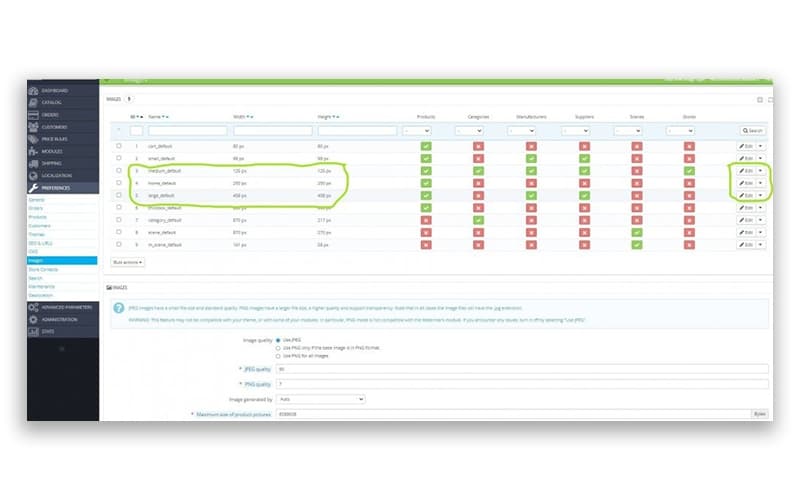
The software gives merchants tools to build and maintain detailed product catalogs. Product information can include pricing, size, descriptions, EAN codes, weight, stock, images, and variations. For larger catalogs, users can also import product data through CSV files instead of entering every item manually.
Dashboard
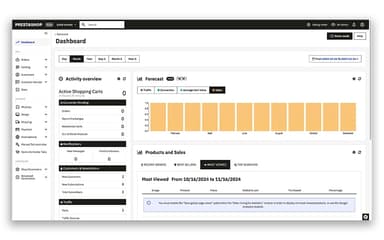
PrestaShop’s dashboard provides a detailed view of store statistics and ongoing activity. It brings together information on items, orders, sales, turnover, customer service, and other e-commerce metrics. Merchants can use this data to review store performance and monitor key parts of day-to-day operations.
Pros And Cons of PrestaShop
Pros
Easy to set up for new online stores
Flexible customization through modules and themes
Supports multilingual and international store setups
Straightforward product and inventory management
Handles large product catalogs effectively
Cons
Paid modules can raise overall setup costs
Major updates may affect existing customizations
Advanced changes may require technical knowledge
PrestaShop Pricing
Classic | Hosted |
|---|---|
Free Download | From €24 excl. VAT per month |
|
|
Disclaimer: The pricing details were last updated on Oct 23, 2026 from the vendor's website. Please contact us for a tailored pricing list.
PrestaShop Reviews
Total 13 reviews
4.2
All reviews are from verified customers
Rating Distribution
5
Stars46%
4
Stars31%
3
Stars23%
2
Stars0%
1
Stars0%
Share your experience
Design, 1-10 employees
More than a year
“for growing a flexible online shop”
Pros
This tool proved to be a truly complete CMS for e-commerce: right from the start it includes everything needed to launch and manage an online store. I'm talking about a product catalog with combinations and variants, order, shipping and payment management, discount rules, as well as multilingual and multicurrency support. The real strength lies in customization because the modular architecture and themes allow you to adapt practically every part of the store to your business needs, without having to compromise. In addition, there is a huge ecosystem of modules, both free and paid: those with technical skills can also develop custom functions, create integrations with management systems and external services via APIs and fine-tune the theme down to the smallest details. Being open source, there is also the advantage of not being tied to a closed platform, with full control over your own data. The Italian community is also active and decidedly competent so it is easier to find support when needed. For those aiming for a flexible online store that is ready to grow over time, it is a choice that delivers concrete satisfaction.
Cons
The less appealing side is that customization also involves quite a few paid modules: some features that on other platforms are often included here end up requiring extra purchases and costs can rise quickly. It is also worth paying attention to module quality because those with few stars or few reviews can be full of bugs, poorly updated or even incompatible with your version. It is always advisable to check the source, preferring the official store or reliable developers: downloading from unsafe sources can create risks that are even serious from a security standpoint. And then, between updates and possible conflicts between extensions, at least a minimum of technical expertise is needed to keep everything under control.
Rating Distribution
Ease of use
10
Value for money
8
Customer Support
10
Functionality
8
Marketing and Advertising, 11-50 employees
Less than a year
“build a ready-to-go online store”
Pros
The frontend interface feels very easy and it comes with a ton of built-in tools that help you get an ecommerce website or store up and running quickly. You don't have to start from scratch for most common needs.
Cons
The platform includes a lot of features but many of the more useful add-ons end up costing extra so you can't get everything for free, for instance some SEO-related tools require a paid option.
Rating Distribution
Ease of use
8
Value for money
7
Customer Support
8
Functionality
7
Computer Software, 1-10 employees
Less than a year
“multi-currency support and paid modules”
Pros
PrestaShop feels pretty solid overall. Getting a shop up and running is easy and the multi-currency support works well. The admin dashboard is especially accessible so managing products orders and basic settings doesn't feel confusing.
Cons
One thing I'm not too happy about is that many integrations you'll want later are provided through extra modules and a lot of them are paid. That can really bump up the initial cost when you start adding features beyond the basics.
Rating Distribution
Ease of use
5
Value for money
5
Customer Support
5
Functionality
6
Frequently Asked Questions
What languages does PrestaShop support?
PrestaShop primarily supports multiple languages, including English, French, Italian, Polish, and Spanish.
Does PrestaShop offer an API?
Yes, PrestaShop offers an API.
What types of pricing plans does PrestaShop offer?
PrestaShop price starts with its Hosted plan at €24/month, excluding VAT. It also offers a free Classic plan for users who prefer to set up and host their own store. Get a detailed PrestaShop cost breakdown tailored to your specific requirements.
Does PrestaShop have a mobile app?
No, PrestaShop does not offer a dedicated mobile app.
Who are the typical users of PrestaShop?
PrestaShop is used by organizations across a range of industries and sectors, including consumer electronics, cosmetics, fashion and apparel, and food and beverage.
What other apps does PrestaShop integrate with?
PrestaShop integrates with various systems and platforms, including PayPal, Mailchimp, Brevo, Zendesk, and Manago AI.
What level of support does PrestaShop offer?
PrestaShop offers support through a care center, community, and paid plans, ranging from €90 to €1490.