Last Updated
Key Takeaways
Generated from the text of customer reviews
Ariba is a cloud-based spend management platform which is frequently used by finance, supply chain, and procurement teams. Large enterprises operating in manufacturing and logistics are likely to benefit. Users often praise audit trials, purchasing control, invoice tracking, and supplier management. However, navigation and setup complexity draw the most criticism.
Our Verdict
SAP Ariba works best for larger organizations juggling complex procurement, supplier, and approval needs. Its ability to handle high transaction volumes and structured procurement processes makes it a practical fit for enterprise environments. We recommend it for organizations that have the resources to manage a more involved deployment and adoption process.
Overall Rating
Based on 40 users reviews
4.2
Rating Distribution
Positive
80%
Neutral
18%
Negative
3%
Starting Price
$2,420
per month
Ariba Specifications
- Financial Management
- Supply Chain Management
- Business Intelligence
- Compliance and Risk Management
What Is Ariba?
Ariba, part of SAP's spend management suite, centralizes sourcing, procurement, and supplier data into one system rather than managing each function through separate tools. It connects to SAP S/4HANA and SAP Business Network, which ties procurement activity directly into a company's broader financial and supplier records. Businesses use it to run sourcing events, manage contracts, and route purchase approvals through configurable workflows.
Moreover, with next-gen SAP Ariba, SAP is bringing these processes onto a more unified platform with embedded AI assistance.
What Is Ariba Best For?
‘Reimagined Buying Experience’ is one of the standout features of Ariba software as it brings purchasing, order tracking, receiving, and approvals into a connected workflow. Its ‘Agentic AI’ assists with purchasing and policy-related tasks, while catalog capabilities improve ingestion, indexing, marketplace connectivity, and search. This way, it keeps purchasing and catalog search connected in one system instead of splitting across separate tools.
How Much Does Ariba Cost?
Ariba pricing starts at $2,420/month for SAP Strategic Procurement with built-in blocks of 1 user and contract terms of 3 to 36 months. Notable features included in this plan are RFI and RFP event management, supplier qualification, performance tracking, and contract creation with a built-in clause library.
Besides this, Joule Base, SAP's foundational AI assistant, is included at no additional cost across all Spend Management plans.
Apart from the base fee, users should also keep in mind the following potential costs when estimating the total cost:
- Additional Modules/Suite Add-Ons: up to $1.5 million+/ year
- Implementation And Configuration Services: up to 40% of Year-1 subscription cost
- ERP And Third-party System Integration: up to $300,000+
- SAP Business Network Transaction Fees: up to 0.35% of transacted volume, annual cap of $20,000/buyer relationship
- Training And Change Management: up to $50,000+
- Additional Users Beyond The Base Tier: up to $600/user/month
Users have mixed views on SAP Ariba’s cost. Some say better supplier negotiations have helped lower procurement spending, but others find the platform expensive compared with alternatives. Implementation, maintenance, configuration, and customization costs can also push the total investment higher.
Disclaimer: The pricing is subject to change.
Ariba Integrations
Ariba software supports integration with different third-party system such as:
- SAP S/4HANA
- SAP ERP
- Oracle
- RFQ/Quotation
- Fiori UI
How Does Ariba Work?
Log in to the platform and follow the steps outlined below to get started:
- Add supplier information to build out a centralized supplier database
- Create sourcing events to collect and compare bids from multiple suppliers
- Configure approval workflows for purchase requests and contracts
- Manage contracts through their full lifecycle, from drafting to renewal
- Track spend across departments through built-in analytics and dashboards
- Process invoices and match them against purchase orders before payment
- Connect Ariba to SAP S/4HANA or other ERP systems to keep procurement and financial data aligned
Who Is Ariba For?
Ariba is suitable for businesses across various industries and sectors, including:
- Automotive
- High tech
- Mining
- Retail
- Travel and transportation
- Construction
- Government
- Media and sports
Ariba Use Cases
Based on what we have assessed from user feedback and Ariba features, these are the key scenarios where this platform can be considered as a suitable option:
Finance Teams Automating Invoice Matching
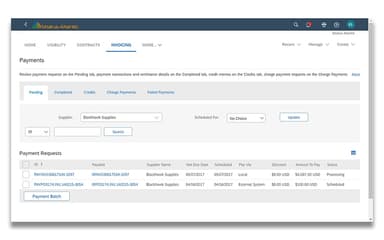
Manual invoice matching can become difficult to manage as invoice volumes grow. Ariba supports two-way matching between invoices and purchase orders and three-way matching across invoices, purchase orders, and receipts. Its automatic reconciliation can accept, reject, or route invoices with exceptions for further review.
Enterprises Managing Large Supplier Network
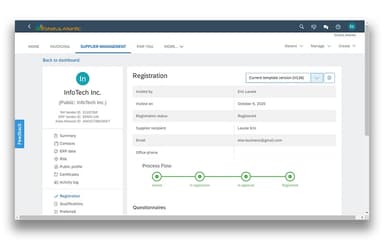
SAP Ariba works well for enterprises that need to manage large supplier volumes within a structured procurement environment. It keeps sourcing documents, contract terms, supplier questionnaires, and approval records in one place, creating a consistent audit trail. This is especially relevant for organizations where supplier governance involves multiple documents, approvals, and stakeholders.
Organizations Needing Spend Visibility Across Multiple Business Units
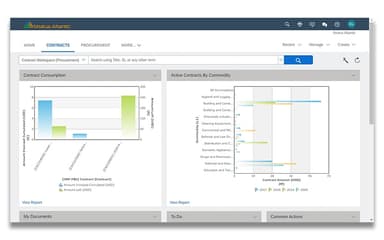
Companies running procurement across several departments often lack a single view of where money is going until reports get compiled after the fact. Ariba's Spend Analysis dashboards show spend by vendor and category in real time. Reviewers highlight how the platform helps enforce compliance and improves visibility across business units while centralizing supplier data for large-scale sourcing and risk management.
Teams Centralizing Procurement Requests And Approvals
Teams that want to move procurement requests and approvals out of scattered email threads can use SAP Ariba to manage them in one place. Requests follow defined approval workflows, while users can track their status and see pending actions. As per user feedback, the platform gives one place to create procurement requests, track them through completion, and see pending requests in the To Do section.
Is Ariba Right For You?
Ariba is a practical option for organizations looking to scale procurement operations across large user bases, suppliers, and purchasing activities. The platform encrypts its transactional database at rest and offers an additional encryption layer for sensitive fields and attachments. Its mobile app uses TLS 1.2 for data in transit and AES-256 encryption for stored mobile data.
Another point to consider for companies importing goods into the EU is that the Carbon Border Adjustment Mechanism entered its definitive phase on January 1, 2026. That means importers now have to buy and surrender certificates based on suppliers' actual, verified emissions data, not rough estimates. SAP rolled out a CBAM Declarants solution in June 2026 to help with exactly this. It pulls in Sustainability Footprint Management and Green Ledger so procurement and finance teams can track supplier data and manage what they owe.
It is also worth noting that SAP launched next-gen SAP Ariba in March 2026, which introduced a rebuilt source-to-pay platform with embedded AI and a more unified experience. Organizations evaluating Ariba now should account for this transition when planning their longer-term procurement technology strategy.
Not sure whether SAP Ariba matches the scale and complexity of your procurement operation? Call (661) 384-7070, and we will assist you in assessing the right fit.
Ariba Features
Intake Management
The platform gives employees one place to submit and track non-catalog purchase requests. A context-aware AI assistant collects the required details and checks requests against procurement policies. Users can follow request status from the intake dashboard, while no-code tools let procurement teams build and adjust intake-to-procure workflows as requirements change.
Supplier Management
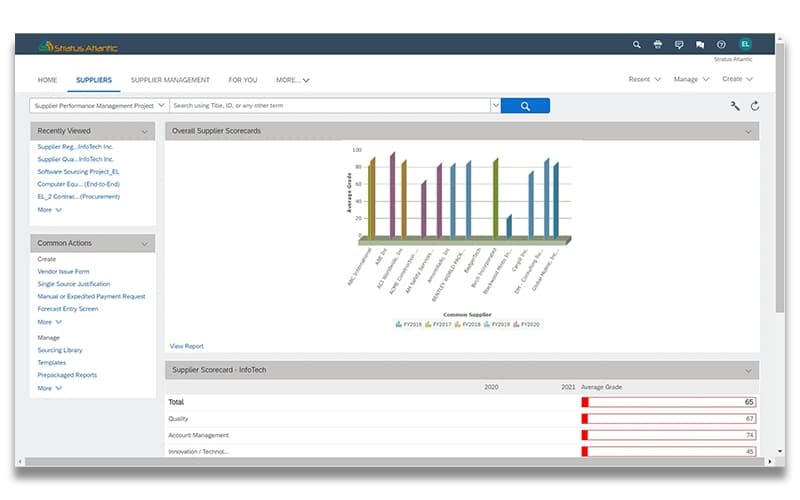
This feature keeps supplier information and related activities in a centralized system. It covers registration, qualification, segmentation, performance assessments, and risk monitoring. Procurement staff can follow supplier performance over time rather than relying on separate records at different stages of the relationship.
Procure-To-Pay
The software covers everyday purchasing and invoice processing. Employees can submit purchase requests, search catalogs, and follow guided buying workflows. Approvals, purchase orders, invoices, and exceptions are handled within the same process, keeping purchasing activity easier to track.
Source-To-Contract Management
Ariba handles the process from sourcing events through contract execution. It supports RFIs, RFPs, competitive bidding, supplier selection, negotiations, and contract management. Savings tracking sits alongside these activities, making it easier to compare negotiated savings with actual outcomes.
Procurement Strategy
This feature brings spend data from SAP and non-SAP systems into one place. It covers spend classification, supplier data enrichment, KPI dashboards, and category planning. Procurement managers get a clearer picture of where money is going and where sourcing opportunities may exist.
Spend Management Assistants
Ariba offers specialized AI agents for buying, sourcing, supplier management, category planning, and travel. Each assistant handles specific procurement tasks, from policy-based purchasing and supplier risk monitoring to sourcing events and award decisions, reducing manual work across spend processes.
Pros And Cons of Ariba
Pros
Offers simple setup management for leads generation and information
Improves buyers, and supplier experience through digital transformation
Automates and centralizes the complete procurement process
Cons
Interface may feel complex for new users
Some advanced workflows could be simplified
Ariba Reviews
Total 40 reviews
4.2
All reviews are from verified customers
Rating Distribution
5
Stars53%
4
Stars28%
3
Stars10%
2
Stars8%
1
Stars3%
Share your experience
Emma B.
Non-Profit Organization Management, 51-100 employees
More than a year
“Clear tracking”
Pros
One thing that really works well with this software is the customer support. They reply quickly by email, give good guidance on how to resolve errors and often include screenshots that make the steps much clearer. I use the platform regularly for creating POs and invoices and it's very useful being able to see the status of submitted invoices and track when payments are due. Matching POs to invoices helps move payments through faster and reduces the chance of invoices being rejected. Our external auditors also appreciate the system because it provides a reliable time stamped audit trail. It's also helpful that there is both a buyer and supplier login option. The dashboard gives a clear view of where invoices are in the process and highlights any that need attention.
Cons
Getting started with the software involves a few tedious steps especially when input is needed from several different teams. You have to be careful that the identification number and description match correctly although customer support is available to help when needed.
Rating Distribution
Ease of use
9
Value for money
8
Customer Support
7
Functionality
8
Nishant J.
Cosmetics, 500+ employees
More than a year
“supplier management powerhouse”
Pros
Working with this tool has aligned really well with industry requirements in my experience. It comes with strong features like SBN, Ariba Risk and the Ariba Sourcing suite which together make it feel like a complete one stop solution for supplier relationship management and contract management.
Cons
Is a very strong product and honestly one of the best in terms of utility and overall purpose. The only downside is that navigation can be a bit tricky at times and not every product shares the same UI but the functions easily outweigh those issues.
Rating Distribution
Ease of use
8
Value for money
10
Customer Support
10
Functionality
10
Sergi F.
Electrical/ Electronic Manufacturing, 500+ employees
More than a year
“solid compliance and audit trail”
Pros
When compliance, approval tracking and year end audits matter, this software really comes through! You can see exactly who approved each step and when it happened. On the invoicing side once the approval workflows and routing are set up properly, the procure to pay process works very well. It helps reduce a lot of the manual data entry errors too. It also manages huge amounts of vendor information and contracts without struggling. It's clearly designed for large, complex organizations and that really shows.
Cons
At the same time the platform feels dated like software from 15 years ago. Training new employees takes much longer than it should because almost nothing feels accessible right away.
Rating Distribution
Ease of use
9
Value for money
6
Customer Support
9
Functionality
8
Frequently Asked Questions
Does Ariba offer an API?
Yes, it offers an API.
What other apps does Ariba integrate with?
The platform can integrate with SAP ERP, Oracle, SAP S/4HANA, RFQ/Quotation, and Fiori UI systems.
Does Ariba have a mobile app?
Yes, it provides a native SAP Ariba mobile app for iOS and Android devices.
What level of support does Ariba offer?
The software provides support through phone, contact form, email, and knowledge base.
Who are the typical users of Ariba?
Ariba can be used by users across multiple industries and sectors including retail, high tech, mining, automotive, construction, mining, media, and sports.
What language does Ariba support?
The platform is available in multiple languages including English, German, French, Japanese, Turkish, Portuguese (Brazil), Latvian, Korean, Italian, Indonesian, and more.
What types of pricing plans does Ariba offer?
Its pricing starts at $2,420/month for SAP Strategic Procurement. Users can also request Ariba cost quote based on their needs.