


Last Updated
Overview
Ansys Fluent provides powerful computational fluid dynamics simulation, aiding accurate prediction of flow behaviors in designs. It accelerates product development through validated physics models. Although it requires careful boundary setup, its GPU solvers and precise turbulence handling make it a top choice for manufacturing simulations.
Ansys Fluent Specifications
- Collaboration Tools
- Document Management
- Reporting And Analytics
- Production Planning
What Is Ansys Fluent Software?
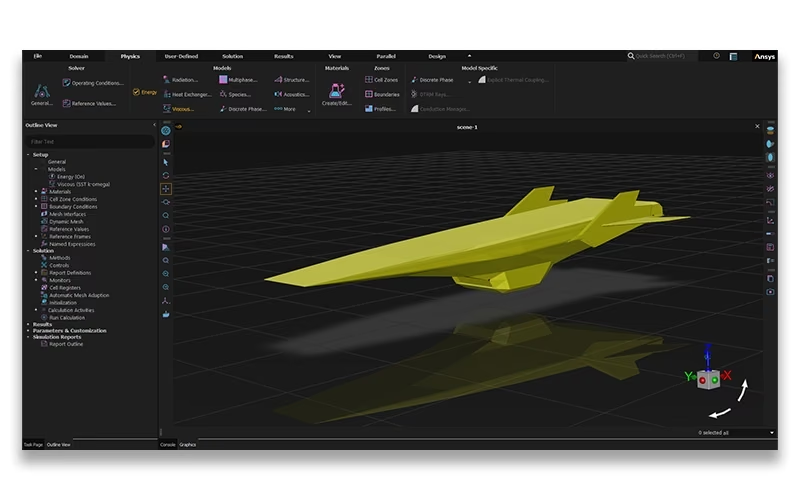
Ansys Fluent is an on-premise computational fluid dynamics platform for manufacturing processes. It models complex fluid interactions, heat transfer, and reactions to reveal performance insights early. The software tackles pain points like prolonged prototype testing by delivering fast solve times on Graphics Processing Units (GPUs). Users optimize designs virtually, eliminating the need for physical builds and associated costs. It handles multiphase systems and combustion scenarios, helping firms refine products before production.
Ansys Fluent Pricing
Ansys Fluent Integrations
Who Is Ansys Fluent Software For?
Ansys Fluent software is ideal for a wide range of industries and sectors, including:
- Aerospace
- Automotive
- Energy
- Manufacturing
- Electronics
Is Ansys Fluent Software Right For You?
Seeking advanced Computational Fluid Dynamics (CFD) for manufacturing challenges? Ansys Fluent excels in precise fluid modeling, shortening design cycles. It addresses inaccuracies in prototypes and slow iterations with validated solvers. The platform complies with data transfers and export controls for secure handling. Ansys Fluent ensures safe operations and grows with enterprise needs.
Still not sure if Ansys Fluent is right for you? Contact our customer support team at (661) 384-7070, who will help you make the best decision.
Ansys Fluent Features
Advanced Turbulence Modeling
Ansys Fluent incorporates tunable models, such as GEKO, for various flow regimes. Users adjust coefficients to match specific conditions without recalibration. This approach accurately captures details in boundary layers and separations. Results align closely with experiments across speeds. Teams refine predictions more quickly, enabling better product decisions and increased efficiency in design reviews.
Multiphase Flow Simulation
The platform switches methods for gas-liquid or particle interactions dynamically. It refines meshes where phases mix or separate. This handles breakups and pooling in real-time. Accuracy improves in complex systems, such as separators. Engineers spot issues early, improving safety and performance through informed teamwork.
GPU-Accelerated Solving
Ansys Fluent software runs solvers natively on GPUs for compressible or multiphase cases. It scales across multiple cards, dramatically reducing solve times. Large models finish quicker than on CPUs, with performance boosts reaching high factors in transients. Groups iterate designs rapidly, enhancing decision-making and overall project pace.
Task-Based Meshing Workflows
Fault-tolerant tools process dirty Computer-Aided Design (CAD) files directly with reliable options. The user’s guide steps in one window for polyhedral or hex meshes, automating processes and reducing manual fixes. Import quality improves for faster preprocessing. Collaborations accelerate workflows, supporting efficient setups and dependable team results.
Fluid-Structure Interaction
Ansys Fluent features structural tools to analyze pressure or thermal loads. It simultaneously solves deformations and flow in one run. This reveals the stresses fluid forces exert on solids, with predictions closely matching real-world behavior. Designers can adjust them together, leading to improved efficiency and stronger collaborative insights.
Pros And Cons of Ansys Fluent
Pros
Delivers accurate turbulence results
Handles multiphase accurately
Predicts combustion precisely
Cons
Needs powerful hardware sometimes
Involves parameter tuning initially
Ansys Fluent Reviews
Total 24 reviews
4.7
All reviews are from verified customers
Rating Distribution
5
Stars71%
4
Stars29%
3
Stars0%
2
Stars0%
1
Stars0%
Share your experience
saravanakumar m.
Automotive, 500+ employees
“Accurate physics modeling”
Pros
The comprehensive physics modeling is incredibly helpful and covers a wide range of simulation needs really well.
Cons
The biggest downside is the cost and the meshing can sometimes be less reliable than expected.
Rating Distribution
Ease of use
10
Value for money
8
Customer Support
10
Functionality
10
Anonymous
Computer Software, 11-50 employees
“Strong hybrid simulation performance”
Pros
One of the best things about Ansys Fluent is that it can run simulations with the GPU and CPU at the same time. Its model library, codebase and algorithms are also very solid and well established, with strong validation across both scientific research and real-world applications.
Cons
price which is noticeably higher than competing products and often makes customers consider Ansys Fluent as their second option.
Rating Distribution
Ease of use
10
Value for money
9
Customer Support
10
Functionality
10
Anonymous
Research, 500+ employees
“excellent results and rich analysis”
Pros
During my PhD work on air quality, I used Ansys Fluent and saw firsthand that it's a very capable though fairly complex, simulation tool. A big advantage is being able to build your 3D geometry in other software and import it into Fluent in a compatible format which saves you from having to learn modeling inside another program. The output quality is excellent and it gives you plenty of material to analyze, including animations, detailed plots and a large amount of simulation data.
Cons
Even though the interface is fairly user-friendly, the software still takes quite a bit of time to learn and doesn't always feel simple. It's definitely worth going through a few tutorials before jumping into real projects. On top of that, complex simulations with meshes containing millions of elements can take a long time to run and usually need access to a powerful computing cluster. The results are very strong but reaching that point can be challenging. Errors are common while learning although there is a solid user community, open forums and support available when you need help.
Rating Distribution
Ease of use
6
Value for money
8
Customer Support
7
Functionality
9
Frequently Asked Questions
What types of pricing plans does Ansys Fluent offer?
Ansys Fluent price is customized, depending on modules and users. Get a tailored quote on Ansys Fluent cost.
Does Ansys Fluent have a mobile app?
No. Ansys Fluent does not have a standalone mobile app.
Does Ansys Fluent offer an API?
Yes, through PyFluent for scripting and automation.
What other apps does Ansys Fluent integrate with?
The vendor has not shared information about its third-party integration.
Who are the typical users of Ansys Fluent?
Ansys Fluent is suitable for a wide range of industries, particularly in aerospace and automotive.
What language does Ansys Fluent support?
Ansys Fluent supports multiple languages, including English, French, and Italian.
What level of support does Ansys Fluent offer?
Ansys Fluent provides support through the ticketing system.