


Fusion 360
Last Updated
Key Takeaways
Generated from the text of customer reviews
Fusion 360 is a cloud-based CAD/CAM/CAE software used mainly by mechanical engineers, product designers, and manufacturers. Users praise its intuitive 3D modeling and smooth cloud-based collaboration across teams. It recently added custom light placement for more realistic rendering.
Our Verdict
Fusion 360 is suitable for small businesses that need CAD, CAM, and simulation software but do not want to pay for multiple programs. Most reviews say that the price is fair for professionals, but others say that it’s expensive if you are just trying to tinker around once your free trial is up. We would recommend it to most technical designers looking to integrate a CAD program into their existing design-to-manufacturing workflow.
Overall Rating
Based on 59 users reviews
4.3
Rating Distribution
Positive
85%
Neutral
8%
Negative
7%
Starting Price
$680
per year
Fusion 360 Specifications
- Collaboration Tools
- Production Planning
- Inventory Management
- Quality Control
What Is Fusion 360?
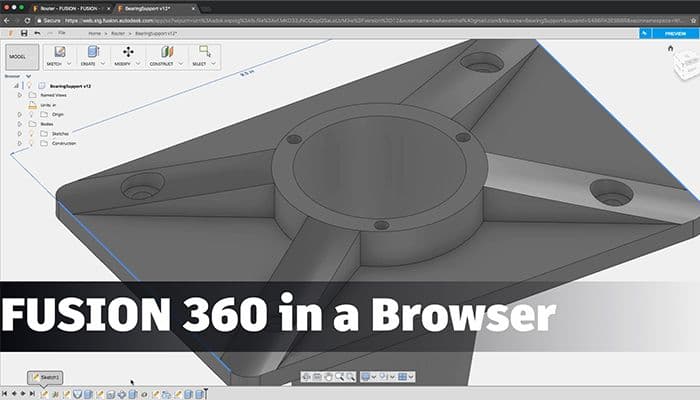
Fusion 360 is a cloud-connected engineering platform, also used for manufacturing and simulation tasks. It helps product designers and engineers to design and analyze products in 3D, create prototypes efficiently, and produce CNC machining instructions. The application saves the user’s workpieces in the cloud, and they can be opened in the same view on any device. Additionally, people can work on the same task at the same time due to the collaborative nature of the program, instead of sending files via email.
What Is Fusion 360 Best For?
Fusion 360 software is notable for its multi-axis machining capability. The tool tilts on 5-axis, allowing it to approach the part from different angles simultaneously compared to a 3-axis machine. It allows machinists to machine intricate free-form geometries, saving time and material since there is less need for complicated fixturing like a traditional 3-axis machine while maintaining the accuracy and precision parts manufacturers require.
How Much Does Fusion 360 Cost?
Fusion 360 pricing starts at $680/year ($57/month, billed annually) with the Autodesk Fusion plan, and this plan comes with a 30-day free trial as well. Other paid plans include:
Autodesk Fusion For Manufacturing: $2,040/year ($170/month, paid annually).
Other than the base subscription, users can consider the following factors that can potentially increase the fusion 360 cost:
- Fusion Manufacturing Extension: Approximately $1,465/user/year for advanced 3- to 5-axis machining, nesting/fabrication and metal additive manufacturing
- Fusion Simulation Extension: Typically $1,465/user/year for expanded simulation and engineering analysis capabilities
- Fusion Design Extension: Around $595/user/year for advanced modeling, design automation and manufacturing-aware design
- Fusion Manage: Approximately $495/user/year for PLM, BOM, change management and lifecycle workflows
- Flex Tokens: Generally between $100–$1,000+/year depending on cloud rendering, simulation, generative design and other usage-based workloads
- Additional Users: Roughly $680/user/year for each additional standard Fusion commercial license
Disclaimer: The pricing is subject to change.
Fusion 360 Integrations
Fusion 360 software integrates with various third-party applications, including:
- Ansys
- Cadence
- Avent
- Xometry
- Makersite
How Does Fusion 360 Work?
Here's how a typical manufacturing workflow runs once the software is open:
- Begin work in the Design workspace by sketching or importing the part to be machined
- Convert the sketch into a 3D solid model using features like Extrude, Fillet, or Shell
- Switch to the Manufacture workspace to define stock, fixtures, and machining origin
- Define a toolpath strategy (2D, 3-axis, or multi-axis milling) based on the geometry of the part
- Verify the toolpath strategy in simulation to avoid collisions with tools
- Generate the NC code using a post-processor for the particular CNC machine
- Conduct probing or surface inspections to evaluate the machined part against the design specification
- Direct the final toolpath to the shop floor, with updates reflecting design changes automatically
Who Is Fusion 360 For?
It caters to manufacturing businesses of all sizes. Some of the facilities using Fusion 360 include:
- Machinist
- Mechanical Engineer
- Industrial Designer
- Electronics Engineer
- Collaborator
Fusion 360 Use Cases
Based on our analysis of Fusion 360 features and capabilities, we have identified a few key scenarios where this platform is a good match for specific operational buyers:
Machine Shops Turning Down Jobs They Can't Program Fast Enough
A shop that was previously turning down complicated jobs due to the limitations of their old CAM software being unable to create 5 axis toolpaths without weeks of manual programming can let Fusion 360 automatically generate those toolpaths, drastically reducing programming time. They can take on jobs they previously avoided and make money from work they could previously only dream of completing in a small 3 axis shop.
Fabricators Reducing Material Waste From Sheet Cutting
A fabricator cuts brackets and enclosures from flat sheet stock, but manually arranging the parts on the sheet is creating material waste. Fusion 360 nests the parts, updating the toolpaths when a design change happens in real time as opposed to a person having to manually update the sheet after a few dimensions change.
Product Teams Testing Parts Before Committing To Tooling
A team can test how a new part fits and functions before spending tens of thousands of dollars on injection mold tooling that they may never use. With Fusion 360, the team can design, test, and 3-D print the product before issues with fit or strength are found on the printed piece rather than the molded piece that has already been paid for.
Engineering Teams Losing Track Of Design Data Across Spreadsheets
An engineering team might keep their bill of materials in one spreadsheet, have revision history in email threads, and have part specifications in other files. It can be a real pain to update all the places that a part is used when the part changes. Fusion's data management makes it easy to keep everything in one place, so no one has to search through emails to find the latest version of a part.
Is Fusion 360 Right For You?
Fusion 360 is ideal for small job shops and large manufacturers who want to use one software for their CAD, CAM, and simulation needs. The platform is used by companies such as Logitech, Toyota, and Yamaha in the development and manufacturing of their products. Autodesk also offers GDPR compliance through a Data Processing Addendum and Standard Contractual Clauses and Binding Corporate Rules approved by the Irish DPC and UK’s ICO.
One of the trends that could be observed in recent years is CAM software’s transition from standalone, single-use programs to systems that integrate various processes in design, engineering, and manufacturing. The role of AI in CAM software is also growing as it allows for automating numerous programming tasks through machine learning and reducing the time spent on CNC machining.
Still confused about investing in the Fusion 360 software? Contact us at (661) 384-7070 to make the right decision.
Fusion 360 Features
2-Axis VS. 3-Axis Milling
With 2-axis milling, the cutting tool moves along the X and Y axes. In 3-axis milling, the tool head moves along the additional Z-axis, thus being able to move upwards or downwards. Fusion 360 is also compatible with 4-axis milling, essentially allowing it to move an additional rotational axis in addition to the other three.
Multi-Axis Machining
This feature includes 3 + 2-axis machining, during which the cutting tool moves along the three main axes (X, Y, Z) while also being rotated along two additional rotational ones, and simultaneous 5-axis machining, where it moves along all of the five axes at once. Fusion 360 allows for machining of parts at more complex angles using all of the five axes at a time.
Turning And Turn-Mill
Turning utilizes lathe machines that cut rotating stock with a stationary tool. This machining process enables removing material, threading, and boring holes. Besides, the Fusion 360 software offers turn-mill machining, which combines the turning and milling processes on machines that have been constructed to utilize both techniques in one system.
Sheet Metal Design
The sheet metal design feature allows one to complete the work on the modeling of a part made from flat metal by cutting it with various machines like a shear, laser, waterjet, or plasma cutter. The piece is formed by bending it on a brake or roller and joined with welding, rivets, or glue to produce an item composed of flat metal elements.
3D Printing
Fusion 360 features 3D printing that enables users to design, simulate, and prepare additive manufacturing for the production of objects layer by layer via an extruder or printhead. The software allows a user to design intricate parts and then collaborate on shared print-ready files instead of using different design tools.
Pros And Cons of Fusion 360
Pros
Allows designing and manufacturing more products without purchasing additional software
Reduces the time needed to move from a prototype to a computer numerical control machining
Creates drawings and tool paths to save time
Maintains connections with members working remotely through the cloud
Eliminates the need to manually enter information that was previously lost due to a software failure
Cons
Performance slows down on older or lower-spec computers
Requires a stable internet connection to work properly
Customer support response times could be more consistent
Fusion 360 Pricing
Autodesk Fusion | Autodesk Fusion for Manufacturing |
|---|---|
$680 per year | $2,040 per year |
|
|
Disclaimer: The pricing details were last updated on Oct 12, 2026 from the vendor's website. Please contact us for a tailored pricing list.
Fusion 360 Reviews
Total 59 reviews
4.3
All reviews are from verified customers
Rating Distribution
5
Stars58%
4
Stars27%
3
Stars8%
2
Stars0%
1
Stars7%
Share your experience
Mechanical or Industrial Engineering, 1-10 employees
“Positive experience overall”
Pros
I've had a great experience with this program. It's where I developed numerous project designs, including my robo soccer bot. The entire robot was modelled in Fusion and I exported DXF files for laser cutting to produce the final machine. It's been invaluable for drafting pieces for patent submissions, lab reports, class projects and more. Right now I'm designing an FPV drone in Fusion and I'm hoping this one turns out well too. Before that I completed a robo race bot using Fusion as well. A lot of my 3D-printed parts were modelled here and I even designed a medical delivery robot's storage box. I sketched up a cycle design and several other devices using the same workflow. It provided an excellent learning curve as a beginner and helped move me up to an intermediate level. I'm looking forward to improving even further with this tool.
Cons
Generally I don't run into major issues but occasionally the program stutters when I use more complicated commands. For example, if I try to run an extrude immediately after applying a pattern, it can slow down because it's processing a lot at once. Another annoyance is that I need an internet connection to save files, without being online I can't save my work.
Rating Distribution
Ease of use
10
Value for money
10
Customer Support
10
Functionality
10
Entertainment, 1-10 employees
“Beginner-friendly”
Pros
As someone who's fairly new to CAD, I'm honestly blown away as it's ridiculously simple for me to design whatever I imagine, I get all the tools I need at no cost and it just keeps getting better over time!
Cons
I notice that it still freezes sometimes for no clear reason, even on my high-end PC workstation although that's a pretty minor issue!
Rating Distribution
Ease of use
10
Value for money
10
Customer Support
10
Functionality
9
Building Materials, 500+ employees
“Flexible software”
Pros
I've found it incredibly flexible. It handles everything I need, from sketching P&IDs and preparing parts for 3D printing to running simulations that help me model new process flows.
Cons
Getting up to speed was tough at first because it packs so many features so I ended up needing lots of tutorials, hands-on practice and real work time to learn it properly.
Rating Distribution
Ease of use
7
Value for money
10
Customer Support
10
Functionality
10
Frequently Asked Questions
What type of pricing plan does Fusion 360 offer?
Fusion 360 price comprise two plans: $680/year ($57/month, billed annually) for the Autodesk Fusion plan and $2,040/year ($170/month, paid annually) for Autodesk Fusion For Manufacturing. Get in touch for a personalized Fusion 360 pricing quote based on your business's specific needs.
Who are the typical users of Fusion 360?
Fusion 360 is suitable for businesses operating in multiple industries and sectors, such as automotive, aerospace, consumer goods, medical devices, and industrial equipment.
What languages does Fusion 360 support?
The platform supports multiple languages, including English, French, German, Japanese, and Chinese.
What other apps does Fusion 360 integrate with?
It integrates with various third-party tools, such as Avent, Makersite, Cadence, Ansys, and Xometry.
Does Fusion 360 offer a mobile app?
Yes, it does offer a mobile app for iOS and Android.
Does Fusion 360 offer an API?
Yes, the software provides API access.
What level of support does Fusion 360 offer?
Fusion 360 offers support via phone, chat, and email.