





The best candidates in your pipeline are evaluating you just as critically as you’re evaluating them. Every unanswered email, cumbersome application form, or unstructured interview leaves an impression. And most organizations only find out it’s broken when it’s already cost them the hire.
Candidate experience begins the moment a job seeker encounters your brand and ends only when you deliver a final decision. It shapes how candidates interpret every interaction with your team. When those interactions consistently fall short, hiring slows, costs climb, and the employer brand you’ve spent years building takes the hit.
That kind of damage is hard to reverse through recruiter effort alone. What actually moves the needle is how the process is designed and whether the HR technology behind it gives your team the tools to be consistent at scale.
This guide covers what candidate experience actually means, how to measure it, where most teams go wrong — and what the best-performing TA teams do differently.
Ask ten HR professionals to define candidate experience and you’ll get ten variations of the same answer, most of them focused on the interview. That’s the problem. Candidate experience doesn’t begin when someone walks into your office or joins a video call. It starts before they even apply and doesn’t end until they’ve either started the job or received a rejection.
It is the sum of every perception a job seeker forms through every interaction with your organization during the hiring process, from how your careers page represents the role, to how you communicate an outcome, regardless of what that outcome is. Perception is the operative word. Two candidates can go through an identical process and walk away with entirely different impressions based purely on how it was communicated to them.
Where It Differs From Related Concepts?
Candidate engagement covers each interaction you have with a candidate and sits within your control. Candidate experience is how a candidate feels about those interactions and the impression they carry away. A recruiter can send five status update emails and still leave a candidate feeling ignored if the tone is transactional and the content is vague. Engagement is the input. Experience is what accumulates from it.
Employer branding and candidate experience are related but not interchangeable. Your employer brand, expressed through your careers page, job descriptions, social presence, and Employee Value Proposition (EVP) messaging, sets the expectations candidates arrive with.
Your recruitment process either validates those expectations or quietly contradicts them. When a company positions itself as people-first externally but runs a cold, disorganized hiring process internally, candidates notice the gap. That gap is a candidate experience problem, not a branding one.
Candidate experience ends at the point of hire or rejection. Employee experience picks up from there. The two are more connected than most HR teams treat them – candidates who enter with unmet expectations or a difficult hiring journey tend to arrive with lower trust, which compounds through onboarding and into early tenure. They operate in different domains, but a poor handoff between them carries real retention consequences.
Concept | Focus | Owned by | When it matters |
Candidate Experience | End-to-end perception throughout hiring | TA team | First touchpoint - final decision |
Employer Branding | External image that attracts candidates | Marketing + HR | Before the application stage |
Candidate Engagement | Quality and frequency of interactions | Recruiters | Throughout the active pipeline |
Employee Experience | Perception across full employment tenure | HR / People ops | Day 1 onward |
Candidate Experience: The Formula
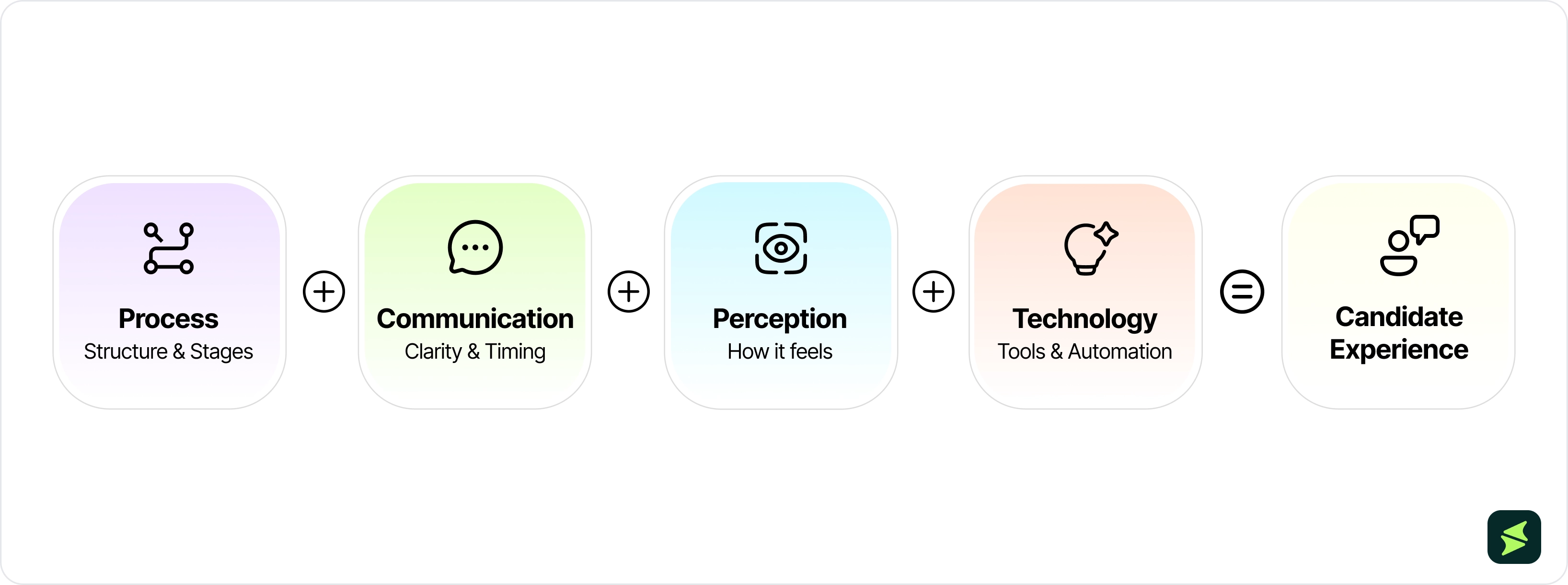
Think of candidate experience as the product of four elements working in sync. This includes process design, communication quality, perception, and the technology infrastructure, with candidate experience as the output. Remove any one of them, and the others cannot compensate.
A well-structured process with inconsistent communication still produces frustration. Solid technology built on top of a confusing application flow automates the friction rather than removing it. This is why surface-level fixes rarely hold; patching one element while neglecting the others just shifts where the experience breaks down.
Understanding candidate experience as a system, rather than a collection of separate hiring tasks, is what allows HR teams to diagnose it accurately, improve it deliberately, and measure whether those improvements are actually working. The sections that follow map out exactly how to do that, starting with the journey itself.
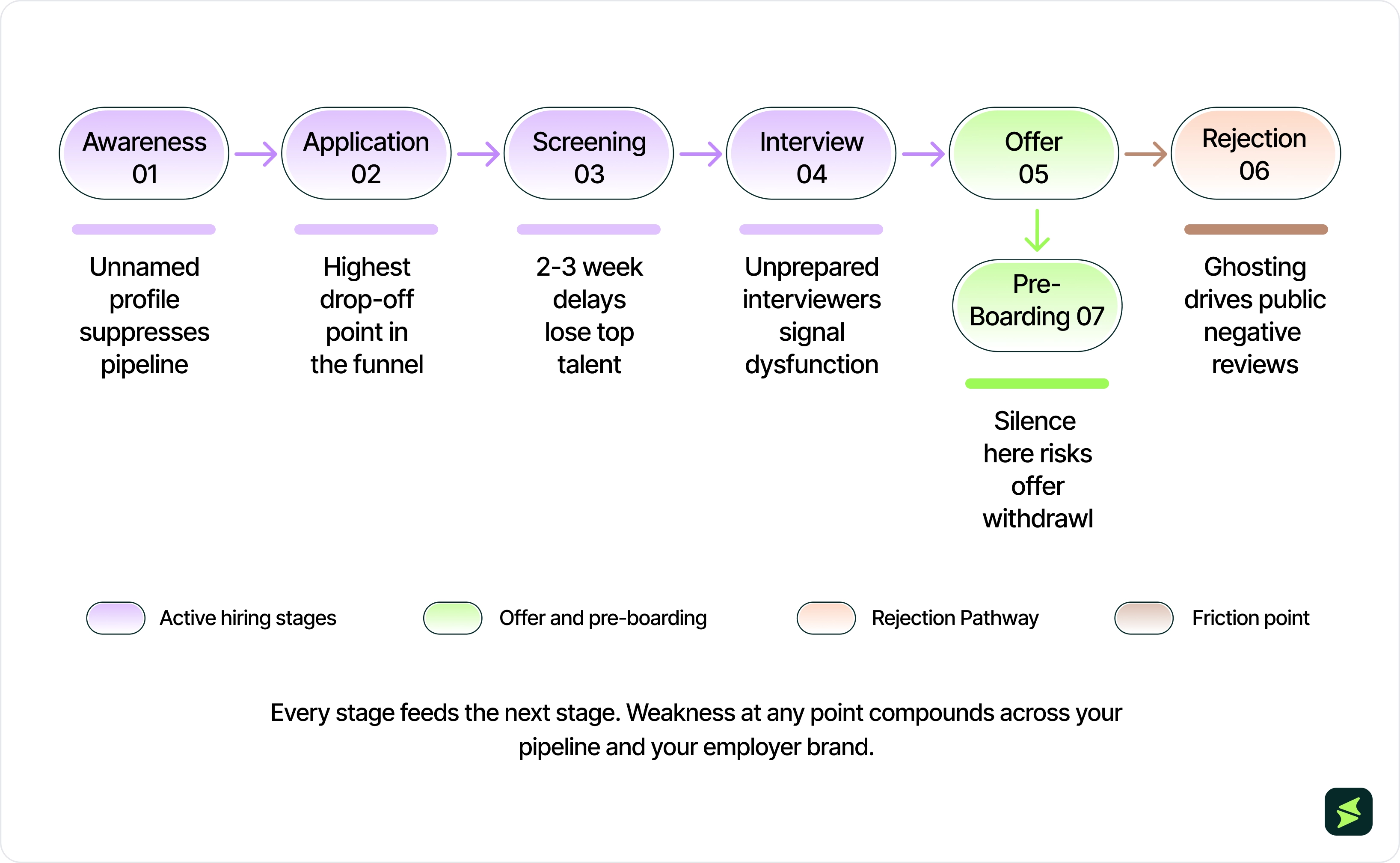
Every stage of the hiring process is a decision point for the candidate - stay engaged or move on. Most HR teams direct their attention toward the interview and offer stages because those feel highest stakes. By that point, the experience has already been shaped, and in many cases, already lost.
Awareness
This is where the journey begins, long before anyone fills out a form. A poorly written job ad, an outdated careers page, or a thin social presence can end consideration before it starts. Seventy percent of Glassdoor users are more likely to apply when the employer actively manages its presence there. This means an unmanaged profile isn't neutral. It's actively suppressing your pipeline without you knowing it.
Application
This is where the most drop-offs happen. Nearly half of candidates say applications are too long and complicated, and a third would abandon the process if it is not user-friendly. Most organizations know this and do nothing about it. Mobile optimization and shorter forms aren't UX preferences - they determine whether qualified people finish applying or close the tab.
Screening
Speed at this stage communicates something that candidates pay attention to. Most hiring teams don't realize how long candidates are waiting.
In many organizations, scheduling an interview alone takes two or three weeks – more than enough time for a qualified candidate to access another offer. Acknowledging receipt and confirming a timeline within 48 hours costs nothing and signals the kind of organization a candidate is deciding whether to join.
A poor screening experience doesn't just cost one candidate; it quietly raises the standard for how well every subsequent stage needs to perform to recover trust.
Interviewing
As per CandE research, companies using structured interviews earn higher candidate experience ratings and a stronger perception of fairness. Unprepared interviewers, excessive rounds, and inconsistent questions don't just frustrate candidates. They signal organizational dysfunction.
Offer
26% of candidates have declined a job offer because of a poor hiring experience, while 81% say a positive experience directly influenced their decision to accept. By the time an offer lands, the candidate has already made a provisional judgment about your organization. Transparency on compensation, timelines, and expectations either confirms that judgment or unravels it.
Rejection
The vast majority of candidates would prefer to receive a rejection than left in silence. A brief explanation of why they were not selected is often enough to leave them with a positive impression of the organization.
At high volume, personal rejection notes feel operationally impossible, and that's exactly why most teams default to silence. The practical answer is tiered: automate acknowledgment for early-stage rejections, personalize feedback for anyone who reached interview stage. Ghosting generates the reviews that shape your next applicant pool. It's a cost that just doesn't show up on a spreadsheet.
Pre-Boarding
The window between offer acceptance and day one is one of the most fragile points in the hiring lifecycle. An engaged candidate is significantly less likely to reconsider their decision or accept a counteroffer. A structured pre-boarding touchpoint - a welcome message, a first-week preview, an introduction to their manager - protects a hire you've spent weeks securing and sets the tone for early retention.
The experience doesn’t end at acceptance. Day 1 is where everything the candidate was told during the hiring process either proves true or doesn’t. Similarly, how well recruiting hands off to onboarding determines whether the candidate experience you built holds or quietly unravels.
Every stage feeds the next, and no single stage stands alone. Understanding where your lifecycle breaks down is the first step, but only useful if you have the metrics to identify it consistently. That is where measurement comes in.
Candidate experience is one of the few areas where HR teams generate strong opinions but weak data. The instinct is to fix what feels broken - a clunky application form, a slow recruiter, an awkward interview format. But without measurement, you're optimizing by feel rather than by evidence, and the fixes that feel most obvious are rarely the ones that matter most to candidates.
The Core Metrics
Candidate Net Promoter Score (CNPS) asks one question: how likely are you to recommend applying here to others? Responses on a 0–10 scale identify detractors, passives, and promoters. Your score is promoters minus detractors. Scores between 30 and 50 are good, 50 to 70 excellent, and above 70 world-class.
The headline number matters less than what sits underneath it, segment by stage and recruiter, and you stop asking "how is our experience?" and start asking "where is it failing and who owns it?"
Where candidates abandon your process is equally telling. Drop-off rate measures applications started versus completed and is one of the clearest signals of process friction. A spike at application points to a form problem. A spike at scheduling points to a communication problem. The metric locates the exit, which is where your next fix should go.
Offer acceptance rate is what happens when everything upstream either worked or didn't. A strong rate falls between 85 and 95 percent. Below 80 is typically a sign of misalignment around compensation, role expectations, or candidate experience. By the time it drops, something earlier in the process has already gone wrong.
Timing determines whether survey responses are honest or polite. Candidates surveyed mid-process - while still being considered - are unlikely to give candid feedback. The most reliable approach is to send surveys immediately after a candidate exits the funnel, regardless of outcome.
For rejected candidates, send within 24 hours of the rejection communication while the experience is fresh. For hired candidates, wait until after their first week - early enough to capture the hiring experience accurately, late enough that they've had context to assess whether what they were told matched what they found. Surveying both groups is essential. Hired candidates tend toward positive scores. The most actionable feedback almost always comes from those who didn't get the role.
Qualitative Feedback And External Signals
Funnel metrics tell you where candidates are leaving. Qualitative data tells you why a specific stage is underperforming. Short surveys conducted after candidates exit the funnel give you the context behind the scores. Open-text responses surface what structured surveys miss, recurring complaints about communication gaps or unprepared interviewers that no multiple-choice question would catch.
External signals, such as Glassdoor ratings and Indeed reviews, are worth monitoring precisely because they are unsolicited. Review platforms capture perspectives from rejected candidates who are far less likely to respond to an internal survey, and they directly shape whether future candidates decide to apply at all.
Turning Feedback Into Action
Monthly metric reviews align well with most hiring cycles - frequent enough to catch problems while they're still fixable, spaced enough to let changes register before drawing conclusions.
When prioritizing fixes, go by friction impact, not ease. Look for the stage with the sharpest drop-off, the lowest CNPS segment score, or the longest time-in-stage. The real value of measurement is tracking whether specific stages and recruiters are improving over time, not producing a better dashboard, but producing a better experience at the exact stage where candidates are struggling.
Candidate experience has a direct line to business outcomes that most organizations haven't fully accounted for.
Your EVP - the promise you make about what it means to work at your organization - is expressed through your careers page, job descriptions, social presence, and recruiter conversations.
When the hiring process validates that promise, candidates arrive as employees with accurate expectations and higher baseline trust. When it contradicts it, you may still fill the role, but you've started the relationship on a deficit that rarely recovers cleanly. That gap between what you project and what candidates actually experience is where most retention problems begin.
The cost implications are tangible. Companies that actively invest in employer brand see a 28% reduction in employee turnover and a 50% decrease in cost-per-hire. Both outcomes flow from how candidates experience the process before they become employees.
For HR teams under pressure to demonstrate ROI, candidate experience is one of the few areas where the business case is both measurable and immediate. Offer acceptance rates, pipeline conversion, and review platform scores all move in response to deliberate experience improvements, and all carry cost implications that finance and leadership can engage with directly.
Candidate experience, handled well, is a compounding asset. Neglected, it raises your cost-per-hire, suppresses future pipelines, and quietly drives the early attrition that brings you back to the same roles six months later.
Most candidate experience frameworks focus on process steps. The 3C model focuses on the design principles that make those steps actually work.
Communication
It is the most immediate lever. Candidates form impressions based on how often they hear from you, how clearly you explain what comes next, and whether the tone of your outreach reflects the organization they're considering joining.
A practical starting point is defining stage-specific update windows — confirming every application within two business days, providing post-interview feedback within five, and building those into recruiter accountability rather than leaving them to individual judgment.
Consistency
This is what makes a good experience scalable. A candidate applying for a role in engineering should have experience equivalent to that of a candidate applying for operations or sales. That requires standardized interview kits, shared evaluation criteria, and ATS workflows that remove the dependency on whichever recruiter happens to own the role. Without consistency, candidate experience becomes a function of who is hiring rather than who you are as an organization.
Candidate-Centricity
This is the shift in perspective that separates teams that improve their process from those that redesign it. It means auditing every touchpoint through the candidate's eyes. The friction points that matter most are rarely the ones that feel biggest internally. The interview confirmation email contains no dial-in link. The offer letter arrives as a PDF with no cover note. The application confirmation that says "we'll be in touch" without saying when. These feel minor from the inside and defined from the outside.
Any process change worth making should be able to answer which of the three it improves. If it can't, it's probably solving the wrong problem.
Simplify The Application
Audit your current form and remove every field that doesn't directly inform a hiring decision. LinkedIn applies, and one-click options reduce drop-off at the top of the funnel without sacrificing candidate quality. Most candidates encounter your job posting on a phone - if your application doesn't work cleanly on mobile, you're filtering out candidates before you've seen their credentials.
Set Expectations Before Candidates Have To Ask
Salary ranges, remote or hybrid arrangements, and a rough hiring timeline should be visible before anyone submits an application. 57.8% of US job postings included salary information by September 2024, and the share continues to rise. Candidates who arrive informed move through the process faster and drop off less frequently at the offer stage.
Treat Your Careers Page As A Product
It's often the first place a candidate goes after seeing a job ad, and most careers pages answer the wrong questions. Lead with employee stories and EVP messaging that reflects how people actually experience working there. If your page could belong to any company in your industry, it needs a rewrite.
Know Where Automation Belongs
Automated acknowledgment emails, status updates, and scheduling confirmations handle volume without sacrificing responsiveness. Personalization belongs at the moments that shape the relationship - finalist feedback, offer conversations, rejection communications for candidates who invested significant time. The practical rule is to automate touchpoints that confirm or inform, and personalize touchpoints that decide or close.
Define Communication Standards And Hold To Them
34% of candidates assume they have been ghosted if they don't hear back within seven days. A recruiter who responds on day nine, with no interim message, has already lost that candidate psychologically. Published timelines - shared with candidates at the start of the process - set expectations that protect the relationship through silence.
Structure Your Interviews
Standardized questions, trained interviewers, and scorecards aren't bureaucracy. They're what separate organizations that hire well from those that hire fast and regret it. Limiting rounds to what's genuinely necessary respects candidate time and reduces the attrition that happens when processes stretch past three conversations without a decision in sight.
Let Data Lead The Next Improvement
Track drop-off by stage. Review the CNPS by the recruiter and the department. The practice that needs the most attention is rarely the one receiving it, because the most visible problems are rarely the most damaging ones.
Virtual/Remote Interview Experience
With hybrid and remote hiring now standard, the virtual interview is often the primary setting where candidates form an impression of your team. Therefore, send candidates a clear pre-interview brief covering the platform link, interviewer names and roles, expected duration, and a backup contact for technical issues.
Additionally, test your own setup - connection, lighting, and audio - before every session. A candidate who spends the first ten minutes troubleshooting a broken link has already formed a view of your organization's operational competence.
DEI And Bias Reduction
Candidate experience is not equal by default. Job descriptions written with exclusionary language, application forms that don't function on assistive technology, and interview panels that lack diversity all create friction that specific groups of candidates feel disproportionately, and that most hiring teams never see.
Audit your job postings for unnecessarily restrictive requirements and gendered language. Ensure your application platform works across devices and accessibility tools. Train interviewers to recognize where unconscious bias shapes evaluation, particularly at the culture fit stage, where subjective judgment does the most damage.
A candidate from an underrepresented background who encounters a well-structured, bias-aware process walks away with a meaningfully different impression, and that difference shows up in acceptance rates, early retention, and referrals.
Candidate Feedback Loops
Collecting CNPS data without sharing it with the people who shaped the experience is the most common reason measurement stalls. Stage-level scores should be reviewed with individual recruiters and hiring managers regularly, not as a performance review exercise, but as a coaching conversation.
A recruiter whose screening scores are consistently lower than the team average doesn't necessarily know what they're doing differently. Sharing the data creates the conversation. That conversation is where candidate experience actually improves, not in dashboards, but in the specific moments where a recruiter changes how they communicate, how they prepare, or how they close out a process with a candidate who didn't get the role.
Good intentions don't scale. At the volume most organizations hire, candidate experience quality is largely determined by the technology stack supporting it.
ATS usage can shorten the hiring cycle by up to 60%, and 94% of hiring professionals say recruitment software has positively impacted their hiring process. The operational case is well established. What matters for candidate experience specifically is whether the software does three things well: removes friction from the application process, keeps candidates informed without manual effort, and gives HR teams the data to see where the experience is breaking down by stage.
An ATS handles the structural layer, centralized candidate data, automated communications, interview scheduling, and pipeline visibility. For teams managing high application volumes, this alone changes the candidate experience meaningfully: fewer acknowledgment delays, fewer candidates falling through the cracks, fewer manual errors in scheduling. A candidate relationship management tool extends the reach into proactive engagement - nurturing passive candidates and maintaining talent pools between active hiring cycles. Scheduling tools eliminate the back-and-forth that burns candidate goodwill at the screening stage.
The candidate-facing features carry the most direct experience impact: mobile apply, automated status updates, self-scheduling portals, and post-process survey tools that capture CNPS at the point of exit rather than weeks later when context has faded.
When evaluating platforms, the most useful starting point is diagnosing your primary friction point before looking at feature lists. Teams with a drop-off problem at application need a different tool priority than teams with a communication gap at screening or a measurement gap across the whole funnel. High-volume hiring teams typically benefit most from ATS automation and AI screening.
Smaller or specialized teams often get more value from scheduling tools and CRM functionality that keeps candidate relationships alive between cycles. Integration with your existing HRIS is worth assessing early; a best-in-class ATS that doesn't talk to your HR system creates a data problem that offsets much of the efficiency gain.
Platforms worth exploring across these categories include Greenhouse software, Lever ATS, and Ashby for ATS functionality; GoodTime software for scheduling; and Starred or Survale for candidate feedback and CNPS measurement.
On the whole, candidate experience is not a project with a completion date. It responds to consistent, incremental attention - a shorter form here, a faster response there, a rejection email that treats the reader as someone worth addressing directly. Those changes compound over hiring cycles into a measurably stronger pipeline, lower cost-per-hire, and an employer brand that does some of the recruiting work before a recruiter ever makes contact.
The practical next step is simpler than most teams expect: pick the stage with the highest drop-off rate or the lowest CNPS score, find out why candidates are leaving at that point, and fix the highest-friction element. Then measure whether it changed anything. That cycle, repeated consistently, is what candidate experience improvement actually looks like in practice.