
Article
G2 Alternatives — Platforms That Solve What G2 Can't
29 mins read
Last Updated

Writer


Article
29 mins read
Last Updated
Writer
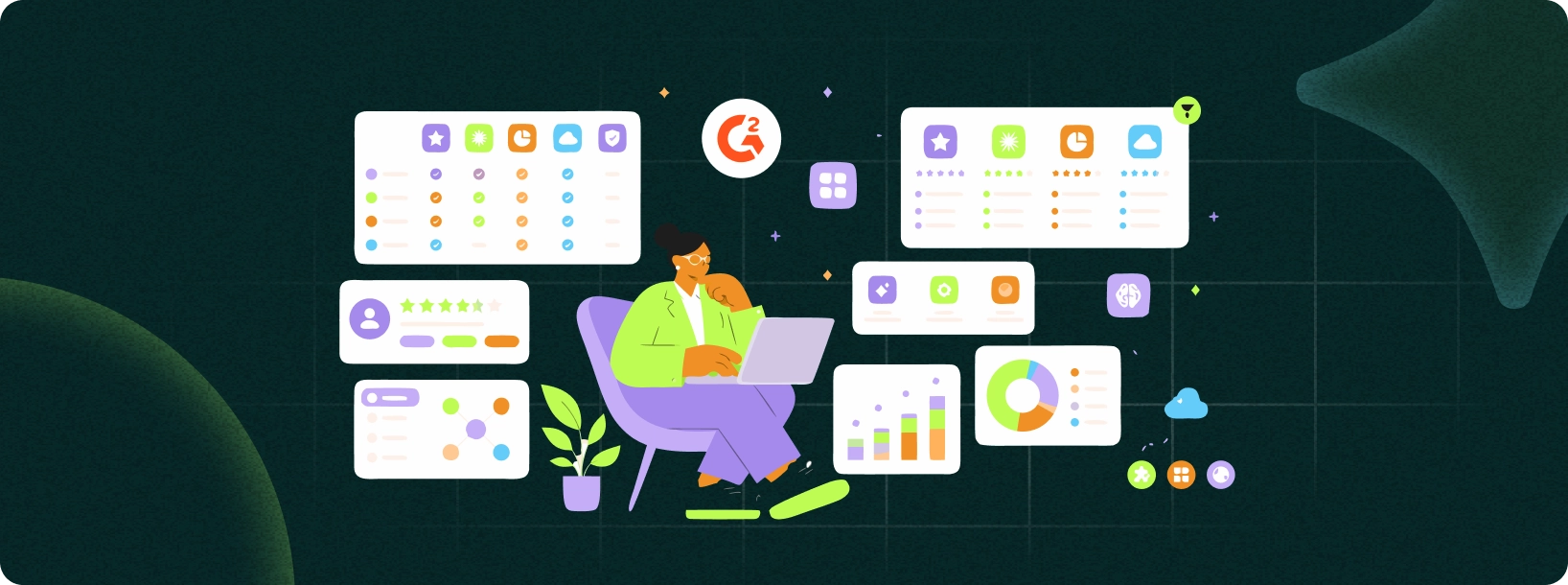
G2 is a B2B software review marketplace — its job is to help buyers find and evaluate business tools. It has over 100 million software buyers annually, more than 2.8 million verified reviews, and 180,000+ products listed on its platform. But G2 has some limitations.
Our thorough guide will help you find the true G2 alternative backed by up-to-date data, along with honest reviews through different industry forums.
Platform | Type | Best for | Where It Outperforms G2 | Limitation |
Capterra | Review platform | Buyers who want FTC-compliant incentivized review labeling | Clearly labels which reviews were incentivized — G2 doesn't | No longer an independent alternative — same owner as G2 |
GetApp | Review platform | Buyers who want integration-based filtering and a free advisory call | Declares a winner in comparisons instead of leaving the decision open-ended | Acquired by G2 |
Software Finder | Review platform | Buyers who want neutral, independently owned content with clear final verdicts | No vendor ownership conflicts — not owned by G2 or Gartner | Review volume significantly lower than G2 |
Software Advice | Review + advisory platform | Buyers who want BANT-qualified vendor matches and 1-on-1 advisor help | Screens vendors against 500+ criteria before connecting you to one — G2 just lists them | Acquired by G2 |
GoodFirms | Review platform | Buyers evaluating development agencies, IT firms, or digital service providers alongside software | Verifies reviewer identity via LinkedIn before publishing | Comparisons limited to software only |
Appvizer | Review + comparison platform | Buyers in European markets who need localized, language-specific software research | Catalogs written to local market norms in 6 languages | Owned by Softonic |
Crunchbase | Business intelligence platform | Buyers evaluating the financial stability and ownership background of a vendor before long-term contracts | Shows vendor funding, ownership, and growth signals before you commit to a long-term contract | Contact information frequently outdated |
LeanIX | IT management platform | Enterprise IT managers and architects who need visibility over their existing software estate | Reference catalog with lifecycle data on 62K+ products — flags what needs replacing before it becomes a liability | Acquired by SAP in 2023 |
AssetSonar | ITAM platform | IT managers at mid-sized organizations tracking and managing existing hardware and software assets | Manages and audits hardware and software you already own | Mobile app is limited compared to desktop |
Eracent | SAM/ITAM platform | Large enterprises and government organizations managing complex software license environments | IT-Pedia library covers millions of products with lifecycle and vulnerability data | Minimal community presence |
Capterra lists 100,000+ products across 900 categories with 2.5 million+ verified reviews, which, in comparison, is lower than G2. But what makes Capterra the first alternative to G2 is that it doesn't let vendors suppress or reorder reviews. Where G2 lets vendors fund review campaigns through gift card credits with minimal disclosure, Capterra requires full FTC-compliant labeling on any incentivized review, displaying a clear tag when gift cards were offered. That labeling difference makes incentivized reviews easier to identify, which is a big plus for buyers who have concerns about review credibility.
But the most significant development is that G2 has completed its acquisition of Capterra from Gartner in Q1 2026. The platform now shares the same owner, so considering it as an independent alternative no longer makes sense.
Most forum discussions around Capterra follow the same narrative — from a buyer's point of view, it is a solid starting point for software research. From a vendor's perspective, it has decent ROI when their review count is high enough to lower CPCs.
Where the community starts raising concerns is with review integrity. Capterra contains a gift card incentive model; for that reason, multiple threads question whether reviewers actually used the software. One SaaS founder even claims fake reviews were submitted and approved without question.
Its comparisons do not give upfront answers. Buyers who prefer a definitive recommendation of their exact query have to draw their own conclusions from the side-by-side view, which is inconvenient.
Since G2 owns Capterra, they're no longer independent alternatives. But still, buyers who prefer the controlled filter can use it.

GetApp has 2 million+ verified reviews across 37,000+ software products in 900+ categories, which is, in fact, lower than both G2 and Capterra. But where it stands out is its human advisory services — buyers can get a call with a human consultant who helps narrow down software choices based on specific business needs and their budget.
It even has integration filters that allow you to filter software specifically by what integrates with your current tools. For example, buyers can check CRM systems that work with their specific accounting software.
From a buyer's perspective, threads discuss how easy the platform is to navigate; the filters are competitive, and many praise the free advisory call. Some threads suggest vendors with high review counts report solid lead quality from the PPL program.
But just like Capterra, commentators were bashing the gift card program across multiple threads. At the same time, some flag that listings weren't accurate — products being miscategorized — which raises questions about how carefully the directory is maintained.
When it comes to traffic, GetApp ranks #95,461 globally, compared to G2 at roughly #22,136. For buyers, that means fewer people are using GetApp to research software — so the review pool is smaller, and the comparisons are less credible than G2. Plus, its side-by-side comparison is also limited; when you click ‘Expand list’, it opens individual listings, not an actual side-by-side view.
G2 acquired this platform as well, so choosing either is uncertain now, but buyers who prefer easy integration filters can use this platform.
Software Finder covers 500+ software categories with 350,000+ vetted user reviews, which is, in fact, lower than G2. But its organic traffic is competitive, not just from G2 but from numerous platforms in this market, such as Capterra, GetApp, TrustRadius, and many more. Over a 49-month period (January 2022 – January 2026), only 4 out of 11 platforms grew organic traffic. Software Finder grew the most — +62K.
Platforms lose organic traffic when Google stops trusting their content. And that usually happens when website pages are thin, the content is repetitive, or written for search engine purposes, and doesn't answer the queries of specific buyers. Software Finder's growth suggests its content is specific, structured, and relevant enough that both Google and AI search tools are surfacing it over larger competitors.
It even has 1.8 million global visitors in 2025, which combined means their software profiles get more visibility, and their traffic comes from genuine search intent, which means readers and Google trust their content.
In a forum where Capterra and Software Advice were being discussed, a commentator said they no longer knew where to find impartial reviews or get their SaaS listed. Some community members started referring to Software Finder as an alternative worth trying.
At the same time, some community discussions mentioned outreach frequency. Some vendors report contract continued longer than expected, even after asking to be removed.
Review volume is significantly lower than G2 and Capterra, which limits how much peer data buyers can rely on during research.
If you, as a buyer, prefer an independently owned platform and want neutral content with clear answers, then this can be a perfect fit.
Software Advice has over 2.5 million verified reviews, covers 150 industries, and has helped nearly 900,000 businesses find software since its launch. Like Capterra and GetApp, it used to operate within the Gartner Digital Markets network and has since been acquired by G2 – meaning all the three platforms now share the same PPC dashboard and listings.
The best part about Software Advice is its side-by-side comparisons, which is beneficial for quick scan readers. As a buyer, you can quickly compare what one platform offers that the other does not. It also rates each feature both platforms offer, so readers can gauge not just whether a feature exists but how well it performs.
From a buyer's perspective, community discussions were mostly positive. Numerous buyers mentioned that the platform’s advisors actually listened and understood their whole requirements.
Commenters were pointing out that they saved research time because Software Advice gave them options upfront that they wouldn't have found on their own.
Vendors, however, see it differently. Some vendors reported that they were paying/lead, but half never picked up the phone. What made it worse was that the information collected during the consultation didn't match what the leads actually said when contacted. Several users flagged a similar issue. They were pointing out that the leads are shared across multiple vendors, so by the time a vendor reaches out, buyers have already been contacted by every company in that category, which overwhelms their decision.
Software Advice does not collect its own reviews. All reviews displayed on the platform are pulled from the Gartner Digital Markets shared catalog, which means the review data is identical to what appears on Capterra and GetApp.
Just like Capterra and GetApp, Software Advice lost its independent ownership, so choosing it over its same owner does not make sense. But still, the platform performs its best for buyers who prioritize at-a-glance comparisons and want 1-on-1 help from human advisors.
GoodFirms has 80,000+ verified reviews across 26,000+ software listings and service providers (which is lower than G2). Its focus is different from G2's, which is where it stands out: GoodFirms covers both software products and service providers (including development agencies, IT firms, marketing companies), which G2 does not. If you're a buyer looking for a software development partner or a digital agency, not just a SaaS tool, then GoodFirms gives you a separate catalog that G2 simply doesn't have.
Plus, like Software Finder, this one is also independently owned, unfunded, and has no connection to G2 or the Gartner network, which means there is a high chance of content neutrality.
There were multiple forums specifically praising the company’s verified review methodology. Commentators said that GoodFirms reviews are more credible than its competitors. But at the same time, some threads suggest that vendors actively try to remove their listings. That raises a real concern for buyers; if the companies on the platform don't want to be there, their profiles are likely outdated, unmanaged, and not a reliable source of current information.
Their comparisons are limited, there is no detailed information, and buyers can only compare software here, not service providers. Plus, the platform allows content sponsorship for vendors to position their brand as an industry expert, which means what looks like neutral advice could be paid placement.
It can benefit buyers who are evaluating service providers rather than software alone.
Appvizer covers 10,000+ software listings across 500 categories and attracts 2 million professional users monthly. In comparison to G2, this platform stands out in terms of geography and content approach. Appvizer is the leading B2B software comparison platform in Europe, with localized catalogs in French, Spanish, German, Italian, Portuguese, and English.
The software listed on each country-specific version is written to local market norms and regulations. The content is fully rewritten for each region, not just translated. That is something G2, which is heavily US-centric, does not offer.
Its AI module is arguably its most distinctive feature across all the software listed on the platform. It uses Appvizer's own content and analysis to recommend the right software to buyers. Buyers can ask it anything in any language, and it answers their queries based on its own data.
Appvizer has virtually no presence in English-language forum discussions about software research. For buyers who primarily research in English and operate in the US market, Appvizer is largely unknown as a reference point.
Appvizer is owned by Softonic, which means it does not hold its ownership anymore. Plus, Softonic's core business is distributing software to end consumers. They make money from software downloads and distribution, not from B2B research or impartial reviews. So, whenever a company whose revenue depends on software distribution owns a B2B review platform, it questions the authenticity of its recommendations. Buyers can't determine whether the content is still neutral or has started leaning toward products that benefit Softonic's download business.
It can be highly beneficial for buyers to research software in European operations.
Beyond review platforms, several tools can support more informed software decisions depending on your organization’s stage and needs. Here we have highlighted a few of them:
Crunchbase is a database and business intelligence platform that provides detailed information on public and private companies. Its job is to tell you who owns a company, how much estimated revenue they generate, who invested in them, and what stage they are at. It now covers 4M+ private companies with data on funding rounds, acquisitions, leadership, and investor activity, powered by a user base of 80M+.
Crunchbase's 2025 partnership with Perplexity makes its firmographic and funding data available in Perplexity Enterprise Pro. So, buyers, as well as vendors, can ask Perplexity directly which company is worth investing in, and can get summarized answers backed up by Crunchbase.
It is not a software comparison tool, but it can influence a buyer's decision. If a buyer can check that a vendor has had no funding in the past three years, they would never invest in that software, because it signals the product is not being actively developed and may not be around for long.
It can complement G2. Any buyers who need to evaluate the financial stability and ownership background of a software vendor before signing a long-term contract can use this platform.
LeanIX is an Enterprise Architecture Management tool, and its job is to help IT leaders map, manage, and rationalize the software their organization already owns. More than 1,000 businesses worldwide trust this platform (including 10% of the Fortune 500 and the majority of companies in the German DAX 40). LeanIX was acquired by SAP in 2023, which means SAP owns this platform now.
In comparison, where G2 helps you evaluate a product, LeanIX helps you evaluate whether your organization has a legitimate gap for it in the first place.
Only enterprise IT managers and architects who need visibility and control over their existing software estate should consider this platform. It is not suitable for buyers who want to compare software.
AssetSonar is on this list for IT managers who currently use G2 to evaluate software can first get visibility over their organization's existing assets. Its purpose is different than G2, but buyers who don't know what software they are already using can use it before making any new investment. Because it can influence the buying decision entirely.
AssetSonar has a built-in vulnerability and patch management module that most ITAM tools don't offer. It scans Windows, macOS, and Linux endpoints; flags devices running outdated or vulnerable software, so the admins can patch them before any data breach. If a buyer signs a contract with the software that has unpatched systems running across their environment, that means their data is at risk as well.
IT managers at mid-sized organizations use it to track, audit, and manage existing hardware and software assets. If that is your use case as a buyer, it is worth considering.
Eracent is an enterprise IT Asset Management and Software Asset Management platform, not a review site. But big companies running on a larger scale have bigger things to evaluate before buying any new software, and they don't get that information through platforms like G2.
They have to know exactly how many licenses they already own, how many are actually being used, and whether they are over or under their license count with vendors like Oracle, SAP, and IBM. Being under means vendors can audit and penalize heavily. Eracent solves that by scanning the entire environment, counting every installation, and matching it against purchased licenses — so before any new software decision is made, the IT team already knows exactly where they stand.
Startup companies do not need this. But still making software decisions without this visibility is essentially guessing.
It can be useful for large enterprises and government organizations managing complex software license environments.
A lot of things matter when looking for a reliable software review platform. The content should be neutral, and the verdict should be non-biased. If a platform offers gift cards to users for leaving reviews, then buyers can’t distinguish between organic and paid feedback. But beyond content quality, something has recently changed that matters just as much; platform independence.
G2 acquired its biggest competitors: Capterra, GetApp, and Software Advice. Four platforms are now under the same owner. That means:
That means vendors who pay more can influence the results, and as rates keep climbing under one owner, vendors will end up competing against each other's budgets just to stay visible, with no alternative platform to turn to. Being independently owned is a green flag right now. Independent platforms have more reason to keep content neutral and verdicts non-biased. And reviews are more likely to vary because they are not sitting under the same business umbrella. Choose accordingly.
The criteria for evaluating review sites differ depending on where your business is. Here is what to look for at each stage:
If your business is at the starting point and you need to buy software, you will likely have limited knowledge of software review sites. At this stage, you will do a quick scan rather than go into detail. These are the factors to check that can give you a better scan:
Similarly, if you are a medium-sized business, and your view is to scale, you will likely prefer not to take risks on software decisions. At this stage, you probably know about software review sites, but want to know which one is more trustable, whose information is more accurate, and which will help you get more specific software.
These are the factors to check at this stage:
If you are a large company, you can sometimes afford to take calculated risks to test what works. Chances are, you are already aware of software review sites. But what you want is a connection — you are approaching this software review site almost like a partnership, because you will be relying on them for multiple needs beyond just one software. So, your evaluation is partnership driven.
This checklist will tell you which platform can become a good partner for you:
No single platform gives you the complete picture. Review sites like Software Finder tell you what users think. Business intelligence tools tell you whether a vendor is financially stable. Asset management tools tell you what you already own. The smartest software decisions combine all three; and start with knowing which sources you can actually trust.