

Comparison
InEight Document Vs Oracle Aconex: Which Document Control Solution Is Right For You?
13 mins read
Last Updated


By Ramla Shahid and


InEight Document and Oracle Aconex are two of the most established document control platforms for large capital construction and infrastructure projects. While both help teams control drawings, RFIs, transmittals, approvals, and audit-ready records, they take different approaches to document governance, collaboration, and information control.
This comparison breaks down how each platform handles document control, so you can decide which one aligns better with your project structure and delivery requirements.
TL;DR: InEight Document is best for organizations that need to govern documentation internally across regulated or complex capital projects, with configurable approval processes, strict revision tracking, and strong compliance credentials. Oracle Aconex is best for projects involving multiple independent organizations that need a neutral and shared layer for document exchange. Both platforms can handle large-scale project delivery very well.
| InEight Document | Oracle Aconex |
|---|---|
| Best for: Enterprises | Best for: Enterprises |
| Deployment: Cloud-based | Deployment: Cloud-based |
| Industries: Transportation, power and renewables, nuclear, water, oil, gas and chemical, and mining, alongside construction and engineering | Industries: Construction, infrastructure, engineering, energy and utilities, and transportation |
| Mobile App: Available | Mobile App: Available |
| Free trial: No free trial | Free trial: No free trial |
| Pricing: Custom pricing | Pricing: Starts at $49/user/month |
Disclaimer: Pricing references are based on publicly available third-party information and industry benchmarks. Actual costs may vary.
InEight Document provides owners, EPC firms, and contractors with construction document control for capital projects. It helps users manage drawings, RFIs, and approvals through role-based access and a logged revision history. This documented history makes it easier to trace approvals and information exchanges during audits, claims, or disputes.
Oracle Aconex, on the other hand, helps multiple organizations collaborate on project information through a common data environment with controlled document sharing and an unalterable audit trail. It supports transmittals, reviews, and approvals among owners, contractors, and supply chain partners. This permanent record gives all participating organizations a shared record of project communication, which makes it easier to trace document decisions and maintain consistent project records.
Feature | InEight Document | Oracle Aconex |
|---|---|---|
Configurable Approval Sequences | ✓ | ✓ |
Subworkflows | ✗ | ✓ |
Third-party E-signature Integration | ✓ | ✗ |
Concurrent Document Markup | ✓ | ✓ |
Bulk Annotation and Document Stamping | ✗ | ✓ |
Side-by-side Version Comparison | ✓ | ✓ |
Transmittals | ✓ | ✓ |
RFI Management | ✓ | ✓ |
Submittal Management | ✓ | ✓ |
Organization-owned Data Model | ✗ | ✓ |
Role-based Permission Controls | ✓ | ✓ |
Immutable/Unalterable Audit Trail | ✓ | ✓ |
Microsoft Office/Microsoft 365 Integration | ✓ | ✓ |
FedRAMP Authorization | ✓ | ✓ |
IRAP Protected Assessment | ✓ | ✗ |
ISO 27001 Certification | ✓ | Not stated |
Workflow Automation And Approval Flexibility
InEight Document and Oracle Aconex both let project teams define who reviews a document and in what order. This is done through configurable approval workflows. They help reduce the need to manually route documents and follow up with reviewers. One key difference appears when something unexpected comes up mid-review.
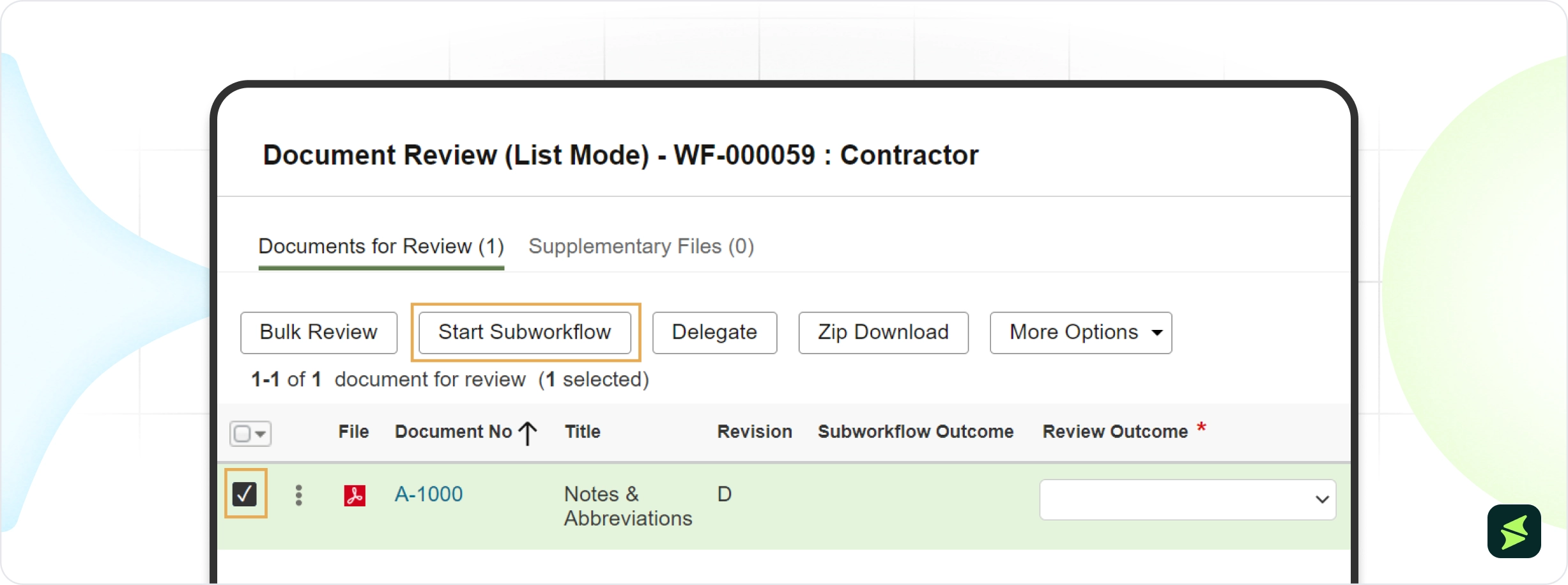
Oracle Aconex lets a reviewer start a subworkflow. It is a smaller approval step inside the existing chain to bring in someone who was not part of the original review list. It can be a structural engineer, legal advisor, or technical expert whose input is needed before the review can move forward. That subworkflow runs and closes without disrupting or restarting the main approval process. InEight Document does not offer an equivalent subworkflow capability.
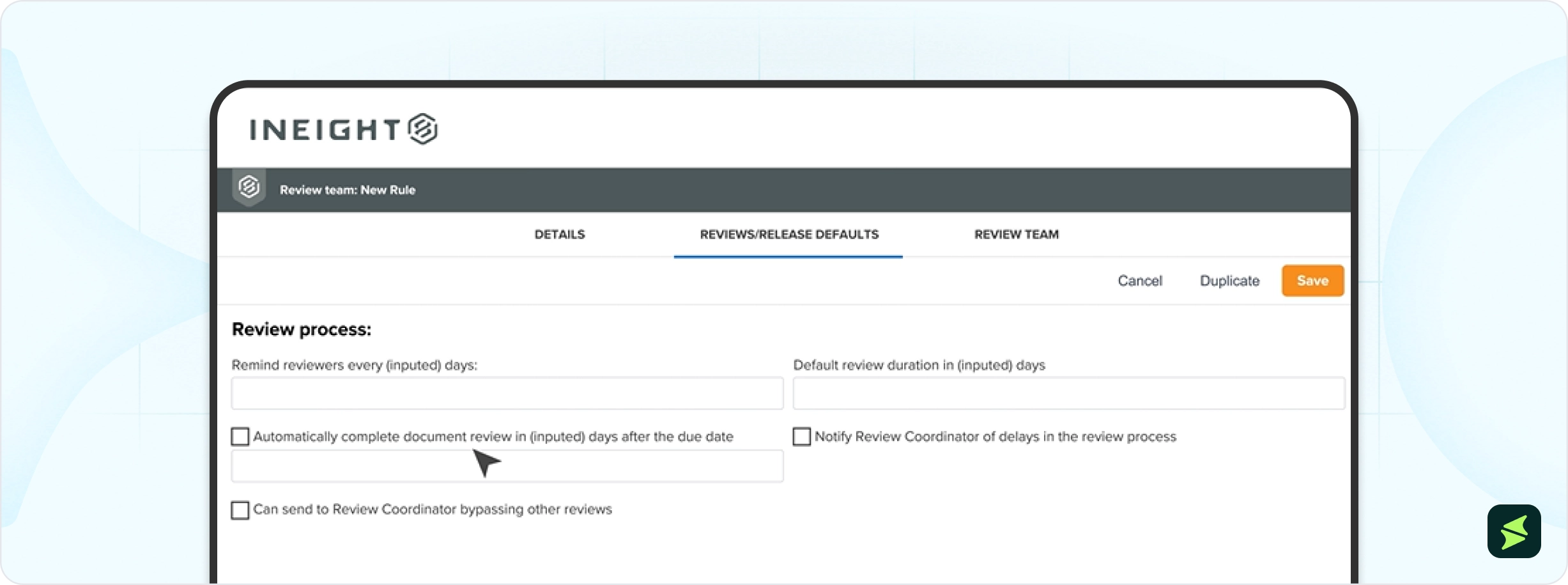
Other than that, InEight Document emphasizes structured approval execution through integrations with DocuSign and Adobe Acrobat Sign to support electronic approvals while preserving a complete approval history. Oracle Aconex also supports workflow-based approvals, but through its built-in review and approval processes rather than external e-signature integrations. In both platforms, completed approvals remain linked to the document history, which makes it easier to trace who approved a document and when.
Transmittals, RFIs, And Formal Distribution
Both InEight and Aconex treat transmittals, RFIs, and submittals as a traceable record of who sent what, to whom, and when it was acknowledged (not just a delivery notification). The difference shows up in how much each platform lets a project shape that record around its own process.
InEight Document lets organizations customize transmittals, RFI workflows, submittals processes, and document distribution to match their existing business practices. Teams can reuse workflow templates, define recipient lists, and configure governed distribution processes instead of relying on fixed workflows. Oracle Aconex works through its Document Processes (Mail) module, where transmittals, RFIs, and related documents follow a more standardized structure that every project participant uses in the same way.
This difference is most visible in external distribution; Oracle Aconex uses organization-owned workspaces, so subcontractors only see the documents formally transmitted to them, not the wider project registry, which helps ensure a consistent understanding of each transmittal. This control is built into the system’s data model. InEight achieves a similar outcome through configurable permission settings applied at the document registry level.
Audit Trails And Document Accountability
What matters most in audit and document control systems is whether project teams can reliably reconstruct document history when needed. Both InEight Document and Oracle Aconex maintain records of document activity across the project lifecycle, including uploads, reviews, approvals, revisions, and distributions with associated users and timestamps. This visibility is particularly relevant during compliance checks, contractual disputes, or claims where a documented decision history is required.
Both platforms also preserve immutable records of document activity, although they present this capability differently. Oracle Aconex maintains an unalterable audit trail, while InEight Document provides immutable histories of document views, revisions, approvals, markups, and outcomes. In practice, both approaches give project teams a reliable way to trace document decisions throughout the project lifecycle.
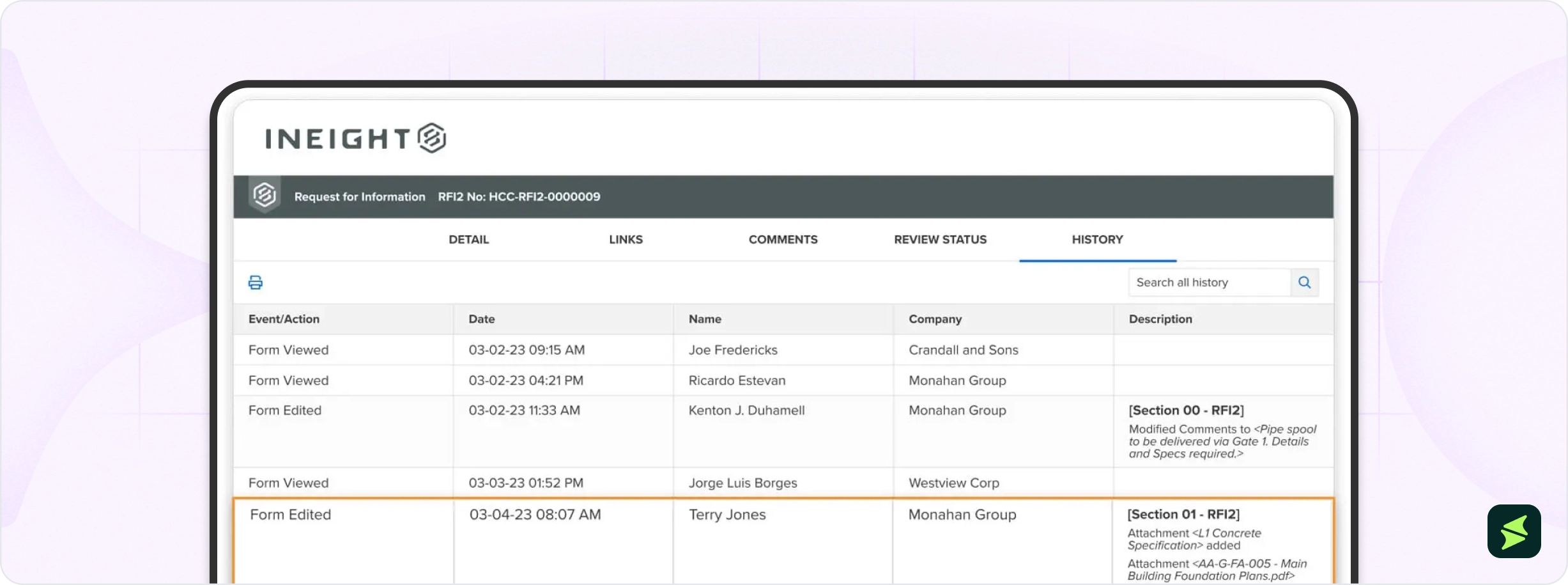
The value of this traceability becomes most apparent when project decisions are questioned. On large capital projects, teams may need to verify who approved a drawing revision, when it was approved, and which version was in use at that time. Having a complete document history helps organizations investigate issues, respond to audits, and support claims or dispute resolution with greater confidence.
Information Ownership And Permission Controls
While both platforms let administrators control document access, they take different approaches to information governance. InEight Document uses configurable role-based permissions and security groups, which gives organizations the authority to decide who can view, edit, approve, or distribute documents based on individual responsibilities. Oracle Aconex, on the other hand, is built around its "each organization owns its own data" model. This means every company on a project retains control of its own information while securely sharing documents with other participants. Both approaches protect sensitive project information, but InEight focuses on flexible permission management, whereas Oracle Aconex prioritizes data ownership across multiple independent organizations.
Mobile Access And Field Productivity
InEight Document Mobile and Oracle Aconex Mobile allow users to review documents, add markups, and participate in document workflows from the field. They also support field teams in capturing and updating project information, but with different priorities. InEight Document Mobile emphasizes recording controlled project information through document metadata, photo and file uploads, and synchronization with the document register.

Oracle Aconex Mobile places greater emphasis on keeping field reviews, drawings, RFIs, and field correspondence connected to a centralized project record. This centralized record can be shared across all project participants.
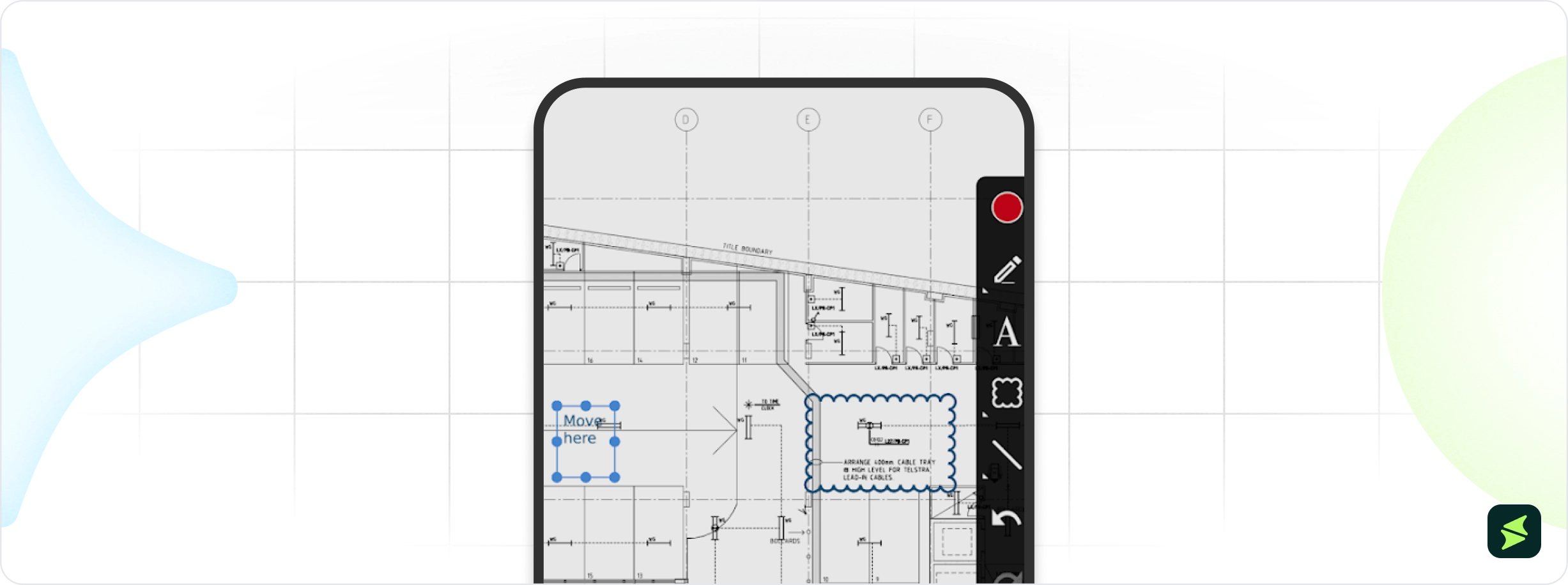
Document Version Control And Revision Management
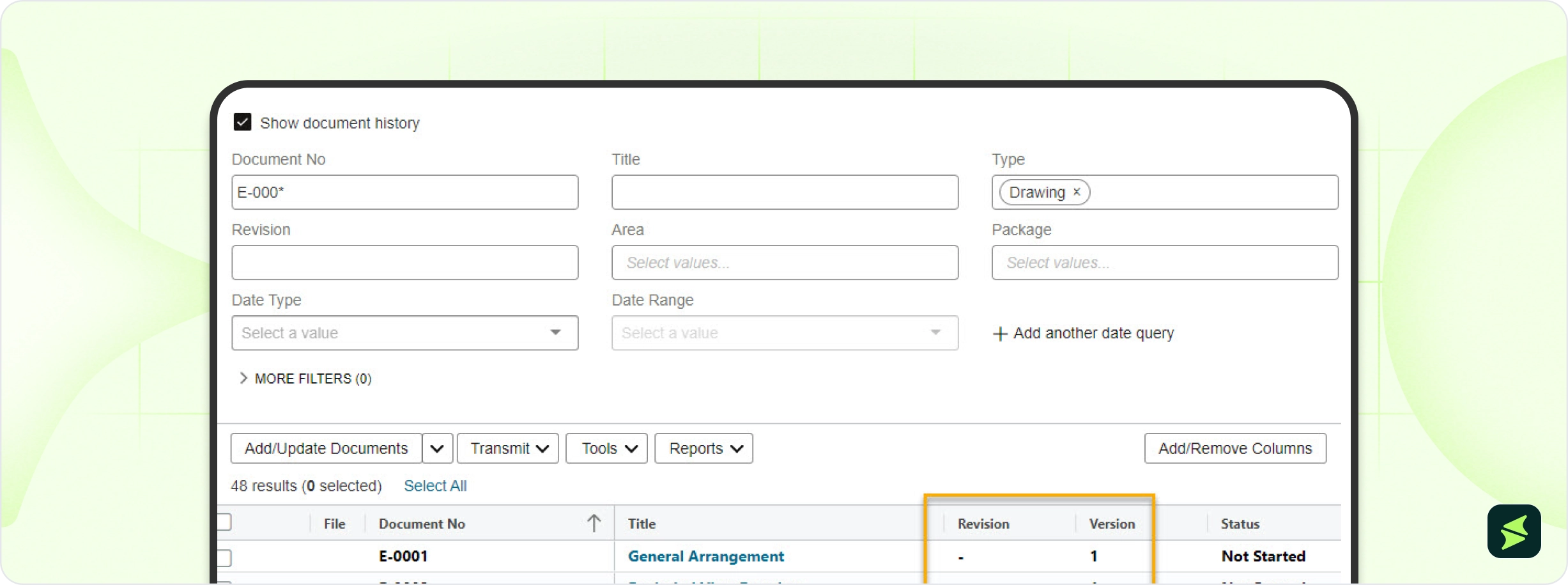
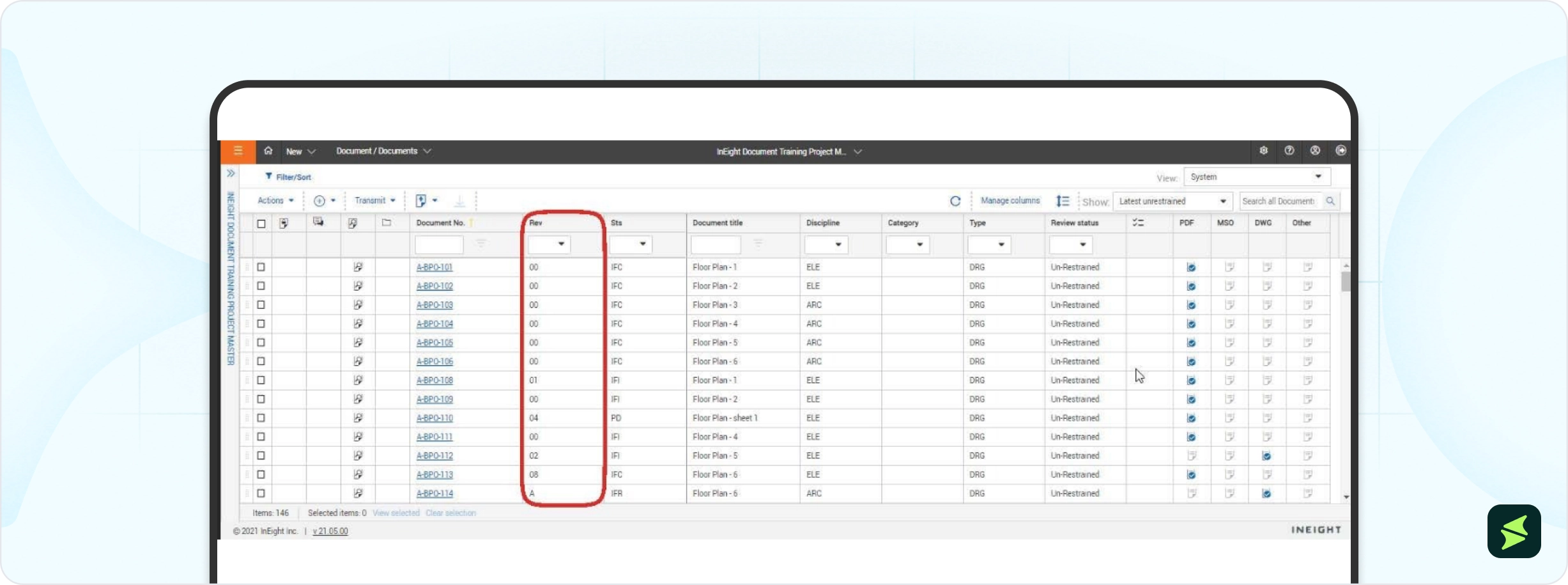
Keeping field teams and reviewers on the latest drawing is one of the most operationally critical functions either platform performs. InEight Document enforces a strict rule that each uploaded revision must carry a revision number greater than the previous one, with metadata carried over automatically during upload to maintain consistency across the document history. Its Document Register always surfaces the latest approved version by default while keeping all prior revisions accessible.
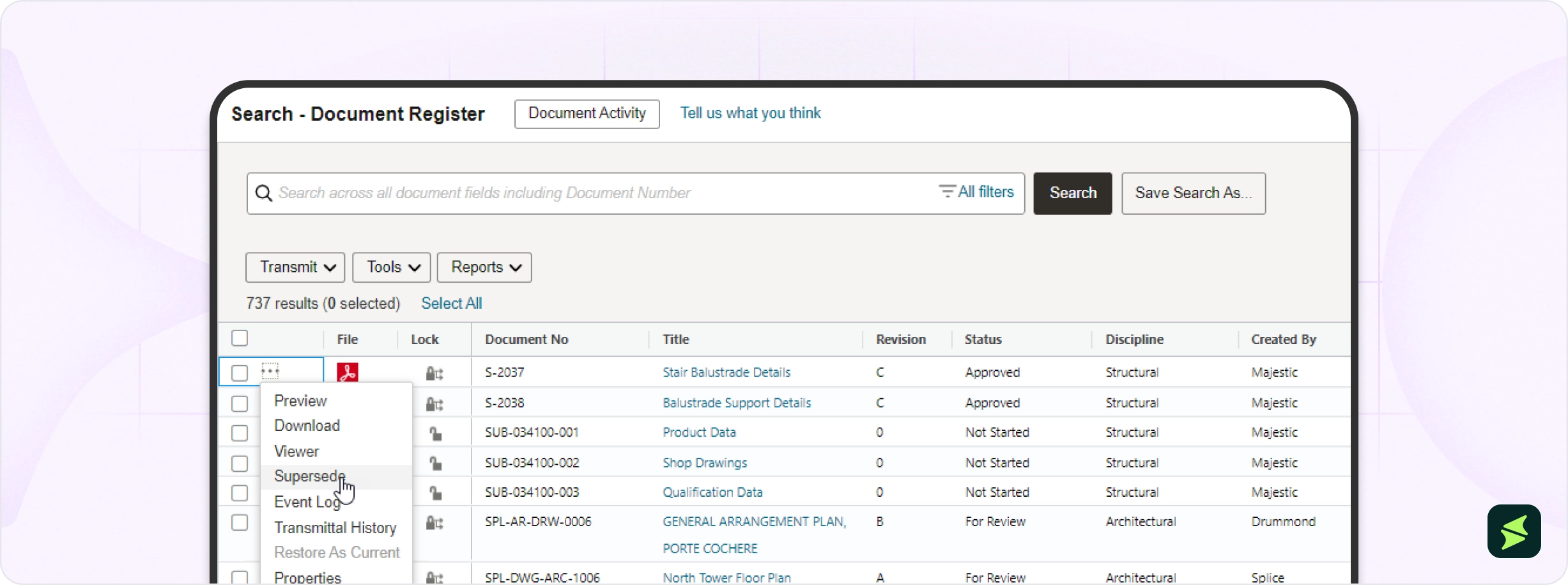
In Aconex, updating a document to a newer version is called ‘superseding.’ A user manually uploads the new file and confirms the update, and Aconex automatically retains every prior version. Separately, Aconex tracks two fields for each document; revision, a free-text label matching the drawing's title block that Aconex does not validate, and version, a system-generated number that increases automatically and sequentially every time a document is superseded. InEight also supports concurrent engineering, allowing operations teams to manage live asset drawings while multiple active projects update those same documents simultaneously.
Security And Compliance
For organizations delivering regulated or high-security projects, both InEight Document and Oracle Aconex hold independently audited security certifications that go beyond standard access controls.
InEight Document holds several independently audited security certifications, including ISO 27001 for information security management, ISO 27701 for privacy management, and SOC 1 Type 2 and SOC 2 Type 2 for security and operational controls. It has also achieved FedRAMP Moderate Equivalency and an IRAP Protected assessment, both of which make it more suitable for organizations delivering government, defense, or other highly regulated projects with strict security and compliance requirements.
Oracle Aconex, meanwhile, offers a dedicated Aconex for Defense environment that has achieved FedRAMP Moderate and DISA Impact Level 4 authorizations for U.S. federal and defense projects. These certifications demonstrate that Aconex meets stringent U.S. government and defense security requirements that make it suitable for organizations handling sensitive project information or delivering government and defense infrastructure projects. For commercial projects, Oracle also provides encryption, continuous monitoring, and secure cloud infrastructure to protect project information.

How Much Does InEight Document Cost?
InEight pricing is tailored to each organization's deployment and is based on three primary factors: the number of users, the products or modules implemented, and the contract length. Customers can choose between two pricing models:
- InEight Enterprise Pricing Model: A subscription-based model designed for enterprise-wide deployments. It offers predictable annual pricing with unlimited projects across the licensed InEight modules
- InEight NOW: A per-user subscription available on either monthly or annual billing. It is more suited to organizations that want to adopt InEight gradually or only need access for a specific group of users, rather than deploying the platform across the entire enterprise
This flexible pricing approach allows organizations to scale their deployment based on project size and business requirements rather than following a one-size-fits-all licensing model.
How Much Does Aconex Cost?
Oracle Aconex pricing starts at $49/user/month, which may go up to $4,000 monthly for larger teams (100 users). However, the exact pricing generally varies based on project scale, user requirements, selected cloud services, and implementation needs. Oracle Aconex offers the following licensing models:
- Enterprise Cloud Service
- Single Project Cloud Service
- Hosted Named User
- Project Value Allowance
- Add-on Cloud Services
With this range of licensing options, Oracle Aconex can support both single-project implementations and enterprise-wide deployments.
Disclaimer: Pricing references are based on publicly available third-party information and industry benchmarks. Actual costs may vary.

The right choice between InEight Document and Oracle Aconex often comes down to how your project is structured and not just what features you need.
If your organization... | Consider... | Why? |
|---|---|---|
Runs projects where document workflows differ between clients, regions, or business units | InEight Document | Its strength lies in configurable document processes that can adapt to different project requirements without forcing a standardized workflow. |
Delivers owner-led infrastructure projects involving many independent companies | Oracle Aconex | Its collaboration model is designed for projects where owners, consultants, contractors, and suppliers need to work together while each organization retains ownership of its own information. |
Operates in highly regulated industries such as energy, mining, water, or nuclear | InEight Document | Strong compliance credentials and configurable governance help organizations meet strict documentation and audit requirements. |
Frequently manages claims, audits, or contractual disputes | Either platform | Both maintain detailed document histories, approval records, and version control that support traceability throughout the project lifecycle. |
Wants to standardize document control across a large enterprise | InEight Document | Flexible configuration allows organizations to align document processes with existing governance rather than changing established business practices. |
Primarily delivers large capital projects with many external stakeholders | Oracle Aconex | The platform is purpose-built around secure collaboration between multiple independent organizations working on the same project. |

By this point, you know what each platform does. However, the harder part is pressure-testing your own situation before you commit. A wrong platform decision on a multi-year capital project can cost a lot more than just money. It costs time during disputes, creates friction across organizations, and can leave your documentation incomplete at exactly the moment it matters most.
So, before you book a demo or enter a procurement conversation, get answers to these questions internally:
Ask your team:
- How many independent organizations will actively exchange documents on this project? If the answer is more than five, the data ownership question matters more than any individual feature.
- Does your organization need to adapt document processes/client or project, or do you need one consistent structure that everyone on the project follows?
- Is document control a standalone requirement, or does it need to connect to cost, schedule, or field execution data in the same system?
Ask the vendor:
- How does the platform handle a dispute scenario where a subcontractor claims they never received a revised drawing? Walk me through the exact steps to prove transmission
- What happens to our project data if we end the contract? Who owns it, where does it go, and in what format?
- Can you show us a project with a similar number of external organizations to ours? How did they structure access and transmission?
The answers to those questions will tell you more than any feature comparison. Both platforms have what it takes for large-scale project delivery. What separates them is fit, and fit only becomes clear when you test it against your actual project structure and not a generic use case.