Article
A Detailed Guide To Talent Management Systems In 2026
20 mins read
Last Updated

Writer


Article
20 mins read
Last Updated
Writer
Even in uncertain labor markets, skilled employees rarely stay where growth opportunities are limited. This puts increasing pressure on organizations to attract, develop, and retain top talent. But wanting great talent and building a system to sustain it are two very different things.
The reason most organizations fail at this is that they manage talent reactively, scrambling to fill seats only as needs arise. To prevent this, organizations need a dedicated talent management system that enables them to proactively monitor workforce health and better source and retain top talent.
Understanding how these systems work and the value they bring to modern HR operations is therefore critical. This guide examines what a talent management system is, how it connects to the different parts of HR, highlighting benefits such as centralized employee data and improved performance visibility. It provides a practical framework that readers can act on to evaluate the most scalable solution for their organization.
A talent management system — commonly abbreviated as TMS — is software designed to manage the entire employee lifecycle, from the moment a candidate first interacts with a company to the day they eventually leave the organization. This includes recruiting, onboarding, learning and development, performance management, succession planning, and compensation management. By integrating these functions into a single platform, a TMS acts as the operating system for an organization’s workforce strategy, helping businesses attract, develop, and retain top talent.
Some TMS are built on a modular architecture so that businesses can start small with what they need right now and scale up as they evolve, while others offer standalone solutions designed with a focused scope.
Most importantly, a TMS connects human resource planning directly to business strategy to ensure the right talent is always in place to support the organization where it is today and where it's headed.
This is where many buyers get tripped up: understanding the difference between a Talent Management System (TMS) and a broader Human Capital Management (HCM) suite. While they are related, they are not the same thing.
A Talent Management System is focused. It is built specifically around the strategic side of people management—finding, developing, and retaining talent.
An HCM suite, on the other hand, casts a much wider net. It typically includes core HR administration, payroll, benefits, time tracking, and compliance, in addition to talent management capabilities. While this means more functionality, it often also brings greater complexity, higher costs, and more configuration requirements.
So, which one should an organization choose? The answer depends on its stage and needs. A fast-scaling startup may benefit from a nimble, best-in-class talent platform that integrates with its existing payroll software. In contrast, a global enterprise managing thousands of employees across regions may need the unified data model and centralized management that broader HCM platforms are designed to provide.
Neither option is inherently better. The right choice is the one that solves the organization’s real challenges—not simply the one with the longest feature list. Understanding this distinction is the first step toward making a decision that will deliver long-term value.
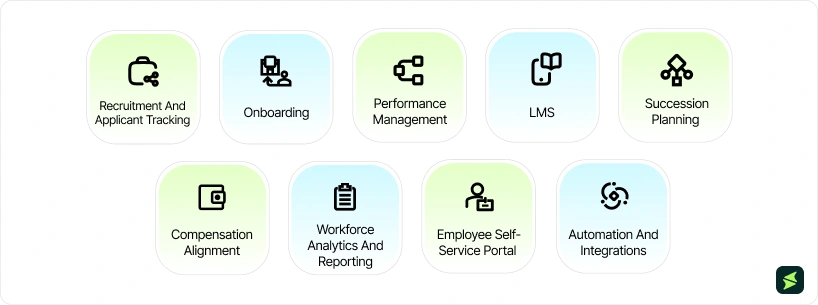
A system is only as strong as what it's built on. The following nine pillars are the core capabilities that separate a talent management system that transforms a workforce strategy from one that merely digitizes paperwork.
An Applicant Tracking System (ATS) is typically the first point of entry into a TMS because it combines job requisitions, candidate profiles, interview stages, and hiring team feedback into a single process. What makes this valuable inside a TMS, as opposed to a standalone ATS, is continuity. Which means the candidate data that is collected during recruitment — such as skills, assessments, role fit — doesn't disappear at the point of hiring but carries forward into onboarding and performance to give managers the context they need from day one.
The goal of an onboarding module in a TMS is to reduce an employee's enrollment time by orchestrating structured processes before the employee’s start date. It sets up compliance documentation, equipment provisioning tasks, introductory learning paths, and manager check-in prompts based on the new employee’s role, department, or location. This not only removes the dependency on individual managers by mapping what a new hire needs to know and do in their probation period, but it also automates the delivery of that content.
Performance management inside a TMS is structured around a cycle of goal-setting, continuous check-ins, formal reviews, and calibration. Most modern platforms support frameworks like OKRs or SMART goals at both the individual and team levels, with visibility up and down the org chart. What matters technically is how review data is stored and used. In a well-configured TMS, performance ratings feed directly into compensation planning, succession readiness scores, and development recommendations, turning review cycles into a driver of real workforce decisions
The LMS module in a talent ecosystem offers organizations the ability to house course content, track completions, and manage certifications. However, its real value lies in its connection to performance and skills data. When a review surfaces a development area or a skills gap is identified for a future role, the system can automatically recommend or assign relevant learning content. This closed loop—from gap identification to learning intervention to reassessment—is what distinguishes an integrated L&D function from a standalone content library.
Succession planning relies on two inputs: an accurate map of critical roles and a clear view of employee readiness. A TMS addresses both. HR can designate key positions and outline the competencies each role requires, while the system simultaneously aggregates performance history, skills assessments, and manager evaluations into individual readiness profiles.
From there, it surfaces viable candidates for each role and identifies development gaps that need to be addressed. This same infrastructure also supports internal mobility, allowing employees to gain visibility into open roles and express their interest. Because of this, HR can exhaust all internal options before turning to external hiring to fill those positions.
Compensation management in a TMS centralizes employee pay administration and helps automate HR workflows around compensation cycles. It draws on inputs such as performance ratings, market benchmarks, internal equity analysis, and budget constraints to generate pay recommendations and defined salary ranges. During each cycle, HR teams and managers follow a predefined process for approvals and change tracking, while the system maintains an auditable record of each pay decision.
Workforce analytics is where a TMS shifts from an operational tool to a strategic one. Because the system houses data across the employee lifecycle, it can generate insights that no single module could produce alone. These include offer acceptance rates by source, onboarding completion versus 90-day retention, performance distribution by manager, and skills coverage against future headcount plans. Most platforms surface these insights through standard dashboards for common metrics, while also offering ad-hoc reporting tools for deeper analysis.
A self-service portal gives employees direct access to their own talent profile, where they can update personal information, track goals, check learning progress, request feedback, and inspect internal opportunities without routing every action through HR.
Managers get the same access to submit reviews, approve requests, and keep tabs on team development. The result is less administrative back-and-forth for HR, more ownership for employees and managers, and data that stays accurate because the people closest to it are the ones keeping it current.
Automation in a TMS handles the process logic that would otherwise fall on HR coordinators to manage manually. This includes triggering onboarding tasks, routing review forms to the right approvers, sending certification reminders, and escalating incomplete steps. All these are rule-based routine processes that are configured once and then executed consistently.
Integrations extend this further by connecting the TMS to payroll, HRIS, and communication platforms making sure that employee data only needs to be entered once. This, consequently, lessens the errors such as incorrect pay or duplicate records, and speeds up processes like onboarding, benefits enrollment, and performance reporting.
Understanding the pillars individually is one thing. Seeing how they work together is where it clicks.
Take a single employee's journey through a connected TMS. A recruiter posts a software engineering role. Applications come in, get scored against predefined criteria, and top candidates move through interview stages, with organized feedback logged at each step. An offer goes out, the candidate accepts, and the TMS picks up from there: IT provisioning tasks get created, compliance documents are queued for e-signature, and a 30-60-90 day development plan is assigned based on the role.
Ninety days in, the manager completes a new hire check-in inside the performance module. The employee's initial goals — set during onboarding — are already there. Six months later, a skills assessment flags a gap in cloud architecture; the L&D module surfaces a relevant certification path and assigns it. Two years on, that same employee's performance history, completed certifications, and manager endorsements have them flagged in the succession plan for a senior engineering lead role. No data re-entered and no dropped handoffs, just one continuous thread.
Data flow is what separates a TMS from a loose collection of HR tools. In a well-architected system, the employee record acts as the central object, with every module reading from it and writing back to it. Recruiting creates the initial hire record, which onboarding then inherits.
During onboarding, role competencies are captured and later used by performance management as the baseline for goal setting. Performance reviews may surface development needs, which L&D addresses with targeted learning recommendations. When a certification is completed, L&D records it, and succession planning updates the employee’s readiness score accordingly.
This is just data model design done right. One source of truth per employee, every process operating against the same record rather than generating siloed copies. For HR, that means reporting that reflects reality. For managers, context without the chase. For employees, a system that carries their history forward so they don't have to.
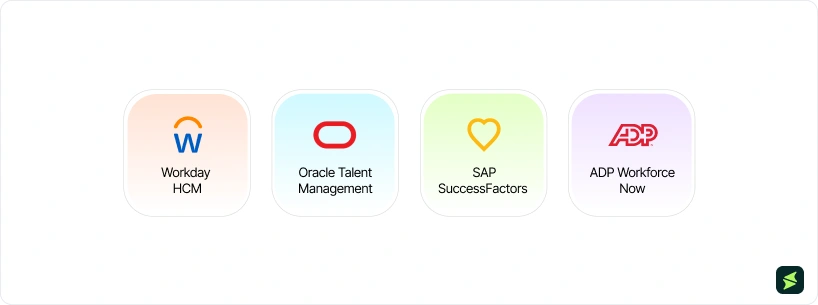
Not all talent management systems are built the same way. Each major vendor has made distinct architectural and philosophical choices about how to support the talent lifecycle. Here's how the leading platforms approach it.
Workday HCM's talent suite is built on a unified HCM data model, meaning Recruiting, Performance, Compensation, and Workforce Planning operate against a single employee record rather than siloed databases.
This architectural coherence enables the ‘HiredScore AI’ layer to handle candidate grading, pipeline prioritization, and passive talent rediscovery with contextual accuracy that fragmented systems struggle to match. Alongside it, the Skills Cloud continuously maps and evolves workforce capabilities across the organization in real time.
That integration extends into how employees and managers actually work. Workday Illuminate surfaces AI-driven role recommendations based on employee skills profiles, while managers collaborate on hiring and performance protocols directly within Microsoft Teams or Slack.
Oracle Talent Management (part of Oracle HCM Cloud) is designed around the candidate experience from the ground up, supporting account-free applications and using a digital assistant to guide applicants through the process.
Recruiters benefit from native CRM tooling built for pipeline development, enabling personalized outreach and relationship management without leaving the platform. Direct LinkedIn sourcing further optimizes intake by pulling profile data automatically and eliminating redundant entry.
Where Oracle particularly distinguishes itself is in succession planning. Its bench strength tools visualize readiness, flight risk, and cross-unit mobility in a single view, giving leadership teams structured data rather than relying on institutional knowledge alone. Scenario simulation capabilities allow organizations to stress-test leadership pipelines proactively.
SAP SuccessFactors HCM is built on a modular architecture that allows organizations to deploy Recruiting, Onboarding, Performance, Learning, Compensation, and Succession independently or as an integrated suite.
Spanning these modules is the Talent Intelligence Hub, a unified skills layer capable of inferring competencies from performance review text and job profiles. This inference reduces the manual work required to maintain an accurate skills taxonomy across large workforces.
Performance management reflects a continuous philosophy, emphasizing ongoing check-ins, constructive feedback loops, and goal alignment that connects individual objectives to broader strategy. Development plans link directly to competency frameworks and curated learning content, translating growth discussions into structured development paths for employees.
ADP Workforce Now’s Talent Management is distinguished by its native integration with payroll and core workforce data to guarantee compensation decisions, time records, and HR information are drawn from a consistent source of truth.
This operational coherence is especially valuable for midmarket organizations where misalignment between HR and finance systems creates downstream inefficiencies. Performance and pay decisions benefit directly from that shared data foundation, reducing the reconciliation work that often burdens talent teams running disconnected platforms.
ADP also translates its scale into an analytical advantage. Because its payroll footprint spans an exceptionally large client base, talent leaders can benchmark compensation trends and workforce metrics against aggregated market data.

A well-implemented TMS changes how the organization understands and develops its people. Here are some of the guaranteed benefits of a talent management system:
When employee information, such as skills, performance history, learnings, and compensation, is unified in a single system, HR managers gain a complete, accurate view of their workforce. This eliminates the need to piece together data from fragmented records and enables faster, better-informed decisions.
Continuous feedback cycles and structured review data give managers a real-time view of team progress. They make it easier to identify high performers, address skill gaps or low productivity early, and align individual goals with business priorities.
Skills gaps are identified systematically and addressed through targeted learning interventions rather than generic training catalogs to make certain that development is tied to real business needs and proper career progression.
Through the automation of routine procedures and enabling self-service, a TMS significantly reduces the time HR teams spend on administrative tasks. This frees up capacity to concentrate on more strategic priorities, and gives managers and employees the autonomy to handle day-to-day requests without depending on HR for every interaction.
A TMS helps organizations maintain an up-to-date view of talent readiness for critical roles by tracking employee skills, performance, and career progression. This significantly lowers the reliance on reactive external hiring and builds resilience against unexpected leadership changes.
Employees with visibility into internal growth opportunities are less likely to look externally. A TMS makes those pathways visible and actionable, directly affecting engagement and turnover rates.
TMS pricing typically ranges from $25–$36/employee/month (PEPM) for full talent suites, while large enterprise deployments can exceed $200,000 annually.
Some vendors offer modular pricing, where organizations pay only for specific capabilities such as recruiting, performance management, or learning. Individual module pricing generally ranges from $4–$10 PEPM for core modules.
Implementation is a major cost that is often underestimated. Setup usually adds 15–35% of the first-year license cost and includes configuration, integrations, data migration, and user training.
Data migration projects can cost $3,000–$50,000, while integrations may run $5,000–$25,000/connection, depending on complexity. Enterprise deployments frequently require external implementation partners.
The bottom line: don't evaluate a TMS on license cost alone. Factor in implementation, integrations, support tiers, and any AI features or add-ons that sit outside the base subscription. Before signing anything, ask for a full cost breakdown.
Here's a stepwise guide on how to approach choosing the right talent management system:
Before looking at vendors, document what you have. What systems are you using today? Where are the process gaps? What data exists and in what condition? This baseline shapes every decision that follows and prevents you from buying features you already have or overlooking ones you critically need.
Not all eight pillars carry equal weight for every organization. Is your biggest challenge recruiting volume? Skill development? Retention of high performers? Rank your priorities. This becomes your evaluation criteria and keeps conversations with vendors grounded in your actual problems, not their product roadmap.
List every system the TMS needs to connect to, including payroll, HRIS platforms, Active Directory, and communication tools. For each one, determine whether a native integration exists or whether custom work is required. Integration gaps that surface after contract signing can be expensive and time-consuming to resolve.
HR will implement it. Managers will use it. Employees will live in it. Finance will approve the budget. Getting input from each group before selection — not just before launch — surfaces requirements and concerns that HR alone wouldn't catch, and builds the buy-in that makes adoption easier.
Issue a Request For Proposal (RFP) or a detailed briefing document to shortlisted vendors. Score responses against your defined priorities. Request live demos that walk through your actual use cases, not scripted product tours. Ask each vendor to demonstrate how they'd handle your highest-priority work processes specifically.
Ask vendors for references from organizations similar to yours in size, industry, and complexity. Speak directly with HR leaders, not just IT. Ask specifically about implementation experience, support quality, and whether the system delivered on what was promised. References are the most reliable signal you'll get.
License fees are the starting point, not the full picture. Factor in implementation of services, training, data migration, and upgrade costs. A cheaper platform with higher implementation complexity can easily exceed the cost of a pricier platform that deploys in half the time.
Where possible, negotiate a pilot with a representative group before committing to a full deployment. Unlike demos, a live pilot surfaces configuration issues, workflow gaps, and adoption barriers under actual working conditions. Specify clear success criteria upfront so the results give you evidence — not assumptions — going into a full rollout.
Ultimately, the goal of evaluating a TMS is not to find the most feature-rich platform. It's to find the system that best supports the way your people work and the outcomes your organization needs. Start with your workforce strategy. Let the software support it.

The most common reason TMS implementations underdeliver isn't technology, it's people. Managers who are used to handling performance reviews over email or relying on informal processes may resist structured workflows, even when the system is designed to streamline HR workflows. Without executive sponsorship and deliberate change management, adoption rates stay low, and the system becomes shelfware. Training, clear communication about the reasons for the change, and manager accountability are essential to making the transition work.
A TMS is only as useful as the data inside it. Organizations coming from fragmented systems often discover inconsistencies in employee records, missing historical data, or skill taxonomies that don't translate cleanly into the new platform. Poor data quality at launch undermines reporting credibility and erodes trust in the system. A dedicated data audit and migration plan — before go-live, not during — is essential.
Most organizations don't replace their entire HR tech stack when they implement a TMS. That means the new system needs to connect to existing payroll, HRIS, identity management, and sometimes ERP platforms. Integration complexity is routinely underestimated, specifically in enterprise environments with legacy systems and custom configurations. API limitations, field mapping mismatches, and data sync frequency issues can create ongoing maintenance burdens if not scoped carefully upfront.
Enterprise TMS platforms are highly configurable — which sounds like a feature until an HR team is six months into implementation and still debating workflow logic. Over-customization leads to complicated systems that are hard to maintain and harder to upgrade. A pragmatic approach is to start with standard configurations, go live, and refine based on actual usage rather than trying to build the perfect system before anyone has used it.

Talent management isn't just an HR function. It's a business strategy. Because the uncomfortable truth about talent management is that a great employee will cost a lot, but a bad hire can cost even more. The organizations that attract, develop, and retain exceptional people will consistently outperform those that don't — and a well-implemented talent management system is the infrastructure that makes that possible at scale. The technology matters. But the thinking behind it matters more.