


Canva
Last Updated
Key Takeaways
Generated from the text of customer reviews
Canva is an online design and publishing platform. Its business users sit mainly in marketing and creative teams, and sales teams. Users credit its ease of use for non-designers and continuous updates as per the current needs. One drawback is its locked premium content, which results in limited designs for those who are using it without subscription. Its recent AI integration with Gemini and AI Mode in Google Search enables users to customize designs directly through natural language prompts.
Our Verdict
Canva suits small and mid-sized teams where marketing and social content comes from staff outside a design role, which is common across education and nonprofits. Pricing is lauded for the value it provides, though some note that restricted tools for high tiers might be a jump for small businesses. We recommend it to organizations that need to work out quickly and do not employ designers.
Overall Rating
Based on 2169 users reviews
4.8
Rating Distribution
Positive
98%
Neutral
2%
Negative
0%
Starting Price
$18
per month
Canva Specifications
- File Sharing & Management
- Document Management
- Task & Project Management
- Calendar & Scheduling
What Is Canva?
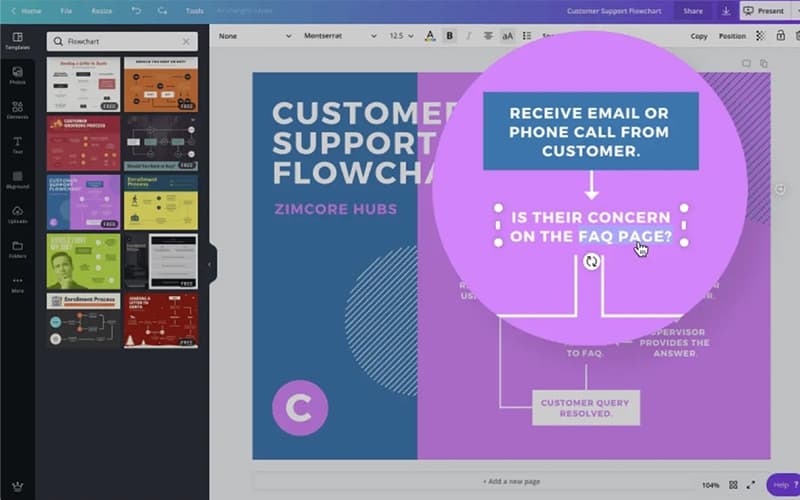
Canva is an Online Design and Publishing platform. Users can drag elements into place or start from a ready-made template, especially the work that does not depend on design training. Its design files are tailored for various needs, such as documents, sheets, whiteboards, presentations, social posts, video, websites, and print pages together.
This range supports marketing content, brand management, and social post scheduling. Besides its tools for creating and editing the designs, Canva also offers collaborative tools so a team can work together in one workspace.
What Is Canva Best For?
Canva is best known for its "Canva AI" tool. This helps users generate text for images as well as whole images, videos, and music as per the requirement of their design. Users can also use this AI tool to remove backgrounds or edit images based on prompts. Moreover, it converts a flat image into an editable layout. Thus, Canva AI facilitates a lot of technicalities for non-designer teams or even for professional designers automating various manual tasks.
How Much Does Canva Cost?
Canva price starts at $18/month for one person on the Pro plan, which opens the premium library of 3.6 million-plus templates and 141 million-plus stock assets. The same tier carries five Brand Kits, social content scheduling, and 100 gigabytes of cloud storage. Other plans include:
- Free: $0
- Business: $25/person/month
- Enterprise: custom quote
A free trial is available on both paid plans. Canva prices education separately:
- Teachers: free for eligible K-12 teachers and their students
- Schools and Districts: free for eligible K-12 schools and districts
- Campus: custom quote
In addition to the base subscription costs, organizations should typically account for the following approximate additional expenses:
- Artificial Intelligence Pass Add-On: $100/person/month, charged when users exceed the artificial intelligence limits included in their plan
- Seat Expansion: Around $20–25/user/month, growing as more team members join a Business plan
- Enterprise Plan Upgrade: Roughly $15–50/user/month, based on seat count and the security and governance controls an organization requires
- Canva Print Orders: Approximately $10–500/order, varying with product type and print quantity
- Brand Kit And Template Setup: Usually $400–$1,500 one-time, depending on how many branded templates and assets a team build
Reviews are generally positive about its pricing, appreciating its plans for meeting various design tasks across personal to professional needs. However, some mention that higher plans might be a bit out of range when small businesses go for restricted tools.
Disclaimer: The pricing is subject to change.
Canva Integrations
Canva connects with several third-party business systems, including;
- Microsoft Teams
- Slack software
- Asana software
- Google Workspace software
- Salesforce
How Does Canva Work?
Here is how users reach the platform and begin working through its features:
- Log in to your Canva account through a browser or the desktop and mobile apps to access your workspace
- Set up a Brand Kit by adding logos, colors, and fonts so designs stay consistent across a team
- Pick a template from the library, or start a design from scratch across formats like presentations, social posts, videos, or print
- Edit the design by dragging elements onto the page, adjusting text, and applying AI tools such as Magic Write or Background Remover
- Invite team members into the same file to collaborate and review the design together
- Resize the design for different channels using Magic Resize, keeping the layout consistent across formats
- Export the finished file for digital use or send it to Canva's Print Shop for physical production
Who Is Canva For?
Canva serves a wide range of industries and sectors, including:
- Education
- Government
- Healthcare
- Real estate
- Technology
Canva Use Cases
Based on our analysis of user reviews and Canva features, the following scenarios show where the software can fit different types of teams and workflows:
Small Creative Teams Supporting Multiple Regional Markets
Small creative teams turn to Canva when regional offices need to produce their own marketing content. Brand Kits keep approved logos, colors, fonts, and other assets available across the team, while Brand Templates give regional employees ready-made designs to customize. Brand Controls can also limit the fonts, colors, content, and templates available for use, keeping local changes within the set brand rules. Teams frequently note that shared brand assets hold output consistent across separate accounts and locations.
Public Sector Communications Teams Issuing Time-Sensitive Notices
Government communications teams utilize Canva to prepare notices and other public-facing content from shared brand templates. Teams can lock key elements such as logos and backgrounds, while Brand Controls can limit the fonts, colors, and templates available for new designs. This gives communications teams a defined set of design elements to work with when preparing content. Users often mention that ready-made templates remove formatting decisions when work must go out quickly.
Data Teams Producing Recurring Business Reports
Data teams rely on Canva when reports need to be created and updated on a regular basis. Canva Sheets can hold data that connects to charts, while presentations and docs can combine those visuals with other content. Teams can keep the same report layout and update the underlying data instead of rebuilding each report from the beginning. Feedback indicates that document and presentation work moves faster once a layout is reused rather than recreated.
Franchise Networks Equipping Agents With Marketing Material
Franchise networks use Canva to give independent agents access to approved marketing templates and brand assets. Brand Templates provide ready-made designs, while Brand Controls can restrict the fonts, colors, content, and templates available within Canva. Agents can then customize the available designs while keeping the required brand elements in place. Users report that a wide template range removes the need to build listing material from scratch.
Is Canva Right For You?
Canva can help organizations give more employees access to self-service design tools while keeping visual work on brand. Administrators control who joins a team and what each member can open, along with how designs leave the organization.
Leading companies such as HubSpot, Expedia Group, and Airbnb trust Canva for their collaboration and productivity tasks. Larger organizations get single sign-on, automated user setup, and a multi-team structure, which are backed by ISO 27001 and SOC 2 Type II certification.
Still doubtful if Canva software is the right fit for you? Get in touch at (661) 384-7070, and we will help you make an informed decision.
Canva Features
Brand Templates
Canva Brand Templates provide shared designs for presentations, docs, social posts, and other content. Teams can lock logos, text boxes, and backgrounds while leaving other parts of the template editable. Custom templates can also be created from Canva’s professional template library.
Brand Management
The platform stores logos, colors, fonts, icons, imagery, graphics, and internal brand guidelines together. Brand assets can be accessed while creating designs and used across different content. Brand Controls can also limit the fonts, colors, content, and templates available for use.
Content Management
Canva provides shared folders for organizing branding, templates, and other content. Teams sort content by project or type and pin the items they open most often. Sharing then works at two levels, since a folder can go to the whole organization or stay with named people.
Productivity
Canva supports real-time collaboration through shared designs, live cursors, and activity selections. Users can add feedback, tag others, assign tasks, and share designs for viewing, commenting, or editing. Collaboration also extends to presentations, docs, and whiteboards.
Creativity Tool
Design approval workflows allow teams to encourage or require approval before designs move forward. Specific team members can be assigned as approvers, while feedback and tasks can be handled during the review. These workflows support design reviews within the same Canva workspace.
Pros And Cons of Canva
Pros
Offers ready-made templates that speed up work
Stores brand colors and fonts for consistency
Facilitates shared editing so teams work together
Uses drag-and-drop editing that beginners understand
Cons
Advanced editing controls could be more precise
Can slow down with very large designs
Finding specific elements can take time
Canva Pricing
Individuals and Business Free | Individuals and Business Pro | Individuals and Business (Business) | Individuals and Business Enterprise | Education Teachers | Education Schools and Districts | Education Campus |
|---|---|---|---|---|---|---|
$0 per personal per month | $18 per person per month | $25 per person per month | Custom Pricing | Free, for eligible K-12 teachers, students and schools | Free, for eligible K-12 teachers, students and schools | Custom Pricing |
|
|
|
|
|
|
|
Disclaimer: The pricing details were last updated on Sep 25, 2026 from the vendor's website. Please contact us for a tailored pricing list.
Canva Reviews
Total 2169 reviews
4.8
All reviews are from verified customers
Rating Distribution
5
Stars83%
4
Stars15%
3
Stars1%
2
Stars0%
1
Stars0%
Share your experience
Apparel & Fashion, 1-10 employees
More than a year
“user friendly graphics”
Pros
Creating graphics with Canva is fantastic and I love it. It's very user-friendly and pretty much anyone on the team can jump in and feel like a graphic designer.
Cons
The more impressive features and design options are locked behind paid plans and we don't always have the budget to pay for them.
Rating Distribution
Ease of use
10
Value for money
9
Customer Support
10
Functionality
9
Education Management, 101-500 employees
More than a year
“Consisten quality”
Pros
It has become one of my favorite tools because I use it all the time for flyers event pieces social media graphics, presentations and all kinds of other communications. It's very approachable to use yet it still gives you plenty of creative freedom to put together polished, professional-looking designs even without any formal graphic design experience. One feature I've really come to appreciate is Canva's print service. Being able to create something and send it straight to print in the same platform saves me from having to deal with a separate printer. The print quality has been consistently strong and the rush printing option has genuinely saved me when I've needed something at the last minute.
Cons
Because Canva offers so many tools and design choices, it can feel a little overwhelming at times especially when I'm searching for one specific feature or function. A few of the more advanced capabilities are locked behind the paid version which may be tough for teams or organizations working with tighter budgets. I'd also like to have a bit more customization and control when it comes to certain print settings and specialty print products.
Rating Distribution
Ease of use
10
Value for money
8
Customer Support
9
Functionality
8
Health, Wellness and Fitness, 1-10 employees
More than a year
“creative toolkit with tons of options”
Pros
Canva comes with a whole range of useful tools. It lets me create posters and logos, edit videos, make animations and even handle basic document editing all in one place.
Cons
The AI struggles quite a bit to generate good results unless you retry many times. The image and video library also only offers content with fairly average quality.
Rating Distribution
Ease of use
10
Value for money
9
Customer Support
9
Functionality
10
Frequently Asked Questions
Does Canva offer an API?
Yes, Canva offers an API.
What language does Canva support?
Canva supports multiple languages, including English, French, Italian, Polish, and Spanish.
Who are the typical users of Canva?
Canva is used by organizations across multiple sectors and industries, including education, government, healthcare, real estate, and technology.
Does Canva have a mobile app?
Yes, Canva offers mobile apps for Android and iOS devices.
What level of support does Canva offer?
Canva offers support through live chat, ticketing, AI help assistant, contact form, and help center.
What types of pricing plans does Canva offer?
Canva price includes multiple plans. These include Free ($0/month/person), Pro ($18/month/person), Business ($25/month/person), and Enterprise (custom pricing). Education plans include Teachers and Schools and Districts (free for eligible K-12 teachers, students, and schools) and Campus (custom pricing). A free trial is available on paid plans. Get in touch for a tailored Canva cost estimate.
What other apps does Canva integrate with?
Canva integrates with different third-party systems such as Microsoft Teams, Slack, Asana, Google Workspace, and Salesforce.