Last Updated

Key Takeaways

Generated from the text of customer reviews

Slack is an AI work platform used by remote teams and internal functions such as IT, HR, customer support, marketing, and sales across manufacturing, education, and retail. Users highlight easy communication and real-time collaboration, while noting information overload in larger workspaces. Recent updates include Slackbot skills, allowing Slackbot to handle complex or recurring tasks using admin-approved skill sets.

Our Verdict

Slack software is a strong fit for midsize to large organizations managing distributed teams and complex internal coordination. It handles high volumes of communication well, and most teams see clear value at higher tiers, though per-user pricing can add up as headcount grows. We recommend it for organizations prioritizing organized internal communication and connected workflows for daily operational needs.

Overall Rating

Based on 117 users reviews

4.6

Rating Distribution

Positive

96%

Neutral

3%

Negative

1%

Starting Price
$0

/month

Slack Software Specifications

  • Time Tracking
  • Task Management
  • Reporting
  • Budget Management
View All Specifications

What Is Slack Software?

Slack is a cloud-based project collaboration solution designed to help businesses improve communication and enhance team productivity. It offers a wide range of features that include lightning-direct messaging, group discussions, file sharing, video conferencing, and integration with various third-party tools.

Business teams can also create channels on Slack, which serve as centralized communication hubs for specific projects, topics, or departments. These conversations are fully searchable, so users can easily find past discussions and shared files. Slack has consistently earned its place among leading digital communication tools in the realm of project management and is widely adopted by teams across diverse industries and organizational verticals.

What Is Slack Software Best For?

Slack is best known for its use of channels to organize team communication, which creates spaces for collaboration by project, topic, department, or work category. Public and private channels make it straightforward to connect and collaborate across departments, offices, time zones, and even other companies. Any information shared in a channel can be accessed by anyone in that channel, allowing teams to stay up-to-date and in sync no matter where members are located. Organizations dealing with scattered email threads, missed updates, or slow cross-team communication tend to find the most value here. It brings all relevant people, files, and discussions brought into one focused space where work can move forward without the usual back-and-forth.

How Much Does Slack Software Cost?

Slack software pricing starts at $8.75/user/month. This plan, known as Pro, includes unlimited message history, unlimited app integrations, group meetings, group external messages, and AI conversation summaries. Further pricing tiers of the software are as follows:

  • Free – $0/user/month
  • Business+ – $18/user/month
  • Enterprise+ – Custom pricing

In addition to the base subscription cost, organizations should also account for the following expenses:

  • Implementation And Workspace Configuration: Usually ranges from $0–$50,000 depending on whether it’s self-setup or enterprise onboarding with training, rollout support, and workspace configuration
  • Data Migration: Typically falls between $1,500–$20,000 for moving messages, files, and channel structures from platforms like Microsoft Teams or Google Chat
  • SSO/Identity Provider Integration: Generally ranges from $500–$5,000 for setting up SAML SSO, SCIM provisioning, and connecting identity tools like Okta or Azure AD
  • Third-Party Automation Platforms: Usually costs around $600–$15,000/year for workflow automation tools like Zapier or Workato used alongside Slack
  • App And Integration Licensing: Can range from $3,000–$100,000+/year depending on the number of paid tools like Salesforce, Zoom, or Jira used in the stack
  • Premium/Priority Support: Generally adds about $5,000–$30,000/year for faster support response times and enhanced assistance
  • Slack Atlas Add-on: Usually costs around $2–$4/user/month for employee profiles, org charts, and improved company directory features

User reviews generally rate Slack’s pricing favorably, with most users finding the value for money reasonable relative to what the platform offers. However, a small number of reviewers note it runs slightly more expensive for small-sized organizations.

For accurate pricing based on your organization’s needs, it’s recommended to request a custom Slack software price estimate.

Disclaimer: The pricing is subject to change.

Slack Software Integrations

Slack integrates with a wide range of third-party services. Workspace administrators can also use various APIs, enabling users to build 'custom connects' with the platform.

Here are some of the many programs that Slack works with (many of which are considered among the ‘best apps’ for efficient networking within their domains):

How Does Slack Software Work?

Here is how your entire team can begin using the Slack project collaboration software:

  • Enter your provided login email and password that was used to set up your team's Slack workspace
  • You will now be on your Slack workspace home, where all your channels are listed on the sidebar
  • To join a conversation, click on an existing channel name from the sidebar. This will open the channel where you can see previous messages and start interacting
  • You can upload files, react to messages with emojis, or send direct messages to other users
  • To organize your work, you can pin important messages, create new channels for projects, or send a direct message to a team member with 1:1 chats
  • Use the search bar at the top to quickly find previous messages, files, or conversations on any topic across all channels
  • You can customize your Slack experience by installing additional apps and configuring notification settings through your user profile icon
  • Jump between all your conversations, channels, direct messages, files, and more using the navigation menu on the left
You can also schedule a free Slack software demo to explore its full functionality.

Who Is Slack Software For?

Slack is designed for business organizations of all sizes. Its features and integrations further make it an ideal solution for remote and distributed teams. Here are some industries and business functions that prefer using Slack as their primary communication tool:

  • Engineering
  • Financial services
  • Education
  • Retail
  • Media
  • IT
  • Sales
  • Project management
  • Human resources
  • Marketing
  • Customer service

Slack Software Use Cases

Based on our analysis of user reviews and Slack’s current capabilities, we have identified key scenarios where this software is a good fit for remote teams, cross-functional business units, and organizations managing high-volume internal communication:

1. Distributed Teams Operating Asynchronously Across Time Zones

Global teams often hit a stage where scheduling overlapping working hours becomes impractical, and relying on meetings to share updates creates bottlenecks that slow work down for everyone. Without a shared system, decisions get buried in email threads, context gets lost between time zones, and team members regularly start their day without knowing where things stand. Slack may be a suitable fit for distributed teams in this position, particularly where the priority is keeping work moving and accessible to everyone without requiring real-time coordination.

2. Internal Teams Replacing High-Volume Email Communication

Organizations that run heavily on email for day-to-day coordination frequently find that important information gets buried, response times slow down, and threads become difficult to follow as they grow. The problem gets worse when multiple departments are involved, and there is no clear place for conversations to live. Slack could be worth considering for teams dealing with this, where the goal is moving routine communication out of inboxes and into organized, searchable channels that anyone on the team can follow without being copied on every exchange.

3. Small Teams Managing Projects Without Dedicated Project Management Software

Smaller teams often manage projects through a mix of messaging apps, email, and shared documents; a setup that works at early stages but starts breaking down as the number of concurrent tasks grows. Keeping track of who is doing what, where the latest file version is, and which decisions have been made becomes increasingly difficult without a shared workspace. For teams at this stage, Slack may offer a reasonable starting point, handling communication, file sharing, and lightweight task tracking in one place before a full project management tool becomes necessary.

4. Customer Support And Client-Facing Teams Managing Fast Response Workflows

Customer support teams frequently deal with situations where an issue requires quick input from colleagues in other departments - technical teams, account managers, or supervisors - and the speed of that internal communication directly affects how quickly the customer gets a resolution. When that coordination happens over email or phone, delays are common, and context gets lost in the handoff. Slack could be a workable fit for support teams in this environment, where keeping internal conversations fast, organized, and tied to specific cases reduces the time between identifying a problem and resolving it.

5. HR Teams Coordinating Approvals And Document Sharing Across Departments

HR teams managing processes like onboarding, policy updates, or approval cycles often find themselves chasing responses across departments, resending documents, and maintaining long email threads with multiple stakeholders. The back-and-forth slows down processes that have real deadlines and affects employees waiting on outcomes. For HR teams dealing with this level of back-and-forth, Slack may suit environments where approvals, document sharing, and cross-department queries need to move faster and be easier to track than email allows.

Is Slack Software Right For You?

Businesses should consider Slack to improve communication, encourage quick decisions, and promote real-time collaboration. The platform's flexibility in choosing apps and add-ons, its messaging-centric approach, and its customization options make it a strong alternative to traditional workplace communication tools.

Slack also stands out due to its versatility for workplace communication. The platform is designed to fit into your business, with benefits such as its search capabilities and company directory, integrations with your favorite apps, and the ability to send audio. It is also trusted by companies like OpenAI, IBM, and Stripe.

Regarding security and compliance, Slack provides a secure communication environment, including features such as data loss prevention and enterprise-grade compliance with standards like HIPAA, FedRAMP, GDPR, and ISO/IEC 27001. It is more organized and secure than email, making it a valuable tool in today's business environment. Businesses can be assured of the safety and privacy of their data when they use Slack for their operations.

We recommend reading Slack reviews to see what existing users say about the software. Contact Software Finder at (661) 384-7070 for more information.

Slack Software Features

Channels 

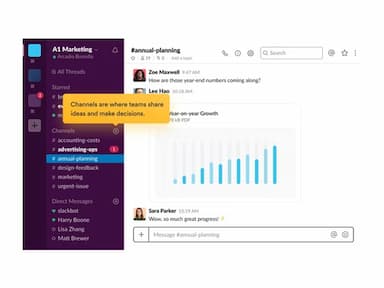
Team members can use their user accounts to organize conversations into private or public channels based on team, project, or topic. This streamlines team communication by reducing clutter and enabling workgroups to quickly find relevant discussions. Additionally, users can collaborate in real time, share files, create new channels, use Slack Huddles (for informal discussions), and stay up to date on project progress.

See How It Works
Workflow Builder 

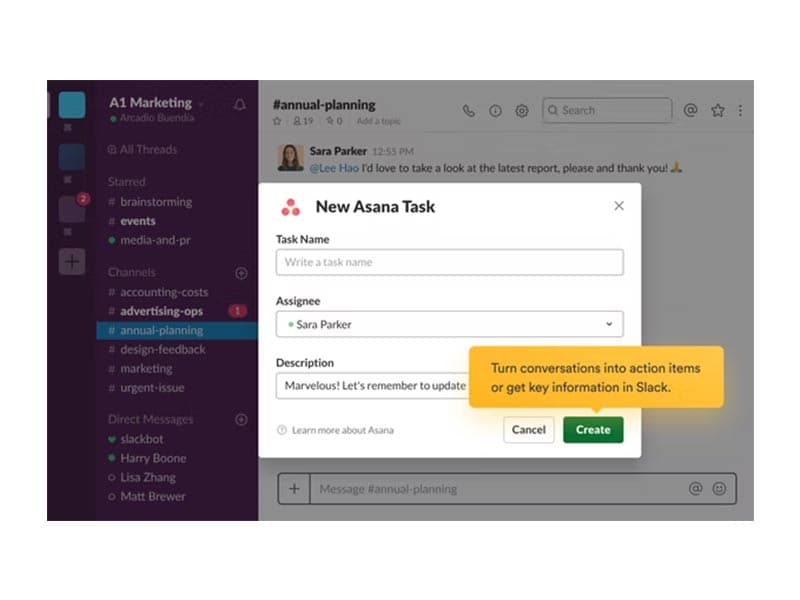
This function empowers users to create custom workflows and automate repetitive tasks using an intuitive and user-friendly visual interface. With Workflow Builder, teams can automate many processes, from scheduling meetings and onboarding new employees to collecting customer feedback.

See How It Works
File Sharing

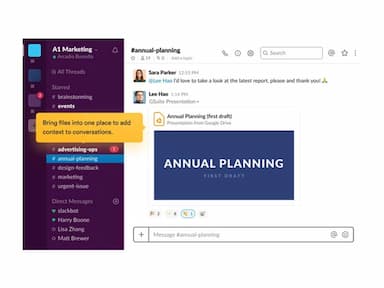
Slack's file-sharing feature allows users to easily share files, documents, photos, and videos with team members. This option allows users to send files from their mobile device, computer, or cloud storage service without switching tabs and leaving Slack.

See How It Works
Search

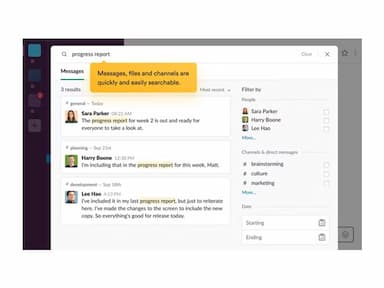
The search function lets users quickly find messages, files, and people. With clickable filters, users can quickly locate essential information, whether it's a conversation from years ago, a comment made yesterday, or a thread deep within a particular message history. This helps users find important information when needed.

See How It Works
Slack Connect

Slack Connect equips users to collaborate with external partners, vendors, and customers within a single platform (via channel or direct messages). Through this offering, they can send direct messages, share channels, and even make voice or video calls with people outside their organization. Additionally, Slack Connect offers advanced security and compliance features, ensuring that confidential information remains secure and compliant with regulatory requirements.

See How It Works
Agentforce

This feature brings AI agents into Slack as active participants, not just chatbots you query, but as assistants that understand conversation context, use enterprise data, and take actions inside channels, DMs, and threads. They can suggest next steps, trigger automations, and help keep workflows moving without users switching between tools.

See How It Works
Slackbot

Slackbot is Slack’s built-in AI assistant. It can search conversations, summarize threads, retrieve information from connected files, and handle tasks such as scheduling meetings or drafting content without leaving Slack. It works across DMs and integrated apps, and can trigger actions or start automated workflows when needed.

See How It Works

Slack Software Key Sentiments

Most Positive Sentiments

Real-time Collaboration

simley face

87.1% Positive

simley face

12.9% Neutral

simley face

0% Negative

Instant messaging and screen-sharing features enhance team communication, making collaboration seamless across platforms. Users appreciate the versatility for real-time discussions, efficient file sharing, and integrated audio and video conferencing capabilities that elevate teamwork.

User Feedback

simley face

70% Positive

simley face

30% Neutral

simley face

0% Negative

Users consistently highlight the app's reliability and seamless integration into workflows, praising its extensive features that enhance communication. Many appreciate the addition of video conferencing tools, further enriching their collaborative experience.

Least Positive Sentiments

Channel Management

simley face

5.56% Positive

simley face

38.89% Neutral

simley face

55.56% Negative

Navigating numerous channels often leads to information overload, making it challenging for users to track important messages. The design of message threads and organization could significantly enhance user experience and reduce confusion.

User Onboarding

simley face

28.57% Positive

simley face

23.81% Neutral

simley face

47.62% Negative

Navigating the software can be challenging for new users, often requiring additional training to fully utilize its features. The implementation process is complex, leading to a steep learning curve that can feel overwhelming.

Pros And Cons of Slack Software

Pros

  • Helps keep user access secure and controlled

  • Makes screen sharing easier during collaboration

  • Reduces manual work through automated workflows

  • Simplifies managing multiple workspaces in one place

  • Enables safe communication with external partners

  • Protects sensitive discussions within selected teams

Cons

  • Often requires integrations for better task tracking

  • Managing many channels and chats can be challenging

  • Can lead to information overload in large teams

  • Notifications can sometimes feel distracting

Slack Software Reviews

Total 117 reviews

4.6

All reviews are from verified customers

Rating Distribution

5

Stars

72%

4

Stars

24%

3

Stars

3%

2

Stars

1%

1

Stars

1%

Share your experience

M

Matt

Utilities, 51-100 employees

More than a year

5.0
February 2024

Slack helps Pickup the Slack

Pros

What I find most appealing about Slack is its simplicity and straightforwardness. I can effortlessly launch the application and engage in real-time conversations with my teammates.

Cons

there is not much I can fault about Slack because it just works. I am able to get my tasks done without any hassle.

Rating Distribution

Ease of use

10

Value for money

10

Customer Support

10

Functionality

10

S

Sierra

Design, 1-10 employees

More than a year

3.0
February 2024

Communication without Project Management

Pros

Slack simplifies internal communication, allowing for quick exchanges on the go.

Cons

It is challenging to link communication directly to specific tasks and projects without setting up integrations. Even with integrations, it's often easier to use a dedicated project management tool.

Rating Distribution

Ease of use

8

Value for money

8

Customer Support

8

Functionality

7

A

Anonymous

Not Specified, 51-100 employees

More than a year

5.0
February 2024

Very effective communication tool for companies

Pros

I appreciate having both desktop and mobile apps at my disposal, with the huddle feature being particularly impressive. It eliminates the need for other platforms for calls, even offering screen-sharing capabilities plus the ability to send notes to myself is a handy addition.

Cons

It could be made more user-friendly. For instance, the design of message threads could be improved, and I wish there were more customization options available.

Rating Distribution

Ease of use

10

Value for money

10

Customer Support

10

Functionality

10

Frequently Asked Questions

Does Slack have a mobile app?

Yes, Slack offers a dedicated mobile app for both iOS and Android.

Who are the typical users of Slack?

Slack is typically used by business teams that need a central place to communicate and coordinate work. It’s commonly used among remote teams as well as departments like IT, engineering, customer support, HR, marketing, and sales, along with project-based teams working across different functions.

What types of pricing plans does Slack offer?

Slack offers a free plan with core features and paid plans starting at $8.75/user/month for Pro, $18/user/month for Business+, and customizable pricing for the Enterprise+ plan. Get a detailed Slack software cost breakdown to make an informed decision.

Does Slack offer an API?

Yes, API access is available.

What other apps does Slack integrate with?

It offers a wide range of app integrations, including Zoom, GitHub, and Salesforce.

What languages does Slack support?

It supports multiple languages, including Chinese (Simplified and Traditional), English (US and UK), French, German, Italian, Japanese, Korean, Portuguese, and Spanish (Latin America and Spain).

What level of support does Slack offer?

Slack offers support via live chat, articles, guides, an online contact form, and a dedicated help center.