Last Updated

Key Takeaways

Generated from the text of customer reviews

Asana is a project management platform used by project managers and cross-functional teams, especially in marketing, healthcare, IT, and operations. Users highlight its user-friendly interface and task tracking, while noting occasional search issues. Recently, Asana has introduced a Claude integration that turns natural language conversations into structured projects and tasks, alongside expanding AI integrations with ChatGPT and Google Gemini.

Our Verdict

Asana is project management software that is suited to small to mid-sized collaborative teams aiming to improve structured cooperation and accountability while working on multiple projects. Its user interface and user experience are widely regarded for usability and navigation. In addition, the various features are worth the Asana cost; its pricing is generally viewed as reasonable for growing teams, though it may feel less suitable for very small budgets. Overall, it is recommended for teams seeking long-term value in organized, cross-functional project execution.

Overall Rating

Based on 2031 users reviews

4.6

Rating Distribution

Positive

95%

Neutral

4%

Negative

0%

Starting Price
$13.49

per user per month
Asana Specifications

  • Time Tracking
  • Task Management
  • Reporting
  • Resource Allocation
View All Specifications

What Is Asana Software? 

Asana is a project management tool that lets teams plan, track, and manage tasks and projects in one place. It helps conduct their daily activities and long-term strategic planning efficiently, allowing collaboration across locations and borders. Over 169,000 organizations in 200+ countries use Asana through its paid and free plans. Users can manage projects through multiple views, including timelines, calendars, Kanban boards, and Gantt-style layouts, depending on how their teams prefer to work. 

Asana is one of those project management systems that prioritize the team and the project manager. While some other project management software alternatives are solely concerned with improving the management experience, Asana encourages every team member to utilize the software to their advantage with worker-centric features and a simple user interface. 

The platform also supports workflow automation and AI-powered features that help reduce manual follow-ups and surface project insights in real time. Overall, the tool helps organize all efforts toward accomplishing company objectives. 

What Is Asana Best For? 

The platform is best known for its workflow and automation tools, which help teams manage structured processes without needing to code. Users can create ‘Rules’ that automatically trigger actions based on certain conditions, such as due dates, task assignments, project moves, or notifications. ‘Forms’ make it easier to collect and organize requests from the start, while ‘Templates’ and ‘Bundles’ help teams standardize workflows across multiple projects. 

How Much Does Asana Cost? 

Asana’s pricing starts at $13.49/user/month for the Starter plan (supports AI Studio Basic with 50,000 credits/billing account/month). Free features include time tracking integrations, status updates, lists, boards, and calendar views. On the other hand, premium features include custom templates, guest accounts, additional security, and SAML authentication. Other plans offered by the vendor are: 

  • Personal: $0 (free forever for two users) 
  • Advanced: $30.49/user/month (supports AI Studio Basic with 75,000 credits/billing account/month) 
  • Enterprise: Custom pricing (supports AI Studio Basic with 200,000 credits/billing account/month) 
  • Enterprise+: Custom pricing 

There are no user seat limits in the paid plans. Paid add-ons are also provided, including ‘AI Teammates,’ ‘Compliance management,’ and ‘Timesheets and Budgets.’ ‘AI Studio Plus’ and ‘AI Studio Pro’ require paid access. Annual billing option is also available. Asana also offers discounts for eligible non-profits. A free trial for paid plans is also available. 

Furthermore, organizations considering this software may also incur additional costs, which may include: 

  • Standard onboarding guidance: Generally $0–$1,500 one-time 
  • Professional onboarding / implementation package: Usually $2,000–$15,000 one-time 
  • Enterprise implementation (multi-team rollout): Typically $10,000–$50,000+ one-time 
  • Data migration: Usually $3,000–$25,000 one-time 
  • Complex enterprise migration (multiple systems + historical data mapping): Ranges between $20,000–$75,000+ one-time 
  • Workflow design and configuration consulting: Roughly $1,000–$20,000 one-time or project-based hourly consulting (~$100–$250/hour via partners) 
  • Training workshops: Usually $500–$5,000/session 
  • API / custom integration setup: Approximately $2,500–$30,000 one-time 
  • Dedicated support packages: Typically included in Enterprise base, but premium advisory or enhanced SLAs can effectively add $5,000–$25,000+ annually in contract value 

Asana’s pricing is easy to understand at the entry level and feels justified for smaller teams. However, costs can escalate as organizations scale, especially when advanced features, add-ons, and implementation services are needed, which may make the overall investment feel substantial for larger deployments. 

Get custom Asana price quote tailored to the unique needs of your company.

Disclaimer: The pricing is subject to change. 

Asana Integrations 

The software integrates with more than 300 platforms, including: 

Who Is Asana For? 

Asana serves organizations ranging from small businesses to large enterprises across a wide range of industries, including: 

  • Government 
  • Healthcare 
  • Retail 
  • Financial services 
  • Education 
  • Manufacturing 

How Does Asana Work? 

Here’s a simple step-by-step guide to show you how Asana works and how it is navigated: 

  • Sign up or log in to access the workspace dashboard 
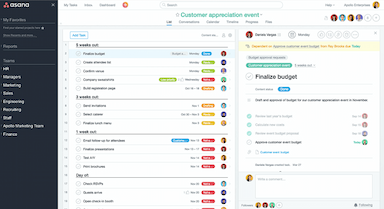
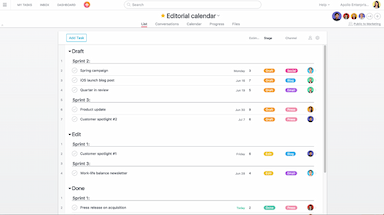
  • Create a new project and select a preferred view (list, board, timeline, or calendar) 
  • Add tasks to the project and structure them into subtasks where needed 
  • Assign tasks to teammates and set due dates, priorities, and details 
  • Organize and update task status as work progresses 
  • Communicate through task comments, attachments, and activity updates 
  • Review overall progress using dashboards, project overviews, and workload tracking tools 
Book a free Asana demo for a guided walkthrough of the platform.

Critical Benefits of Asana Project Management Software 

Users can create projects, manage their initiatives, and break them down into tasks using Asana. The robust Asana software allows you to assign tasks to individual members, follow separate tasks, share the progress of each project and use the comment feature to communicate with everyone involved. In addition, it can completely replace spreadsheets and email for scheduling, tracking, and communication purposes. 

Streamlined Workflow 

Asana allows you to upload all documents and attachments in one place, add notes on task descriptions, follow public tasks for updates, and group related tasks together. Moreover, you can assign priority to tasks, create a workflow, and receive notifications on tasks' completion or due date. 

Team members get alerted in their Asana or email Inbox on all assigned tasks and projects they are members of. According to users, Asana is highly convenient and offers various robust tools and features, worth the Asana cost. 

Organized Tasks 

Organizing has never been easier with the multiple workspaces to separate different projects and group together various teams. With Asana, managers can track every member's progress and stay updated without relying on lengthy email threads. In addition, global corporations like Spotify, Sephora, and Viessman use Asana to streamline their work and accelerate progress. 

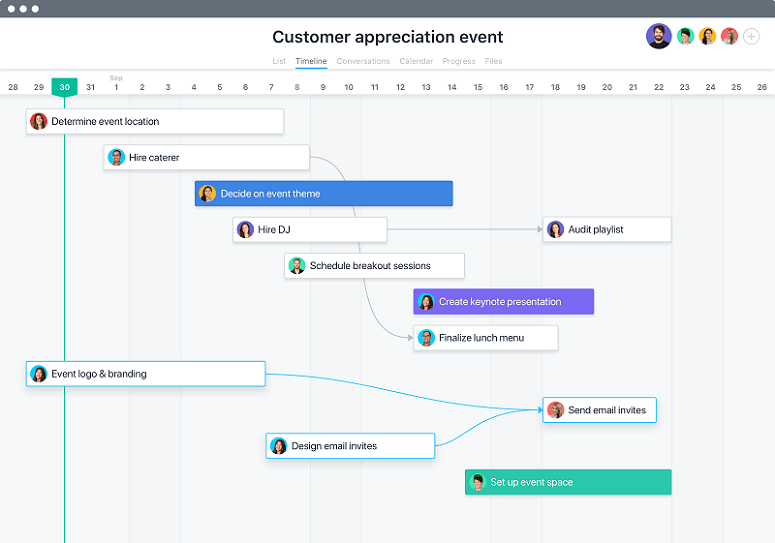
Asana simplifies task management by allowing users to define, assign and monitor them all in one place. You can view the progress in the timeline, calendar, or board form with the required attachments available for all to view or download. There are also fields to add descriptions or comments to ensure all parties are on the same page. 

Company-Wide Management 

With the help of Asana, you can structure workflows to track initiatives across large multinational organizations. The software allows you to send in work requests, facilitates managers with the 

onboarding process, and helps achieve company goals and milestones. In addition, streamlining is easier with quick notifications sent to all users so they can take immediate action. 

Digital Security 

Google SSO, SAML, forced password reset, member deprovisioning, and strict password complexity rules are much more secure than any collaboration tool. In addition, your data is protected under export, deletion, full-organization export, service requests, and cross-regional backups. 

Extended Capability 

Asana allows integration across more than 300 different third-party applications. In addition, you can plug-in software and export data to make your workspace even more functional. The top integration options include Google Drive, Slack, Twist, GitHub, and Dropbox. 

Mobile Application 

Asana project management software offers a mobile app that allows you to work even when not physically present in your office. You can take your projects with you on the go with the Asana Android and iOS apps that help collaboration, tracking, and documenting new ideas. You can view the various features of the mobile app during the Asana demo. 

Asana Use Cases 

Based on Asana’s positioning and how teams typically use it in real work settings, here are a few scenarios where the platform will be an ideal fit: 

Teams Aligning Day-To-Day Work With Company Priorities 

Some organizations struggle with keeping everyday tasks connected to higher-level goals. Work gets done, but it drifts away from what leadership actually cares about. Asana can address this by giving teams a shared space to connect ongoing projects with broader objectives. It works best in environments where multiple departments need to stay aware of shifting priorities without constant meetings. 

Operations Teams Handling A Steady Flow Of Internal Requests 

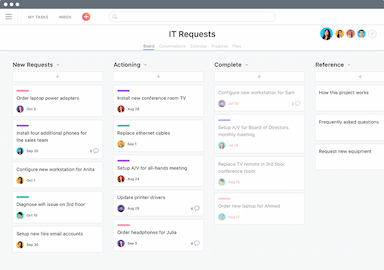
In many companies, work-related requests arrive in a scattered way. Tasks come through emails, chats, meetings, and ad-hoc conversations, which makes it easy for things to slip through the cracks. Asana is often used in this kind of setup to bring those requests into one place, so they can be reviewed and assigned in a more structured way. This is especially useful when several stakeholders are submitting work at the same time and expectations need to stay clear. 

Regulatory Compliance And Risk Management Teams Handling Audit Requirements 

Some teams work in environments where compliance is ongoing rather than occasional. They need a way to keep track of requirements without losing sight of who is responsible for what. Asana fits this type of work because it keeps compliance-related tasks visible across different teams in one place. It is often used when organizations need a clearer record of ongoing checks and updates, especially during audits or internal reviews. 

Marketing Teams Coordinating Ongoing Campaign Work 

Marketing workflows tend to span across various departments. A single campaign usually involves planning, content creation, approvals, and scheduling across different people. In such settings, Asana gives teams a shared view of what stage each piece of work is in. It is lauded by teams that handle regular campaign cycles and need a consistent way to keep track of progress without relying on scattered documents or messages. 

Product And Business Teams Planning Launches 

Launching a product or new service usually brings together several parts of an organization. Product, marketing, and operations all contribute in different ways, and timing matters at every step. Asana is commonly used in this context to keep launch work visible across teams so dependencies are easier to notice. It is particularly helpful when launch plans evolve and need regular updates rather than a fixed checklist. 

Teams Trying To Get A Clearer View Of Workload And Capacity 

Some teams reach a point where it is no longer obvious who is working on what. Work builds unevenly, and a few people end up carrying more than others. Asana is often used in these situations to get a simple view of how work is distributed across the team. This helps managers understand where pressure is building without relying on guesswork or informal updates. 

Asana Demo 

You can schedule an Asana software demo by clicking Watch Demo. The demo is one of the best ways to analyze software in real time. In addition, Asana will enable you to evaluate the multiple Asana features in an actual environment. As a result, you can better decide whether it’s an ideal fit for your organization or not.

Asana Support 

Asana offers a variety of customer support solutions, including onboarding materials, forums, webinars, manuals, training, a developer's guide, and help articles. Unfortunately, it currently does not provide phone support. You'll need to contact or submit a question in the Asana forum if you want to communicate to troubleshoot or get problems answered. 

However, if you subscribe to a premium subscription, you will receive priority help. This package features a Customer Success Manager (CSM) who can assist with on-site training, coaching calls, onboarding, and problem resolution. 

What Do Users Say About Asana Project Management Software? 

Asana Project Management Software Pros 

The software is highly user-friendly, with an intuitive display that shows all the tasks and upcoming activities in one place. Users receive automatic updates on items they care about and can bridge the gap between multiple departments. The interface is customizable and allows members to see their projects in a list, calendar form, or Kanban style. 

Asana Project Management Software Cons 

Their technical support system is slower than competitors, and it takes a while for representatives to get back to you. They also lack the sophistication required in implementation by larger organizations. 

Is Asana Right For You? 

Many teams struggle with scattered tasks, unclear ownership, and missed deadlines that slow down progress. Asana addresses this by centralizing work in one platform where teams can plan and track everything with clarity. Its well-rounded features include task assignments, timelines, automation, and reporting dashboards, helping teams stay organized and aligned without switching between tools. 

Trusted by companies like Uber, PayPal, Google, Time Inc., and FedEx, it also follows strong security standards including SOC 2 (Type 2), SOC 3, GDPR, and US privacy laws. The software is also built to scale easily from small teams to large enterprises without losing structure or visibility. 

If you are still unsure whether Asana is the ideal platform for you, we are here to assist you. Contact us at (661) 384-7070, and we will help you make a well-informed decision.

Asana Features

Project Tracking And Status Visibility

Project tracking in Asana gives a live view of how tasks are moving through different stages. It also shows dependencies and completion status, so it’s easier to see what might be holding work up. Updates appear across list, board, timeline, and calendar views, depending on how a project is set up. This keeps changing priorities visible without needing to switch between separate tools or reports.

See How It Works
Work Notifications Management

Asana’s ‘Inbox’ brings together updates from messages and project activity in a single feed. Instead of checking different parts of the platform, users can see what needs attention in one place. The notifications can be adjusted so only relevant work stands out. Follow-ups and replies can also be handled directly from the inbox, which helps keep track of ongoing activity without losing context.

See How It Works
Reporting Dashboards

Reporting dashboards show real-time data through charts built from tasks, projects, and goals. Users can adjust filters and apply templates to view information in different ways, such as progress or trends. The layout can be changed depending on what needs attention at the moment. This helps make ongoing work easier to understand when making day-to-day decisions.

See How It Works
Asana AI

Asana includes AI features that help with everyday task and project management. Its ‘AI Teammates’ can take part in workflows and assist with completing task-related actions when needed. There are also tools for organizing projects and keeping teams up-to-date. In addition, ‘Smart Workflows’ provide prebuilt structures for common processes, which helps teams spend less time on repetitive coordination and more time on actual work.

See How It Works
Admin Console

The admin console in Asana gives organizations a central place to manage users, security, and access settings. It supports login controls like Google Single Sign-On and SAML, while also letting administrators set up permissions for sharing, reporting, integrations, and more. User accounts can be added or removed as needed, and plan and billing details can be managed from the same area.

See How It Works
Time Tracking And Workload Measurement

Time tracking capability records both estimated and actual time spent on tasks using timers or manual entry. It also keeps a log of who tracked time and when, so activity stays easy to follow. Comparing tracked time with estimates helps highlight gaps in planning and gives a clearer view of how work is distributed across projects.

See How It Works

Asana Key Sentiments

Most Positive Sentiments

Task Management

simley face

94.57% Positive

simley face

4.79% Neutral

simley face

0.64% Negative

Users appreciate the intuitive interface that allows for quick navigation and effective task tracking. The platform enhances collaboration by providing clear task assignments and daily briefs, ensuring seamless project management and team coordination.

Customer Support

simley face

66.67% Positive

simley face

7.64% Neutral

simley face

25.69% Negative

Customers appreciate the responsive and knowledgeable support team, which effectively resolves issues and enhances their overall experience. The user-friendly interface and efficient communication tools further contribute to a seamless project management process.

Resource Tracking

simley face

62.07% Positive

simley face

37.93% Neutral

simley face

0% Negative

Visual project tracking capabilities enhance clarity and collaboration, allowing teams to easily monitor progress on significant projects. Users appreciate the seamless experience and transformative project templates that boost efficiency and focus on essential tasks.

Least Positive Sentiments

Pricing Structure

simley face

12.36% Positive

simley face

25.84% Neutral

simley face

61.8% Negative

Many users find the pricing structure to be on the higher side compared to competitors, which can deter small businesses. They express a desire for a more flexible payment option to enhance accessibility.

Task Scheduling

simley face

0.78% Positive

simley face

40.31% Neutral

simley face

58.91% Negative

Setting up recurring tasks proves to be complicated, with users struggling to manage end dates and updates across iterations. The interface can confuse project structures, leading to a frustrating experience during task organization and prioritization.

Email Notifications

simley face

9.33% Positive

simley face

38.67% Neutral

simley face

52% Negative

Email notifications often experience delays, leading to frustration among users. Many express a desire for more personalized alerts to reduce excessive notifications while still ensuring important updates are not missed. Additional reminders beyond due dates are also requested.

Pros And Cons of Asana

Pros

  • Highly user-friendly, with an intuitive display that shows all the tasks

  • Users receive automatic updates on items

  • Interface is highly customizable

  • Members can see their projects in a list, calendar form, or Kanban style

Cons

  • Technical support team's response time can be improved

  • Implementation may be time consuming

Asana Reviews

Total 2031 reviews

4.6

All reviews are from verified customers

Rating Distribution

5

Stars

65%

4

Stars

30%

3

Stars

4%

2

Stars

1%

1

Stars

0%

Share your experience

PB

Pam Boney

Tilt365, 11-50 employees

More than a year

5.0
May 2026

We stay organized using agile

Pros

Works seamlessly and we have never had to write anyone or get support of any kind. Great UX that enables agile kanban. Affordable and flexible pricing. Hope it stays that way.

Cons

Nothing I can think of.

Rating Distribution

Ease of use

10

Value for money

10

Customer Support

10

Functionality

10

IA

Ibrahim A.

Marketing and Advertising, 1-10 employees

Less than 6 months

4.0
April 2026

clean task tracking

Pros

Creating tasks is quick, assigning them to people is simple and it gives a clear view of project activity without having to dig through complicated settings.

Cons

A few really useful features are only available on the paid plans and it can start to feel somewhat limiting when you need to handle more complex workflows or want deeper customization.

Rating Distribution

Ease of use

8

Value for money

8

Customer Support

8

Functionality

8

A

Anonymous

Financial Services, 500+ employees

Less than 6 months

5.0
April 2026

Team coordination done right

Pros

Getting work tracked feels very simple. It does a really good job of keeping tasks visible, teams organised and everyone on the same page. The features are laid out clearly and collaboration between teammates happens without friction.

Cons

The reporting tools on the advanced side can feel a bit limited and when projects get larger, setting everything up can take extra effort and become somewhat tedious.

Rating Distribution

Ease of use

10

Value for money

10

Customer Support

10

Functionality

10

Frequently Asked Questions

What languages does Asana support?

Asana supports English, Spanish, French, German, Korean, Portuguese, Japanese, Chinese (Traditional), Dutch, Polish, Russian, Swedish.

Does Asana offer an API?

Yes, Asana has an API available for use.

What other apps does Asana integrate with?

The software integrates with more than 300 platforms, including Claude, Microsoft Teams, ChatGPT, Splunk, Okta, Google Drive, Canva, and GitLab.

Does Asana support mobile devices?

Asana supports a mobile app for both iOS and Android.

What level of support does Asana offer?

Asana project management tool offers support through: ticketing, help desk, chat, 'Asana Academy,’ faqs, and forum.

What type of pricing plans does Asana offer?

Asana offers a subscription-based model that starts at $13.49/user/month for the Starter Plan. It also offers a free forever plan, called Personal, for two users. Other paid plans are: Advanced ($30.49/user/month), Enterprise (custom pricing), and Enterprise+ (custom pricing). Free trial is also available. Get a personalized Asana price based on your company’s requirements.